
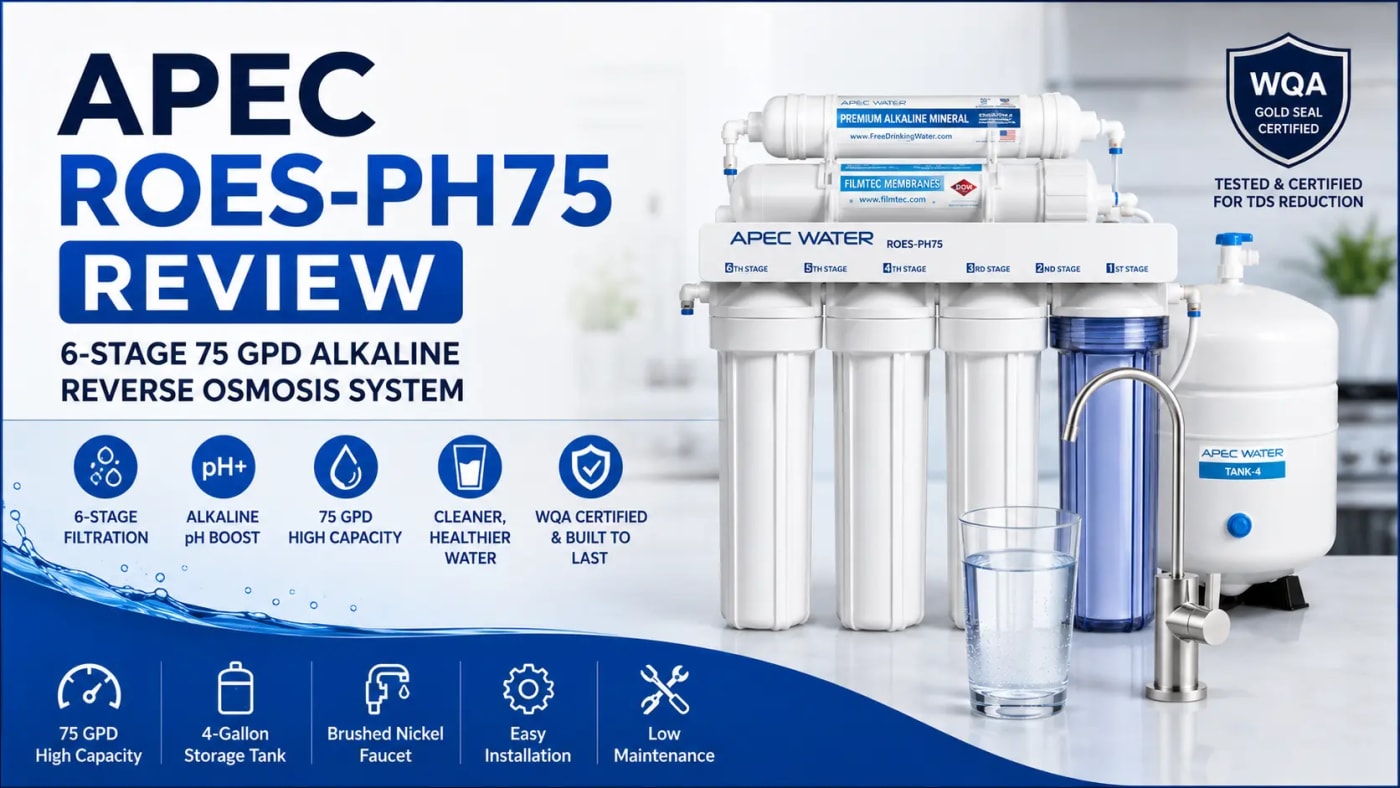
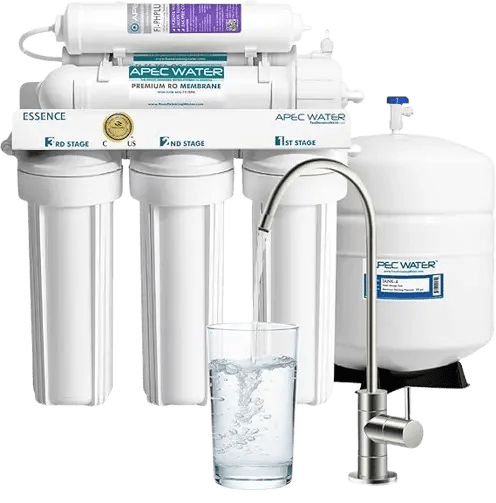
The APEC ROES-PH75 is a conventional under-sink reverse osmosis system. It uses a tank-based design, not a tankless one. The system runs six stages of filtration and adds a 75 GPD membrane, a 4-gallon pressurized tank and a sixth-stage calcium-carbonate remineralization filter.
This review looks at every part of the system in detail. It covers filtration, contaminant reduction, alkaline output, certification, real-world performance, installation, maintenance and ownership value. Each section uses official APEC specifications and independent lab test data, so you get a full picture before you decide if this system fits your home.
What filtration architecture does the APEC ROES-PH75 use to treat drinking water?
Water moves through six stages before it reaches your glass. Each stage has a specific job, and the water gets cleaner as it passes through each one.The path starts with a 5-micron sediment filter. This stage catches dust, rust and loose particles. Water then moves through two carbon block filters. These stages remove chlorine, bad taste, odor and volatile organic compounds (VOCs).After the carbon stages, water reaches the fourth stage, the TFC reverse osmosis membrane. This is the core filtration stage. It pushes water through a thin film membrane that blocks dissolved solids, heavy metals and many other contaminants.The fifth stage is a post-carbon filter. It polishes the water one more time after it leaves the tank, right before it reaches the faucet. The sixth and final stage is the calcite remineralization filter. This stage adds calcium carbonate back into the water to raise its pH and improve its taste.
Six-Stage Filtration Path of the ROES-PH75:
Sediment filter (5 micron) removes dust, rust and particles
Carbon block filter removes chlorine, taste and odor
Carbon block filter removes remaining chlorine and VOCs
TFC reverse osmosis membrane removes dissolved solids and heavy metals
Post-carbon filter polishes water before the faucet
Calcite remineralization filter adds calcium carbonate and raises pH
How does each ROES-PH75 filter stage affect the water before and after the RO membrane?
Each stage plays a different role in the treatment process. The first three stages protect the membrane and improve taste before filtration. The membrane itself does the heavy work of removing dissolved contaminants. The last two stages improve the water after it leaves the membrane.
This table shows the function, position and main target of each filter stage.
Stage | Media Type | Position | Purpose | Main Target |
1 | Polypropylene sediment filter | Before membrane | Protects membrane from particles | Dust, rust, sand |
2 | Carbon block filter | Before membrane | Removes taste and odor issues | Chlorine, VOCs |
3 | Carbon block filter | Before membrane | Extends membrane life | Remaining chlorine, chemicals |
4 | TFC RO membrane | Core filtration stage | Separates dissolved contaminants | TDS, heavy metals, salts |
5 | GAC post-carbon filter | After tank, before faucet | Final taste polish | Trace taste and odor |
6 | Calcite remineralization filter | Final stage | Restores alkalinity | Low pH, flat taste |
What does the 75 GPD RO membrane capacity mean for actual household water production?
APEC rates the ROES-PH75 membrane at 75 gallons per day. This number is measured at 60 PSI feed pressure and 77°F water temperature. These are ideal lab conditions. Most homes do not have water at this exact pressure and temperature all year.Independent testing by Water Filter Guru measured real output under different conditions. Their test used 48 PSI feed pressure and 60.4°F water temperature. Under these conditions, the system produced water at a measured rate of 42.74 GPD, well below the 75 GPD rating.
This gap does not mean the system is faulty. Lower pressure and colder water both reduce how fast an RO membrane can push water through. If your home has feed water pressure close to 60 PSI and warmer tap water, your output will sit closer to the rated 75 GPD. If your pressure or temperature runs lower, expect a slower fill rate.
How does the ROES-PH75's 4-gallon pressurized tank affect drinking-water availability?
The pressurized tank stores filtered water so it is ready at the faucet, without you waiting for the membrane to produce water on demand. This is the main advantage of a tank-based RO system over a tankless one. You get instant access to stored, filtered water at any time.
The tank holds 4 gallons, but this number is not the same as usable capacity. A pressurized tank uses air pressure inside a bladder to push water out. As water leaves the tank, pressure drops, and the tank cannot push out every drop before it needs the pump-free system pressure to refill it again. In practice, usable output sits below the full 4-gallon mark.
APEC lists tank dimensions of 11 x 11 x 15 inches. This size fits under most standard kitchen sink cabinets, but you should measure your available space before buying, especially if your cabinet also holds a garbage disposal or trash bin.
Which contaminants does the APEC ROES-PH75 reduce, and what evidence supports those claims?
APEC markets the ROES-PH75 as a system that removes up to 99% of impurities, covering more than 1000 substances. This is a broad manufacturer claim. It is important to separate this marketing claim from what is actually certified and from what independent lab testing confirms.
The system holds one official WQA certification, for total dissolved solids (TDS) reduction. This is the most important certification for an RO system, since TDS reduction reflects how well the membrane works overall. However, the unit is certified for only 1 of the 51 contaminants listed on APEC's product page. This does not mean the other contaminants are not reduced. It means they have not been through a formal certification process.
Independent lab testing by Water Filter Guru, using Tap Score lab analysis, gives a clearer picture of real contaminant reduction. This table shows what was found in their tested feed water and what came out after filtration.
Contaminant | Feed Water | Filtered Water | Reduction |
Total Dissolved Solids (PPM) | 875 | 54 | 93.83% |
Fluoride (PPM) | 2.4 | 0 | 100% |
Uranium (PPM) | 0.0036 | 0 | 100% |
Bromodichloromethane (PPB) | 4.29 | 0 | 100% |
Bromoform (PPB) | 11.4 | 0 | 100% |
Dibromochloromethane (PPB) | 11.9 | 0 | 100% |
Copper (PPM) | 0.287 | 0 | 100% |
Sulfate (PPM) | 122 | 0 | 100% |
Barium (PPM) | 0.033 | 0.000649 | 98.03% |
Strontium (PPM) | 0.566 | 0.0179 | 96.84% |
Chromium (Total, PPM) | 0.0047 | 0.000618 | 86.85% |
Nitrate as N (PPM) | 1.4 | 0.5 | 64.29% |
Boron (PPM) | 0.487 | 0.248 | 49.08% |
The system eliminated every contaminant that had been detected above its Health Guideline Level in the tested feed water. This included fluoride, uranium and three disinfection byproducts. Nitrate and boron showed weaker reduction, likely because the test used lower feed pressure and cooler water than APEC's rated test conditions.
How much does the ROES-PH75 reduce total dissolved solids and other dissolved contaminants?
TDS is a measurement of everything dissolved in water, including minerals, salts and some contaminants, combined into one number. It does not identify each individual substance, but it gives a fast way to track how well an RO system is working over time.Water Filter Guru recorded a feed TDS of 647 PPM during on-site testing. The first-draw reading after filtration measured 49 PPM. After running the water for two minutes, the stable reading dropped slightly to 44 PPM. In separate lab testing, feed water TDS of 875 PPM dropped to 54 PPM after filtration, a reduction of 93.83%.
A low TDS number is a strong general sign of RO performance. It does not confirm removal of every specific health-related contaminant, which is why lab-based contaminant testing matters alongside a basic TDS check.
How well does the ROES-PH75 handle health-related contaminants in independent testing?
Independent lab testing found 16 contaminants with possible health effects in the tested feed water. Five of these were above the Health Guideline Level: fluoride, uranium and three disinfection byproducts (dibromochloromethane, bromodichloromethane and bromoform). All five were fully removed after filtration.The system also removed 100% of molybdenum, selenium, sulfate and vanadium. Barium dropped by 98%, strontium by 97%, and chromium by 87%. Nitrate and boron showed the weakest reduction, at 64% and 49%.
These results reflect one test, under one set of water conditions and one feed pressure. A different water source with different starting contaminant levels, or a system running at higher feed pressure, could show different numbers. The results should be read as strong real-world evidence, not as a guarantee that applies to every household.
What does the ROES-PH75 remineralization stage add back after reverse osmosis?
Reverse osmosis removes almost everything dissolved in water, including minerals that give water its normal taste. The sixth stage of the ROES-PH75 is a calcite filter. APEC describes this stage as an acidic-water neutralizer that adds calcium carbonate back into the treated water.
This stage does not restore water to its original mineral makeup. It adds a controlled amount of calcium carbonate to correct the low pH that raw RO water usually has, and to give the water a rounder taste instead of the flat taste associated with pure RO output.
How does the alkaline pH stage change the ROES-PH75 water's pH and taste?
Raw RO water, before remineralization, typically has a pH between 5.5 and 6.5, which is mildly acidic. The purpose of the sixth stage is to raise this pH into alkaline territory and improve the taste of the finished water.
Test results vary depending on the measurement method. Water Filter Guru's on-site pH meter recorded a rise from 7.59 to 8.77 after filtration. Their laboratory Tap Score test showed a different pattern, with pH moving from 8.1 down to 7.8. Both results still landed in alkaline territory, above the neutral point of 7.0, which shows the remineralization stage is doing its job of avoiding acidic output. The difference between the two results shows why the testing method and equipment used can change the exact number you see.
Does remineralization restore the minerals removed by the RO membrane?
Remineralization does not mean full mineral restoration. Lab testing showed calcium dropped by 90% and magnesium dropped by 97%, even with the remineralization stage active. Sodium dropped by 94%, and potassium was fully removed.
This means the finished water still has a much lower mineral content than the original feed water. The remineralization stage adds back enough calcium carbonate to prevent acidic pH and improve taste. It does not turn RO water into mineral-rich water.
How does the ROES-PH75 perform for water efficiency, wastewater and TDS creep?
Efficiency describes how much wastewater an RO system sends down the drain for every gallon of purified water it produces. APEC states a pure-to-drain ratio of 1:3, meaning 3 gallons go to drain for every 1 gallon produced.
Independent testing found a different result. This table compares the manufacturer's stated ratio with measured results under real test conditions.
Test Condition | Pure-to-Drain Ratio |
Manufacturer claim | 1 : 3 |
12-ounce draw (measured) | 1 : 10.6 |
64-ounce draw (measured) | 1 : 5.1 |
The 12-ounce draw test showed the system produced far more wastewater per gallon of purified water than APEC's stated ratio. The 64-ounce draw showed a better ratio, since RO systems need a short period to stabilize after starting, and a larger draw spends more time at steady flow. Even at its best measured ratio, the system used more water per gallon produced than the manufacturer's claimed figure.
TDS creep is a separate issue. It happens when the first draw of water after a system sits idle shows higher TDS than water drawn a few minutes later. Testing found a first-draw TDS of 49 PPM after 10 hours idle, dropping to 44 PPM after two minutes of flow. A 5 PPM difference is small and shows TDS creep is not a real concern for this system.
How much water does the ROES-PH75 waste compared with the manufacturer's stated ratio?
The manufacturer's 1:3 ratio means 3 gallons drain away for every gallon of purified water. Measured results showed a smaller draw produced a much higher waste ratio, near 1:10.6, while a larger draw improved to about 1:5.1. Both measured ratios are higher than the manufacturer's claim. This gap comes from test conditions like draw size, feed pressure and water temperature, and should be treated as real-world observation rather than a fixed operating number for every household.
How quiet and responsive is the ROES-PH75 during normal operation?
Noise level is one advantage of a conventional, non-pumped RO system like the ROES-PH75. Since it has no built-in booster pump, it runs quieter than tankless systems that use a motor to push water through the membrane.
Testing measured 24.3 decibels at 1 foot away from the unit, and 23.9 decibels at 3 feet away. These readings were taken using a phone app, which has known limitations compared to a dedicated sound meter, so treat the exact numbers as a general reference rather than lab-grade precision. Even with that caveat, the readings confirm the system runs at a low, unobtrusive noise level during normal use.
What is the ROES-PH75 installation process like under a kitchen sink?
Installation involves connecting the system to your cold water line, mounting a dedicated RO faucet, connecting a drain line, running tubing between components and placing the tank in your cabinet. If your sink does not already have a hole for a separate faucet, you will need to drill one into your countertop or sink deck.A hands-on installation test took 90 minutes to complete, including faucet installation and drain line hookup. If your kitchen does not already have a faucet hole or drain adapter in place, expect the process to take longer, closer to 2 hours or more.
After installation, the system needs to be flushed according to the manufacturer's instructions before you can use the water. This flushing step took about 3 hours to complete one tank's worth of water, followed by 2 to 3 more hours for the tank to refill.
What under-sink space and plumbing connections does the ROES-PH75 require?
Before installing, check that your cabinet has enough room for both the filter unit and the tank. APEC lists the main system at 15.5 x 5.25 x 17.5 inches, and the tank separately at 11 x 11 x 15 inches.
This table shows the physical and plumbing requirements you need to plan for.
Requirement | Specification |
System dimensions | 15.5 x 5.25 x 17.5 inches |
Tank dimensions | 11 x 11 x 15 inches |
Feed water pressure | 40 to 85 PSI |
Max feed water TDS | 2000 PPM |
Connections needed | Cold water line, drain line, dedicated faucet |
Included hardware | Faucet, tubing, mounting bracket, fittings |
Keep the filter housings within reach for future filter changes. A cabinet packed tightly with cleaning supplies or a garbage disposal can make routine filter access harder than it needs to be.
What installation issues can cause ROES-PH75 leaks or slow performance?
The manufacturer's manual addresses several common issues directly, including housing leaks, tank valve leaks and low-pressure shutoff problems. These issues most often trace back to loose fittings, worn O-rings or insufficient Teflon tape on threaded connections.
Common Leak and Performance Issues:
Housing leaks from loose or improperly seated O-rings
Tank valve leaks from a worn or misaligned valve seal
Slow water flow from feed pressure below the 40 PSI minimum
Drain line leaks at the membrane drain connection fitting
Low-pressure shutoff triggering when incoming pressure drops too low
Independent testing also found a leak at the manufacturer-installed membrane drain connection during setup, which was fixed by installing a locking clip on the fitting. Community reports on forums describe similar housing and fitting issues after installation, which supports the idea that careful attention to fittings and O-rings during setup reduces the chance of leaks later.
How often do the ROES-PH75 filters and membrane need replacement?
Each stage of the system has its own replacement schedule. The manufacturer's manual lists specific intervals for each filter type.
This table shows the recommended replacement schedule for every stage.
Stage | Filter Type | Replacement Interval |
1, 2, 3 | Sediment and carbon pre-filters | Every 6 to 12 months |
4 | RO membrane | Every 2 to 4 years |
5 | Post-carbon filter | Every 2 to 4 years |
6 | Calcite remineralization filter | Every 6 to 12 months |
O-rings on the filter housings should be replaced yearly, at the same time as the pre-filters. The filter housings themselves should be replaced about once every 5 years. The system does not include a filter life tracker, so you will need to set your own reminders to stay on schedule.
What does it cost to maintain the ROES-PH75 over time?
Ongoing cost depends on how much water your household uses daily. Based on an assumed daily use of 2 to 4 gallons, independent cost estimates place the ongoing cost between $0.10 and $0.21 per gallon, with an estimated annual cost near $133.
This estimate is based on assumed usage patterns and stated replacement intervals, not an official cost figure published by APEC. Your actual cost will depend on your household's water use and how closely you follow the recommended replacement schedule. Even with 6 filters to track, the system remains affordable to maintain compared with many RO systems on the market.
How does the ROES-PH75 certification compare with its broader contaminant claims?
The ROES-PH75 holds a WQA Gold Seal certification, which is a program run by the Water Quality Association to confirm that a system performs as claimed and is built from safe materials. This certification specifically covers TDS reduction, tested under NSF/ANSI 58, the standard used for reverse osmosis systems.
It is important to separate this certification from the wider marketing claim of removing up to 99% of impurities across more than 1000 substances. The certification confirms TDS reduction performance and materials safety. It does not mean each of the many contaminants listed on the product page has gone through its own individual certification test. The system should not be described as certified for every listed contaminant, since only TDS reduction carries a formal certification record.
What do ROES-PH75 owners report about taste, installation, leaks and long-term use?
Customer reviews give a useful real-world view alongside lab data. On Lowe's, the ROES-PH75 holds a 4.8 out of 5 rating from 145 reviews, with 96% of reviewers saying they would recommend the product.
Many owners report a clear taste improvement compared to tap water, and describe installation as manageable for someone comfortable with basic plumbing work, especially when following the included instructions closely. One Home Depot reviewer measured their own water before and after installation, recording a drop from 490 PPM TDS to 40 PPM TDS after setup.
Some owners report a different experience. Complaints include leaks at fittings during the first days of use, tight housing access that makes filter changes harder in a small cabinet, and a longer than expected setup time when a faucet hole needs to be drilled. These reports match the installation challenges noted in independent lab testing, and they should be treated as real but not universal experiences, since the large majority of reviewers rate the system positively.
Is the APEC ROES-PH75 worth buying for its alkaline 6-stage RO configuration?
The ROES-PH75 combines strong contaminant reduction, a remineralization stage that keeps water alkaline, and a WQA certification for TDS reduction. It removed every contaminant detected above Health Guideline Levels in independent lab testing, and it runs quietly compared to tankless alternatives.
The trade-offs are real. Installation takes real time and some plumbing comfort, wastewater ratios in testing run higher than the manufacturer's stated 1:3 figure, and output speed depends heavily on your home's water pressure and temperature. The tank also takes up real cabinet space compared to compact tankless designs.
For a buyer who wants a conventional, well-certified under-sink RO system with alkaline output and does not mind a tank taking up cabinet space, the ROES-PH75 is a solid choice. For a buyer who prioritizes water efficiency, a compact footprint, or built-in monitoring features like a TDS display, a tankless system with a booster pump would be a better fit.
Which type of household water supply is the ROES-PH75 best suited to?
The right RO configuration depends on your water source. Municipal water usually arrives pre-treated with chlorine and generally lower contaminant loads, while well water can carry higher mineral content, iron, or agricultural contaminants like nitrate, depending on your local area.
The ROES-PH75 works with both municipal and well water, provided feed pressure stays within its 40 to 85 PSI range and feed TDS stays under 2000 PPM. Before choosing a system, it makes sense to test your specific water source, since the right filtration setup depends on which contaminants are actually present in your home's supply and how strong your feed pressure runs.
How does the APEC ROES-PH75 compare with the APEC ROES-50?
The ROES-50 and ROES-PH75 share a similar core design, with two main differences. The ROES-50 is rated for 50 GPD, while the ROES-PH75 is rated for 75 GPD. The ROES-PH75 also adds the sixth-stage remineralization filter, which the ROES-50 does not include.
How does the APEC ROES-PH75 compare with the iSpring RCC7AK?
Both systems use a similar 6-stage layout with remineralization and a 75 GPD membrane rating. Differences show up in certification scope, specific filter materials, maintenance intervals and price. Buyers comparing the two should check current certification records and pricing directly, since both details can change over time.
How often should APEC ROES-PH75 filters be replaced?
The first three pre-filters and the remineralization filter need replacement every 6 to 12 months. The RO membrane and post-carbon filter last longer, at 2 to 4 years. A detailed maintenance guide with step-by-step replacement instructions is available separately.
How do you fix an APEC ROES-PH75 filter housing leak?
Start by checking that all O-rings are seated correctly and that threaded fittings have enough Teflon tape, following the manufacturer's manual guidance. A dedicated troubleshooting guide covers each leak point in more detail.
Why is the APEC ROES-PH75 producing low water pressure?
Low pressure at the faucet can come from low feed water pressure below the 40 PSI minimum, a tank that has lost its air charge, a clogged filter restricting flow, or resistance in the delivery tubing. A dedicated troubleshooting guide walks through how to check each cause.
Can the APEC ROES-PH75 supply a refrigerator or ice maker?
Yes. APEC offers a separate ice-maker connection kit that lets the system supply a refrigerator or ice maker in addition to the dedicated faucet.
Does the APEC ROES-PH75 need a booster pump?
A booster pump is not required, but it can help if your home's feed water pressure runs low. Independent testing showed that adding a booster pump increased flow rate and improved the pure-to-drain ratio compared to running without one.
Is alkaline remineralization worth it in a reverse osmosis filter?
Remineralization raises the pH of RO water and gives it a fuller taste instead of the flat taste common with pure RO output. Whether it is worth it depends on your taste preference and whether you dislike the taste of standard RO water.