
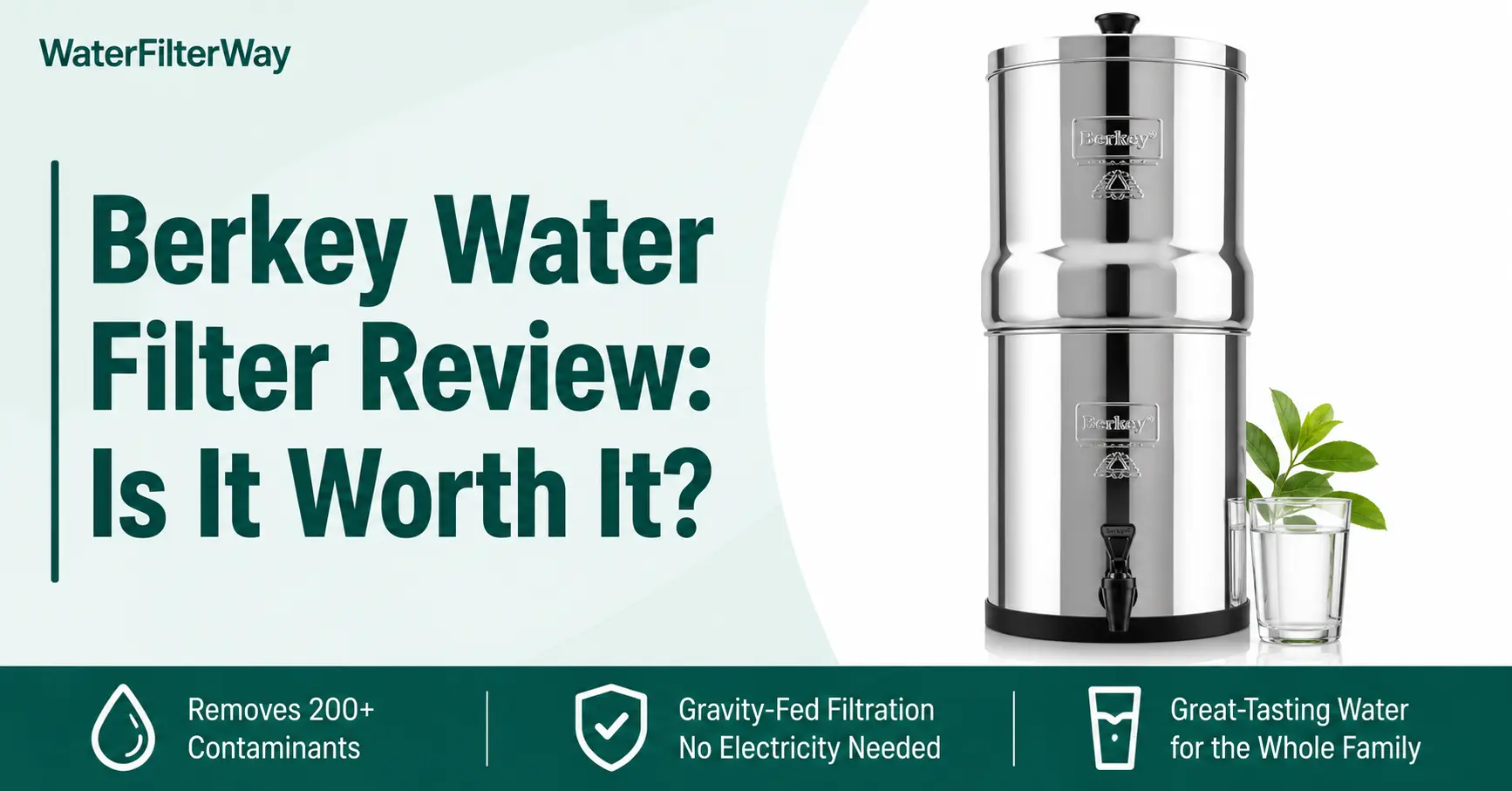
A Berkey is a gravity fed water filtration system that removes a wide range of contaminants without needing electricity or a plumbing hookup, and pricing typically runs from around 300 to 400 dollars depending on the size chosen. Whether it is worth buying largely comes down to how much weight a household puts on independently commissioned lab results versus formal NSF certification, since Berkey has never pursued the latter. This review works through how the system performs, what it actually costs over time, the certification and lawsuit questions that come up repeatedly, and who ends up genuinely well served by owning one.
What Is a Berkey Water Filter and How Does It Work?
A Berkey system is built around two stacked chambers. Water poured into the upper chamber passes down through the Black Berkey purification elements by gravity alone, with no pump or water pressure involved, and collects as filtered water in the lower chamber ready to be dispensed from the spigot. The elements themselves rely on microporous filtration combined with ion exchange, which sets them apart from a simple carbon block filter and is part of why the media inside lasts as long as it does.
What Contaminants Does a Berkey Water Filter Actually Remove?
Independent lab testing and Berkey’s own published data agree closely on some contaminants and diverge noticeably on others. Chlorine, chloroform, total trihalomethanes, lead, copper, barium, and manganese have all shown strong and consistent removal across multiple independent tests, with several landing at or near 100 percent. Other contaminants tell a messier story. Molybdenum was reduced by only about 25 percent in one independent lab test, selenium showed no measurable reduction at all in another round, and cobalt came back reduced by just 3 percent in one test despite Berkey’s own published figure of 95 percent for that same contaminant. Fluoride and arsenic are not touched by the standard elements at all and require the separate PF-2 add-on filter. It is also worth being direct about a point that trips people up often: Berkey has publicly withdrawn its earlier claims about removing microorganisms such as bacteria and viruses, so the system should not be treated as a stand in for proper disinfection when the source water itself has not already been treated.
| Contaminant Category | Approximate Reduction (Independent Testing) | Consistency |
| Chlorine, chloroform, total THMs | Near 100% | Strong and consistent |
| Lead, copper, barium, manganese | Near 100% | Strong and consistent |
| Molybdenum | About 25% | Weak, one test |
| Selenium | No measurable reduction | Weak, one test |
| Cobalt | About 3% (vs 95% claimed) | Weak, inconsistent with manufacturer claim |
| Fluoride, arsenic | Not removed by standard elements | Requires separate PF-2 filter |
| Bacteria, viruses | Claim withdrawn by Berkey | Not a substitute for disinfection |
Is Berkey Safe to Use With Untreated Water Like Rain, Pond, or River Water?
This question comes up constantly in emergency preparedness circles, and it deserves a direct answer. Berkey’s own marketing and a number of independent blogs have at times described the system as suitable for straining and filtering untreated sources such as rain, pond, or river water during an emergency. Since then, Berkey has withdrawn its earlier claims about removing microorganisms including bacteria and viruses, a change that independent reviewers have confirmed. Anyone planning to rely on a Berkey for a genuinely untreated water source should pair it with a separate, proven disinfection step such as boiling or a certified purification method rather than trusting the Berkey alone to handle microbiological safety. Forum suggestions like adding silver coins to the chamber are not an established solution and should not be treated as one.
Is a Berkey Water Filter NSF Certified?
No. Black Berkey elements do not carry NSF/ANSI certification from an independent body such as NSF International, IAPMO, or WQA. Instead, Berkey commissions its own third-party lab testing through EPA-accredited labs and publishes those results directly. That is a meaningfully different arrangement from formal NSF certification, where an outside organization controls the testing methodology itself and certifies that a product keeps meeting the standard over time. Berkey has attributed this choice to protecting proprietary manufacturing details and to cost, with press coverage citing figures that can reach seven figures for full certification of a system as complex as Berkey’s. One concrete data point worth knowing: the New York Times Wirecutter reported that a tested Berkey filter stopped meeting the NSF removal standard after roughly 1,100 gallons, well short of the 3,000 gallon lifespan claimed per filter pair. That finding is about testing rigor and longevity claims, not evidence that the filters simply do not work, which is a separate and more complicated question covered in the lawsuit section below.
Why Are Berkey Water Filters Banned in California?
California’s 2009 no-lead law, covered under AB 1953, SB 1334 and 1395, and Health and Safety Code Section 116875, requires every water filtration system sold in the state to carry lead-free certification from an NSF-approved independent organization. Berkey has not pursued that certification, which means its indoor systems cannot legally be sold in California. Iowa has a similar restriction in place. This is a certification and paperwork issue rather than any finding that the filters are unsafe or contain lead, and there is no public statement from Berkey suggesting otherwise.
What Is the Berkey Water Filter Lawsuit About?
Three separate legal actions are worth untangling rather than lumping together. The first is a consumer class action filed in late 2022 alleging that Black Berkey elements do not perform as advertised, with no claim of physical harm involved. New Millennium Concepts, the company behind Berkey, has denied the allegations and disputes them partly by pointing to counterfeit Berkey Black products that it says were used in some of the plaintiffs’ testing. The other two actions are lawsuits NMCL itself filed against the EPA, challenging the agency’s 2023 classification of Black Berkey elements as a pesticide device. That classification led to a stop-sale order on standalone replacement elements, though complete systems kept shipping from existing inventory during the dispute. All three matters remain legal disputes still working through the process rather than settled findings against the company, and this section should be read as a status update rather than a verdict on either side’s claims.
How Much Does a Berkey Water Filter Cost Over Time?
Upfront pricing starts around 327 dollars for the Travel Berkey and climbs to 367 dollars and up for the larger systems. Each pair of elements is rated for about 6,000 gallons before replacement, which works out to roughly 2 to 3 cents per gallon over the life of the filter. The optional PF-2 fluoride and arsenic filter is priced separately and is not included with a standard system. Measured purely on a per gallon basis, that puts Berkey in a similar range to reverse osmosis and ahead of most pitcher filters, though a fuller comparison of those alternatives is covered further down the page.
| System | Approximate Cost Per Gallon |
| Berkey (standard elements) | 2 to 3 cents |
| Reverse osmosis | Roughly comparable, varies by system and membrane life |
| Standard pitcher filter | Generally higher on a per gallon basis |
How Do You Choose the Right Berkey Size for Your Household?
Household size and daily water use are the two things that should decide which Berkey model makes sense. The Travel Berkey suits 1 to 3 people, the Big Berkey works for 1 to 4 people, the Royal Berkey covers 2 to 6 people, and the Imperial or Crown Berkey are built for larger households or heavier daily use. Flow rate also increases with the number of filter elements installed, reaching up to seven gallons per hour with four elements in place.
| Model | People Served | Notes |
| Travel Berkey | 1 to 3 | Smallest footprint, good for limited counter space |
| Big Berkey | 1 to 4 | The most common household size |
| Royal Berkey | 2 to 6 | Larger capacity for bigger households |
| Imperial / Crown Berkey | 6+ | Best for large households or heavy daily use |
What Are the Real Drawbacks of Using a Berkey Water Filter?
A fair review has to include the limitations that independent testing and repeated user reports keep surfacing, rather than relying only on marketing copy. These are practical tradeoffs worth weighing, not reasons to dismiss the product outright.
● Real-world flow rate has tested well below Berkey’s marketed numbers, in one case just 0.75 gallons per hour against a marketed 3.5 gallons per hour, and it slows further if elements are not primed correctly
● The PF-2 fluoride filter has been found in independent testing to leach aluminum oxide into filtered water, sometimes above the EPA limit, though results improve with a fresh filter and careful priming
● Overflow and leaking are a recurring complaint, since the system keeps filtering into the lower chamber even when full
● The lower chamber’s water level is not visible without lifting the top chamber, unless a separate sight glass spigot is purchased
● Setup and priming are frequently described as tedious, and the included attachments work poorly with modern pull-out or spray faucets
● No fluoride or arsenic removal without the separate PF-2 filter
● No NSF certification behind any performance claim
● Not sold in California or Iowa
Who Is a Berkey Water Filter Actually Worth It For?
A Berkey tends to make the most sense for households that prioritize broad contaminant reduction without needing plumbing or electricity, for off-grid or emergency preparedness situations, for travelers and outdoor users who need a durable portable system, and for buyers who are comfortable relying on independently commissioned lab testing rather than insisting on formal NSF certification. It is a weaker fit for households in California or Iowa, for anyone who specifically needs certified fluoride or arsenic removal without paying extra for the add-on filter, and for buyers who treat NSF certification as a non-negotiable requirement. The honest answer is that it depends on which of those descriptions sounds more like the household doing the buying.
What Should You Know Before Choosing a Water Filtration System Like Berkey?
Berkey is one option among several for filtering household water, alongside reverse osmosis systems, certified gravity competitors, and simple pitcher filters. The right choice depends on budget, the water source being treated, and how much weight a given household puts on formal certification versus independently published testing. The sections below widen the lens slightly to cover how Berkey stacks up against those alternatives and a few closely related questions, without repeating the full detail already covered above.
How Does a Berkey Water Filter Compare to Reverse Osmosis?
Reverse osmosis removes dissolved solids and fluoride automatically through its membrane and carries NSF/ANSI 58 certification, while a Berkey needs no plumbing or electricity and costs less per gallon but does not lower total dissolved solids and needs the PF-2 add-on to touch fluoride at all. The practical tradeoff comes down to portability and certified performance on one side against certification-free flexibility on the other, and a closer look at how reverse osmosis systems work, get certified, and hold up over time lays out that side of the comparison in full.
| Factor | Berkey | Reverse Osmosis |
| Installation | No plumbing, gravity fed | Requires plumbing connection |
| Certification | Independent lab testing, no NSF certification | NSF/ANSI 58 certified |
| Fluoride removal | Only with PF-2 add-on | Removed by the membrane automatically |
| Cost per gallon | Roughly 2 to 3 cents | Comparable, varies by system |
How Does a Berkey Water Filter Compare to Other Gravity Filters Like Clearly Filtered?
Competitors such as Clearly Filtered and Culligan MaxClear carry NSF certification that Berkey has chosen not to pursue, while Berkey counters with a longer track record in the market and a larger stainless steel capacity option for bigger households. The certification gap is really the central difference between these systems, alongside smaller practical points like taste and portability, and a full comparison of gravity fed water filters including Clearly Filtered, Culligan MaxClear, and ProOne breaks each of those brands down side by side.
| Brand | NSF Certification | Notable Difference |
| Berkey | No | Longer track record, larger stainless steel capacity option |
| Clearly Filtered | Yes | Certified performance claims |
| Culligan MaxClear | Yes | Certified performance claims |
Does a Berkey Water Filter Remove Fluoride Without an Add-On?
The standard Black Berkey elements do not meaningfully reduce fluoride on their own. Removing it requires the separate PF-2 fluoride and arsenic filter, which is rated to reduce fluoride by up to 99.75 percent. Independent lab testing has found that real-world performance can vary between individual filters and testing rounds, including one documented case where a fresh PF-2 filter only cut fluoride by about half before a properly primed replacement reached the expected reduction. Activated alumina based fluoride filters, the same media used in the PF-2, have also been found in independent testing to add trace amounts of aluminum to filtered water. This is a common point of confusion worth resolving directly, and readers who want the fuller picture beyond Berkey specifically can look at fluoride removal methods across reverse osmosis, activated alumina, distillation, and add-on filters for how the options compare.
Is Berkey Water Filter Certification a Bigger Concern Than for Other Home Filters?
NSF/ANSI 42, 53, and 58 each test for different things: standard 42 covers taste and odor, standard 53 covers health related contaminants such as lead and PFAS, and standard 58 covers reverse osmosis systems specifically. The absence of certification matters far more for health related claims than it does for taste and odor claims, which is exactly why Berkey’s lack of NSF certification draws more scrutiny than it might for a basic pitcher filter making only taste claims. A closer look at what NSF/ANSI water filter certifications actually cover walks through what each standard number means and why the distinction matters beyond Berkey specifically.
What Water Filter Options Work Best for Off-Grid or Emergency Use?
Gravity fed systems like Berkey are commonly chosen for off-grid and emergency situations because they need no electricity and no water pressure to operate, and in that context portability and filter lifespan tend to matter more than raw flow speed. Because this use case is closely tied to filtering untreated water sources, it is worth flagging again briefly that microbiological safety for water from streams, rain catchment, or similar untreated sources deserves the careful treatment already covered earlier on this page rather than a repeat here. A broader roundup of water filters built for off-grid living and emergency preparedness covers how Berkey stacks up against other portable options for this specific use case.
How Do You Maintain and Clean a Berkey Water Filter?
Routine upkeep involves cleaning the stainless steel chambers roughly once a month, scrubbing the exterior of the Black Berkey elements with a non-soap pad every 3 to 6 months or whenever flow starts to slow down, and re-priming the elements after the system has sat unused for several days. It is worth knowing ahead of time that the priming attachments included in the box tend to work better with older, simple faucet heads than with modern pull-out or spray faucets, since a slow first fill often comes down to that mismatch rather than a defective unit. The full Berkey maintenance and cleaning routine walks through each of these steps in more detail.
Frequently Asked Questions
Is a Berkey water filter NSF certified?
No. Berkey relies on independent third-party lab testing through EPA-accredited labs rather than formal NSF certification from a body like NSF International.
Does a Berkey remove fluoride?
Not with the standard elements. Fluoride removal requires the separate PF-2 add-on filter, rated to reduce up to 99.75 percent of fluoride.
Why can’t you buy a Berkey in California?
California requires NSF-approved lead-free certification for filtration systems sold in the state, and Berkey has not pursued that certification, so indoor systems cannot legally be sold there.
Is Berkey safe for untreated water like rain or river water?
Berkey has withdrawn its earlier claims about removing bacteria and viruses, so untreated water sources should be paired with a separate proven disinfection method rather than relying on a Berkey alone.
How much does a Berkey cost per gallon over time?
Roughly 2 to 3 cents per gallon, based on a filter lifespan of about 6,000 gallons per pair of elements.