
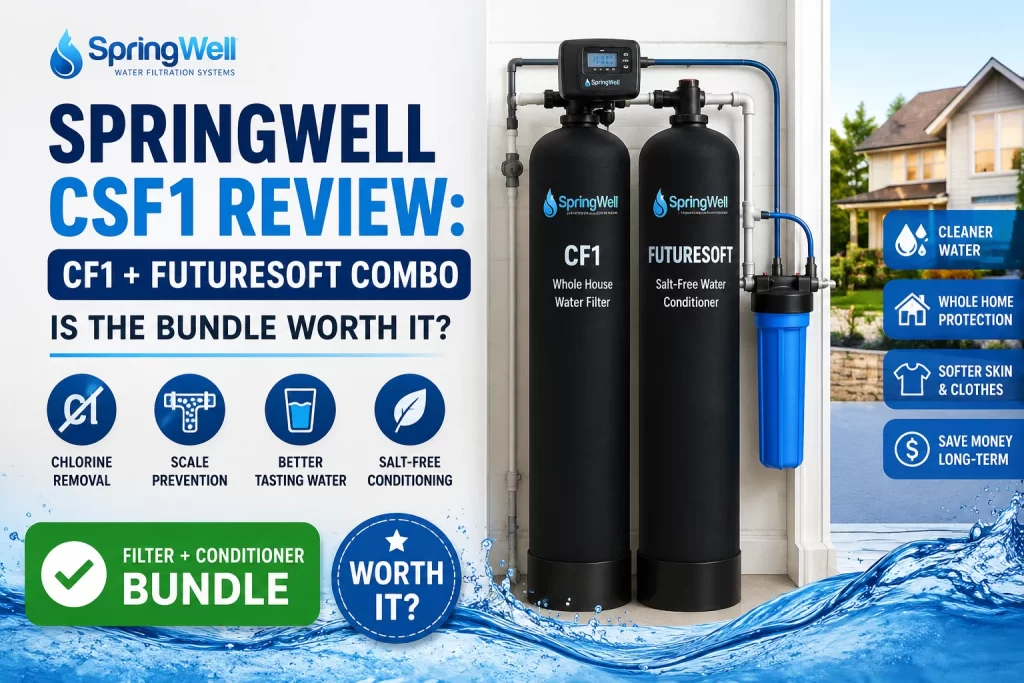
Springwell CSF1 is a dual-stage whole-house system. It processes water at approximately 9 gallons per minute (GPM), and it targets chlorine reduction and scale control in residential plumbing lines. The SpringWell CSF1 combines two technically different processes. CF1 carbon adsorption filtration and FutureSoft Template Assisted Crystallisation (TAC) conditioning. These two stages work in sequence, not in overlap. CF1 works as a carbon filter system using adsorption, while FutureSoft functions as a salt-free conditioner system using mineral crystallisation change rather than removal.
The following table shows the function of both stages
| Component | Function | Mechanism | Limitation |
| CF1 | Chlorine + VOC reduction | Carbon adsorption | Does not reduce hardness |
| FutureSoft | Scale prevention system | TAC crystallization | Does not remove minerals |
The system is designed for homes with moderate chlorine and hardness. The CF1 stage handles chemical contaminants, while FutureSoft changes hardness behaviour to reduce scale formation inside pipes. CF1 media lifespan is approximately 1 million gallons, depending on water quality and flow conditions. FutureSoft does not use salt regeneration and does not physically remove calcium or magnesium. Data shows users often expect a soft-water feel, but this system works as a filtration vs conditioning combination, not a traditional softening unit.
What Does the SpringWell CSF1 System Actually Do?
The SpringWell CSF1 system has dual-stage water treatment with CF1 filtration and FutureSoft conditioning. Water flows in a fixed sequence. Incoming water goes into the CF1 stage, then the FutureSoft stage and to the household output; each stage performs a separate function.
CF1 works as a carbon filtration system using adsorption, chlorine and VOCs attached to carbon media and get removed during flow. CF1 targets chemical contaminants but does not affect hardness minerals like calcium or magnesium. CF1 is a chlorine removal system, not a hardness treatment system. FutureSoft works as a TAC conditioning system (Template Assisted Crystallisation). It does not remove minerals. It changes calcium and magnesium structure into small crystals that reduce so they cannot scale on pipes and surfaces. This makes it a scale control technology, not a softening system.
CF1 handles contaminant reduction, while FutureSoft handles mineral behaviour change. This combination makes it a water filtration process plus conditioning vs softening distinction, not a single combined treatment outcome.
How Does the CF1 Filtration Stage Perform in Real Conditions?
In real conditions, the CF1 filtration stage reduces chlorine and common VOCs using carbon media through adsorption, with real-world flow conditions around 9 GPM (gallons per minute) in residential systems. This performance level is good for whole-house water requirements without major flow restriction in standard plumbing setups. CF1 targets chlorine removal and organic chemical reduction, where contaminants bind to the carbon surface instead of going out of the system. This removes water odour, especially in municipal water supplies with disinfectant chemicals like chlorine. In real conditions, performance depends on water quality and usage, not only lab-rated capacity. The system has approximately 1 million gallons of filtration lifespan, but chlorine reduction efficiency changes when sediment or high contaminant concentration increases carbon load. CF1 does not reduce dissolved solids, hardness, or metals. This creates a clear boundary in whole-house filter performance, where visible particles, iron staining, or mineral scale may still appear if present in the water source. Feedback shows users think mineral residue is for filter failure, but CF1 is designed strictly for contaminant reduction, not hardness correction or TDS reduction.
How Does FutureSoft Conditioning Actually Work on Hard Water?
FutureSoft works on hard water by using Template Assisted Crystallisation (TAC), where hardness minerals like calcium and magnesium are not removed but changed into very small particles. This process makes them micro-crystals that do not easily attach to surfaces and cause scales.
FutureSoft is a salt-free conditioning system, not a softener. No sodium exchange occurs, and there is no regeneration cycle like ion exchange systems.
The main mechanism is calcium crystallisation control; the minerals became so small that they cannot bind to pipes, fixtures, and heating surfaces. This reduces scale formation behaviour rather than eliminating hardness levels in water.
Hardness remains in the water after treatment, but its impact on surfaces is removed. This is the difference between water conditioning system output and mineral removal systems.
Does the CSF1 Combo Replace a Traditional Water Softener?
The CSF1 combo does not replace a traditional water softener because it uses TAC conditioning instead of ion exchange hardness removal. A softener removes calcium and magnesium through resin and replaces them with sodium ions, while CSF1 only changes mineral structure. In ion exchange systems, hardness levels drop from 10 to 25 grains per gallon (GPG) down to zero, producing a strong soft water effect. CSF1 keeps minerals in water but makes them very small to form scale. This is a clear difference in hardness removal vs scale control comparison. Salt-based softeners require regeneration cycles using sodium chloride, while CSF1 uses no salt and has no regeneration process. CSF1 works best in moderate hardness ranges rather than extreme hardness conditions.
Feedback shows users expecting the same results as softeners and think of remaining hardness effects as system failure, even though the system is not designed for mineral removal.
What Water Conditions Make This Bundle Worth Buying?
The CSF1 bundle is suitable for water supplies with chlorine presence and moderate hardness levels, approximately 10 GPG. It works best in municipal water systems where disinfectants are used, and hardness is not extreme. In city water filtration scenarios, CF1 handles chlorine and VOCs, and FutureSoft manages scale formation risk caused by calcium and magnesium. This creates a balanced water profile matching system for the treated municipal supply. In well water systems. If iron, sulfur, or heavy sediment is present, CSF1 performance reduces because CSF1 is not designed for iron removal or bacterial treatment. This makes water testing important before installation.
The following are the ideal conditions for CSF1:
- Municipal water with chlorine
- Moderate hardness levels (<10 GPG)
- Low iron and sulfur presence
- Low sediment load
The system is not designed for untreated or heavily contaminated well water. In those cases, additional filtration stages are needed before CSF1. Feedback shows that incorrect application of well systems causes staining, odour issues, and reduced performance.
How Much Does the SpringWell CSF1 Cost Over Time?
CSF1 cost includes the initial system price and long-term use cost over an estimated 10-year lifespan. The CF1 filter media handles about 1 million gallons of water, which reduces frequent replacements.
The upfront cost includes both CF1 filtration and FutureSoft conditioning in one whole-house system. After installation, ongoing costs stay low because the system does not use salt and does not need regeneration cycles.
The Main running costs include:
- No salt purchase cost
- No electricity for regeneration
- Only periodic filter checks or replacement
- Long lifespan of around 10 years (depends on water quality)
When the system lasts longer, the cost per year becomes lower, which makes it a long-term investment instead of a regular consumable system. Total cost still depends on water conditions. If water has more sediment or high chlorine levels, the filter media can wear faster, and replacement may happen sooner. Many users compare it with salt-based softeners and often miss the ongoing salt and maintenance costs that increase total ownership cost over time.
Is the “Salt-Free Means Maintenance-Free” Claim a Myth?
The claim that salt-free systems need no maintenance is not true. The CSF1 system still needs basic maintenance and regular performance checks. The CF1 filter needs attention when water contains sediment. If sediment builds up, it blocks the carbon surface and reduces filtration performance over time.
The following are the main maintenance tasks:
- Checking and replacing the sediment pre-filter
- Monitoring water pressure and flow
- Inspecting valves and system connections
- Checking filtration performance regularly
FutureSoft does not need salt or regeneration cycles. But it still depends on clean incoming water and stable flow to work properly. Performance drops happen when maintenance is ignored or when water quality changes. This means the system does not maintain itself completely; it depends on external water conditions. Many users think “salt-free” means zero maintenance, but in reality, maintenance is reduced, not removed.
Which Alternatives Compete With the CSF1 Bundle?
CSF1 competes with three main types of water treatment systems. Carbon-only filters, Salt-based softeners with filters, and other Salt-free conditioning systems.
Carbon-only systems remove chlorine and VOCs from water but do not control hardness or scale. Salt-based softeners remove hardness minerals using ion exchange, but they need salt and produce wastewater during regeneration.
The following are the main competing options:
- Aquasana Rhino systems – carbon filtration systems with optional softening upgrades
- Traditional softener + carbon filter setups – remove hardness and chemicals separately
- Other TAC conditioners – reduce scale without removing minerals
Each system works differently:
- Carbon systems remove chemicals only
- Softeners remove hardness minerals completely
- CSF1 reduces chemicals and controls scale in one system
The main difference is how they treat water, not just the final result. Some focus on removal, some on transformation, and CSF1 combines both approaches in separate stages. Many users compare these systems based on price and performance, especially when expecting soft-water results from salt-free conditioning systems.
Which Type of Buyer Should Choose the CSF1 Combo?
The CSF1 combo fits four specific buyer types based on water quality and expectations, not general use for all homes.
- City water users with chlorine benefit from CF1 because it removes chemical contaminants, while FutureSoft reduces scale inside pipes.
- Moderate hardness homes below 10 grains per gallon (GPG) benefit from scale prevention without salt-based softening.
- Low-maintenance users benefit because the system does not need salt handling or frequent servicing.
- Whole-house users get combined chemical reduction and scale control in one system setup.
CF1 handles chemicals, FutureSoft handles scale behaviour, and both work together based on water profile needs. This system is not suitable for users expecting full hardness removal or strong soft-water results. It does not replace ion exchange softeners. Water testing is important before choosing the system because performance depends on chlorine levels, hardness range, and water source type. Many users face poor results when they skip water testing and assume the system works for all water conditions.
Can You Use CSF1 on Well Water Systems?
CSF1 can be used on well water only if proper pre-treatment is added first. Well water contains iron, sulfur, and sediment, which reduce CF1 performance and affect overall system efficiency. CF1 does not remove iron or treat bacteria. FutureSoft also does not treat these contaminants. Because of this, well water needs extra filtration before entering the system.
The following things are required for pre-treatment:
- Sediment filter to remove dirt and particles
- Iron removal system if iron is present
- Sulfur treatment if there is a bad smell
- Water test before installation to check contamination levels
Without these steps, problems like staining, bad odour, and weak filtration performance occur. CSF1 works best when well water is properly tested and cleaned before it enters the system.
How Long Does the CF1 + FutureSoft Media Last?
CF1 media lasts 1 million gallons or up to 10 years, depending on water quality and usage levels. FutureSoft media has a similar long lifespan under normal residential conditions.
Lifespan depends on the following things:
- Daily water usage volume
- Chlorine concentration levels
- Sediment and contaminant load
- Plumbing system flow conditions
High usage households or poor water quality reduce media durability and shorten replacement cycles. Lifespan is therefore not fixed. Users expect identical lifespan across homes, but performance duration changes based on water load and environmental conditions.
Does the System Reduce Water Pressure?
CSF1 does not directly reduce water pressure; it works at about 9 GPM (gallons per minute), which supports normal home water use. Any change in pressure depends on the home plumbing system, not only the filter.
Pressure depends on the following things:
- Pipe size and plumbing layout
- Number of taps running at the same time
- Installation setup quality
- Balance between water flow demand and system capacity
If many taps or showers run together, the pressure is lower. This is due to water distribution, not system damage or failure. Flow rate controls how much water can pass through the system. It does not create pressure itself. When installed correctly, CSF1 gives a stable water flow across normal household usage.
Is Installation Difficult for Homeowners?
CSF1 installation is not simple for beginners and requires intermediate plumbing skills. The system must be connected to the main water line, which includes cutting pipes and installing a bypass valve.
The following are the installation steps:
- Cutting and aligning pipes correctly
- Mounting and connecting the system
- Setting up the bypass valve
- Checking for leaks and testing water pressure
People with plumbing experience can install it themselves. However, professional installation is better for copper pipes or high-pressure water systems. If installation is done incorrectly, it can cause leaks, reduced water flow, or bypass problems. Proper setup is important for safe and stable system performance.
Does FutureSoft Leave Any Residue or Scale?
FutureSoft does not fully remove scale or minerals. It changes how minerals behave in water. Calcium and magnesium stay in the water, but they become less sticky crystals, which reduces how strongly they stick to pipes and surfaces. Some light residue still appears. This happens because minerals are still present in the water. FutureSoft changes scale formation behaviour, not water composition or hardness level.
Is SpringWell CSF1 Certified by NSF Standards?
NSF certification does not always apply to the full CSF1 system. It applies to specific parts or performance tests, not the entire bundle. NSF standards like NSF/ANSI 42 test chlorine reduction, and NSF/ANSI 61 test material safety in water systems. CSF1 carbon filtration meets NSF-related performance requirements for chlorine reduction. However, FutureSoft TAC conditioning is usually tested through independent labs instead of full NSF certification. NSF certification means a product has passed strict safety and performance testing. If a product is not fully certified, it may still be tested, but not officially certified under NSF standards. Many users assume the whole system is NSF certified, but in most cases, certification applies to one component, not combined systems like CSF1.
FAQ’s:
1. What does the SpringWell CSF1 system actually do?
The CSF1 is a dual-stage system that combines CF1 carbon filtration and FutureSoft TAC conditioning. It removes chlorine and VOCs while reducing scale formation caused by hard water minerals.
2. Does SpringWell CSF1 remove hard water completely?
No. CSF1 does not remove calcium or magnesium. Instead, FutureSoft changes mineral structure to reduce scale buildup, but hardness levels remain in the water.
3. Is CSF1 better than a traditional water softener?
CSF1 is not a replacement for a salt-based softener. Softener systems remove hardness completely, while CSF1 only controls scale and provides chemical filtration.
4. Can SpringWell CSF1 be used on well water?
Yes, but only with proper pre-treatment. Well water often contains iron, sulfur, and sediment, which must be filtered first for CSF1 to perform properly.
5. How long does the CSF1 system last?
The CF1 media can last up to 1 million gallons or around 10 years depending on water quality and usage. FutureSoft also has a long lifespan under normal conditions.

