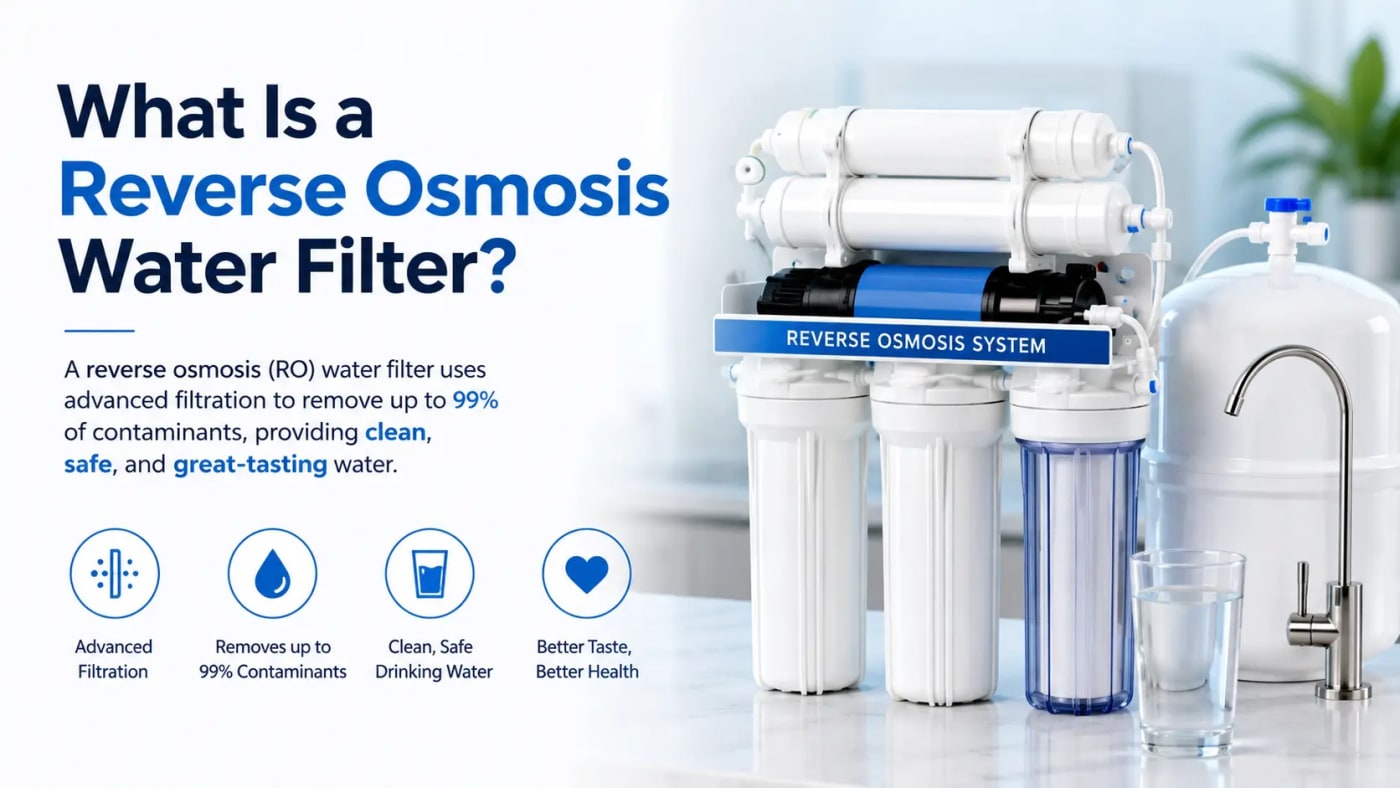
A Reverse Osmosis Water Filter System Is a system that uses pressure and a semipermeable membrane to separate water from many dissolved contaminants. As water passes through the membrane, some of it moves through as clean water, called permeate, while the rest stays behind carrying the rejected material, called concentrate or reject water. This article explains how reverse osmosis works, what components make up a typical system, which contaminants it can reduce, and what to understand about RO water once the basic technology makes sense.
How Does Reverse Osmosis Differ From Natural Osmosis?
Reverse Osmosis Differ From Natural Osmosis in one key way: it reverses the natural direction water normally moves. Natural osmosis is a simple process. Water moves across a semipermeable membrane on its own, flowing from an area with fewer dissolved substances toward an area with more of them. This movement happens because nature works to balance concentration on both sides of the membrane.
Reverse osmosis does the opposite. It applies outside pressure to push water against that natural direction. Instead of water moving toward the side with more dissolved substances, pressure forces water away from them, through the membrane, leaving many of those substances behind.
The table below compares the two processes side by side:
Process | Direction of water movement | Driving force |
Natural osmosis | Toward higher concentration of dissolved substances | Concentration difference alone |
Reverse osmosis | Away from dissolved substances, through the membrane | Applied pressure |
This pressure-driven reversal is the core idea behind every RO system, and it is the same basic principle described by agencies such as the EPA and FDA when explaining how reverse osmosis functions.
How Does Pressure Drive Water Through an RO Membrane?
Pressure Drive Water Through an RO Membrane by pushing incoming water, called feed water, against the membrane under force. The membrane is semipermeable, meaning it lets some substances through while blocking others.Water molecules pass through the membrane and become what is called permeate, or product water. Substances that do not pass through stay concentrated on the feed side and eventually leave the system to concentrate, or reject water.
How feed water moves through the membrane:
Feed water enters: Water arrives at the membrane under applied pressure.
Separation occurs: Water molecules pass through the membrane while many dissolved substances are blocked.
Two streams form: Permeate becomes the treated product water, and concentrate carries away rejected material.
Membrane performance depends on factors such as the molecular characteristics of the substances in the water and the operating conditions of the system. No single pore size describes every membrane, and no RO system blocks every possible contaminant. Actual performance depends on the specific membrane and how the system is built and maintained.
What Happens to Water During Each RO Filtration Stage?
Happens to Water During Each RO Filtration Stage is a three-part process: pre-filtration, membrane separation, and post-treatment. Not every system uses identical stages, but this general sequence describes how water typically moves through a home RO unit.
How water moves through the treatment sequence:
Pre-filtration: Sediment and carbon filters remove larger particles and chlorine before water reaches the membrane. This step protects the membrane from damage and clogging.
Membrane separation: Water passes through the RO membrane under pressure, where dissolved contaminants are separated from the water.
Post-treatment: Some systems add a post-filter to polish taste, while others add a remineralization stage to restore certain minerals after the membrane strips them out.
Storage: Treated water often moves into a storage tank until it is needed at the tap.
Pre-filtration and post-treatment support the membrane. The membrane itself performs the central separation work of the entire system.
What Components Make Up a Typical Reverse Osmosis Water Filter System?
Components Make Up a Typical Reverse Osmosis Water Filter System include several physical parts, each with its own job.
The table below shows the main components and what each one does:
Component | Function | Position in system | Optional or typical |
Sediment pre-filter | Removes dirt, sand, and larger particles | Before the membrane | Typical |
Carbon pre-filter | Removes chlorine and protects the membrane | Before the membrane | Typical |
RO membrane | Separates water from dissolved contaminants | Center of the system | Typical |
Post-filter | Polishes taste of the treated water | After the membrane | Typical |
Storage tank | Holds treated water until used | After the membrane | Typical |
Dedicated faucet | Delivers treated water at the point of use | At the sink | Typical |
Drain or concentrate line | Carries away reject water | Connected to the membrane housing | Typical |
Booster pump | Increases water pressure for better performance | Before the membrane | Optional |
Remineralizer | Adds minerals back into the water | After the membrane | Optional |
This component list, consistent with guidance from sources such as the Minnesota Department of Health, gives a clear picture of what a typical under-sink RO system contains.
How Does an RO System Separate Permeate From Reject Water?
An RO System Separate Permeate From Reject Water by producing two separate water streams. Permeate, also called product water, is the portion that successfully crosses the membrane. It is the clean water delivered to the tap.Concentrate, also called reject water or brine, is the stream that carries the substances the membrane blocked. This stream exists because those rejected substances need somewhere to go. Rather than building up on the membrane surface, they get carried away through a drain line.
Calling this stream simply dirty water misses the point. It is water that retains a higher concentration of dissolved substances the system was designed to separate out. The existence of this second stream is a normal and necessary part of how reverse osmosis works, not a flaw in the process.
Which Contaminants Can a Reverse Osmosis System Reduce?
Contaminants Can a Reverse Osmosis System Reduce vary by system and by certification, since RO is not a universal purifier that removes everything from water.
The table below organizes commonly targeted contaminant categories:
Contaminant category | Example substances | Reduction depends on |
Dissolved solids and salts | Total dissolved solids (TDS) | Membrane performance and certification |
Heavy metals | Selected metals depending on system | Specific tested claims |
Nitrogen compounds | Nitrate and nitrite | Verified contaminant-reduction claims |
Metalloids | Arsenic | NSF/ANSI 58 certified claims |
Minerals | Fluoride | Certified system performance |
Organic chemicals | Certain VOCs | System-specific testing |
Forever chemicals | PFAS, where specifically certified | Verified certification for that contaminant |
NSF/ANSI 58 is the standard used to verify these claims for residential RO systems, and the EPA describes the broader capability of reverse osmosis as a treatment technology. A buyer concerned about a specific contaminant should check the exact certified claims for that system rather than assuming general RO capability covers it.
How Does Reverse Osmosis Affect Dissolved Minerals and TDS?
Reverse Osmosis Affects Dissolved Minerals and TDS in a direct way, since minerals are part of the dissolved load the membrane addresses. Total dissolved solids, or TDS, describes the combined amount of dissolved substances in water, including minerals. Because minerals are part of this dissolved load, reverse osmosis can substantially reduce TDS as it separates water from other dissolved contaminants.
TDS reduction is not the same as proof that every individual contaminant has been removed. A low TDS reading shows that the overall dissolved load has decreased, but it does not confirm the status of any one specific substance on its own. NSF identifies TDS reduction as a required performance element under NSF/ANSI 58, which reflects how central this measurement is to evaluating RO system performance.
What Determines the Performance of a Reverse Osmosis Water Filter System?
Determines the Performance of a Reverse Osmosis Water Filter System is a set of independent variables that affect how well an RO system performs at any given time.
Factors that influence RO system performance:
Incoming water quality: The starting contaminant load affects how much work the membrane needs to do.
Operating pressure: Adequate pressure is necessary for the membrane to function as designed.
Water temperature: Temperature can affect membrane efficiency and output rate.
Membrane characteristics: Different membranes have different rejection capabilities.
Pretreatment quality: Effective pre-filtration protects the membrane and supports consistent performance.
Maintenance history: Regular filter and membrane replacement keeps performance closer to its intended level.
Performance should be evaluated against the manufacturer's specifications and any applicable certification claims, rather than against a generic percentage that may not apply to a specific system or water condition.
Where Are Residential Reverse Osmosis Systems Typically Installed?
Residential Reverse Osmosis Systems Typically Installed most often as point-of-use systems, meaning they treat water at one specific location rather than throughout the entire home. The most common installation is under a kitchen sink, feeding a dedicated faucet used for drinking and cooking water.
This is different from point-of-entry treatment, which treats water as it enters the home and supplies every fixture connected to the plumbing. A point-of-use RO system does not automatically treat water at every household outlet, only at the fixture it is connected to.
The table below compares these two installation types:
Installation type | Treatment location | Typical use |
Point-of-use (POU) | One specific fixture, often under the kitchen sink | Drinking and cooking water |
Point-of-entry (POE) | Where water enters the home | Whole-house treatment |
This distinction, supported by guidance from the EPA and Penn State Extension, helps explain why a single RO unit under the sink does not change water quality at every tap in the house.
What Are the Main Physical Limitations of Reverse Osmosis Filtration?
The Main Physical Limitations of Reverse Osmosis Filtration are real limitations built into the technology itself, separate from any specific brand or product.
Physical limitations of the RO process:
Reject water production: The process always generates a concentrate stream that goes to drain.
Slower production rate: RO typically produces treated water more slowly than a basic sediment or carbon filter.
Dependence on operating conditions: Adequate pressure and water temperature are needed for the system to perform as intended.
Ongoing maintenance needs: Pre-filters and the membrane require periodic replacement to maintain performance.
Limited scope for some water problems: Certain water-quality issues may need additional or different treatment beyond RO alone.
These limitations, described by sources including the EPA, Penn State Extension, and manufacturers such as Pentair, apply to the technology itself rather than to any single product.
How Does Certification Define What an RO System Can Claim to Remove?
Certification Define What an RO System Can Claim to Remove by tying contaminant claims to actual verified testing, since a specific RO system can only claim to remove or reduce contaminants that it has been tested and certified for. Not every RO unit performs identically, so certification exists to make that difference clear.
NSF/ANSI 58 is the primary certification standard for residential RO systems. It addresses several performance areas, including TDS reduction, system efficiency, water recovery, and specific contaminant-reduction claims for substances such as arsenic, nitrate and nitrite, lead, fluoride, certain VOCs, and PFAS where applicable.
Key attributes covered by NSF/ANSI 58 certification:
Attribute | What it verifies |
TDS reduction | Overall reduction of total dissolved solids |
System efficiency | How effectively the system uses feed water |
Recovery rate | The ratio of treated water to total water used |
Specific contaminant claims | Verified reduction of individual named contaminants |
Checking a system against these certified claims gives a buyer accurate information about what that particular system actually does, rather than relying on general assumptions about reverse osmosis as a technology.
What Should You Understand About RO Water After Learning How the System Works?
You Understand About RO Water After Learning How the System Works comes down to a short list of core ideas. Reverse osmosis uses pressure-driven membrane separation to divide incoming water into permeate and reject streams. Most residential systems use multiple treatment stages, including pre-filtration and often post-treatment, around the central membrane. The technology can reduce many dissolved contaminants, and it also reduces minerals and overall TDS as part of that same process.
Understanding this foundation naturally leads to a few common follow-up questions people ask once they know how the system itself works.
Is Reverse Osmosis Water Safe to Drink?
Reverse Osmosis Water Safe to Drink is generally the case for water from a properly designed, maintained, and appropriately certified RO system. Safety depends on the quality of the source water, how well the system performs, how consistently it is maintained, and which contaminant-reduction claims actually apply to that system. For a full explanation, see Is Reverse Osmosis Water Safe to Drink?
Does Reverse Osmosis Remove Beneficial Minerals From Water?
Reverse Osmosis Remove Beneficial Minerals From Water is something it does, since minerals are part of the total dissolved load the membrane addresses. Adding minerals back through remineralization is a separate treatment choice, not something every RO system includes by default. For more detail, see Does Reverse Osmosis Remove Minerals?
How Much Water Does a Reverse Osmosis System Waste?
Much Water a Reverse Osmosis System Wastes varies by system efficiency and operating conditions, since every RO system produces a reject or concentrate stream. There is no single ratio that applies to every unit. For detailed figures and efficiency comparisons, see How Much Water Does Reverse Osmosis Waste?
How Often Should Reverse Osmosis Filters and Membranes Be Replaced?
Often, Reverse Osmosis Filters and Membranes Get Replaced on a schedule that differs by component, by system design, by source-water quality, and by household usage. There is no universal replacement schedule that applies across every RO system. For complete maintenance guidance, see How Often Should RO Filters Be Replaced?
What Is the Difference Between Reverse Osmosis and a Water Softener?
The Difference Between Reverse Osmosis and a Water Softener comes down to the mechanism each one uses. Reverse osmosis uses membrane separation to reduce many types of dissolved contaminants. A conventional water softener primarily addresses water hardness through a different process called ion exchange. For a full comparison, see Reverse Osmosis vs Water Softener.
What Is the Difference Between Reverse Osmosis and Distilled Water?
The Difference Between Reverse Osmosis and Distilled Water lies in how each process separates water from contaminants. Reverse osmosis uses membrane pressure, while distillation evaporates water and then condenses the vapor back into liquid form. For a detailed breakdown, see Reverse Osmosis vs Distilled Water.
How Does a Reverse Osmosis System Compare With a Standard Water Filter?
A Reverse Osmosis System Compares With a Standard Water Filter through a difference in mechanism. Conventional filters, such as sediment and carbon filters, use physical trapping and adsorption to address specific categories of contaminants. Reverse osmosis uses membrane separation, which addresses a broader range of dissolved substances. For a complete comparison, see Reverse Osmosis vs Water Filter.
How Do You Maintain a Reverse Osmosis Water Filter System?
You Maintain a Reverse Osmosis Water Filter System through a basic routine: replacing pre-filters and post-filters on schedule, monitoring membrane condition, checking for leaks, and watching for changes in water output or taste that may signal a maintenance need. For complete step-by-step maintenance instructions, see Reverse Osmosis System Maintenance.
Conclusion
A reverse osmosis water filter system uses pressure to push water through a semipermeable membrane, separating clean permeate from a concentrate stream that carries away many dissolved contaminants. Most residential systems support this membrane with pre-filtration and post-treatment stages, and performance always depends on the specific system, its certification, and how well it is maintained. Understanding this basic mechanism makes it easier to evaluate any RO system by what it actually does, rather than by assumptions about what reverse osmosis in general is supposed to do.