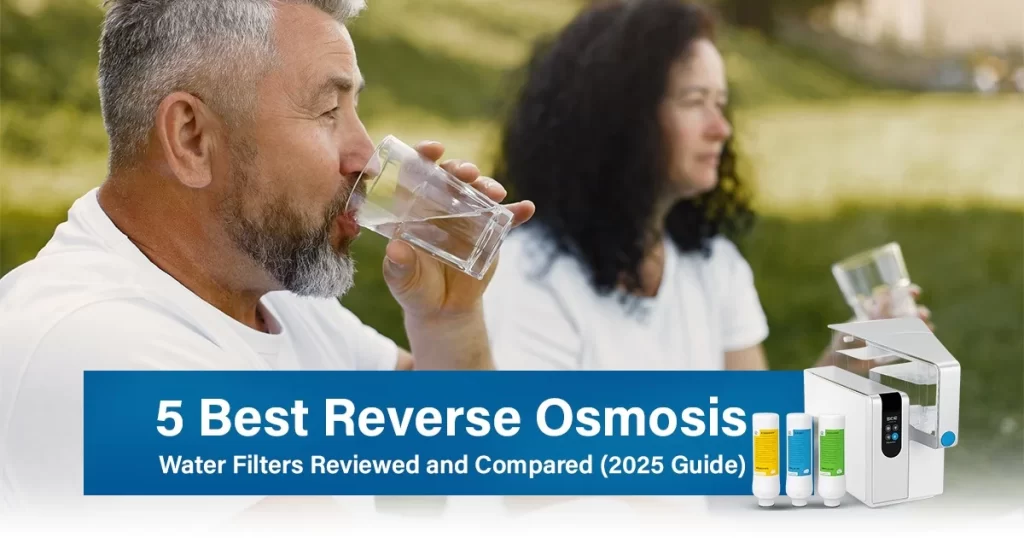
Reverse osmosis, or RO, is a water cleaning process that uses pressure to push tap water through a special, very tight membrane, leaving behind almost all contaminants. This process effectively removes impurities such as lead, fluoride, salts, and even the challenging “forever chemicals” known as PFAS. The big benefit of RO is that it delivers water that is incredibly pure, crystal clear, and tastes better than almost any bottled water.
Because reverse osmosis is the most effective purification method for home use, there are hundreds of options on the market, which makes it confusing to choose one. To make it easy for you, we reviewed five of the top-performing and most popular systems, ranging from simple countertop designs to high-efficiency, permanent under-sink setups.
Our detailed analysis focuses on these top five systems:
- AquaTru Classic Countertop Water Filtration System
- Waterdrop G3P800 Reverse Osmosis System
- iSpring RCC7 Reverse Osmosis Filtration System
- APEC ROES-50 Reverse Osmosis Filtration System
- Home Master TMHP HydroPerfection Reverse Osmosis System
Choosing the perfect RO system depends entirely on your specific kitchen setup, your family’s water demands, and your budget. Water Filter Way offers honest reviews, detailed buying guides, and informative blogs to ensure you have all the information you need to select the absolute best filter for your home.
1. AquaTru Classic Countertop Water Filtration System

The AquaTru Classic Countertop Water Filtration Purification System is the best option for people who want the highest level of water cleaning without hiring a plumber. This machine is a reverse osmosis (RO) system that sits right on your kitchen counter, and you just plug it in. It uses a patented ultra-fine filtration process that is officially certified to remove a wide range of contaminants. You get pure water quality that beats expensive bottled water, all from a compact, simple unit.
Key Specifications
| Feature | Detail |
| Brand | AQUA TRU |
| Model Name | AquaTru Classic |
| Dimensions | 14″ L X 12″W X14 “H |
| Price | $475 |
| Purification Method | reverse osmosis (RO) |
| Capacity | 2.7 Liters (Purified Water Storage) |
| Certifications | NSF/ANSI 42, 53, 58, 401, P473 |
| Installation Type | Countertop (No installation, just plug-in) |
| Rating | 4.6 out of 5 |
| Warranty | 1 Year (Standard manufacturer warranty) |
Filtration Process and Performance
This filtration system performs a deep clean through four separate stages to ensure the water is as pure as possible. The process includes:
- Stage 1 and 2: Pre-Filter (Sediment and Carbon): This first filter acts like a bodyguard. It traps larger particles, such as dirt, rust, and grit. It also uses activated carbon to eliminate unpleasant tastes and odors, especially those caused by chlorine.
- Stage 3: Reverse osmosis (RO) Membrane: This is the heart of the system. Water is pushed through an incredibly fine membrane under pressure, which rejects almost all inorganic contaminants, such as salts, nitrates, and heavy metals.
- Stage 4: VOC Carbon Filter: Volatile Organic Compounds (VOCs) are chemicals that readily evaporate, such as those found in solvents and gasoline. This filter targets these specific chemicals, as well as “forever chemicals” (PFOS & PFOA), ensuring enhanced safety.
The table below summarizes each contaminant and its corresponding reduction level.
| Contaminant | Removal Range |
| TDS (Total Dissolved Solids) | 92% – 95% |
| Lead / Heavy Metals (e.g., Chromium, Arsenic) | 95% – 98% |
| Chlorine / Taste / Odor | >99% |
| PFAS (Forever Chemicals) | 93% – 96% |
| Microplastics | >99.9% |
| Pesticides / Herbicides | 94% – 97% |
Flow Rate and Pressure Assurance
This unit is completely independent of your home’s plumbing and water pressure. The AquaTru system requires you to manually fill the raw water tank (the tank in the back) from your sink. It runs its own internal pump to push the water through the tight RO membrane filters. The cleaning process is not instant; it takes time to purify a full tank. Clean water then collects in the 2.7-liter pitcher at the front, ready to pour whenever you are.
Certifications and Trust
Trust is everything when it comes to water purity. AquaTru has backed up its claims with solid, independent testing.
- IAPMO Tested and Certified: A respected third-party testing organization (IAPMO) verified that the system works exactly as advertised.
- NSF/ANSI Standard 58: This is the most important certification for any reverse osmosis system. It guarantees the machine effectively reduces Total Dissolved Solids (TDS).
- NSF/ANSI Standard P473: This certification demonstrates that the system is effective at reducing PFAS (‘forever chemicals’).
- NSF/ANSI Standard 401: This certifies the removal of emerging contaminants, such as specific prescription drugs and herbicides that are now showing up in tap water.
Cost of Maintenance and Ownership
Understanding how much the filter will cost over time is key to making a smart purchase.
- Initial Cost is Low: At $475, this is a great price for a certified RO system, especially compared to under-sink units.
- Long-Lasting Filters: The replacement filters are designed to last 6 months to 2 years (up to 1,200 gallons). This helps keep yearly maintenance costs manageable.
- No Plumbing Costs: Because it requires no installation, you save the $100-$200 you spend hiring a professional to install an under-sink unit.
- Requires Power: The unit must be plugged into a standard electrical outlet to power the internal pump that pushes the water through the filters.
Summary
| What We Like | What We Don’t Like |
| Zero Installation: Plug-and-play setup. Perfect for renters or temporary living. | Manual Refilling: You must pour tap water into the back tank when it’s empty. |
| Highly Certified Purity: Meets multiple strict NSF standards, including the critical PFAS certification (P473). | Slow Purification: Processing a full tank of water takes time, so planning is necessary. |
| Portable: Easy to move if you change homes or apartments. | Takes Up Counter Space: You lose valuable counter space to the unit. |
| BPA Free Material: The plastics used are safe and do not contain BPA. |
Our Final Verdict: Who Is This Filter Best For?
The AquaTru Classic is an outstanding choice for getting truly pure RO water without the need for permanent installation. The system is best for:
- Renters and apartment dwellers where plumbing modifications are not permitted.
- Anyone on a budget who wants certified RO purity but finds under-sink systems too expensive.
- Small homes or offices that need high-quality drinking water on demand.
- People who are willing to manually refill a pitcher to get the highest level of filtration.
2. Waterdrop G3P800 Reverse Osmosis System

The Waterdrop G3P800 reverse osmosis System is built for speed, efficiency, and smart monitoring. This powerful unit fits under your sink and is tankless. It cleans water at a significantly higher speed, making it ideal for large families or homes with high water demand. This unit features the most amazing Smart Faucet that provides water-quality updates, ensuring every cup of water is crystal clear and safe.
Key Specifications
| Feature | Detail |
| Brand | Waterdrop |
| Model Name | G3P800 |
| Dimensions | 18.12″ L × 5.67″ W × 17.72″ H |
| Price | $999.00 |
| Purification Method | Reverse osmosis (RO) |
| Capacity | 800 Gallons Per Day (GPD) |
| Certifications | NSF/ANSI 42, 53, 58, 372 |
| Installation Type | Under-sink, tankless (requires drilling two holes) |
| Rating | 4.5 out of 5 |
| Warranty | 1-year manufacturer and seller combination |
Filtration Process and Performance
The Waterdrop G3P800 features an impressive 10-stage filtration process that maximizes contaminant removal and extends filter life. This includes:
- Composite Filter (CF): This filter handles the first three stages. It tackles sand, rust, and dirt, then removes chlorine and controls bad tastes and odors.
- Reverse Osmosis (RO) Membrane: This is the high-power, four-stage RO membrane. It reduces the concentration of dissolved particles by pushing water through a super-fine barrier. It specifically targets lead, chromium, iron, salts, PFAS, and fluoride.
- Carbon Block Filter (CB): The final three stages are completed in this filter. It uses high-quality activated carbon to polish the water, eliminating residual organic compounds and impurities, delivering a fresh, crisp flavor.
The table below summarizes each contaminant and its corresponding reduction level.
| Contaminant | Removal Range |
| TDS (Total Dissolved Solids) | 94% – 97% |
| Heavy Metals (Lead, Chromium, Iron) | 96% – 98% |
| PFAS (Forever Chemicals) | 95% – 97% |
| Fluoride | 94% – 97% |
| Salts (Nitrate and Chloride) | 92% – 95% |
| Chlorine / Taste / Odor | >99% |
Flow Rate and Pressure Assurance
This system boasts incredible speed, addressing the biggest complaint people have about older RO machines. With an 800 GPD capacity, the Waterdrop G3P800 delivers purified water almost instantly. You fill a full cup of water in just about 5 seconds, making it one of the fastest home RO systems available. The tankless design means the clean water never sits and waits; it is cleaned on demand every time you open the faucet.
Certifications and Trust
Waterdrop has secured multiple crucial certifications, proving this system is both safe and highly effective.
- NSF/ANSI Standard 58: This is the gold standard for reverse osmosis, guaranteeing effective reduction of Total Dissolved Solids (TDS).
- NSF/ANSI Standards 42 & 53: These certifications verify that the system effectively reduces common issues such as chlorine, bad taste, and odor.
- NSF/ANSI Standard 372: This guarantees that the materials used in the system, including the faucet, are lead-free.
- SGS Lab Tested: Official third-party testing confirms that the 10-stage process effectively reduces a wide range of pollutants.
Cost of Maintenance and Ownership
While the upfront cost is the highest, the long-term running costs are competitive due to efficiency and filter longevity.
- High Initial Cost: This is a serious investment, priced higher than most other home systems.
- High Water Efficiency: The 3:1 pure-to-drain ratio is excellent. This means for every three cups of clean water produced, only one cup of wastewater is used. This saves money on your water bill compared to older, less efficient 5:1 or 4:1 RO systems.
- Three Replaceable Filters: You need to purchase replacement filters for the CF, RO, and CB stages, but they are generally long-lasting.
- Corded Electric Power: The unit requires a power outlet under your sink to run the powerful internal pump, which delivers a high 800 GPD flow rate.
Summary
| What We Like | What We Don’t Like |
| Lightning Fast Flow (800 GPD): Fills a glass in almost no time. | Highest Initial Price: The cost is a major financial commitment. |
| Tankless Design: Frees up valuable space under the sink and reduces the risk of water contamination. | Requires Two Holes Drilled: Installation requires two holes in your countertop or sink for the smart faucet and the drain pipe. |
| 3:1 Water Efficiency: Saves a significant amount of water over time. | Needs Power/Electricity: The internal pump must be plugged in to run. |
| Smart Faucet: Displays the TDS level and filter life right where you get your water. |
Our Final Verdict: Who Is This Filter Best For?
The Waterdrop G3P800 is a brilliant choice for demanding households that require professional-grade purity and instant access to water. The system is best for:
- Large families or kitchens with high-volume water needs (e.g., cooking, making coffee).
- Homeowners who want the most efficient water-saving RO technology available.
- Tech-savvy users who appreciate real-time monitoring of water quality and filter status via the smart faucet.
- Anyone who refuses to wait for their glass or kettle to fill up.
3. iSpring RCC7AK Reverse Osmosis Filtration System

The iSpring RCC7AK reverse osmosis Filtration System is a popular 6-stage domestic RO system that provides excellent water purification directly from under your kitchen sink. Up to 97% of the most common water impurities are effectively removed through this workhorse. And it is the best choice for reliable water quality assurance, as it is easy to install and requires minimal annual maintenance.
Key Specifications
| Feature | Detail |
| Brand | iSpring |
| Model | RCC7 |
| Dimensions (System) | 15.5″L x 16″W x 18″H |
| Price (Estimated) | $279 |
| Purification Method | 5-Stage reverse osmosis (RO) |
| Capacity (GPD) | 75 Gallons Per Day |
| Certifications | NSF/ANSI 58 |
| Installation Type | Undersink (US) |
| Rating (Estimated) | 4.7 out of 5.0 |
| Warranty | 1-Year Money-Back Guarantee, Lifetime Technical Support |
Filtration Process and Performance
The RCC7 implements a fully comprehensive multi-stage filtration process. The various stages of filtration include:
- Stage 1: High-Capacity Sediment Filter (PP): It removes dirt, rust, sand, and other particulates larger than 5 microns to prevent subsequent filters from being fouled.
- Stage 2: Granular Activated Carbon (GAC) Filter: Removes chlorine, chloramines, VOCs, and organic chemicals that cause bad taste and odor.
- Stage 3: Carbon Block (CTO) Filter: Provides additional filtration to ensure maximum removal of residual chlorine and fine particles before the membrane.
- Stage 4: Reverse Osmosis (RO) Membrane: This semi-permeable membrane, with a 0.0001 micron pore size, effectively rejects Total Dissolved Solids (TDS), heavy metals, bacteria, and viruses.
- Stage 5: Post-Carbon Filter (T33): A polishing filter that improves the flavor of the water before it reaches the faucet.
- Stage 6: Alkaline Remineralization Filter: This stage restores healthy minerals to your water that were stripped out during the RO process. It raises the water’s pH level, giving you slightly alkaline water with a much better, natural taste.
The table below summarizes each contaminant and its corresponding reduction level.
| Contaminant | Removal Range |
| Total Dissolved Solids (TDS) | 92% – 97% |
| Lead and Heavy Metals | 95% – 97% |
| Chlorine / Chloramine | 97% – 99% |
| Fluoride | 90% – 94% |
| Asbestos | 90% – 94% |
| Barium | 90% – 95% |
Flow Rate and Pressure Assurance
The iSpring RCC7AK delivers a strong purification capacity of 75 gallons per day (GPD), standard for mid-range residential systems. The system relies on steady municipal water pressure (45-70 psi recommended) to push water through the RO membrane, and its included 3.2-gallon pressurized tank ensures purified water is dispensed instantly at a consistent, usable flow rate from the dedicated faucet.
Certifications and Trust
The iSpring system provides customer assurance based on well-recognized industry standards and certifications:
- NSF/ANSI Standard 58 Certified: This is the most critical certification for reverse osmosis drinking water treatment Systems, verifying that the system satisfactorily reduces specific contaminants.
- Lifetime Tech Support: iSpring provides accessible, US-based lifetime technical support.
Cost of Maintenance and Ownership
The iSpring RCC7 is designed for long-term affordability and minimal hassle.
- Annual Filter Pack: Typically runs between $40 and $60, depending on the supplier. These four filters are replaced every 6 to 12 months.
- RO Membrane Replacement: The membrane is the most expensive component, costing approximately $40 to $50, and should be replaced every 2-3 years, depending on water quality.
- Average Annualized Cost: Given a 3-year ownership cycle, the average total annual maintenance cost is approximately $60-$75.
Summary
| What We Like | What We Don’t Like |
| Excellent contaminant reduction across all major categories, verified by NSF 58. | Standard water waste ratio (RO technology limitation). |
| Extremely low cost of ownership and maintenance. | Requires patience and basic DIY skills for installation (can take 1-2 hours). |
| A high-quality, lead-free, dedicated drinking water faucet is included. | Non-pressurized well water systems may require a booster pump (sold separately). |
| US-based lifetime technical support is industry-leading. | The large storage tank takes up significant cabinet space. |
Our Final Verdict: Who Is This Filter Best For?
The iSpring RCC7 is the ultimate choice for budget-conscious homeowners who demand certified, near-perfect water purity. The system is best for:
- Budget-conscious families are drawn to it for its low upfront cost and remarkably inexpensive annual filter replacements.
- Renters or DIY enthusiasts who can handle the installation, as it is done with basic tools and instructional videos.
- Municipal water users, as it is highly effective at removing chlorine, fluoride, and the remnants of aging infrastructure (like lead).
- Households needing high contaminant removal, as it provides the certified, multi-stage protection required to tackle complex or high-TDS water.
4. APEC ROES-50 Essence Series

The APEC ROES-50 reverse osmosis filtration system is a is a classic, 5-stage RO known as a reliable workhorse. This filter excels at removing common contaminants, including Total Dissolved Solids (TDS), making your water ultra-safe and great-tasting. It uses standard components, which keep the system affordable and the maintenance easy.
Key Specifications
| Feature | Detail |
| Brand | APEC Water Systems |
| Model | ROES-50 (Essence Series) |
| Dimensions (Approx.) | 16″L x 5.25″W x 17.5″H |
| Price (Approx.) | $230.99 |
| Purification Method | 5-staged reverse osmosis (RO) Filtration |
| Capacity (GPD) | 50 Gallons Per Day (GPD) |
| Storage Capacity | Standard 3.2-Gallon Pressurized Tank |
| Certifications | Water Quality Association (WQA) Certified |
| Installation Type | Undersink (Requires a dedicated faucet) |
| Rating (Est.) | 4.4 out of 5 |
| Warranty | 1-Year Limited Warranty |
Filtration Process and Performance
The Essence Series uses a solid approach in which each stage stops contaminants of different sizes and types. The filtration process includes:
- Stage 1: High-Capacity Sediment Filter: This filter captures large, rough particles like rust, dirt, or sand, preventing the delicate membrane filter from clogging.
- Stage 2: Carbon Block Filter (First Pass): Removes residual chlorine, bad smells, cloudiness, and Volatile Organic Chemicals (VOCs). This step is also very crucial for the RO membrane lifespan.
- Stage 3: Carbon Block Filter (Second Pass): Provides additional removal of any remaining chlorine and other chemicals, doubling down on protection and taste improvement.
- Stage 4: High-Rejection TFC reverse osmosis (RO) Membrane: This is the core purification stage. It removes up to 99% of Total Dissolved Solids (TDS), heavy metals, salts, and chemicals.
- Stage 5: Refined Coconut Shell Carbon Filter: This final post-filter polishes the water as it leaves the storage tank, ensuring every glass tastes fresh and clean, with no residual tank flavor.
The table below summarizes each contaminant and its corresponding reduction level.
| Contaminant Removed | Removal Range |
| Total Dissolved Solids (TDS) | 90% – 96% |
| Lead, Arsenic, Fluoride | 90% – 96% |
| Chlorine, VOCs, Taste/Odor | 90% – 98% |
| Microorganisms (Bacteria/Viruses) | 0% – 5% (This system does not include UV or sterilization) |
Flow Rate and Pressure Assurance
The APEC ROES-50 is a standard reverse osmosis (RO) system with a 50 Gallons Per Day (GPD) rating. It does not include a permeate pump or other features to boost speed. The flow rate is typical for a tank-based system. It takes time for the tank to refill after you use a lot of water. You rely entirely on the incoming water pressure in your home to push the water through the membranes. The system fills slowly if your home has low water pressure.
Certifications and Trust
When you buy a filter, you need to know it delivers on its promises. APEC has strong backing.
- The system carries the WQA Gold Seal Certification, which means the Water Quality Association tested the entire system against industry standards for performance and safety.
- WQA specifically certifies the ROES-50 against the NSF/ANSI 58 standard for the reduction of Total Dissolved Solids (TDS) and other key contaminants.
Cost of Maintenance and Ownership
The ROES-50 is one of the more economical reverse osmosis (RO) systems on the market, both for the initial purchase and for filter replacements.
- Initial System Cost: The cost to purchase and install this filter is highly affordable, making it a great entry point into RO technology, usually costing around $230.99.
- Annual Replacement Filter Set: You spend only about $60 to $80 per year to replace the three essential pre-filters that protect the main RO membrane.
- Membrane Replacement: The main reverse osmosis membrane is long-lasting and requires replacement every 2 to 4 years at a cost of about $40.
- Filter Change Schedule: The three pre-filters need to be changed every 6 to 12 months, but the core RO Membrane and the Post-Carbon filter are only replaced every 2 to 4 years.
Summary
| What We Like | What We Don’t Like |
| Excellent Value: The initial cost is very low for a WQA-certified reverse osmosis (RO) system. | Standard Flow Rate: Water delivery speed is slower than that of systems with a pump. |
| Low Maintenance Cost: Replacement filters are affordable and widely available. | No Remineralization: Water may be slightly acidic and very low in minerals, which can affect the taste. |
| Proven Performance: WQA Certification confirms high-level contaminant removal. | No Microorganism Protection: It does not include a UV light to kill bacteria or viruses. |
| Standard Components: Easy to replace filters and parts when needed. | Water Waste: The system wastes water during purification (typical of RO). |
Our Find Verdict: Who Is This Filter Best For?
This system is perfect for anyone who wants high-quality, ultra-pure reverse osmosis (RO) water on a budget and does not require remineralization or UV protection. The system is best for:
- Budget-conscious buyers who still demand certified, high-level reverse osmosis (RO) purity.
- Users with reliably clean municipal water where bacteria or viruses are not a primary concern.
- Buyers who want a reliable, no-frills system with easy-to-find replacement parts.
5. Home Master TMHP HydroPerfection

The Home Master TMHP HydroPerfection filter system is a top-tier choice for families who demand the purest water, period. It uses a massive 9-stage process that removes almost all contaminants. The system also addresses a common reverse osmosis (RO) issue by adding healthy minerals back into your water, improving taste, and preventing damage to your storage tank. A special pump helps speed up the flow, so you wait less for your clean water.
Key Specification
| Feature | Detail |
| Brand | Home Master |
| Model | TMHP HydroPerfection (TMHP) |
| Dimensions (Approx.) | 15″L x 5″W x 16″H |
| Price (Approx.) | $363.34 |
| Purification Method | 9-Stage reverse osmosis (RO), UV Sterilization, Remineralization |
| Capacity (GPD) | 2000 Gallons |
| Storage Capacity | Standard 3.2-Gallon Pressurized Tank |
| Installation Type | Undersink (Requires a dedicated faucet) |
| Rating (Est.) | 4.7 out of 5 |
| Warranty | 5-Year Limited Warranty |
Filtration Process and Performance
The HydroPerfection uses nine distinct steps to clean, purify, and even improve your water before it reaches your glass. The process includes:
- Stage 1: Sediment & Iron Pre-Filter: Removes dirt, rust, and particles down to 5 microns, protecting the rest of the system. This stage includes media designed specifically to handle dissolved iron.
- Stage 2: Catalytic Carbon Filter: Uses advanced carbon to tackle chlorine, bad tastes, odors, and especially hard-to-remove chloramine (a chemical disinfectant many cities use now).
- Stage 3: High-Rejection reverse osmosis (RO) Membrane: Pushes water through a hair-thin membrane (0.0001 micron) to reject up to 99% of total dissolved solids (TDS) and heavy metals.
- Stage 4 (Remineralization 1) & Stage 5 (Remineralization 2): The patented Full Contact process adds a small amount of calcium and magnesium back into the water at two separate points. This balances the pH and provides a superior, natural taste.
- Stage 6: UV (ultraviolet) Sterilizer: A cold UV LED light destroys 99.99% of bacteria, viruses, and other microorganisms. This provides extra protection for well water users or anyone concerned about waterborne pathogens.
- Stages 7-9: Final polishing and delivery through the faucet.
The table below summarizes each contaminant and its corresponding reduction level.
| Contaminant | Removal Range |
| Total Dissolved Solids (TDS) | 92% – 97% |
| Lead, Arsenic, Fluoride | 92% – 97% |
| Chlorine, Chloramine, VOCs | 95% – 99% |
| Iron | 80% – 90% (Due to specialized pre-filter) |
| Bacteria and Viruses | 98.9% – 99.99% (UV Light effectiveness) |
Flow Rate and Pressure Assurance
Flow rate is a major headache with traditional RO systems. Home Master solves this with a built-in Permeate Pump (ERP). This non-electric pump forces water through the RO membrane more efficiently. The pump increases water pressure in the system, allowing the tank to fill faster. Faster filling means a stronger stream of clean water when you turn on the faucet.
Certifications and Trust
This system gives you peace of mind through multiple layers of safety and trust.
- The Home Master TMHP system is registered with the Environmental Protection Agency (EPA #97952-AZ-1).
- The manufacturer offers a superb 5-year limited warranty, which shows they stand behind their product’s quality for the long haul.
- The system uses high-quality American-made components, including the essential reverse osmosis (RO) membrane.
Cost of Maintenance and Ownership
Owning this top-tier system involves the initial cost plus the price of new filters. Because the HydroPerfection uses high-capacity filters and a UV light, the yearly cost is slightly higher than that of basic models.
- Initial System Cost: The cost to purchase this advanced system, including the specialized UV light, is higher.
- Annual Filter Change Set (UV and Filters): You spend about $130 to $140 per year to replace all the standard filter cartridges and the essential UV (ultraviolet) sterilizer bulb.
- Filter Change Schedule: Replace the filter set once per year or after the system has cleaned 2,000 gallons of water, whichever comes first.
Summary
| What We Like | What We Don’t Like |
| 9-Stage Advanced Filtration: Includes UV for germs and specialized Iron removal. | High Initial Price: The upfront cost is higher than that of basic RO systems. |
| Remineralization: Adds back healthy minerals for better taste and pH balance. | Not Portable: Requires permanent undersink installation and drilling a hole for the faucet. |
| Faster Flow Rate: The permeate pump helps the tank fill quickly and delivers water fast. | Needs Power: The UV sterilizer and permeate pump require an electrical outlet. |
| Easy Maintenance: Modular filter design makes yearly changes quick and mess-free. | Water Waste: Like all RO systems, it still wastes some water, though the pump improves efficiency. |
Our Find Verdict: Who Is This Filter Best For?
This is the ultimate system for homeowners who want the highest possible water purity, fast flow, and guaranteed great taste. The system is best for:
- Families who prioritize high-level germ and virus protection with the added UV stage.
- Users with well water or municipal water that is high in iron or chloramine.
- Buyers who want to avoid the acidic water often produced by basic reverse osmosis (RO) filters.
- Anyone who hates slow water flow at the dedicated RO faucet.
The Ultimate Comparison: 5 Top RO Water Filtration Systems
| Feature | AquaTru Classic | Waterdrop G3P800 | iSpring RCC7 | APEC Water Systems ROES-50 | Home Master TMHP HydroPerfection |
| Price (Approx.) | $475 | $999.00 | $279 | $230.99 | $363.34 |
| Installation Type | Countertop (No Plumbing) | Under Sink, Tankless | Under Sink (Tank Required) | Under Sink (Tank Required) | Under Sink (Tank Required) |
| Purification Method | RO | RO | RO, Remineralization | RO | RO, Remineralization, UV |
| Total Filtration Stages | 4 Stages | 10 Stages (3 Filters) | 6 Stages | 5 Stages | 9 Stages |
| Pure-to-Drain Ratio | N/A (Countertop) | 3:1 (Excellent) | 3:1 to 4:1 (Standard) | 3:1 (Good) | 1:1 (Best Efficiency) |
| Rating | 4.6 | 4.5 | 4.7 | 4.4 | 4.7 |
| Warranty | 1 Year | 1 Year | 1 Year | 1 Year | 5 Years |


The comparison table and bar graphs make the choice much easier. Now that you see the full picture, you can clearly compare and choose the system that aligns with your specific needs. Use these visual comparisons to balance your budget with your family’s water demands and decide if you need a high-speed, high-tech unit or a simple, reliable option.
How Do You Choose the Best Reverse Osmosis System for Home Use?
You can choose the best reverse osmosis (RO) system for home use by focusing on your family’s daily water habits and the space available in your kitchen. A high-quality system removes impurities like PFAS and lead, giving you great-tasting, perfectly clean water right from your faucet. Getting the right size and type of filter gives you peace of mind and stops you from spending money on plastic bottles.
The key factors to consider when making your selection include:
- Installation Type
Look at where the system needs to sit in your home. Countertop models are easy to use, as they do not require plumbing and simply plug into a wall outlet. These units work well for renters or people who move frequently. Under-sink models require a permanent connection to your cold water line and a hole drilled for a separate faucet. Homeowners prefer these systems because they keep the kitchen counter clean and clutter-free.
- Speed and Capacity (GPD Rating)
This factor tells you how fast the machine makes clean water. The GPD stands for Gallons Per Day, which is the total output capacity. Systems rated at 50 or 75 GPD are slower and require a large storage tank to hold the clean water until you need it. High-speed tankless systems, rated at 400 GPD or 800 GPD, deliver clean water almost instantly. Choose the fastest option if you have a big family or constantly use filtered water for cooking.
- Waste Water Ratio
An RO filter uses water to clean itself, which sends wastewater down the drain. Efficiency is shown by the ratio, for example, 4:1 or 1:1. A 4:1 ratio is older technology; it uses 4 gallons of water to produce 1 gallon of pure water. Modern systems are much better, often reaching a 1:1 ratio or close to it. Selecting a system with a great ratio saves you money on your water bill over time.
- Extra Filtration Stages
The basic RO membrane removes almost everything, but some systems add specialized cleaning steps. Alkaline remineralization stages replenish healthy minerals, such as calcium and magnesium, in the water. This improves the water’s taste but slightly raises the pH. UV sterilization is another safeguard. It shines ultraviolet light into water to ensure all tiny bacteria or viruses die, guaranteeing maximum safety.
- Cost of Ownership
The upfront price is just the beginning. Check the maintenance costs, too. You have to know how often you are changing the filters and how much each replacement costs. Long-lasting filters that last 12 to 24 months reduce maintenance costs and frequency. Always look at the warranty. A manufacturer offering a 3-year warranty shows strong confidence in the quality and durability of their filter.
Finding the perfect RO system is easy when you break down the choices into these clear categories. Knowing which features matter most for your kitchen sets you up for success. We want to help you feel confident in your decision. Water Filter Way offers detailed reviews, straightforward buying guides, and informative blogs to help you select the best filter for your family’s needs.
Which companies produce the most reliable RO systems?
The companies that produce the most reliable RO systems are those that specialize in high-quality RO technology. Companies like Home Master, Waterdrop, and APEC are known for innovative designs and strong performance. Looking into the best water filter brands helps you understand who offers the best balance of features, warranty, and customer support for your needs.
What is the downside of reverse osmosis water systems?
The downsides of reverse osmosis water systems are the removal of essential minerals and the production of wastewater. While the system provides very pure water, some people dislike the flat taste. It is also inefficient in some cases, wasting several gallons of water to produce just one gallon of purified water.
What should I look for when comparing different RO systems?
When comparing different RO systems, look at the initial price, filter replacement costs, and the system’s efficiency (the pure-to-drain ratio). Look for certifications such as NSF/ANSI Standard 58, which confirms that the system effectively reduces TDS. Consult a guide to choosing the right water filter for a complete checklist of features and factors to help you make a confident decision.
Can I service my RO purifier myself?
Yes, you can service your RO purifier yourself, as specified by the manufacturer, including changing filters, cleaning the housings, and draining the tank. However, it is advised that you have a professional service your system periodically. An expert will check for hidden problems, test water quality, and ensure the system is operating effectively and safely.
Can reverse osmosis remove contaminants like lead and arsenic?
Yes, reverse osmosis removes contaminants like lead and arsenic. Many RO filters are highly effective at removing dangerous heavy metals in drinking water. The RO membrane is so fine that these elements cannot pass through, even at tiny, unsafe levels. Always use a professional test kit before and after installation to confirm the results.
How often should I drain my reverse osmosis tank?
You should drain your reverse osmosis (RO) storage tank completely about every two weeks. This helps prevent stagnant water, supports proper system pressure, and maintains clean, fresh-tasting water. Draining is especially important if you use water infrequently, as standing water can encourage bacterial growth and lower water quality.
How to remove bacteria from reverse osmosis?
To remove bacteria from a reverse osmosis (RO) system, deep sanitizing is performed. A diluted bleach or some specialized sanitizer is run through the filter housings and the storage tank to destroy the microbes. For long-term prevention, add a UV sterilizer or post-RO disinfection filter.
Is it safe to drink RO water every day compared to tap water and bottled water?
Yes. It is safe to drink RO water every day compared to tap water and bottled water. RO systems remove harmful contaminants like lead, chlorine, and pesticides. While they also remove essential minerals, a balanced diet replaces them. Many people prefer RO water because it’s cleaner, safer, and better-tasting.
What is the lifespan of a reverse osmosis system?
The lifespan of a reverse osmosis system ranges from 10 to 15 years with proper maintenance. Filters need to be replaced every 6–12 months, while the RO membrane lasts 2–5 years. Routine care and timely servicing ensure consistent purification and extend the system’s performance for long-term household use.
Does RO filter out the healthy minerals?
Yes, the RO process removes almost everything, including healthy minerals like calcium and magnesium. Some systems stop there. Many high-end systems, however, have a final stage called remineralization. This stage adds a healthy mix of minerals to the water, improving its taste and making it slightly alkaline.
How long do RO filters last before I need to replace them?
RO filters last a year to several years before needing to be replaced. The answer depends on the specific filter stage. Pre-filters (those that remove sediment and chlorine) typically last 6 months to 1 year. The main RO membrane is much tougher; it lasts two to five years, depending on your water quality and how much water you use.
