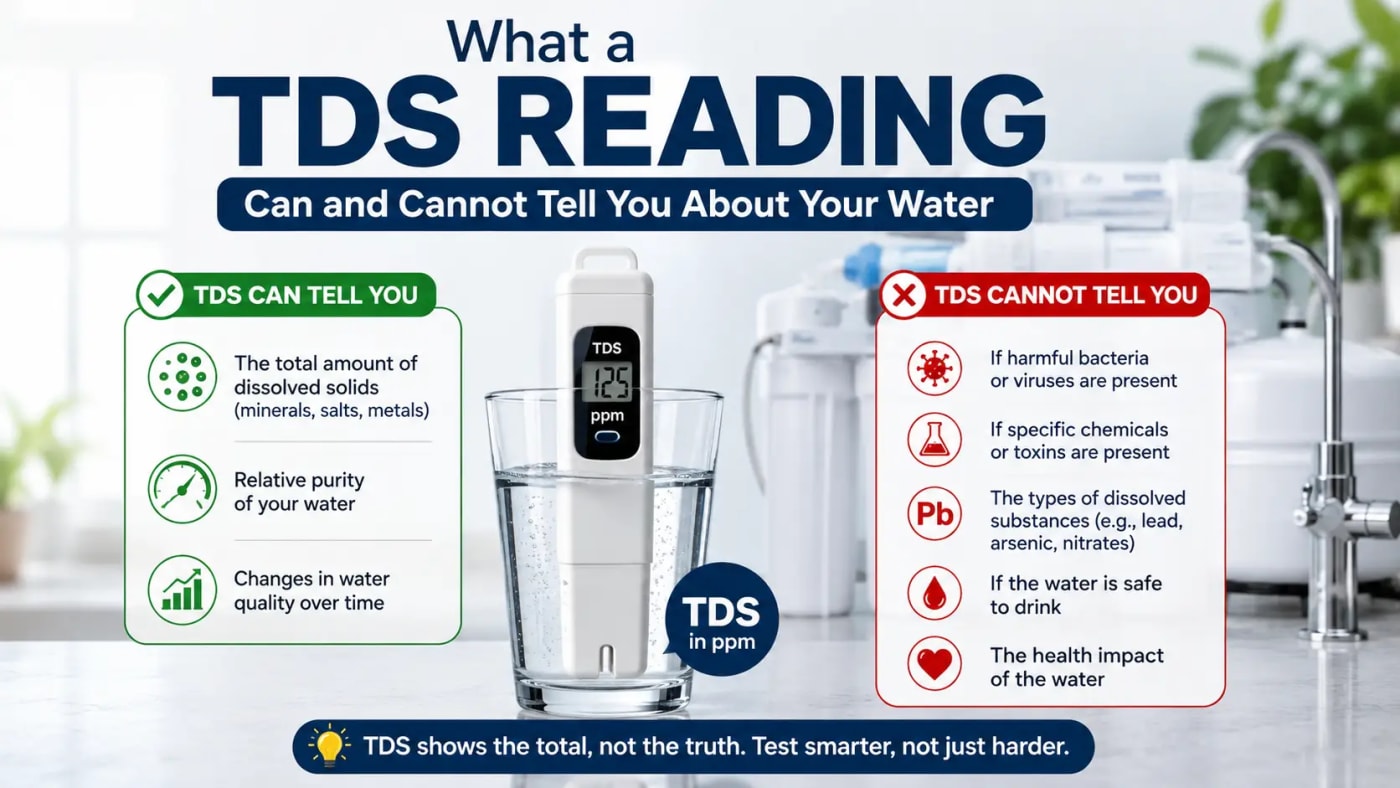
A TDS reading tells you the total concentration of dissolved solids in your water, but it does not tell you which specific substance is responsible for that number. TDS is a useful general indicator, yet it cannot identify contaminants like lead, bacteria, arsenic, or PFAS on its own. In this article, you will learn what a TDS reading actually measures, which water problems need a different and more specific test, when a private well needs broader monitoring, and how to decide what to test next based on your actual situation.
What Can a Basic TDS Reading Tell You?
A basic TDS reading tells you the overall concentration of dissolved solids in your water, expressed in parts per million or milligrams per liter. This number reflects the combined presence of many different dissolved substances, including calcium, magnesium, sodium, chloride, sulfate, and nitrate, among other ions.
The table below separates what a TDS reading tells you from what it cannot tell you:
What TDS tells you | What TDS cannot tell you |
The overall concentration of dissolved solids | Which specific substance is responsible for the reading |
A general indicator of mineral or ion content | Whether specific contaminants like lead or arsenic are present |
A useful screening number for tracking changes over time | Whether bacteria, viruses, or PFAS are present |
TDS works well as a general screening tool, since a sudden change in the number can signal that something in your water has changed. It does not, however, work as a diagnostic tool for identifying a specific substance.
Which Water Questions Need More Than TDS?
Water questions that need more than TDS are ones that ask about a specific substance rather than the total dissolved-solids level. A TDS meter cannot answer questions such as whether water contains a specific contaminant.
Categories of questions TDS cannot answer:
Is a specific metal present: TDS cannot confirm or rule out lead, arsenic, or other individual metals.
Is the water microbiologically safe: TDS cannot detect bacteria, viruses, or protozoa.
Are specific chemicals present: TDS cannot identify PFAS, pesticides, or particular industrial chemicals.
Is a named substance at a safe level: TDS gives no information about any single regulated contaminant's concentration.
Whenever a water concern involves a named substance rather than the general mineral load, a second, more specific test becomes necessary.
Which Water Problems Need a Specific Test?
Water problems that need a specific test are those tied to a particular concern, such as hardness, bacteria, or a specific chemical, since each concern requires its own dedicated testing method rather than a general TDS reading.
The table below matches common water concerns to the appropriate test:
Water concern | What to test | Why that test matters |
Hardness and scale | A hardness-specific test, such as strips, titration, or lab analysis | TDS cannot isolate calcium and magnesium from other dissolved ions |
Bacteria or nitrate risk | Total coliform bacteria test and nitrate test | These require dedicated biological and chemical analysis methods |
Metals or chemical contamination | Analyte-specific testing for lead, arsenic, pesticides, or VOCs | The suspected source determines which specific substance to test for |
Each of these tests is explained in more detail in the sections below.
When Should You Test Water Hardness Separately?
You should test water hardness separately whenever you notice scale, soap-lather problems, or appliance deposits, since TDS cannot isolate hardness from the rest of the dissolved solids in your water.
A quick comparison between TDS and hardness testing:
TDS: Measures the total of all dissolved solids, including sodium, chloride, and other ions alongside calcium and magnesium.
Hardness test: Measures calcium and magnesium specifically, using methods such as test strips, titration, or laboratory analysis.
Since sodium and other dissolved ions also contribute to a TDS reading, a household could have moderate TDS but still have significant hardness, or the reverse. This is why hardness-related decisions, such as whether to install a softener, should rely on a hardness-specific test rather than a general TDS number.
When Should You Test for Bacteria or Nitrates?
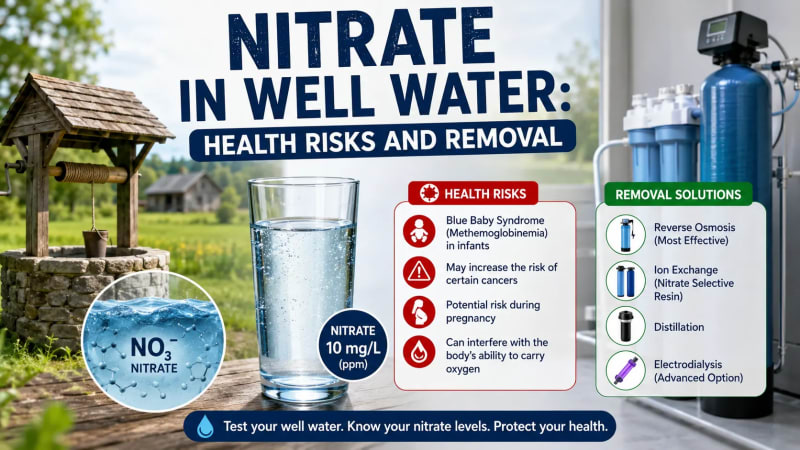
You should test for bacteria or nitrates whenever your water comes from a private well, is near agricultural land, or is near a septic system, since these situations carry a higher risk of microbial or nitrate contamination that TDS cannot detect.
Common triggers for bacteria or nitrate testing:
Private well ownership: Wells are not automatically monitored the way public systems are.
Nearby agricultural activity: Fertilizer and manure runoff can introduce nitrates into groundwater.
Nearby septic systems: Septic system issues can introduce bacteria into a nearby well.
CDC recommendation for annual testing: The CDC recommends annual private-well testing for total coliforms and nitrates specifically.
Total coliform testing and nitrate testing are dedicated tests, separate from TDS, and neither is captured by a general dissolved-solids reading.
When Should You Test for Metals or Chemical Contaminants?
You should test for metals or chemical contaminants when a specific source of concern is present nearby, since the suspected source generally determines which specific analyte needs testing.
The table below connects common conditions to relevant tests:
Condition | Relevant test |
Older home plumbing | Lead and copper testing |
Nearby agricultural land | Pesticide testing |
Nearby fuel storage or industrial activity | Volatile organic compound (VOC) testing |
Nearby mining activity | Metals testing, including arsenic |
This condition-based approach reflects how EPA guidance frames testing decisions: identify the likely source of contamination first, then choose the test that matches that specific source.
When Should a Change in Water Trigger More Testing?
A change in water should trigger more testing whenever you notice a sudden shift in taste, odor, color, or clarity, since TDS alone cannot explain why that change occurred.
Observed changes and reasons for broader testing:
Sudden taste change: May indicate a new contaminant or a shift in water source conditions.
Unusual odor: Can point toward chemical, biological, or plumbing-related issues.
Color change: Often signals metal contamination, sediment, or plumbing corrosion.
Increased cloudiness: Can indicate sediment, microbial activity, or a treatment system malfunction.
EPA and CDC both identify changes in taste, color, and smell as valid reasons to pursue further, more specific testing rather than relying on a single TDS reading to explain the change.
When Should You Test After Flooding or Repairs?
You should test after flooding or repairs because these events directly change the contamination risk to your water source, independent of any symptoms you might notice.
Events that should trigger testing:
Flooding: Floodwater can introduce bacteria, chemicals, or sediment into a well or water system.
Well repairs: Physical work on a well can disturb the surrounding area and introduce contamination.
Pump replacement: Equipment changes can affect water quality immediately after the work is done.
Well-system work of any kind: Any disturbance to the well structure warrants a follow-up test.
Significant land disturbance nearby: Construction or excavation near a well can change groundwater conditions.
New construction nearby: New building activity can introduce contamination risks not previously present.
Known local groundwater problems: Awareness of a local contamination issue is itself a reason to test.
EPA recommends immediate testing after these types of events, since they represent a distinct risk separate from routine annual monitoring.
When Does a Private Well Need Broader Testing?
A private well needs broader testing because well owners carry the full responsibility for monitoring their own water, unlike customers on a public water system who benefit from regulated monitoring. This responsibility calls for a two-layer approach: routine baseline monitoring, plus additional testing based on local risk factors.
Which Well Tests Belong in Routine Annual Monitoring?
The well tests that belong in routine annual monitoring are total coliform bacteria, nitrate, TDS, and pH, since these four parameters together give a consistent baseline picture of well-water condition year to year.
The table below explains what each baseline parameter indicates:
Parameter | What it indicates | Why it belongs in routine monitoring |
Total coliform bacteria | Presence of bacteria that can signal contamination | Detects biological risk that has no visible warning signs |
Nitrate | Presence of nitrate, often from agricultural or septic sources | Tracks a common groundwater contaminant tied to land use |
TDS | Overall dissolved-solids concentration | Establishes a general baseline to notice future changes |
pH | Acidity or alkalinity of the water | Affects corrosion potential and treatment system performance |
The CDC recommends this baseline panel be tested annually, forming the foundation before any situation-specific testing is added.
Which Local Risks Require Extra Well-Water Tests?
Local risks that require extra well-water tests are ones tied to nearby land use and industrial activity, since these factors introduce specific contaminants that the baseline annual panel does not cover.
The table below maps local risks to relevant additional tests:
Local risk | Relevant additional test |
Agricultural land nearby | Pesticide and nitrate-related testing |
Mining activity nearby | Metals testing, including arsenic |
Industrial sites nearby | Chemical-specific testing based on the industry involved |
Gas stations or fuel storage nearby | VOC testing |
Landfills nearby | Broader chemical and metals screening |
Coastal or seawater exposure | Chloride and salinity-related testing |
This structure follows EPA guidance directly: match the additional test to the specific local risk present, rather than testing for every possible contaminant regardless of relevance.
When Should You Test Plumbing Instead of TDS?
You should test plumbing instead of TDS whenever the concern involves contamination introduced between the water source and the tap, since a source-water TDS reading cannot diagnose a problem that originates inside the home's own plumbing.
Plumbing-related warning conditions worth testing for:
Older homes with lead service lines or lead-containing materials: These require direct lead testing at the tap.
Visible corrosion or blue-green staining: Often linked to copper leaching from plumbing.
Low water pH: Can accelerate corrosion of plumbing materials over time.
Unexplained metallic taste: Can indicate plumbing-related metal contribution rather than a source-water issue.
EPA links lead-containing plumbing directly to lead, copper, and pH testing, since these factors interact with corrosion in ways a general TDS reading cannot capture.
When Should You Test a Filter Beyond Its TDS Reading?
You should test a filter beyond its TDS reading whenever the filter's actual purpose is not primarily about reducing dissolved solids, since TDS is only a meaningful performance indicator for treatment technologies specifically designed to lower it.
When Is TDS Useful for Checking Reverse Osmosis?
TDS is useful for checking reverse osmosis because RO systems are specifically designed to reduce dissolved solids, which makes a drop in TDS a reasonable practical indicator that the system is functioning as intended.
Even so, a stable or reduced TDS reading does not prove that every individual contaminant has been removed. TDS reduction and contaminant-specific removal are two separate claims, and NSF/ANSI 58 performance requirements address specific contaminant reduction separately from general TDS reduction. A working RO system should show a meaningful TDS decrease, but confirming removal of a specific contaminant still requires a targeted test for that substance.
When Does a Filter Need Contaminant-Specific Verification?
A filter needs contaminant-specific verification when it is designed to target a substance that TDS does not meaningfully measure, such as chlorine, PFAS, VOCs, pesticides, specific metals, or biological contaminants.
Carbon filters and specialty media systems are common examples, since their intended purpose is often unrelated to lowering total dissolved solids. A stable TDS reading before and after using this type of filter does not indicate failure, and a TDS decrease is not required for the filter to be working correctly. The right way to verify performance is to test specifically for the contaminant the filter claims to address.
When Is a Lab Test Better Than Home Testing?
A lab test is better than home testing when the situation calls for identifying or quantifying a specific contaminant, making a safety-related decision, evaluating a private well thoroughly, obtaining official documentation, or confirming a suspected problem with confidence.
The table below compares three common testing options:
Testing option | Best suited for | Limitation |
TDS meter | Quick general screening of dissolved-solids concentration | Cannot identify specific contaminants |
Home-specific test kit | Basic detection of a targeted parameter, such as hardness or a simple chemical indicator | Generally less precise than laboratory analysis |
Certified laboratory | Accurate identification and quantification of specific contaminants | Requires more time and cost than home testing |
EPA recommends certified laboratories for drinking-water testing, particularly whenever a decision depends on knowing the exact concentration of a specific substance rather than a general estimate.
How Should You Collect a Sample for Targeted Testing?
You should collect a sample for targeted testing by using the laboratory's supplied container and following the analyte-specific collection instructions provided, since collection conditions differ depending on what is being tested.
A general sample collection sequence:
Obtain the correct container: Use the specific container supplied or specified by the laboratory for the test being performed.
Follow the analyte-specific instructions: Some tests, such as lead testing, require first-draw sampling after a period of stagnation, following EPA sampling guidance.
Label and transport the sample as instructed: Proper labeling and timely transport help preserve sample accuracy.
Collection requirements vary by test, so following the specific instructions for that analyte matters more than applying one universal collection method to every test.
How Should You Decide What to Test Next?
You should decide what to test next by following a simple decision path: start with your TDS question, identify the symptom or source behind your concern, determine the suspected parameter involved, choose the appropriate specific test, and pursue laboratory confirmation when the situation calls for it.
A simple decision framework:
Step | Action |
1 | Start with the TDS reading or general question you have |
2 | Identify the symptom or suspected source behind the concern |
3 | Determine which specific parameter is most likely involved |
4 | Select the appropriate specific test, such as hardness, bacteria, metals, or a chemical panel |
5 | Use a certified laboratory when confirmation, quantification, or safety decisions are needed |
This path summarizes the logic covered throughout this article, and it should be used to move from a general TDS number toward the specific test that actually answers your water-quality question.
Conclusion
A TDS reading gives useful general information about the overall dissolved-solids level in your water, but it cannot identify a specific contaminant on its own. Hardness, bacteria, nitrates, metals, and specific chemicals each require their own dedicated test, and private wells carry additional testing responsibility beyond what public water systems require. Whenever your water changes noticeably, or after events like flooding or well repairs, targeted testing matters more than a general TDS check. Following the decision path above helps you move from a basic TDS number to the specific test that actually answers your question.