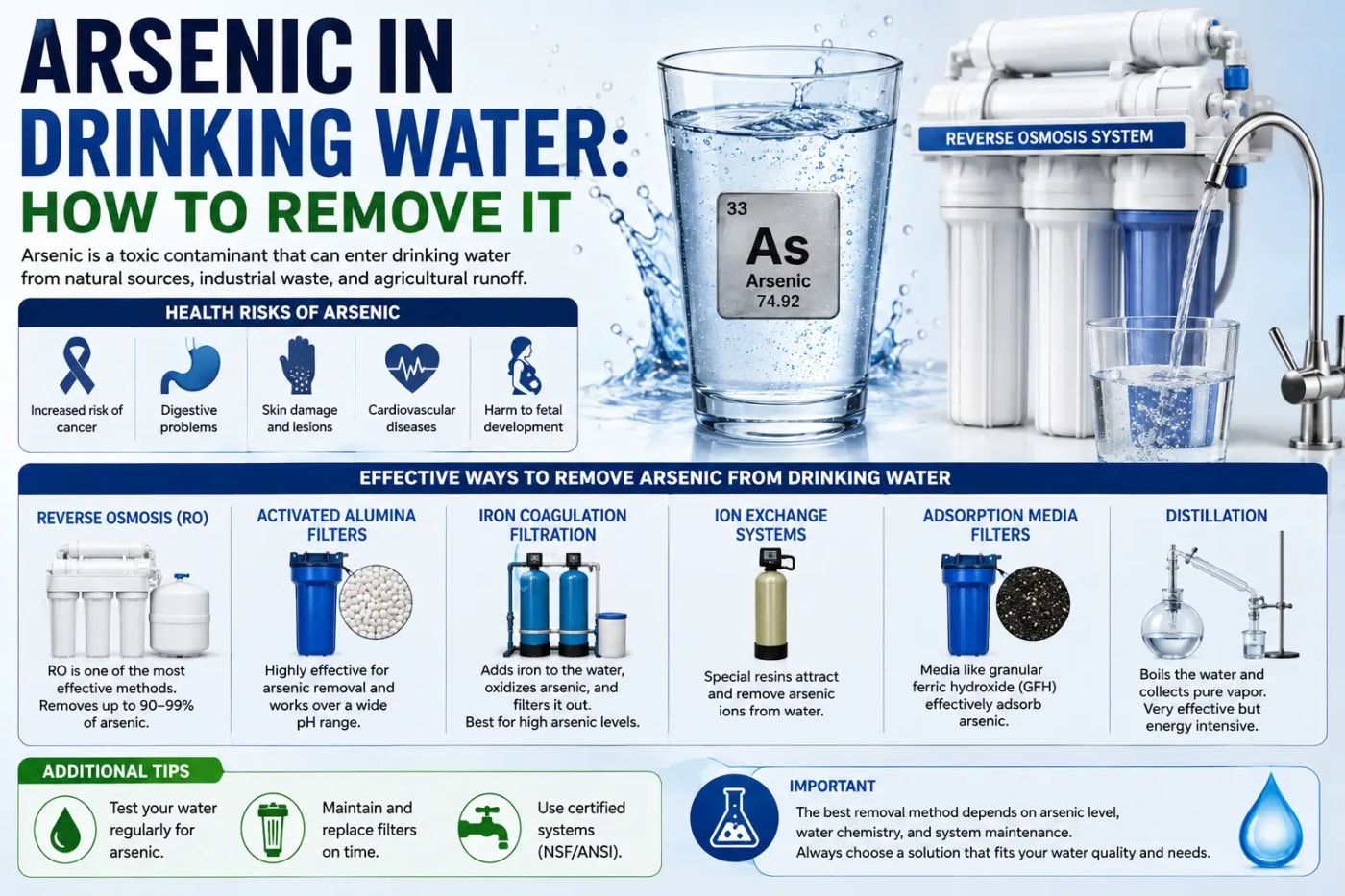
Arsenic in drinking water is removed through several treatment approaches, and the right choice depends on the arsenic concentration, the arsenic form present, the water chemistry, source-water conditions, and where the treatment needs to happen in the home. There is no single universal best method, since performance varies from one water supply to another. The major treatment families include membrane treatment, ion exchange, adsorptive media, oxidation combined with filtration, coagulation with filtration, and distillation. In this article, you will learn where arsenic comes from, how it is tested, which factors affect removal, how each major treatment method works, and how to verify that your treatment is actually working.
What causes arsenic to occur in drinking water?
Arsenic occurs in drinking water mainly because it is naturally present in rocks, minerals, soil, and groundwater, though certain human activities can also add arsenic to water sources. Groundwater and private wells are more commonly affected by naturally occurring arsenic than treated public supplies, since public systems are regularly monitored and treated under regulation.
Common sources of arsenic in drinking water:
Natural rock and mineral deposits: Arsenic-bearing minerals in bedrock can dissolve into groundwater over time.
Soil erosion and geology: Certain soil types release arsenic into water as it moves through the ground.
Mining activity: Past or current mining operations can disturb arsenic-containing rock and soil.
Smelting operations: Metal smelting processes can release arsenic into surrounding air, soil, and water.
Historical pesticide use: Older arsenic-based pesticides, no longer in common use, left residual contamination in some agricultural areas.
Industrial activity: Certain industrial processes have historically contributed arsenic to local water sources.
Private well owners face a different situation from customers of public water systems, since a private well is not automatically tested or treated unless the owner arranges it directly.
Which forms of arsenic need to be removed from drinking water?
The forms of arsenic that need to be removed from drinking water are the two inorganic species relevant to treatment, arsenite, known as As(III), and arsenate, known as As(V). Inorganic arsenic is distinct from organic arsenic, and it is the inorganic forms that drinking-water treatment is designed to address.
The table below compares the two forms relevant to treatment:
Form | Chemical name | Charge or behavior | Relative treatment difficulty | Treatment implication |
As(III) | Arsenite | Generally uncharged in typical water conditions | More difficult to remove directly | Often needs oxidation before effective removal |
As(V) | Arsenate | Negatively charged in typical water conditions | Easier to remove with standard technologies | Responds well to adsorption, ion exchange, and coagulation |
Understanding which form is present in a specific water supply is a key part of choosing the right treatment approach, since a method that works well on arsenate may perform poorly on arsenite without an added pretreatment step.
How much arsenic in drinking water requires treatment?
Arsenic in drinking water requires treatment under federal regulation once it exceeds the EPA's public drinking-water maximum contaminant level of 10 micrograms per liter, also expressed as 10 parts per billion. This limit applies specifically to regulated public water systems.
The table below shows this threshold in both common units:
Unit | Regulatory limit |
Micrograms per liter (µg/L) | 10 |
Parts per billion (ppb) | 10 |
Private well owners are not covered by this public system requirement, and they are responsible for testing and treating their own water if needed. It is also important not to treat 10 ppb as a line where anything below it is automatically risk-free. This number represents a regulatory standard for public systems, not a scientific guarantee that lower concentrations carry zero risk.
How should drinking water be tested for arsenic before treatment?
Drinking water should be tested for arsenic before treatment through certified laboratory analysis, since arsenic cannot be identified by taste, smell, or appearance. Relying on the senses alone will never reveal whether arsenic is present.
Testing generally follows these steps:
Collect a water sample: Follow the instructions provided by an accredited or certified laboratory for proper sample collection.
Send the sample for laboratory analysis: A certified lab measures total arsenic concentration using validated analytical methods.
Review the reported concentration: Compare the result against the relevant threshold, such as the 10 µg/L public-water standard, to understand the scale of the issue.
Determine if further testing is needed: If treatment selection depends on knowing the specific arsenic form or broader water chemistry, additional speciation or water chemistry testing may be arranged.
Using an accredited or certified laboratory, rather than a general consumer test strip, gives a far more reliable basis for choosing the right treatment system.
Which factors determine how effectively arsenic can be removed?
The factors that determine how effectively arsenic can be removed include the arsenic concentration, the arsenic form present, pH, sulfate, silica, iron, manganese, turbidity, competing contaminants, and the treated-water target the household is trying to reach. Treatment performance is highly water-specific, so a method that works well in one home may perform differently in another.
Key factors and their treatment implications:
Arsenic concentration: Higher starting concentrations often require more robust or combined treatment approaches.
As(III) versus As(V): Arsenite generally needs oxidation before many treatment methods work effectively.
pH level: Water pH affects how well certain adsorptive media and coagulation processes perform.
Sulfate levels: High sulfate can compete with arsenic for space on ion exchange resin, reducing effective capacity.
Silica levels: Elevated silica can interfere with adsorptive media performance.
Iron and manganese: These minerals can affect certain adsorption and filtration processes, sometimes positively and sometimes negatively depending on the system.
Turbidity: Cloudy or particle-laden water can reduce the efficiency of membrane and filtration-based systems.
Competing contaminants: Other dissolved substances can reduce the effective capacity of resins and adsorptive media.
Because these factors interact, professional water testing and, in some cases, professional treatment design guidance are valuable before committing to a specific system.
How does reverse osmosis remove arsenic from drinking water?
Reverse osmosis removes arsenic from drinking water by pushing water through a fine membrane that rejects dissolved arsenic along with many other dissolved substances. It is one evaluated treatment pathway among several, not a universal answer for every situation.
Reverse osmosis is commonly applied at the point of use, such as under a kitchen sink, rather than treating all water entering a home. Membrane performance can be affected by source-water characteristics, including arsenic form and other dissolved substances present, so treated-water performance should always be verified through testing rather than assumed based on the system alone.
How does ion exchange remove arsenic from drinking water?
Ion exchange removes arsenic from drinking water using a resin that specifically targets negatively charged particles, which makes it particularly effective against arsenate, the negatively charged inorganic form. Water passes through resin beads that capture arsenate ions in exchange for other ions, such as chloride.
Resin capacity is a key operating consideration, since competing ions like sulfate can reduce how much arsenic the resin can capture before it needs regeneration. Residual management, meaning proper handling of the regeneration wastewater, is also part of operating this type of system correctly.
How do adsorptive media remove arsenic from drinking water?
Adsorptive media remove arsenic from drinking water by allowing arsenic to physically attach to the surface of specialized filtering material. The two most recognized categories are activated alumina and iron-based media, such as granular ferric oxide or ferric hydroxide.
The table below compares these adsorptive media types:
Media type | Mechanism | Relevant arsenic form | Key operating consideration |
Activated alumina | Arsenic adsorbs onto an aluminum-based surface | Effective mainly against arsenate | Performance is sensitive to water pH |
Iron-based media (granular ferric oxide/hydroxide) | Arsenic adsorbs onto an iron-based surface | Effective against arsenate, often used alongside oxidation for arsenite | Media exhaustion requires replacement over time |
Both media types have a finite capacity and eventually become exhausted, at which point they require replacement or, in some system designs, regeneration. Proper disposal of spent media is also part of responsible system operation.
When does oxidation improve arsenic removal?
Oxidation improves arsenic removal when arsenite, the harder-to-remove form, is present, since oxidation converts arsenite into arsenate, which downstream treatment methods handle far more effectively. This step functions as a pretreatment stage rather than a stand-alone removal method.
Common oxidants used for this purpose include chlorine and other appropriate oxidizing agents, applied at a level sufficient to convert the arsenic form without turning the process into a general disinfection strategy. Since arsenate is generally removed more effectively by the major treatment technologies, oxidation becomes an important step whenever arsenite makes up a significant portion of the arsenic present in the source water.
How do coagulation and filtration remove arsenic from drinking water?
Coagulation and filtration remove arsenic from drinking water by chemically converting dissolved arsenic into a solid form that can then be captured through filtration. Ferric or alum-based coagulants are commonly used to trigger this conversion at a conceptual level.
Once arsenic is converted into a particulate form, filtration captures it along with other solids, and the resulting residuals require proper handling and disposal. This approach is generally applied as a centralized or engineered treatment method, more common in larger systems than as a typical default household filter.
How does distillation remove arsenic from drinking water?
Distillation removes arsenic from drinking water through evaporation and condensation, since arsenic does not evaporate along with water vapor and instead remains behind in the original container. The condensed water collected afterward is left largely free of arsenic.
Distillation is generally a point-of-use method rather than a whole-house solution, since it processes water slowly and requires meaningful energy input. Its production rate is limited compared to methods like membrane or media-based treatment, which makes it more practical for drinking and cooking water needs than for an entire household's water supply.
Which common water treatment methods do not reliably remove arsenic?
Common water treatment methods that do not reliably remove arsenic include boiling, conventional activated carbon used alone, standard water softeners, and ordinary sediment filtration. Each of these is often mistaken for an arsenic solution, but each has a specific limitation.
The table below explains why each method falls short for arsenic specifically:
Method | Why people use it | Arsenic limitation |
Boiling | Commonly believed to purify water generally | Concentrates arsenic rather than removing it, since only water evaporates |
Conventional activated carbon alone | Widely used for taste, odor, and chlorine reduction | Not designed to reliably capture dissolved arsenic |
Standard water softener | Used to address calcium and magnesium hardness | Targets different minerals entirely and is not built for arsenic removal |
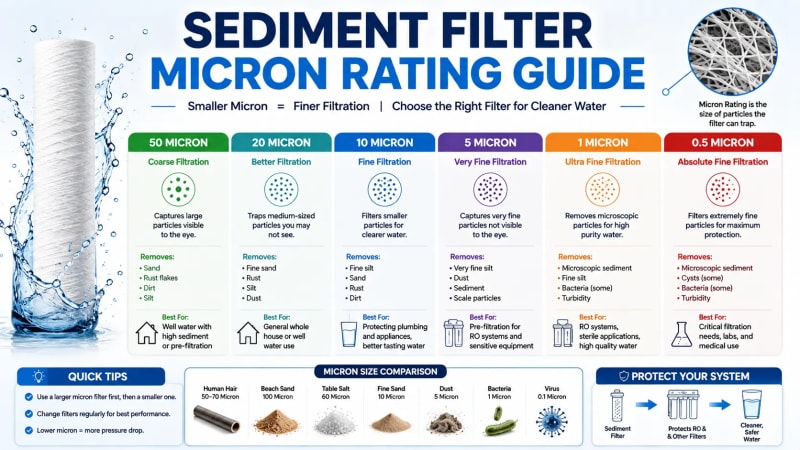
Ordinary sediment filtration | Removes visible particles and cloudiness | Arsenic is typically dissolved, not particulate, so sediment filters pass it through |
This does not mean every specialty or arsenic-specific adsorptive media system is ineffective. Arsenic-specific adsorptive media, discussed earlier in this article, are a distinct category built specifically to target arsenic and should not be confused with general-purpose household filtration.
How should arsenic treatment be matched to point-of-use or whole-house needs?
Arsenic treatment should be matched to point-of-use or whole-house needs based on which water outlets actually require protection and how the household uses water day to day. Point-of-use treatment addresses a single tap, typically for drinking and cooking, while point-of-entry, or whole-house, treatment addresses all water entering the home.
The table below outlines a general decision framework:
Situation | Likely treatment scope | Reason | Verification requirement |
Concern is limited to drinking and cooking water | Point-of-use system at the kitchen tap | Reduces cost and complexity while addressing the main ingestion route | Test water at the treated tap regularly |
Arsenic levels are high across the entire water supply | Point-of-entry, whole-house system | Addresses arsenic exposure through all uses, not just drinking | Test both entry point and multiple household taps |
Water demand is high with multiple daily uses | System sized for household flow and demand | Undersized systems may not maintain consistent removal performance | Verify performance at expected flow rates, not just at rest |
There is no single universal setup that fits every household, and it is not accurate to claim that every home with arsenic-containing water must treat every single outlet. The right scope depends on the specific concentration, water use patterns, and household priorities.
How can treated water be verified after arsenic removal?
Treated water can be verified after arsenic removal by testing the water at the treated outlet and comparing that result against the original untreated concentration, rather than assuming a system works simply because it has been installed.
Verification generally follows these steps:
Test the treated outlet: Collect a sample specifically from the point where treated water comes out, not from an untreated tap.
Compare against the untreated baseline: Review the treated result alongside the original untreated concentration to confirm meaningful reduction.
Repeat testing periodically: Since media and membranes can lose effectiveness over time, ongoing periodic testing confirms the system is still performing.
Maintain service records: Keeping maintenance and replacement records helps track when media or membranes are due for replacement.
Review manufacturer performance claims and certification: Checking that a system carries relevant performance certification adds another layer of confidence in its expected capability.
Skipping verification is one of the most common reasons a household continues to be exposed to arsenic even after installing a treatment system, since a system that is not maintained or checked can quietly lose effectiveness.
What should be considered when choosing an arsenic removal system?
When choosing an arsenic removal system, the main factors to consider are the arsenic concentration, whether arsenite or arsenate predominates, pH and broader water chemistry, the intended treatment location, household flow and water demand, ongoing maintenance requirements, media or membrane replacement needs, residual handling, and system certification.
A compact decision checklist:
Arsenic concentration: Establishes how aggressive the treatment approach needs to be.
Arsenic form: Determines whether oxidation pretreatment is required.
Water chemistry: Factors like pH, sulfate, and silica affect media and resin performance.
Treatment location: Point-of-use versus whole-house treatment changes system scope and cost.
Flow and demand: System sizing must match actual household water use.
Maintenance requirements: Some systems need more frequent attention than others.
Replacement needs: Media and membranes eventually require replacement or regeneration.
Residual handling: Regeneration wastewater and spent media need proper disposal.
Certification: Verified performance certification adds confidence that a system meets a recognized standard.
Working through this checklist moves the decision from general awareness of arsenic toward a specific, informed system choice suited to the actual water conditions involved.
What should you do if arsenic remains above the target after treatment?
If arsenic remains above the target after treatment, the next step is to retest the treated water, inspect the treatment system's condition, and review whether the original water chemistry assumptions still hold. This is not a sign to look into an entirely different contaminant, since the issue is almost always related to how the existing arsenic treatment is performing.
Immediate steps to take:
Retest the treated water: Confirm the current concentration at the treated outlet.
Inspect media or membrane condition: Exhausted media or a degraded membrane is a common cause of reduced performance.
Review water chemistry changes: Shifts in pH, sulfate, or other factors can reduce treatment effectiveness over time.
Reassess treatment design: If the system was undersized or mismatched to the water conditions from the start, redesigning the approach may be necessary.
These steps naturally lead into the specific resources below, which cover individual methods and next steps in more depth.
Does reverse osmosis remove arsenic?
Reverse osmosis does remove arsenic, though actual performance depends on system design and the specific water conditions it is treating. For a complete breakdown of membrane performance, arsenic form considerations, pretreatment needs, and maintenance, see [Does Reverse Osmosis Remove Arsenic?].
How do you test well water for arsenic?
You test well water for arsenic by using an accredited or certified laboratory to establish the total arsenic concentration, and by considering arsenic speciation testing when it is needed for treatment selection. For the complete testing process, see [How to Test Well Water for Arsenic].
What is the safe arsenic level in drinking water?
The safe arsenic level in drinking water, as defined by federal regulation for public water systems, is the EPA maximum contaminant level of 10 micrograms per liter, or 10 parts per billion. This regulatory limit is distinct from the idea of zero risk. For a complete explanation of this standard, see [Safe Arsenic Level in Drinking Water].
Can you remove arsenic from well water without reverse osmosis?
You can remove arsenic from well water without reverse osmosis using alternatives such as adsorptive media, anion exchange, distillation, or other engineered treatment processes. For a full comparison of these alternatives, see [Arsenic Removal Methods Without Reverse Osmosis].
How do you remove arsenic from well water?
You remove arsenic from well water by testing first, identifying the specific arsenic conditions present, choosing a treatment technology suited to those conditions, installing and maintaining it correctly, and verifying the treated water afterward. For a complete step-by-step guide, see [How to Remove Arsenic from Well Water].
Conclusion
Removing arsenic from drinking water starts with understanding the specific conditions in your water, including the concentration, the arsenic form present, and the broader water chemistry. From there, the right treatment method, whether reverse osmosis, ion exchange, adsorptive media, oxidation with filtration, coagulation with filtration, or distillation, depends on matching the technology to those specific conditions rather than assuming one universal solution works everywhere. Testing before treatment and verifying after treatment are both essential steps, since a system that is installed but never checked can quietly stop protecting your water over time.