Tap water is treated drinking water that has traveled through several distinct stages before it reaches your faucet. It starts as source water, either from a surface source or underground, passes through a treatment plant that removes particles, microorganisms, and selected contaminants, and then moves through a distribution system into your home. This article explains where tap water comes from, how a utility turns raw source water into drinking water, why disinfectant residuals remain in it, what normal tap water actually contains, and how quality can change between the treatment plant and the faucet.
What Makes Tap Water Different From Source Water?
Tap water is different from source water because tap water has already passed through a full treatment and distribution process, while source water is the raw, untreated water a utility starts with.Source water is the natural water a utility draws from, such as a river, lake, or aquifer. Finished drinking water is what remains after treatment processes have addressed particles, microorganisms, and selected contaminants. Tap water is that finished water after it has also traveled through the distribution system and household plumbing to reach the faucet.
The table below compares these three states:
State | Description |
Source water | Raw, untreated water drawn from a natural source |
Finished drinking water | Water that has completed treatment at the plant |
Tap water | Finished water after distribution and household plumbing, as it exits the faucet |
Where Does Tap Water Originally Come From?
Tap water originally comes from one of two primary source categories: surface water or groundwater.
Surface water includes rivers, lakes, and reservoirs, where water collects above ground and is drawn directly for treatment. Groundwater comes from aquifers, underground layers of rock or sediment that hold water accumulated over time, accessed through wells. The characteristics of each source, including turbidity, mineral content, and microbial risk, directly influence which treatment steps a utility needs to apply.
How Does a Water Utility Turn Source Water Into Drinking Water?
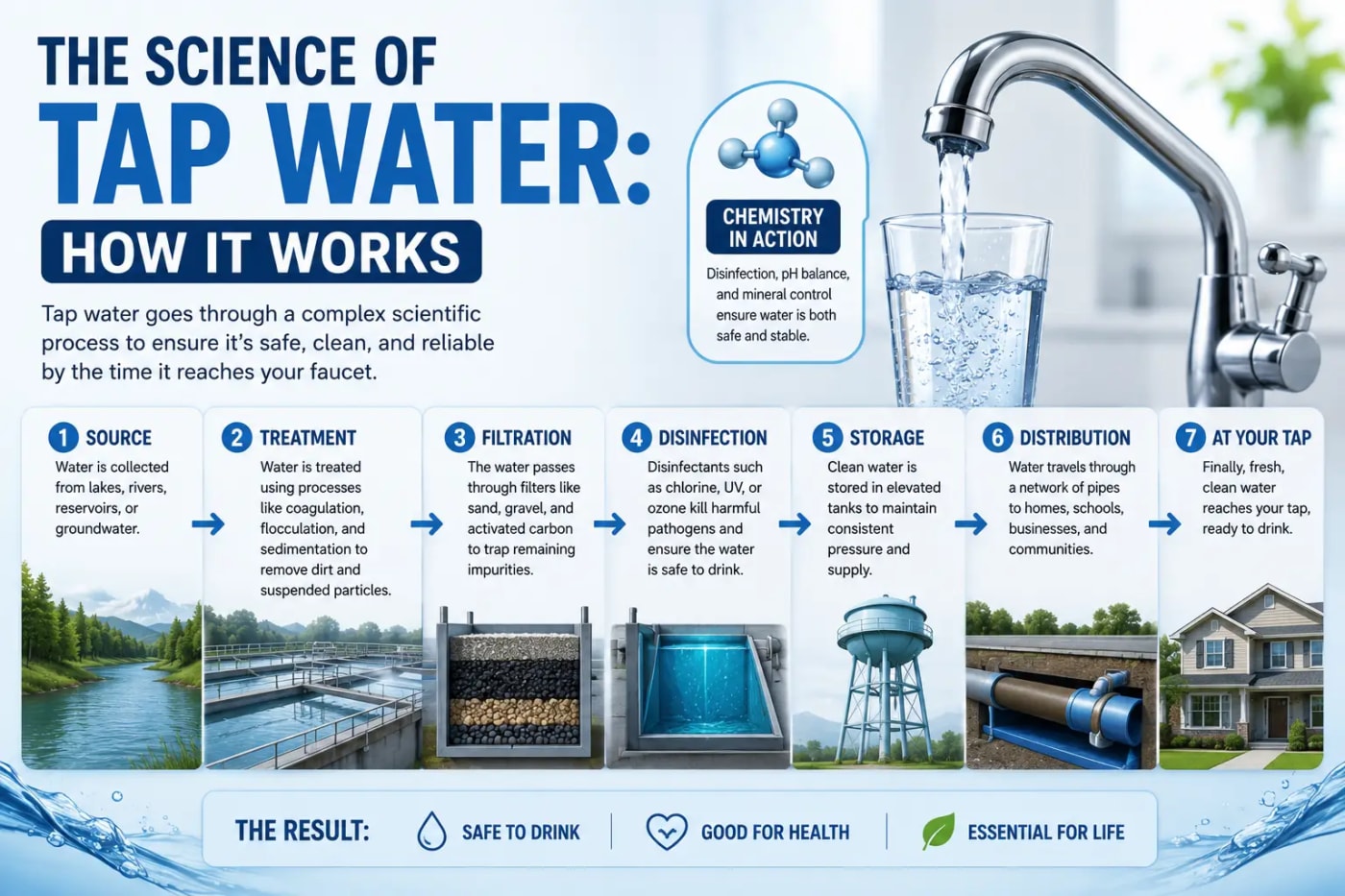
A water utility turns source water into drinking water through a sequence of treatment stages, often called a treatment train, that each address a different part of water quality.
The typical treatment sequence follows these steps:
Coagulation: Chemicals are added to destabilize the charge on small suspended particles, allowing them to clump together.
Flocculation: Gentle mixing encourages the destabilized particles to form larger clumps, called floc.
Sedimentation: The heavier floc settles out of the water under gravity, while clarified water continues forward.
Filtration: Water passes through a physical media bed that removes remaining suspended particles.
Disinfection: A disinfectant, such as chlorine or chloramine, or a method like UV treatment, inactivates remaining microorganisms.
Not every utility uses this exact sequence, since the specific stages depend on the source water and the contaminants present in it.
What Does Each Drinking-Water Treatment Stage Remove or Change?
Each drinking-water treatment stage removes or changes a specific part of water quality, and the table below breaks down that relationship directly.
The table below shows what each treatment stage targets and how it changes the water:
Treatment Stage | Target | Resulting Change |
Coagulation and flocculation | Small suspended and colloidal particles | Particles clump into larger, removable floc |
Sedimentation | Settled floc | Heavier material separates from the water by gravity |
Filtration | Remaining suspended particles and turbidity | Water becomes visibly clearer |
Disinfection | Microorganisms, including bacteria and viruses | Pathogens are inactivated, reducing microbial risk |
Some utilities add further steps, such as adsorption through activated carbon or ion exchange, when the source water contains specific dissolved contaminants that the main treatment train does not address.
Why Does Disinfected Tap Water Contain Chlorine or Chloramine?
Disinfected tap water contains chlorine or chloramine because a residual disinfectant is intentionally maintained through the distribution system to control microbial growth after the water leaves the treatment plant.
This residual is different from a contaminant that enters water accidentally, since it is deliberately added and monitored by the utility as part of the treatment process. As water travels through miles of distribution pipes before reaching a home, the residual disinfectant helps prevent microbial regrowth along the way. A chlorine-related taste or odor is a known consequence of this practice, not a sign that something has gone wrong with the water.
What Substances Normally Remain in Treated Tap Water?
Treated tap water normally contains water itself along with a set of naturally occurring and treatment-related substances that remain after the treatment process is complete.
Substances commonly present in finished tap water:
Dissolved minerals: Naturally occurring substances from the source water, such as calcium and magnesium.
Fluoride: Added in many water systems as part of a public health practice, where applicable.
Disinfectant residuals: Chlorine or chloramine maintained through the distribution system.
These substances are distinct from contamination. Naturally occurring minerals reflect the geology of the source water, while fluoride and disinfectant residuals are intentionally managed by the utility as part of normal treatment practice.
How Do Minerals Affect the Chemistry of Tap Water?
Minerals affect the chemistry of tap water by contributing dissolved constituents such as calcium, magnesium, sodium, chloride, and sulfate, largely determined by the geology of the source water.
Groundwater passing through mineral-rich rock formations often picks up higher concentrations of calcium and magnesium than surface water does. This mineral content is what determines water hardness, a chemical property of the water rather than a contamination category. Hardness affects how water interacts with soap, how it tastes, and whether it contributes to scale buildup in pipes and appliances, but it is a separate topic from contaminants like lead or PFAS.
What Do pH, Hardness, TDS, and Turbidity Reveal About Tap Water?
pH, hardness, TDS, and turbidity each reveal a different measurable characteristic of tap water, and together they help describe its chemistry without individually confirming overall safety.
The table below explains what each parameter measures:
Parameter | What It Measures |
pH | The acidity or alkalinity of the water on a numeric scale |
Hardness | The concentration of dissolved calcium and magnesium |
TDS (Total Dissolved Solids) | The combined weight of all dissolved minerals and substances in the water |
Turbidity | The cloudiness of water caused by suspended particles |
None of these measurements alone establishes whether water is safe to drink. They describe specific chemical or physical characteristics, and a full safety assessment requires looking at these parameters alongside specific contaminant testing.
Which Contaminants Can Occur in Tap Water?
Contaminants that can occur in tap water fall into several broad categories, though the presence of any single contaminant does not automatically mean a health risk exists.
Broad contaminant categories found in drinking water:
Microbial contaminants: Bacteria, viruses, and protozoan cysts.
Inorganic contaminants: Substances such as lead, copper, and arsenic.
Organic contaminants: Substances such as certain pesticides and industrial chemicals.
Radiological contaminants: Naturally occurring or human-made radioactive substances.
Emerging contaminants: Substances such as PFAS and disinfection byproducts, which are subject to increasing monitoring attention.
Not every tap water source contains all of these. The specific contaminants present depend on the source water, the local treatment process, and the condition of the distribution and plumbing system.
How Can Contaminants Reach the Tap After Treatment?
Contaminants can reach the tap after treatment through the distribution and plumbing pathway that water travels through after leaving the treatment plant.
Common post-treatment pathways for contamination:
Distribution pipes and service lines: Aging infrastructure can introduce contaminants, particularly metals from older pipe materials.
Household plumbing: Pipes, fixtures, and solder inside a home can affect water quality between the meter and the tap.
Corrosion: Chemical reactions between water and pipe materials can release metals such as lead or copper into the water.
Leaks: Breaks in the distribution system can allow contaminants to enter the water supply.
Cross-connections and back-siphonage: Improper plumbing connections can allow non-potable water to enter the drinking water system under certain conditions.
This is why water quality measured at the treatment plant can differ from water quality measured at a household tap, since conditions along the distribution and plumbing pathway can change the water after it leaves the plant.
Why Can Tap Water Taste, Smell, or Look Different?
Tap water can taste, smell, or look different because of several sensory characteristics that are separate from health-risk assessment.
The table below connects common sensory characteristics to possible causes:
Characteristic | Possible Cause |
Chlorine-like taste or smell | Disinfectant residual maintained through the distribution system |
Metallic taste | Dissolved minerals or metals such as iron picked up from pipes |
Musty or earthy smell | Certain naturally occurring compounds in the source water |
Cloudy appearance | Turbidity from suspended particles or trapped air bubbles |
Yellow or brown tinge | Iron or manganese, often from source water or aging pipes |
These sensory characteristics do not by themselves indicate whether water is unsafe. They simply reflect specific chemical or physical conditions present in the water at that time.
How Does Public Tap Water Differ From Private Well Water?
Public tap water differs from private well water mainly in who is responsible for treatment, monitoring, and testing.
Public tap water comes from a regulated water system, where the utility is responsible for treatment, ongoing monitoring, and reporting water quality to customers. Private well water comes from a source the homeowner manages directly, and it falls outside the regulatory framework that covers public water systems. This means well owners carry the responsibility for testing their own water and deciding on any necessary treatment, since no utility is monitoring it on their behalf.
How Is Tap-Water Quality Monitored and Reported?
Tap-water quality is monitored and reported through a regulatory framework that requires public water systems to test their water and share the results with customers.
Public water suppliers in the United States provide an annual water-quality report, often called a Consumer Confidence Report. This report describes which contaminants were detected during testing and at what levels, measured against established drinking-water standards. It gives customers a documented picture of what their local utility found in the water supply, rather than requiring each household to test independently.
How Does Water Quality Change From the Treatment Plant to the Faucet?
Water quality changes from the treatment plant to the faucet because the final characteristics of tap water are shaped by several combined factors beyond the treatment process itself.
Finished water leaving the treatment plant reflects the source water and the specific treatment stages applied to it. From there, the distribution system, the condition of household plumbing, and the time water spends sitting in pipes before use, known as residence time, can all further change the water before it reaches the tap. This is why two homes served by the same treatment plant can still experience different water quality at their own faucets.
How Can You Determine What Is in Your Tap Water?
You can determine what is in your tap water through two main sources of evidence: your local Consumer Confidence Report and appropriately selected water testing.
The Consumer Confidence Report from your public water supplier shows what the utility detected at the treatment and distribution level. Water testing at your own tap can reveal what has changed by the time water reaches your home, particularly for concerns related to household plumbing. The correct test to run depends on the specific contaminant or condition you suspect, since no single test covers every possible substance.
Is Tap Water Safe to Drink?
Whether tap water is safe to drink depends on the specific water system, the contaminant levels detected, the treatment applied, and the condition of household plumbing, so the answer varies by location rather than being universal. For a complete explanation, see: Is Tap Water Safe to Drink?
What Contaminants Are Commonly Found in Tap Water?
Contaminants commonly found in tap water include microbial organisms, inorganic substances such as lead and arsenic, organic chemicals, and emerging concerns such as PFAS, though not every source contains all of these. For a full breakdown of contaminant categories and examples, see: Common Tap Water Contaminants.
How Can You Test Tap Water at Home?
You can test tap water at home by selecting a test that matches the specific contaminant you suspect, and using a certified laboratory for reliable results. For a complete testing guide, see: How to Test Tap Water.
What Do Water Filters Remove From Tap Water?
Water filters remove from tap water whatever their specific technology and certified reduction claim actually cover, since performance varies significantly by product. For a detailed breakdown by filter type, see: What Do Water Filters Remove?
How Does Tap Water Compare With Bottled Water?
Tap water compares with bottled water across several factors, including source, regulatory oversight, treatment process, packaging, and cost and environmental impact. For a complete comparison, see: Tap Water vs Bottled Water.
What Causes Hard Water in a Home?
Hard water in a home is caused primarily by dissolved calcium and magnesium in the water supply, which can lead to scaling on pipes, fixtures, and appliances over time. For a complete explanation of causes and treatment, see: Hard Water: Causes, Effects and Treatment.
Why Does Tap Water Taste Like Chlorine?
Tap water tastes like chlorine because of the disinfectant residual that utilities maintain through the distribution system to control microbial growth. For a complete explanation and treatment options, see: Chlorine in Tap Water.
What Is PFAS in Drinking Water?
PFAS in drinking water is a class of human-made chemicals that has drawn increasing monitoring attention due to its persistence in the environment and potential presence in water supplies. For a complete explanation of PFAS regulation and treatment methods, see: PFAS in Drinking Water.
Conclusion
Tap water is the end result of a long scientific and engineering process that begins at a natural source and ends at your faucet. Along the way, treatment stages remove particles and microorganisms, a residual disinfectant protects the water through distribution, and natural minerals along with treatment-related substances remain in the finished product. Water quality can still shift between the treatment plant and the tap, shaped by distribution infrastructure, household plumbing, and time spent in transit. Reviewing your local water-quality report and testing your own tap when needed gives you the clearest picture of what is actually flowing from your faucet.