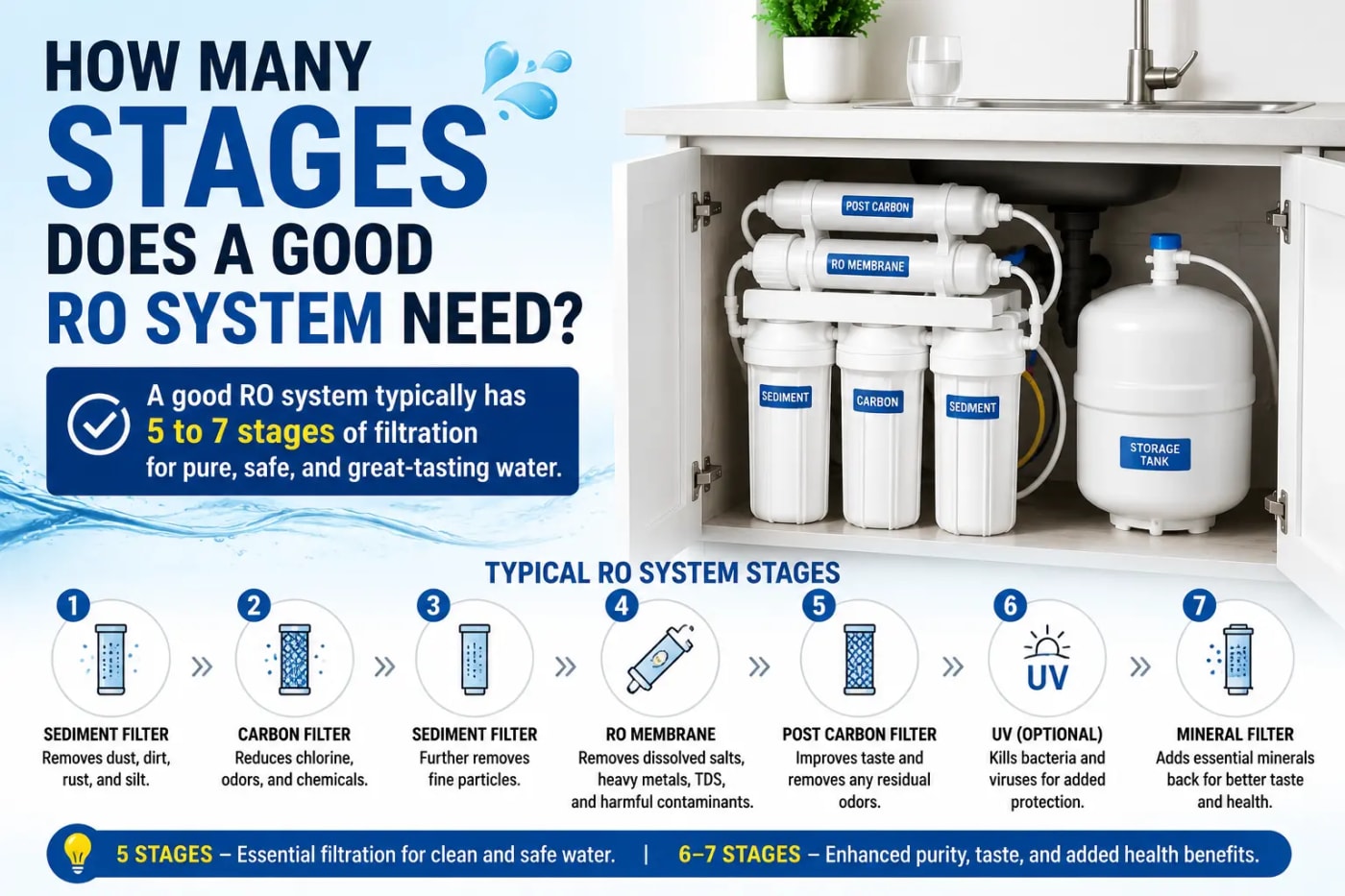
Reverse osmosis, or RO, systems come with different stage counts. Some have four stages. Others have five, six, or even seven. Many buyers assume that more stages always mean cleaner water. That is not the full picture.
A residential RO system needs enough stages to protect the membrane, remove the right contaminants, and give clean, good-tasting water. The exact number depends on the source water, the contaminants present, and the treatment goals of the household. This article explains what each stage does, how manufacturers count stages differently, and how to judge a system by function rather than by number alone. It also covers when extra stages such as remineralization or UV actually add value, and what to check before buying a system.
What Determines How Many RO Stages a Home Actually Needs?
The right stage count depends on the water a home starts with and the goals of the people using it. Two homes with different tap water can need different setups, even if both use reverse osmosis.
Decision factors that shape stage count:
Source-water quality: Municipal water and private well water often carry different contaminants and require different pre-treatment.
Specific contaminants: Chlorine, chloramine, lead, arsenic, nitrate, and other substances each call for a matching filter type.
Hardness level: Hard water with high mineral content can shorten membrane life without proper pre-filtration.
Microbial concerns: Wells and untreated sources may carry bacteria or other microorganisms that plain RO filtration does not fully address.
Desired taste: Some households want a neutral taste, while others prefer added minerals for a fuller taste.
Treatment goals: A household chasing a specific certification claim, such as arsenic reduction, needs a system built and tested for that claim.
These factors, not the number printed on the box, decide what a system should include.
Which Treatment Functions Make Up a Standard Residential RO System?
Most home RO systems, no matter how many stages they advertise, share a core treatment sequence. This sequence protects the RO membrane and polishes the final water.
The table below shows the core treatment functions found in a standard residential RO system:
Stage | Function | Role in the system |
Sediment pre-filter | Removes dirt, rust, and sand particles | Protects later filters and the membrane from clogging |
Carbon pre-filter | Removes chlorine, chloramine, and odors | Prevents chlorine damage to the RO membrane |
RO membrane | Removes dissolved solids and many contaminants | Central component of the whole system |
Post-filter | Polishes taste right before the water reaches the tap | Improves final taste and removes trace odors |
The RO membrane sits at the center of this sequence. Pre-filters exist to protect it, and post-filtration exists to refine what comes out after it. Manufacturers do not all count stages the same way. One brand may count a single carbon block as one stage, while another splits pre-filtration into two separate counted stages for the same job. This is a major reason stage numbers vary across brands even when the actual treatment is similar. Organizations such as APEC Water and NSF describe this core sequence as the foundation of residential RO treatment.
When Does a Fifth Stage Add Useful Filtration?
A common residential configuration uses five stages. In most cases, the fifth stage is an extra carbon or polishing filter placed after the membrane. Its job is to remove any remaining taste or odor before the water reaches the faucet.
Some manufacturers use the fifth stage differently and add a remineralization cartridge instead of a second polishing filter. These are two different purposes, so buyers should check exactly what the fifth stage does in a specific system rather than assuming it works the same way across brands. Fresh Water Systems and APEC both publish verified five-stage configurations that show this difference clearly.
Typical fifth-stage options:
Extra carbon polishing: Improves taste and removes any lingering odor after the membrane stage.
Remineralization cartridge: Adds calcium and magnesium back into the water for taste and mineral content.
When Does a Remineralization Stage Make Sense?
Reverse osmosis removes most dissolved minerals along with contaminants. This can leave water tasting flat to some people. A remineralization stage adds calcium and magnesium, or in some systems an alkaline mineral blend, back into the water after the RO membrane has done its job.
This stage exists for taste and mineral content, not for contaminant removal. It does not make the RO membrane work harder or better. It simply adjusts the finished water after treatment is already complete. In community discussions, such as threads on Reddit about home water systems, many users describe adding a remineralization stage specifically because they preferred the taste of mineral-added water over plain RO output. That real-world preference lines up with how the stage is designed to work.
When Does a UV Stage Justify an Additional RO Stage?
Ultraviolet, or UV, treatment is a separate technology from reverse osmosis. It uses UV light to disable bacteria and other microorganisms. Some systems add a UV stage as one of their counted stages, which is one reason systems with six or seven stages exist.
UV becomes genuinely relevant in specific situations rather than as a default addition for every home.
Situations where a UV stage may be worth adding:
Private well water: Wells are more exposed to bacterial contamination than treated municipal supplies.
Known microbial issues: A water test showing bacteria present is a direct reason to add UV treatment.
No consistent municipal disinfection: Some private or shared water systems do not treat water the same way a municipal utility does.
Not every system that advertises seven stages uses UV the same way, or places it at the same point in the treatment sequence. Water treatment specialists, including companies such as Water Fixers of DFW, note that UV configuration differs by manufacturer, so buyers should confirm exactly how a specific system applies UV rather than assuming a fixed standard.
When Are Extra Carbon, DI, or Specialty Stages Worth Adding?
Beyond the core sequence, remineralization, and UV, some systems include additional carbon blocks, deionization (DI) resin, or other specialty media. These stages exist outside the common residential core and should have a clear treatment purpose.
Common additional stage types:
Extra carbon stages: Added for households especially sensitive to taste or odor, often when source water has strong chlorine or chloramine levels.
DI resin stages: Used when extremely low dissolved solids are needed, such as for certain aquariums or specialty uses.
Specialty media stages: Target specific concerns, such as added filtration for particular metals when source-water testing shows a need.
A stage only earns its place when it solves a defined problem. Adding a stage purely to raise the number on a product label does not improve water quality.
How Should Source Water Change the RO Stage Configuration?
The earlier section on decision factors identifies what to consider. This section explains how those factors turn into actual configuration choices.
Municipal water and private well water usually need different treatment emphasis. Municipal supplies are treated at the source, so the biggest concerns at the tap are often chlorine, chloramine, and general taste. Private well water has no central treatment step, so pre-filtration and microbial protection often matter more.
The table below compares general configuration priorities for municipal water versus private well water:
Water source | Common priority | Typical configuration emphasis |
Municipal water | Chlorine and chloramine reduction, taste | Strong carbon pre-filtration, standard RO membrane |
Private well water | Sediment, hardness, microbial safety | Extra sediment filtration, possible UV stage, hardness-related pre-treatment |
Guidance from agricultural and water-treatment resources, including material from Agriculture and Agri-Food Canada, supports the general principle that source-water conditions can require additional pre-treatment before reverse osmosis. The right configuration always follows a water test, not a guess.
What Changes When Chlorine, Chloramine, Hardness, or Microbial Concerns Are Present?
Each of these conditions affects the system in a different way, so they should not be treated as one blended problem.
How specific conditions affect treatment needs:
Chlorine: Standard carbon pre-filtration usually handles chlorine well and protects the membrane from damage.
Chloramine: Chloramine is more resistant to removal than chlorine and may need a carbon filter designed specifically for chloramine reduction.
Hardness: High mineral hardness can scale the membrane over time, so some systems add a water softener or scale-inhibitor stage before the RO membrane.
Microbial concerns: Bacteria and similar organisms call for UV treatment or another disinfection method, since standard RO filtration alone is not designed as the primary microbial barrier in every system.
No single stage count solves every one of these conditions equally well. The right answer depends on which condition, or combination of conditions, is present in the water.
Does a Higher RO Stage Count Mean Better Water Filtration?
This is the central question behind most stage-count confusion, and the direct answer is no. A higher stage count does not automatically mean better purification.
A 4-stage system with a well-performing membrane can outperform a 7-stage system on core contaminant reduction, because the extra stages in the 7-stage system may be remineralization, UV, or additional carbon rather than additional RO filtration power. The actual purification work happens mainly at the RO membrane. Everything before it protects the membrane, and everything after it either polishes taste or adds a separate treatment function like disinfection.
The table below compares what extra stages commonly represent:
Extra stage type | What it actually does | Effect on core contaminant removal |
Extra carbon polishing | Improves taste and odor | Minimal added contaminant removal |
Remineralization | Adds minerals back after RO | No added contaminant removal |
UV disinfection | Targets bacteria and microorganisms | Adds microbial protection, not membrane filtration |
Extra sediment/pre-filter | Protects the membrane | Indirectly supports RO performance |
Water treatment resources such as The Water Hub, along with many buyer discussions in water-treatment communities, consistently point to this same distinction. The number on the box describes stage count, not filtration strength.
How Should 4-, 5-, 6-, and 7-Stage RO Systems Be Compared?
Rather than ranking these by number, it helps to compare what each configuration typically adds on top of the last one.
The table below compares common RO system configurations by what they add and when each makes sense:
Stage count | Typical configuration | Primary purpose | When it makes sense | What the extra stage adds |
4-stage | Sediment, carbon, RO membrane, post-filter | Core filtration and taste polishing | Clean municipal water with basic taste concerns | N/A, this is the base configuration |
5-stage | 4-stage core plus one more stage | Extra polishing or remineralization | Households wanting improved taste or added minerals | Second carbon polish or mineral cartridge |
6-stage | 5-stage core plus one more stage | Added disinfection or specialty treatment | Well water or specific contaminant concerns | UV disinfection or additional specialty media |
7-stage | 6-stage core plus one more stage | Combined taste, mineral, and disinfection treatment | Households wanting multiple added functions together | Combination of remineralization, UV, or extra carbon |
Configurations vary across brands, so this table shows common patterns rather than a fixed rule that every manufacturer follows. Sources such as WaterVerge and other verified product documentation show this same general progression: core filtration first, then polishing, then conditioning, then specialized treatment.
What Matters More Than the Number of RO Stages?
Stage count is only one detail. Several other attributes matter more when judging real system quality.
Attributes worth checking beyond stage count:
NSF/ANSI 58 certification: This is the recognized standard for RO systems and covers total dissolved solids reduction along with optional contaminant claims.
Specific contaminant-reduction claims: A system should list the exact contaminants it is tested to reduce, not just a general purity claim.
Membrane performance: Membrane quality affects rejection rate and long-term consistency more than stage count does.
Source-water compatibility: A system should match the actual water it will treat, based on test results.
Efficiency and recovery rate: This describes how much treated water the system produces compared to water sent to drain.
GPD (gallons per day) rating: This affects whether the system can keep up with household demand.
Pressure requirements: Some systems need a minimum water pressure to perform properly.
Maintenance needs: Filter and membrane replacement schedules affect long-term cost and performance.
NSF/ANSI 58 is the authoritative reference point for certification and contaminant-reduction claims, and checking a system against this standard tells a buyer far more than counting stages does.
How Should You Choose the Right RO Stage Configuration?
Choosing a configuration works best as a step-by-step process rather than a single decision based on a number.
Steps to choose the right configuration:
Test the source water: Identify what is actually in the water before choosing any filtration stages.
Identify the contaminants present: Match specific contaminants, such as chlorine, lead, or nitrate, to filters tested for those contaminants.
Confirm the core RO treatment: Make sure the system includes proper sediment filtration, carbon filtration, an RO membrane, and post-filtration.
Decide if taste conditioning is needed: Add remineralization only if the household prefers mineral-added taste.
Decide if UV or specialty treatment is needed: Add UV mainly for well water or confirmed microbial concerns, and add specialty media only for a specific identified need.
Verify certification and performance: Check NSF/ANSI 58 certification and the exact tested claims before buying.
Following this order keeps the decision based on actual water conditions and real treatment needs, rather than on which box lists the highest stage number.
What Should You Check Before Buying a Reverse Osmosis System?
Stage count is the starting point, not the finish line. Before buying, a household should also look closely at certification, contaminant claims, water pressure needs, system capacity, maintenance schedule, and ongoing operating cost. These factors decide how well a system performs over time and how much it will cost to keep running. The sections below introduce a few closely related questions that come up right after the stage-count decision, with links to more detailed answers.
What Is Reverse Osmosis and How Does It Work?
Reverse osmosis is a filtration process that pushes feed water through a semi-permeable membrane. The membrane allows water molecules through while blocking many dissolved solids and contaminants. This separates the incoming water into two streams: product water, which is the clean water sent to the tap, and reject water, which carries away the blocked material. For a full explanation of the process, see [Reverse Osmosis: How It Works].
What Contaminants Does Reverse Osmosis Remove?
The exact contaminants an RO system reduces depend on the specific system and its tested claims. Systems with verified NSF/ANSI 58 certification may list reduction claims for substances such as total dissolved solids, lead, arsenic, fluoride, or nitrate and nitrite, but only where testing supports that claim. For the full breakdown, see [What Does Reverse Osmosis Remove?].
How Often Should RO Filters and Membranes Be Replaced?
Replacement intervals differ by component, by manufacturer, and by how much the source water demands from each filter. Sediment and carbon filters typically need more frequent replacement than the RO membrane itself. Manufacturer instructions should always take priority over general guidelines. For general replacement guidance, see [How Often to Change RO Filters].
How Much Water Does a Reverse Osmosis System Waste?
RO systems send some water to drain as part of the separation process, and efficiency varies by system design and recovery rate. This is recognized as a relevant performance factor under NSF/ANSI 58. For detailed ratios and efficiency comparisons, see [How Much Water Does Reverse Osmosis Waste?].
What Is the Difference Between Tank and Tankless RO Systems?
Tank systems store finished water in a pressurized tank so it is ready on demand. Tankless systems produce water as needed, without a storage tank. This is a separate design choice from stage count and should be evaluated on its own terms. For a full comparison, see [Tank vs Tankless Reverse Osmosis Systems].
What Is NSF/ANSI 58 for Reverse Osmosis Systems?
NSF/ANSI 58 is the recognized certification standard for reverse osmosis drinking water systems. It covers total dissolved solids reduction and allows for optional additional contaminant-reduction claims when a system is specifically tested for them. Buyers should check the exact certified claims listed for a system rather than relying on general certification language alone. For the full standard explanation, see [NSF/ANSI 58 Reverse Osmosis Certification].
Conclusion
Stage count alone does not decide how well an RO system performs. What matters is whether each stage has a clear purpose that matches the actual source water and the household's treatment goals. A well-matched 4-stage system can serve a home better than a 7-stage system loaded with stages that do not address the water's real problems. The best approach is to test the water, identify real contaminant and taste concerns, confirm a solid core treatment sequence, and only then decide whether remineralization, UV, or specialty stages are worth adding. Checking certification and tested claims matters more than counting stages on the box.