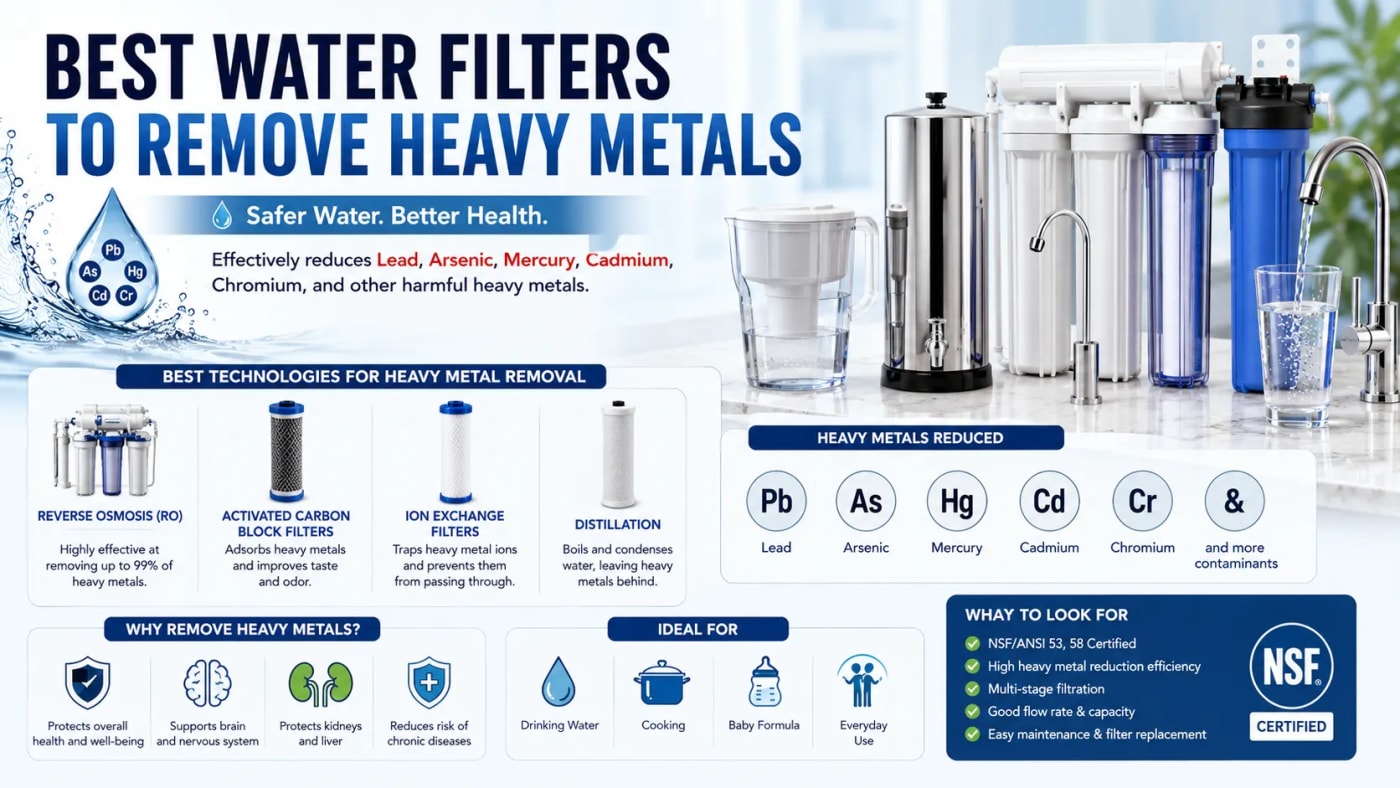
The best water filters to remove heavy metals depend on the specific metal involved, the filtration technology used, and whether independent certification backs the claim.
Heavy metal filtration is not a single feature. Performance changes based on contaminant type, filtration technology, certification and testing, water source, installation type, maintenance, and operating cost. This page compares five specific products, reverse osmosis systems, a filtered pitcher, and a pitcher with ion exchange technology, across these same factors. Each product suits a different scenario, from lead in old plumbing to arsenic in well water to renters who cannot install anything permanent. The sections below give a fast comparison first, then a full review of each product, then a decision guide matched to specific water problems.
Which water filters are strongest for different heavy-metal removal needs?
The strongest water filters for heavy metal removal vary by product, since each one uses a different technology and carries different certification for specific metals.
Below is a table that compares all five products across the attributes that matter most for heavy metal removal.
Product | System Type | Filtration Technology | Lead Capability | Arsenic Capability | Certification | Installation |
Waterdrop G3P800 | Tankless reverse osmosis | RO membrane plus UV stage | Independent testing reports complete removal | Independent testing reports complete removal | NSF/ANSI 58 and 372 | Under sink, needs drain and power |
APEC ROES-50 | Reverse osmosis with storage tank | 5-stage RO, 50 GPD | Independent testing reports full reduction | Addressed through RO membrane stage | WQA certified | Under sink, needs drain and storage tank space |
iSpring RCC7AK | Reverse osmosis with remineralization | 6-stage RO plus alkaline stage | Addressed through RO membrane stage | Addressed through RO membrane stage, verify with lab testing | Listed under NSF/ANSI 58 | Under sink, needs drain and storage tank space |
Filtered Water Pitcher | Gravity fed pitcher | Affinity filtration | Manufacturer states lead reduction target | Manufacturer states arsenic reduction target | Certification and independent testing reported separately | Portable, no installation |
Culligan 10 Cup Pitcher with ZeroWater Technology | Gravity fed pitcher with TDS meter | 5-stage ion exchange filtration | NSF/ANSI 53 reduction figures listed for lead | Not a primary listed target, verify current data | IAPMO certified | Portable, no installation |
Certification applies to specific contaminant claims tested under specific conditions. It does not mean any single product removes every possible heavy metal in every water source.
What should you verify before choosing a heavy-metal water filter?
Before choosing a heavy metal water filter, a buyer needs to verify actual water test results, the specific contaminants present, and whether independent certification backs the product's claims.
Criteria to check before choosing a heavy metal water filter:
Water test results: Know which metals are actually present before buying anything
Specific contaminants: Match the filter to the exact metal found, since not every filter targets every metal
Concentration: Higher contaminant levels may need a technology with stronger reduction evidence
Filtration technology: Reverse osmosis, ion exchange, and adsorptive media all work differently
Certification: Check the exact NSF/ANSI standard or other certification body tied to the claim
Independent testing: Look for lab results beyond the manufacturer's own marketing claims
Installation type: Confirm whether the system needs under sink plumbing, power, and drain access, or needs nothing at all
Filter capacity: Check how many gallons or months the filter lasts before replacement
Replacement cost: Calculate the ongoing cost of maintaining the system over a full year
Point of use: Confirm whether the system treats one faucet, one pitcher, or the entire home
The US EPA recommends independently certified filters specifically for lead reduction, since certification confirms tested performance rather than relying on marketing language alone.
Which heavy-metal filter is most appropriate for lead-contaminated drinking water?
The most appropriate filters for lead contaminated drinking water are the products with independently verified lead reduction evidence, rather than the products relying on marketing claims alone.
Below is a short comparison of the lead reduction evidence across the strongest candidates.
Product | Lead Reduction Evidence |
Waterdrop G3P800 | Independent testing reported complete removal in test water |
APEC ROES-50 | Independent testing reported full reduction across tested heavy metals |
Culligan 10 Cup Pitcher with ZeroWater Technology | Certified reduction figures listed under NSF/ANSI 53 |
The US EPA specifically recommends independently certified products for lead reduction, since certification confirms tested performance under defined conditions rather than relying only on a manufacturer's own claims.
Which heavy-metal filter is more suitable for arsenic in well water?
The most suitable filters for arsenic in well water are reverse osmosis systems, since the membrane technology addresses a wide range of dissolved arsenic forms.The US EPA identifies reverse osmosis, ion exchange, and adsorptive media as recognized treatment approaches for arsenic. Arsenic exists in different chemical forms, known as speciation, and not every technology handles every form equally well. Testing the specific well water for arsenic type and concentration remains the necessary first step before choosing a treatment method, since a general assumption about arsenic removal does not replace an actual water test result.
Which heavy-metal filter works best when the user cannot install an under-sink system?
The heavy metal filters that work best without under sink installation are the two pitcher options, since both need no plumbing connection at all.The Filtered Water Pitcher and the Culligan 10 Cup Pitcher with ZeroWater Technology both sit on a counter or in a refrigerator, using gravity to filter water with no installation of any kind. Online discussions among renters show this is a common priority, since permanent plumbing changes are often restricted or impractical in rented housing. Portability, capacity per fill, and filter replacement frequency become the deciding factors between the two pitcher options rather than installation type, since neither needs installation.
Which heavy-metal filter is better for high daily drinking and cooking demand?
The heavy metal filters better suited for high daily drinking and cooking demand are the reverse osmosis systems with a storage tank or high production rate, rather than the pitcher options.
Capacity comparison for high demand households:
Waterdrop G3P800: 800 gallons per day production, tankless design delivers water on demand
APEC ROES-50: 50 gallons per day production, with a storage tank holding finished water for immediate use
iSpring RCC7AK: 75 gallons per day production, with a storage tank plus remineralization
Filtered Water Pitcher: 80 ounces per fill, requiring manual refilling for higher volume needs
Culligan 10 Cup Pitcher: 80 ounces per fill, also requiring manual refilling for higher volume needs
A household using large volumes of filtered water daily, for drinking, cooking, and refilling multiple containers, generally gets more practical value from an under sink RO system than from a pitcher that needs frequent manual refilling.
What should you do after choosing a heavy-metal water filter?
After choosing a heavy metal water filter, the next step is confirming the choice against an actual water test, the correct installation point, and a clear maintenance schedule.Selecting a product is only the first part of solving a heavy metal problem. The filter needs to match the specific contaminant and concentration found in an actual water test, get installed at the correct point in the home, whether that is one faucet or the whole house, and follow a maintenance schedule that keeps its performance at the certified level over time.
How should you test drinking water before relying on a heavy-metal filter?
Drinking water needs to be tested before relying on a heavy metal filter, since testing identifies the exact contaminant and concentration that the filter needs to address.Certification and performance data tell a buyer what a filter is designed to reduce, but only an actual water test confirms what is present in a specific home's water supply. For arsenic specifically, understanding the exact chemical form, known as speciation, can affect which treatment method performs best. A dedicated water testing guide explains how to get an accurate test and how to read the results.
How often should you replace a water filter?
A water filter needs replacement based on its rated gallons, its rated time period, and the actual water conditions it has been treating, whichever limit comes first.An expired filter can become less effective at reducing contaminants, including lead, even if water still flows through it normally. The US EPA specifically advises following the manufacturer's replacement instructions rather than guessing based on appearance or taste alone. A dedicated maintenance guide covers replacement schedules for different filter types.
What is the difference between reverse osmosis and activated carbon filtration?
The difference between reverse osmosis and activated carbon filtration is the treatment method. Reverse osmosis uses a membrane to block dissolved particles, while activated carbon uses adsorption to trap contaminants on its surface.Reverse osmosis generally reduces a broader range of heavy metals and dissolved solids, while removing beneficial minerals along with contaminants unless a remineralization stage is added. Activated carbon excels at chlorine, taste, and odor reduction, but it does not reduce dissolved metals the way a membrane does. A dedicated comparison guide covers this difference in full detail.
Can water filters remove arsenic, lead and other heavy metals?
Water filters can remove arsenic, lead, and other heavy metals, but only when the specific product carries verified certification or independent testing for that exact metal.A general claim that a filter removes heavy metals does not confirm which specific metals it addresses or at what concentration. A dedicated heavy metals education page explains the underlying chemistry and the treatment methods proven effective for each metal.
When should you choose whole-house filtration instead of a drinking-water filter?
Whole house filtration should be chosen instead of a drinking water filter when the concern involves water used at every tap in the home, not only water used for drinking and cooking.An under sink reverse osmosis system treats water at one faucet only. It does not automatically address water coming from a shower, a bathroom sink, or an outdoor tap. Online discussions show this exact confusion is common, with some users assuming an under sink system protects the whole home. A dedicated whole house filtration guide explains when this broader coverage becomes necessary.