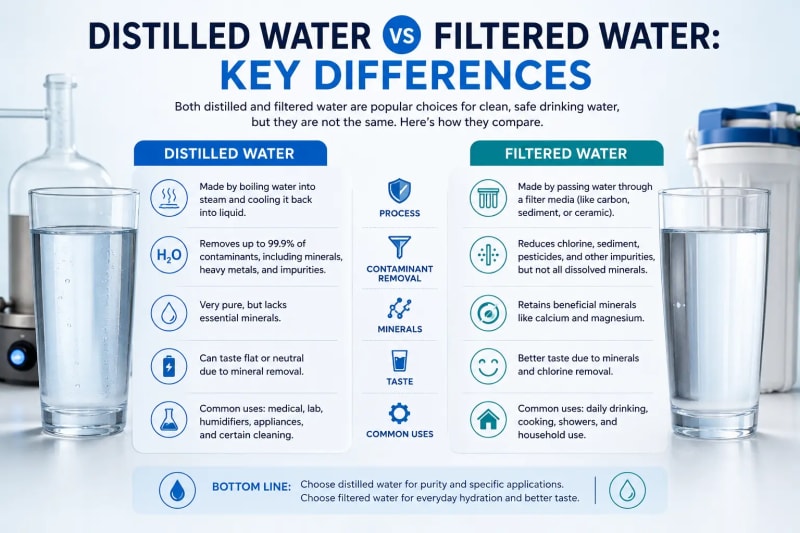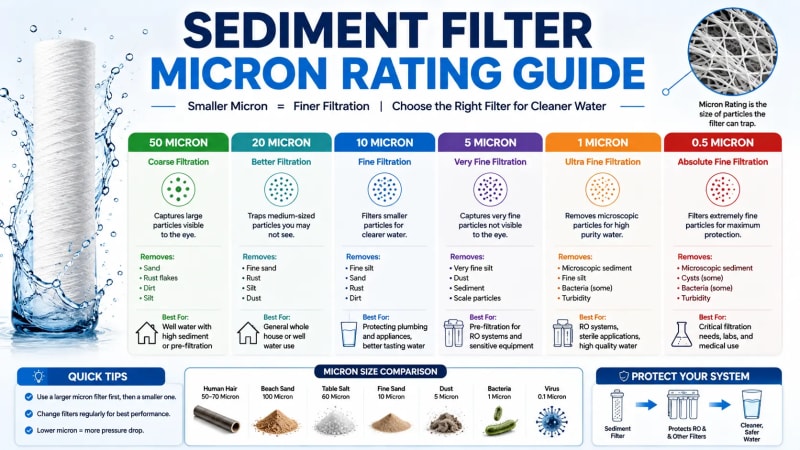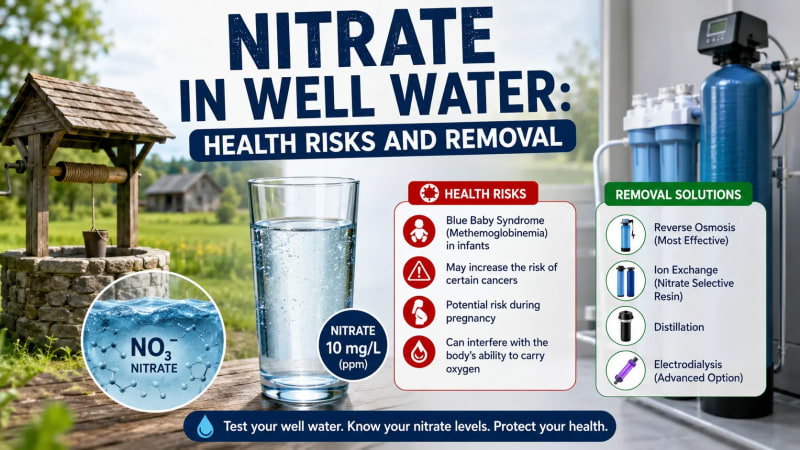
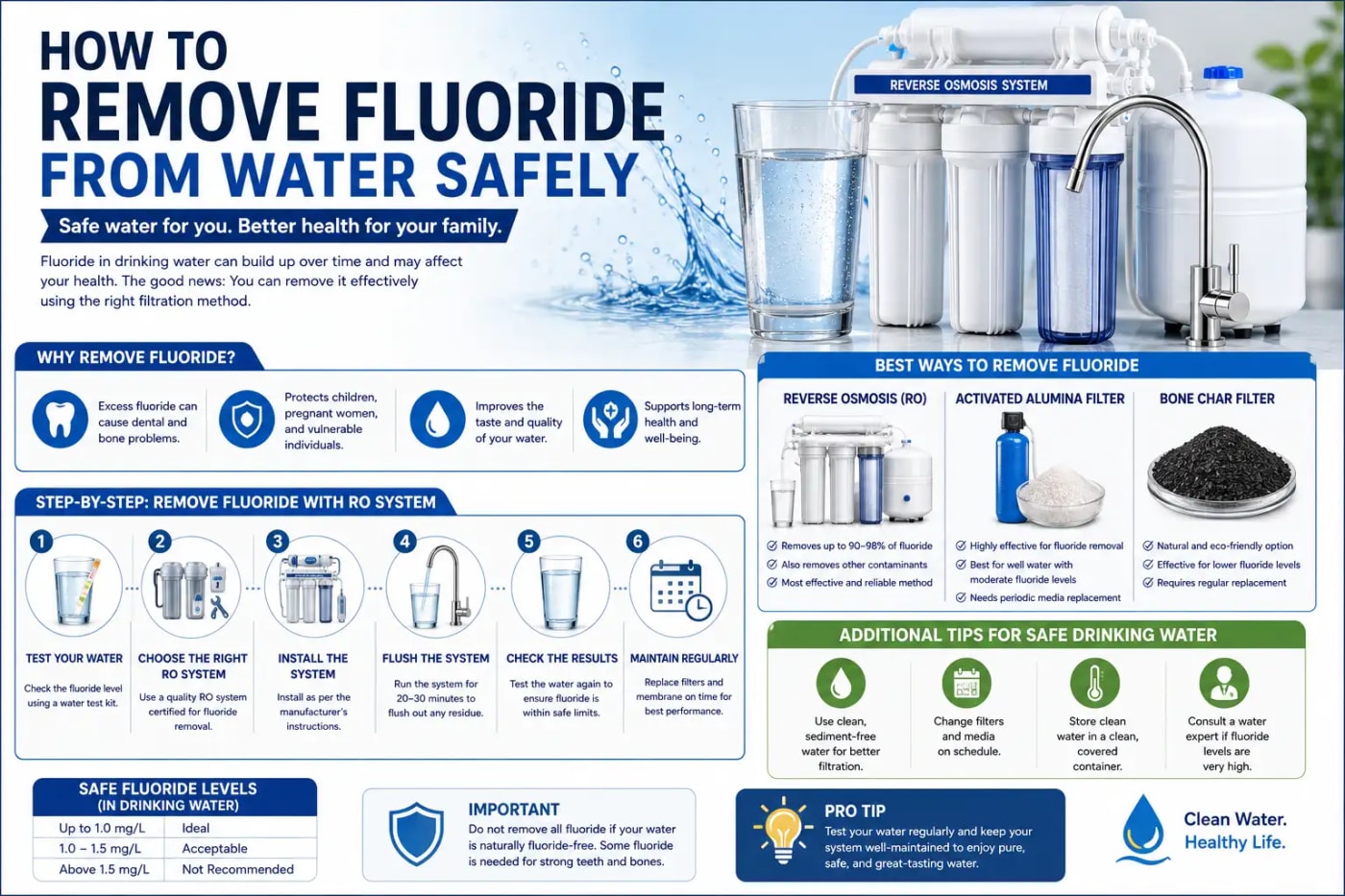
Reverse osmosis, activated alumina, distillation, appropriately selected ion exchange, and bone char can reduce fluoride in water, but their effectiveness depends on the equipment and operating conditions. Fluoride occurs as a dissolved ion, so a filter that catches sediment or improves chlorine taste may leave it largely unchanged. [1–4]
Start with a fluoride measurement, then choose treatment with evidence for your water conditions and daily drinking-water needs. A renter may need a countertop unit; a household with suitable plumbing may prefer an under-sink system. Neither situation automatically calls for whole-house treatment.
The most useful evidence combines an exact-model fluoride-reduction claim with testing of the treated water. This guide explains the methods, their limitations, and the checks to make before buying. WaterFilterWay provides research-based guidance using public-health sources, certification information, and published research; we have not personally tested the equipment discussed here.
Method | Mechanism | Typical setup | Main limitation | What to verify |
Reverse osmosis | Membrane separation | Under-sink or countertop | Pressure requirements and reject water | Exact-model fluoride claim |
Activated alumina | Adsorption onto media | Cartridge or engineered vessel | Chemistry and finite capacity | Feed limits and fluoride capacity |
Distillation | Evaporation and condensate collection | Countertop batch unit | Energy use and production time | Fluoride performance documentation |
Specialized ion exchange | Selected resin binds or exchanges ions | Purpose-designed cartridge or bed | Competing ions and servicing | Resin-specific fluoride evidence |
Bone char | Calcium-phosphate media captures fluoride | Specialty cartridge or media bed | Variable media quality and exhaustion | Complete-device performance and capacity |
What Is Fluoride in Drinking Water and When Is Treatment Necessary
Fluoride is a dissolved, negatively charged ion, written F−, that can occur naturally in water or be added through community fluoridation. Natural concentrations depend partly on the minerals and geology the water encounters. Treatment decisions should begin with the measured concentration and applicable public-health guidance, rather than the presence of fluoride alone. [5]
U.S. reference level | Meaning | What it does not mean |
0.7 mg/L | U.S. Public Health Service recommended community fluoridation concentration, as reported by CDC. [6] | It is not the federal maximum contaminant limit. |
2.0 mg/L | EPA secondary standard addressing dental fluorosis; federal notification requirements apply to exceedances. [7] | It is not the same as the enforceable primary limit. |
4.0 mg/L | EPA enforceable primary maximum contaminant level for public water systems. [8] | It is not a treatment target or an assurance about every other contaminant. |
For dilute drinking water, mg/L and parts per million are approximately equivalent. These figures serve different purposes and should not be treated as interchangeable definitions of “safe water.” EPA is reviewing fluoride; an assessment or proposed change does not itself replace a published drinking-water standard. The values above reflect the official sources checked for this guide. [8,9]
If testing identifies elevated fluoride, ask your utility or local public-health department what action applies. CDC advises contacting public health when water contains 4.0 mg/L or more. Choosing to reduce fluoride in otherwise compliant water is a separate personal preference; it does not establish that all fluoridated water requires treatment. [5]
How Should You Test Fluoride in Tap or Well Water
Municipal-water users should start with their utility’s Consumer Confidence Report; private-well users should arrange a fluoride-specific laboratory test. EPA provides contacts for state certification programs and certified drinking-water laboratories. A utility report cannot establish the concentration in an individual private well. [10]
CDC’s My Water’s Fluoride can help identify a participating public system’s fluoridation information. Its data are not real-time, participation is voluntary, and coverage is incomplete. If the record is missing or old, contact the utility rather than assuming fluoride is absent. [11]
1. Identify your source. Record the utility name or well location and the date of the available water analysis.
2. Choose a suitable laboratory. Ask whether it performs drinking-water fluoride analysis and whether its reporting limit suits the concentration you need to measure.
3. Follow the sampling instructions. Obtain the correct bottle and directions for collection, storage, and delivery from the laboratory.
4. Keep the complete result. Record fluoride in mg/L, the sample point, collection date, and any reporting limit.
5. Assess treatment constraints. Discuss pH, hardness, and other relevant contaminants with the laboratory or treatment provider before selecting equipment.
Retain the baseline result for comparison with treated water. Neither clear water nor an acceptable taste establishes a fluoride concentration, and a general TDS reading cannot substitute for fluoride analysis. [12]
Which Water Treatment Methods Actually Remove Fluoride
Reverse osmosis, activated alumina, distillation, selected ion-exchange media, and bone char can reduce fluoride through different mechanisms. Evidence for a technology is a starting point; it is not proof that every cartridge or appliance using it performs equally. [1–4]
Reverse osmosis uses pressure to move water through a membrane while rejecting some dissolved substances. Household units supply treated water and a separate reject stream; choose a model with documented fluoride performance. [13]
Activated alumina captures fluoride on a porous treatment medium through adsorption. Its effectiveness depends on water chemistry and the amount of usable media; replacement or professionally managed regeneration is necessary when capacity is exhausted. [2]
Distillation boils water, cools the vapor, and collects the condensate separately. Fluoride reduction occurs through that separation process, not by drinking the water left in the boiling chamber. Batch production and electricity demand matter when comparing countertop units. [1,13]
Specialized ion exchange requires media selected for fluoride and the actual feed water. Ordinary anion-exchange resins may perform poorly when competing ions dominate, so a generic “ion exchange” label is insufficient. [1]
Bone char contains bone-derived calcium-phosphate material that can capture fluoride. Published experiments demonstrate its potential, but preparation, media properties, and operating conditions affect results; those studies do not certify a retail filter. Its animal origin may also matter to buyers. [3,4]
For each option, ask what happens at the end of its service life. A fresh-media demonstration is less useful than evidence showing performance across the rated volume or replacement interval. Do not transfer removal percentages from another model to the product you plan to install.
Method | Volume to assess | Maintenance to budget | Evidence to request |
RO | Daily output and peak draw | Pre-filters, membrane, sanitation | Fluoride claim and operating limits |
Activated alumina | Rated volume at your feed concentration | Media replacement or servicing | Capacity and breakthrough information |
Distillation | Liters per batch and cycle time | Descaling and collection-vessel cleaning | Finished-water fluoride results |
Selective exchange | Flow and resin capacity | Cartridge change or specialist service | Performance with competing ions |
Bone char | Media volume and contact time | Scheduled replacement and sanitation | Whole-device testing through service life |
How Do pH Pressure and Dissolved Ions Affect Fluoride Removal
Fluoride reduction depends on the treatment mechanism and the conditions under which it operates. A useful performance claim specifies the feed water, flow, and equipment condition rather than offering one percentage for every installation.
Method | Conditions that matter | Practical check |
RO | Pressure, temperature, membrane condition, scaling and feed chemistry | Compare your supply with the manual’s operating limits. |
Activated alumina | pH, competing substances, contact time and remaining capacity | Ask for capacity at your water chemistry. |
Selective exchange | Resin selectivity, competing ions and exhaustion | Request evidence relevant to the water analysis. |
Bone char | Media properties, pH, flow and contact conditions | Confirm rated flow and replacement criteria. |
Distillation | Correct operation, vapor collection and cleanliness | Use the complete appliance as instructed. |
Adsorption means substances attach to available sites on a medium. Once too many sites are occupied, fluoride can begin appearing in the treated water: this is breakthrough. pH and other dissolved ions can change how well a medium captures fluoride, so a capacity measured under one set of conditions may not apply elsewhere. [2,14]
For RO, mineral deposits or other fouling can interfere with the membrane. A system operating outside its specified pressure or temperature range may also produce less water than its advertised rating. Pretreatment should address an identified feed-water problem, not simply add more stages. [15,24]
Ask the supplier how your laboratory results affect selection and servicing. There is no universal optimum pH or pressure for all five methods, and adjusting water chemistry at home without a designed treatment process is not an appropriate shortcut.
Which Fluoride Filter Configurations Work for Different Homes
Point-of-use treatment serves a drinking-water outlet, while point-of-entry treatment serves water entering the property. Decide which water needs treatment before comparing equipment capacity. [16]
An under-sink RO system can serve drinking and cooking needs without treating every household tap. Check cabinet space, drain access, faucet installation, and clearance for cartridge changes. A storage tank’s nominal capacity is not necessarily its usable water volume.
Countertop RO can suit renters or kitchens with crowded cabinets. Some models use refillable feed tanks; others connect to a faucet. Check power requirements and the filling, draining, and cleaning routine rather than assuming every countertop appliance works the same way.
Specialty gravity filters and cartridge units can offer another configuration, but gravity is only the way water moves. Their media must have a specific fluoride-reduction claim, a rated capacity, and suitable evidence. [1–4]
Whole-house treatment needs sizing for simultaneous household demand and a plan for service access and waste handling. Fluoride in drinking water alone does not automatically justify whole-house RO. CDC states that fluoride is not absorbed through skin in the usual bathing context; treatment for drinking and cooking can therefore address a different scope from treatment for every tap. [5]
Before ordering, confirm rental permissions and measure the proposed location. Include space for hoses, containers, filter changes, and routine cleaning, not just the appliance footprint.
How Much Does Fluoride Removal Cost to Operate and Maintain
The ownership cost is the purchase price plus installation, replacements, energy, water use, servicing, and fluoride verification. Compare those expenses for your actual drinking-and-cooking volume instead of choosing the lowest advertised appliance price.
System | Recurring expenses | Useful question before buying |
RO | Pre-filters, membrane, reject water; power on some models | What are current replacement prices and the stated water ratio? |
Activated alumina or bone char | Media, cartridge housing service and testing | How much water is rated for fluoride reduction under relevant conditions? |
Distiller | Electricity, descaling, cleaning; optional polishing filters | What is energy use per completed batch? |
Selective exchange | Resin or cartridge replacement; regeneration where applicable | Is specialist servicing required, and what does it include? |
For a cartridge, divide its replacement cost by the gallons supported by its fluoride-specific capacity. Do not automatically use a larger chlorine-treatment capacity printed elsewhere on the label. For a distiller, multiply electricity used per batch by your utility rate and expected number of batches. Treat estimates as assumptions until supported by specifications or measurements.
Read RO ratios in the stated direction. A 3:1 drain-to-treated ratio means three gallons discharged for one gallon collected; a 3:1 treated-to-drain ratio means the reverse. At two gallons of treated water daily, the first example uses eight gallons of feed water daily. This is an illustrative calculation, not a rating for a particular product. EPA’s WaterSense listings express efficiency as a waste-to-treated ratio. [17]
Include laboratory testing in the budget and obtain replacement-part prices before purchase. There is no defensible fixed annual cost without the model, water conditions, local utility rates, and maintenance schedule.
Which Popular Home Methods Do Not Remove Fluoride
Ordinary boiling, leaving water standing, sediment filtration, and standard activated-carbon filtration do not reliably remove dissolved fluoride. Boiling without collecting the condensate leaves fluoride behind; evaporation can increase its concentration in the remaining water. [18]
Method or claim | Reality | Better next step |
Boil and cool tap water | Does not separate fluoride from the water you retain | Use a purpose-designed treatment process. |
Leave water standing | Not a reliable fluoride-reduction process | Choose a documented fluoride claim. |
Use a sediment cartridge | Particle capture does not establish dissolved-ion removal | Check the exact contaminant list. |
Use an ordinary carbon pitcher or refrigerator filter | Taste improvement does not prove fluoride reduction | Look for fluoride-specific media and evidence. |
Choose a “natural” remedy | The label does not demonstrate safe, consistent treatment | Require suitable drinking-water performance evidence. |
Brita states that its conventional pitcher filters retain a healthy level of fluoride in fluoridated municipal water. Those products should not be selected specifically to remove fluoride. This does not mean every pitcher is incapable of fluoride reduction: a specialty pitcher can contain different treatment media. [19]
Similarly, a faucet filter or refrigerator cartridge should be judged by its exact documentation. The installation location does not determine what the media removes. If fluoride is absent from the supported claims, do not infer performance from the words “purified,” “premium,” or “multi-stage.”
Avoid improvised chemical dosing or unvalidated household substances. A method must produce usable drinking water consistently, not merely change a reading in a one-off experiment. Also follow any local boil-water advisory for microbial hazards; fluoride treatment and disinfection address different problems.
How Can You Verify That a Fluoride Filter Actually Works
Verify both the exact model’s documented fluoride capability and its performance on your household water. Certification describes evaluated claims; a properly collected treated-water sample tells you what the installed unit is delivering.
NSF/ANSI 58 requires a TDS-reduction claim for covered RO systems, but fluoride reduction is an optional claim. A reference to that standard alone does not establish fluoride certification. Search the NSF, WQA, or IAPMO directory for the complete model and listed fluoride claim. [20–23]
· Match the model and cartridge. Check suffixes, replacement-media identifiers, and any required configuration.
· Read the performance data sheet. Note fluoride challenge concentration, rated capacity, operating conditions, and replacement instructions.
· Distinguish evidence levels. Independent certification, a report saying “tested to” a standard, and an unsupported manufacturer claim are not equivalent.
· Test after commissioning. Follow flushing instructions, then collect feed and treated samples according to the laboratory’s protocol.
· Plan follow-up testing. Account for the rated service life, water-source changes, and any deterioration in treatment performance.
For example, a fall from 2.0 to 0.2 mg/L represents 90% reduction. A fall from 8.0 to 0.8 mg/L is also 90%, but the final concentration is different. These illustrative values show why the output concentration matters alongside the percentage.
A report stating “below detection” means below that method’s detection limit, not proven zero. Keep the test results and maintenance dates together so that a successful startup result is not mistaken for permanent protection.
Which Fluoride Removal Method Fits Your Water and Household
Choose a method by your measured fluoride level, required volume, installation limits, and ability to maintain it. The following profiles provide a practical shortlist rather than a universal product winner.
· Everyday drinking and cooking with suitable plumbing: shortlist under-sink RO models carrying an independently certified fluoride claim. Confirm feed pressure, cabinet clearance, and peak demand before comparing optional features.
· Renters or homes where plumbing changes are impractical: compare refillable countertop RO with specialty fluoride-reduction pitchers or gravity systems. Check the exact fluoride evidence, cartridge capacity, electrical needs, and daily refilling routine.
· Small volumes without permanent installation: consider a purpose-designed countertop distiller with documented fluoride performance. Make sure batch output, cooling time, cleaning, and electricity use fit your schedule.
· Fluoride-rich well water or several dissolved-water problems: obtain a broader water analysis and a treatment design appropriate to that chemistry. Pretreatment and system size should follow the results; whole-house treatment is warranted only when the actual treatment scope requires it.
If the first suitable option exceeds your budget, reduce the treatment scope before compromising the evidence: a verified drinking-water solution may be more practical than treating the entire property. Select the category, confirm the exact-model claim, and test the output before relying on it for an identified fluoride problem.