Water Filter Way
RoundupBuyer’s Guides

Best Activated Carbon Water Filters: Contaminant Reduction, Filtration Performance, Capacity, Maintenance, and Use Case

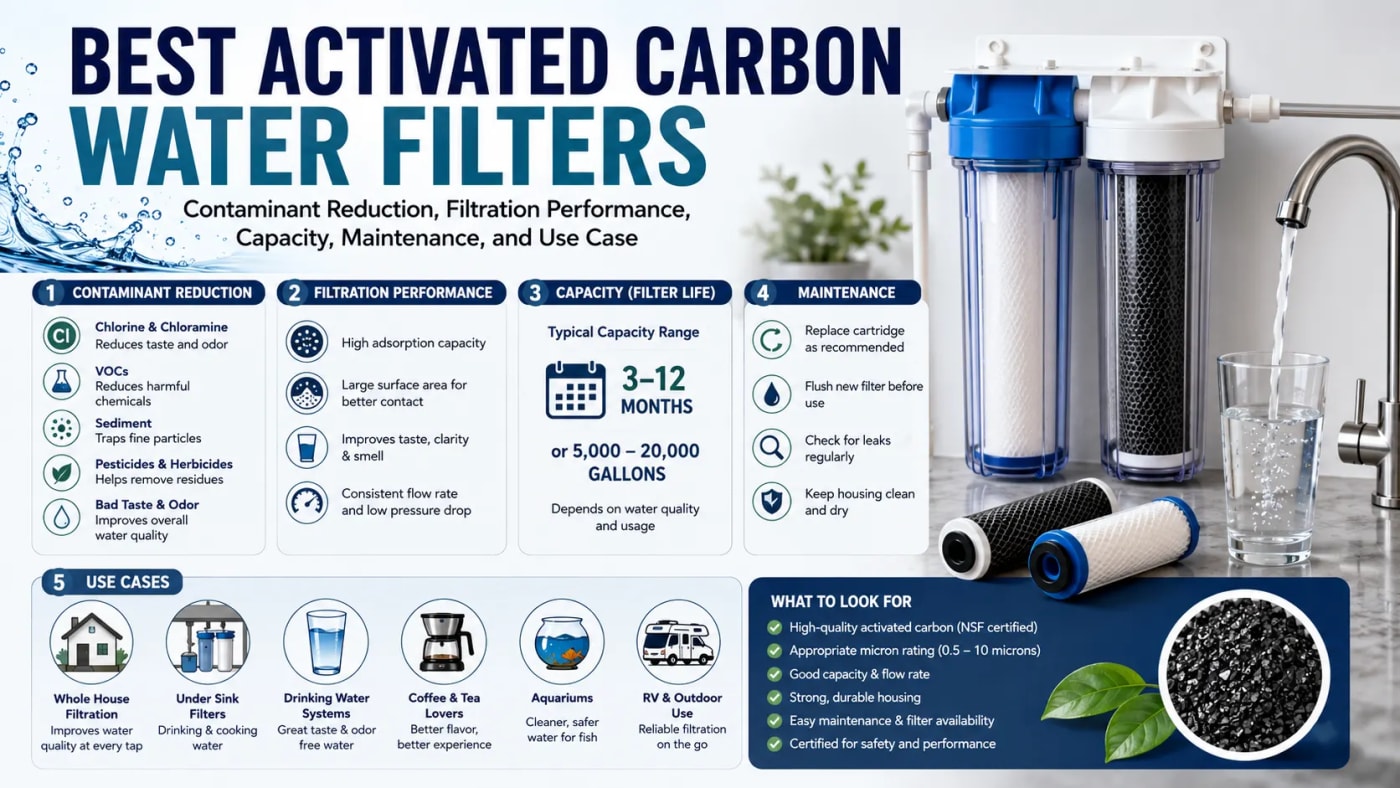
Infographic about the best activated carbon water filters, covering contaminant reduction, filtration performance, filter capacity, maintenance, common use cases, and key features to consider when choosing a filter.

Share

Our Top Picks

Activated carbon water filters differ from each other based on product type, media configuration, certified contaminant claims, capacity, flow rate, maintenance needs, and installation method.

This comparison covers six real products across four different use cases: whole house systems installed at the main water line, an under sink system for drinking water, a countertop system connected to a faucet, and a portable pitcher. Some use plain granular carbon, while others combine carbon with catalytic media, ion exchange resin, or additional filtration stages. Certified contaminant claims also vary by product and by the specific NSF standard each one carries. The sections below compare exact specifications first, then review each product in depth, then answer the practical questions a buyer actually needs answered before choosing one.

In-Depth Reviews

#1Best for PFAS and Chloramine Reduction

SpringWell CF1 Whole House Water Filter

$624.47

Key Features

A tank based whole-house system using catalytic carbon and KDF media, installed at the main line so every tap in the home gets treated water.

Reasons to Buy

  • Very high 1,000,000 gallon capacity before the main media needs replacement
  • Manufacturer lists chlorine, chloramine, PFAS, PFOA, and PFOS as target contaminants
  • 9 GPM flow rate, suited for 1 to 3 bathroom homes
  • Only the sediment pre-filter needs frequent replacement, separate from the long-life main media

Reasons Not to Buy

  • Needs professional or experienced DIY installation at the main water line
  • The complete system lacks NSF 53 certification for health-related contaminants like lead, relying more on individual media testing than full-system certification
  • Won't make well water microbiologically safe by itself, no UV or disinfection stage
  • Higher upfront cost than cartridge-based systems

Specs at a Glance

MediaCapacityFlow rateInstallation
Catalytic carbon, KDF, sediment pre-filter1,000,000 gallons9 GPMPoint of entry, main line

The SpringWell CF1 is a whole house water filter built around catalytic carbon and KDF media, positioned for chlorine, chloramine, and PFAS reduction across the entire home.The system uses a combination of catalytic activated carbon, KDF filtration media, and a sediment pre filter stage. Water enters at the main line, so every fixture in the home receives treated water. SpringWell currently lists chlorine, chloramine, PFAS, PFOA, and PFOS reduction as target contaminants for this system.

SpringWell CF1 specifications:

  • Capacity: 1,000,000 gallons before the main carbon media needs replacement

  • Service flow rate: 9 GPM, suited for homes with 1 to 3 bathrooms

  • Sediment pre filter: A separate cartridge that needs more frequent replacement than the main media

  • Installation: Point of entry, requires plumbing connection at the main water line

  • Operating pressure: Needs to fall within the manufacturer's specified pressure range for correct operation

  • Warranty: Covered under SpringWell's standard product warranty terms

The 1,000,000 gallon capacity and target contaminant list come directly from SpringWell's current published specifications, while the actual reduction performance for any specific household still depends on incoming water chemistry and usage volume. The main limitation of this system is that it needs professional or experienced DIY installation at the main line, along with periodic sediment filter changes separate from the main carbon media.

#2Best for Certified Chlorine Reduction

Aquasana Rhino EQ-1000

$2,697.00

Key Features

An upflow tank system that increases water contact time with carbon media, certified under NSF Standard 42 for chlorine taste and odor reduction across the entire home.

Reasons to Buy

  • Certified 97% chlorine reduction under NSF Standard 42
  • 1,000,000 gallon rated capacity, same as SpringWell CF1
  • 7 GPM rated flow, with tank design that avoids clogging or media channeling
  • Quick, simple tank replacement compared to bulkier cartridge systems

Reasons Not to Buy

  • Contaminant coverage centers mainly on chlorine, taste, and odor rather than a broader range like PFAS
  • Needs adequate incoming water pressure to maintain rated flow
  • Requires professional or DIY installation at the main line
  • Does not reduce TDS, sulfur, or iron

Specs at a Glance

MediaCapacityFlow rateCertification
Activated carbon, upflow tank design1,000,000 gallons7 GPM ratedNSF Standard 42

The Aquasana Rhino EQ-1000 is a whole house activated carbon system built for chlorine reduction, certified under NSF Standard 42, with a 1,000,000 gallon rated capacity.

The EQ-1000 uses an upflow tank design filled with activated carbon media. Water moves upward through the tank, which increases contact time between the water and the carbon. Aquasana's current documentation identifies this exact model, the EQ-1000, at 1,000,000 gallons of capacity and 7 GPM rated flow, with a 97 percent chlorine reduction claim certified under NSF Standard 42.

Aquasana Rhino EQ-1000 specifications:

  • Capacity: 1,000,000 gallons

  • Rated flow: 7 GPM, with a separate peak flow figure for short bursts of higher demand

  • Certification: NSF Standard 42, covering chlorine taste and odor reduction

  • Installation: Point of entry at the main water line

  • Pressure considerations: Needs adequate incoming water pressure to maintain rated flow

  • Suitable household size: Matched to the rated flow and capacity figures rather than bedroom count alone

The main strength of the EQ-1000 is its clear, certified chlorine reduction claim backed by a specific NSF standard. The main limitation is that its contaminant coverage centers on chlorine, taste, and odor, rather than a broader range of chemicals such as PFAS. Buyers looking for wider chemical reduction need to check whether this specific claim matches their actual water test results.

#3Best for Broad Drinking Water Contaminant Coverage

Clearly Filtered Under Sink Water Filter

$550.00

Key Features

A 3-stage under-sink system combining carbon filtration with ion exchange media, installing directly at the cold water line without needing a separate dedicated faucet.

Reasons to Buy

  • Independent testing reported by Water Filter Guru lists reduction across more than 232 contaminants
  • Independent testing reported by Water Filter Guru lists reduction across more than 232 contaminants
  • Universal fit, installs in under 10 minutes with just a wrench
  • Does not target beneficial minerals, so taste stays more natural

Reasons Not to Buy

  • Lower 2,000 gallon capacity compared to whole-house tank systems
  • Broader marketing contaminant list goes beyond the specific certified list, check the certified claims for your exact contaminant of concern
  • Only treats water at one installation point, not the whole home
  • Needs available under-sink space

Specs at a Glance

MediaCapacityCertificationInstallation
Carbon plus ion exchange2,000 gallonsNSF 42, 53, 401Point of use, under sink

The Clearly Filtered Under Sink Water Filter is a point of use system that combines carbon filtration with ion exchange media, rated for 2,000 gallons of capacity.

This system installs under the kitchen sink and connects to a dedicated faucet, treating only the water used for drinking and cooking. It combines activated carbon with additional proprietary media and ion exchange resin, which broadens its contaminant coverage beyond carbon alone. Independent testing reported by Water Filter Guru lists more than 232 contaminants reduced, while the product carries NSF 42, 53, and 401 certification for specific claims.

Clearly Filtered Under Sink specifications:

  • Capacity: 2,000 gallons before filter replacement

  • Certification: NSF 42, 53, and 401 for specific listed contaminants

  • Independent testing: Reports reduction across a broad range of contaminants beyond the certified list

  • Installation: Under sink, with a dedicated faucet required

  • Maintenance: Filter cartridge replacement based on gallons used or elapsed time, whichever comes first

It is important to separate the certified NSF claims, which cover specific tested contaminants, from the broader independent testing results, which cover a wider range but carry a different level of formal certification. Buyers should treat the certified list as the guaranteed claim and the independent testing as supporting evidence. The main limitation of this system is that it requires under sink installation space and a dedicated faucet, and its 2,000 gallon capacity is lower than the whole house systems on this page, since it treats a smaller volume of water overall.

#4Best Budget Whole House Pick

iSpring WGB32B

$420.00

Key Features

A 3-stage system combining a 5 micron sediment filter with two coconut shell carbon block stages, built for DIY installation at the main water line.

Reasons to Buy

  • Up to 15 GPM flow rate, among the highest of the whole-house options
  • Lower upfront cost than tank-based systems like SpringWell or Aquasana
  • Simple DIY installation with three replaceable cartridge stages
  • Targets chlorine, sediment, rust, and select organic compounds

Reasons Not to Buy

  • Only 100,000 gallon capacity, meaning more frequent cartridge replacement than the 1,000,000 gallon tank systems
  • Explicitly does not reduce Total Dissolved Solids (TDS), so it won't soften water or remove dissolved minerals
  • All three cartridges typically need replacing together
  • Best suited to smaller households or lower water usage rather than heavy daily demand

Specs at a Glance

MediaCapacityFlow rateInstallation
Sediment + 2 coconut shell carbon block stages100,000 gallonsUp to 15 GPMPoint of entry, main line

The iSpring WGB32B is a 3-stage whole house filter using a 5 micron sediment stage followed by two coconut shell carbon block stages, rated for 100,000 gallons and up to 15 GPM flow.

The first stage is a 5 micron polypropylene sediment filter, which removes dirt, sand, and rust particles before water reaches the carbon stages. The next two stages both use CTO coconut shell carbon block media, which target chlorine, taste, odor, and select organic contaminants. iSpring explicitly states that the WGB32B does not reduce total dissolved solids, known as TDS, which is an important distinction from reverse osmosis systems that specifically target dissolved solids.

iSpring WGB32B specifications:

  • Stage 1: 5 micron polypropylene sediment filter

  • Stage 2 and 3: coconut shell carbon block filters, CTO rated

  • Flow rate: Up to 15 GPM

  • Capacity: 100,000 gallons before replacement of the main cartridges

  • Installation: Whole house, designed for DIY installation at the main line

  • Limitation: Does not reduce TDS, so it does not soften water or remove dissolved minerals

Compared with tank based systems like the SpringWell CF1 and the Aquasana EQ-1000, the WGB32B uses replaceable cartridges rather than a sealed media tank. This generally means a lower upfront cost and simpler DIY installation, but a shorter rated capacity of 100,000 gallons compared with the 1,000,000 gallon rating on the two tank based systems. This makes the WGB32B a fit for smaller households or lower water usage, where the lower capacity does not require replacement as often in practical terms.

#5Best No-Plumbing Countertop Pick

APEX EXPRT MR-2050

$119.00

Key Features

A faucet-connected countertop system using multi-stage carbon block filtration with an added mineralizing stage, requiring no permanent installation.

Reasons to Buy

  • Easy DIY install, just remove the faucet aerator and screw on the diverter valve
  • Mineralizing stage adds minerals back into filtered water for better taste
  • No permanent plumbing changes needed
  • NSF/ANSI 61 and 42 material and media compliance

Reasons Not to Buy

  • Designed for municipal water only, not recommended for well water
  • Shorter replacement cycle than whole-house systems, about every 4 to 6 months for a family of four
  • Takes up real counter space next to the sink
  • Manufacturer contaminant claims describe intended targets, not a universal removal guarantee

Specs at a Glance

MediaCertificationReplacementInstallation
Multi-stage carbon block + mineralizing stageNSF/ANSI 61 and 42 material compliance4 to 6 months for a family of fourPoint of use, faucet connected

The APEX EXPRT MR-2050 is a faucet connected countertop water filter using a multi-stage carbon block configuration with an added mineralizing stage.

This system sits on the countertop and connects directly to the kitchen faucet, so it requires no under sink plumbing work. It uses carbon block filtration across multiple stages, targeting chlorine, chloramine, and other contaminants listed by the manufacturer, along with a mineralizing stage that adds minerals back into the filtered water. APEX currently identifies NSF/ANSI 61 and 42 material and media compliance, and states an expected replacement cycle of approximately 4 to 6 months for a family of four.

APEX EXPRT MR-2050 specifications:

  • Configuration: Multi-stage carbon block with a mineralizing stage

  • Certification: NSF/ANSI 61 and 42 material and media compliance

  • Replacement cycle: Approximately 4 to 6 months for a family of four

  • Installation: Faucet connected, countertop footprint, no permanent plumbing changes

  • Footprint: Sits on the counter next to the sink, requiring available counter space

The manufacturer's contaminant claims describe what the product is designed to target, and these claims should not be read as a universal removal guarantee for every possible contaminant in every water supply. The main strength of this system is easy installation with no plumbing changes. The main limitation is its countertop footprint, along with a shorter replacement cycle compared with the larger whole house systems on this page.

#6Best Portable, No-Installation Pick

Clearly Filtered Water Pitcher

$109.65

Key Features

A gravity-fed pitcher using carbon based Affinity filtration, requiring no plumbing connection at all, ideal for renters or anyone who cannot modify their kitchen

Reasons to Buy

  • Zero installation needed, fully portable
  • NSF/ANSI 42 and 372 certified
  • Does not strip out beneficial minerals during filtration
  • Additional third-party testing reported separately from the formal certification

Reasons Not to Buy

  • Lowest capacity of all six products here, only 100 gallons before replacement
  • Slower gravity-fed filtration speed compared to pressurized systems
  • Requires frequent refilling for larger households
  • Most frequent filter replacement cycle among the six products, driving up ongoing cost per gallon

Specs at a Glance

MediaCapacityCertificationInstallation
Carbon based Affinity filtration100 gallonsNSF/ANSI 42 and 372Portable, no installation

The Clearly Filtered Water Pitcher is a portable, gravity fed filter using carbon based Affinity filtration, rated for 100 gallons of capacity.Water is poured into the top reservoir and passes down through the Affinity filter media by gravity, with no installation or plumbing needed. Clearly Filtered's current performance page identifies a 100 gallon rated capacity along with NSF/ANSI 42 and 372 certification, while the product page also describes broader third party testing against additional standards beyond the formal certification.

Clearly Filtered Pitcher specifications:

  • Capacity: 100 gallons before filter replacement

  • Certification: NSF/ANSI 42 and 372

  • Filtration speed: Gravity fed, slower than pressurized systems

  • Reservoir size: Holds a set volume per fill, requiring refills for larger households

  • Materials: Pitcher body and filter housing materials meet the certifications listed above

  • Portability: Fully portable, needs no water line connection

The main strength of this pitcher is portability and zero installation requirement, which suits renters or anyone who cannot modify plumbing. The main limitation is its lower 100 gallon capacity compared with every other product on this page, along with slower gravity fed filtration speed and the need for frequent refilling in larger households.

Which activated carbon water filters are being compared, and how do their core specifications differ?

The activated carbon water filters compared on this page differ mainly in system type, filtration media, certified contaminant categories, capacity, and installation method.

Below is a table that shows the core specifications for fast orientation before the detailed reviews.

Product

System Type

Filtration Media

Certified Contaminants

Capacity

Flow Rate

Installation

SpringWell CF1

Whole house

Catalytic carbon, KDF, sediment

Chlorine, chloramine, PFAS, PFOA, PFOS

1,000,000 gallons

9 GPM

Point of entry, main line

Aquasana Rhino EQ-1000

Whole house

Activated carbon, upflow tank

Chlorine, NSF Standard 42

1,000,000 gallons

7 GPM rated

Point of entry, main line

Clearly Filtered Under Sink

Under sink

Carbon plus ion exchange media

NSF 42, 53, 401

2,000 gallons

Standard under sink flow

Point of use, under sink

iSpring WGB32B

Whole house

Sediment plus two coconut shell carbon block stages

Chlorine, sediment, rust, organic compounds

100,000 gallons

Up to 15 GPM

Point of entry, main line

APEX EXPRT MR-2050

Countertop

Carbon block, multi-stage, mineralizing stage

NSF 61 and 42 material compliance

Cartridge based, 4 to 6 month life

Countertop flow

Point of use, faucet connected

Clearly Filtered Pitcher

Pitcher

Carbon based Affinity filtration

NSF 42 and 372

100 gallons

Gravity fed

Portable, no installation

How should activated carbon filters be evaluated before comparing the products?

Activated carbon filters need to be evaluated using a consistent set of criteria, so each product can be judged on the same terms rather than on marketing language alone.

Evaluation criteria used throughout this comparison:

  • Contaminant performance: What the product actually reduces, based on testing

  • Certification: Which NSF/ANSI standard applies, and what specific claim it covers

  • Filtration configuration: The media types and treatment stages used

  • Capacity: How many gallons or months the filter lasts before replacement

  • Flow rate: How much water the system delivers per minute

  • Installation: Whether it fits at the main line, under a sink, on a countertop, or needs no installation

  • Maintenance: What replacement parts are needed and how often

  • Ownership cost: The total cost over the life of the filter, not just the purchase price

  • Application fit: Which household size and water problem the product actually suits

NSF/ANSI 42, 53, and 401 refer to specific certified reduction claims tied to exact contaminants and test conditions. These standards do not mean a product removes every possible contaminant in water. Each product review below applies these same criteria in the same order.

Which activated carbon filter provides the strongest verified contaminant reduction?

The strongest verified contaminant reduction among these products depends on separating formal certification from independent lab testing, rather than comparing marketing contaminant counts alone.

How verified contaminant reduction compares across products:

  • SpringWell CF1: Manufacturer claims cover chlorine, chloramine, PFAS, PFOA, and PFOS, based on catalytic carbon and KDF media

  • Aquasana Rhino EQ-1000: Certified 97 percent chlorine reduction under NSF Standard 42, a narrower but clearly certified claim

  • Clearly Filtered Under Sink: NSF 42, 53, and 401 certification for specific contaminants, plus independent testing reporting reduction across more than 232 contaminants

  • iSpring WGB32B: Targets chlorine, sediment, rust, and organic contaminants, with an explicit limitation on TDS reduction

  • APEX EXPRT MR-2050: NSF/ANSI 61 and 42 material and media compliance, focused on chlorine and chloramine reduction

  • Clearly Filtered Pitcher: NSF/ANSI 42 and 372 certification, with additional third party testing reported separately from the formal certification

NSF certification applies to specific reduction claims tied to exact test conditions, not to every possible contaminant a product might reduce. A product with a longer marketing list of contaminants is not automatically stronger than one with a narrower but fully certified claim. The correct comparison matches a specific water problem to a specific certified claim, rather than ranking products by list length.

Which products are best suited to whole-house, under-sink, countertop, and pitcher use?

The best product for each use case depends on installation scope and how much of the household's water needs treatment, not on contaminant performance alone.

Product fit by application type:

  • Whole house, point of entry: SpringWell CF1, Aquasana Rhino EQ-1000, and iSpring WGB32B all treat water at the main line, covering every fixture in the home

  • Under sink, point of use: Clearly Filtered Under Sink treats only the water used at one dedicated faucet for drinking and cooking

  • Countertop, point of use: APEX EXPRT MR-2050 treats water at the kitchen faucet without permanent plumbing changes

  • Portable, no installation: Clearly Filtered Pitcher treats water poured into it, with no connection to any water line

A point of entry system treats water throughout the entire home, while a point of use system treats only the water at its specific installation point. Household size also affects the right choice within each category, since flow rate and capacity need to match actual daily water use.

Which activated carbon filters offer the best balance of capacity, flow rate, and maintenance?

The best balance of capacity, flow rate, and maintenance depends on matching a product's numbers to actual household water use, since a tank based system and a cartridge based system are not directly equivalent.

Capacity, flow, and maintenance by product:

  • SpringWell CF1: 1,000,000 gallons, 9 GPM, needs periodic sediment pre filter replacement separate from the main media

  • Aquasana Rhino EQ-1000: 1,000,000 gallons, 7 GPM rated flow, single tank media replacement

  • Clearly Filtered Under Sink: 2,000 gallons, standard under sink flow, cartridge replacement based on gallons or time

  • iSpring WGB32B: 100,000 gallons, up to 15 GPM, three separate cartridge stages replaced together

  • APEX EXPRT MR-2050: Cartridge based, replaced approximately every 4 to 6 months for a family of four

  • Clearly Filtered Pitcher: 100 gallons, gravity fed, frequent cartridge replacement due to lower capacity

Capacity figures are not directly comparable between long life tank media, rated in gallons over years of use, and smaller cartridges, rated in gallons or months of everyday drinking water use. The two whole house tank systems offer the highest capacity and flow, suited to full household water treatment, while the under sink, countertop, and pitcher options suit smaller volumes of drinking water with more frequent replacement.

Which activated carbon filter is most economical over its useful life?

The most economical filter over its useful life depends on total ownership cost, meaning the combination of purchase price, replacement frequency, and capacity, rather than the upfront price alone.

Ownership cost factors by product:

  • SpringWell CF1 and Aquasana Rhino EQ-1000: Higher upfront cost for a whole house tank system, offset by a long 1,000,000 gallon capacity before main media replacement

  • iSpring WGB32B: Lower upfront cost with a shorter 100,000 gallon capacity, meaning more frequent cartridge replacement over the same time period

  • Clearly Filtered Under Sink: Moderate upfront cost with a 2,000 gallon capacity, sized for drinking and cooking water rather than whole house volume

  • APEX EXPRT MR-2050: Countertop pricing with cartridge replacement roughly every 4 to 6 months for a family of four

  • Clearly Filtered Pitcher: Lowest upfront cost, but the smallest 100 gallon capacity, meaning the most frequent replacement cycle among all six products

Exact current pricing changes over time and varies by retailer, so this comparison focuses on capacity and replacement frequency rather than a fixed dollar figure. A household with high daily water use through the whole home generally gets more value from a high capacity tank system, while a single person filtering only drinking water may find a smaller point of use system more economical in practice.

Which activated carbon filter should you choose for chlorine, PFAS, lead, fluoride, taste, or general tap-water improvement?

The right activated carbon filter depends on matching the specific water problem to the product with a verified claim for that exact contaminant.

Below is a decision table that maps common water problems to the products best suited for each one.

Water Problem

Suitable Product

Reason

Important Limitation

Chlorine taste and odor, whole house

Aquasana Rhino EQ-1000

Certified 97 percent chlorine reduction under NSF Standard 42

Narrower contaminant scope than PFAS focused systems

PFAS, PFOA, PFOS, whole house

SpringWell CF1

Manufacturer lists PFAS, PFOA, and PFOS reduction alongside chlorine and chloramine

Confirm current certification status for PFAS claims before buying

Lead or broader chemical reduction, drinking water

Clearly Filtered Under Sink

NSF 42, 53, and 401 certification plus independent testing across many contaminants

Requires under sink installation and a dedicated faucet

General tap water improvement, whole house, budget conscious

iSpring WGB32B

Sediment plus two carbon block stages at a lower capacity and cost

Does not reduce TDS or soften water

No installation, portable use

Clearly Filtered Pitcher

NSF 42 and 372 certified, no plumbing required

Lowest capacity, needs frequent refilling and replacement

Countertop, no plumbing changes

APEX EXPRT MR-2050

Faucet connected with NSF 61 and 42 material compliance

Shorter replacement cycle and countertop space needed

The US EPA and NSF both confirm that certified reduction claims apply to specific contaminants under specific test conditions. A household needs to match its actual water test results to the specific certified claim, rather than choosing a product based on a general reputation for being the best overall filter.

What should you check before buying an activated carbon water filter?

Before buying an activated carbon water filter, a buyer needs to check the actual water test results, the specific certified contaminant claims, and the ongoing cost of maintaining the system.

Checklist before buying an activated carbon water filter:

  • Water test or report: know the actual contaminants present before choosing any product

  • Contaminant target: Confirm the product addresses the specific contaminant found in testing

  • Certification: Check the exact NSF/ANSI standard and the specific claim it covers

  • Application type: Decide between whole house, under sink, countertop, or portable based on household needs

  • Capacity: Confirm the rated gallons or months match household water use

  • Flow rate: Confirm the system delivers enough water for simultaneous fixture use, especially for whole house systems

  • Replacement cost: Calculate the ongoing cost of cartridges or media over a full year of use

  • Installation: Confirm whether the product needs professional installation, DIY plumbing work, or no installation at all

  • Maintenance: Understand the exact replacement schedule and any extra steps such as sediment pre filter changes

How can you match your water-quality problem to the right filtration system?

The right filtration system depends entirely on what a water test actually finds, not on choosing a product based on its general reputation alone.Every product compared on this page targets a different combination of contaminants, capacities, and installation types. The next step for any household is testing the water, then matching the confirmed contaminants to a filter with a verified claim for that exact problem. A dedicated water quality testing guide explains how to get an accurate water test and how to read the results before making a final filter decision.

What is activated carbon filtration and how does it work?

Activated carbon filtration works through adsorption, where contaminants stick to the surface of the carbon material as water passes through it.Activated carbon has an extremely porous surface, which gives it a large surface area for contaminants to attach to. This structure makes it effective for chlorine, taste, odor, and select organic contaminants. A dedicated activated carbon filtration guide covers the full science behind this process.

What contaminants can activated carbon water filters remove?

Activated carbon water filters can remove chlorine, taste and odor compounds, and select volatile organic compounds and organic chemicals.The exact list depends entirely on the specific product and its certification, since not every carbon filter targets the same contaminants. A dedicated contaminant removal guide lists these categories in full detail.

What contaminants can activated carbon filters not reliably remove?

Activated carbon filters do not reliably remove dissolved salts, total dissolved solids, hardness minerals, nitrate, or microbiological contamination unless an additional technology is built into the product.Product specific certification determines whether any of these additional contaminants are addressed. A dedicated guide explains these limitations in more depth.

How often should a water filter cartridge be replaced?

A water filter cartridge needs replacement based on its rated capacity, the incoming water quality, and actual household usage, not on a single fixed schedule that fits every product.Once a filter reaches its rated capacity, its ability to reduce contaminants drops, even if water still flows through it normally. A dedicated replacement guide explains how to track usage and know when a specific cartridge needs changing.

How do you test your water before choosing a filter?

Water needs to be tested before choosing a filter by using a utility water quality report for city water or a targeted laboratory test for other sources.The test result then gets matched against the certified claims of a specific filter, rather than assuming any product handles every possible contaminant. A dedicated guide walks through the full water testing process.

What is the difference between activated carbon and reverse osmosis?

The difference between activated carbon and reverse osmosis is the treatment method. Activated carbon uses adsorption, while reverse osmosis uses a membrane under pressure.Activated carbon works especially well for chlorine, taste, odor, and select organic contaminants. Reverse osmosis uses a different mechanism and reduces a broader range of dissolved contaminants, including many that carbon alone does not address. A dedicated comparison guide explains this difference in full detail.

Share