A reverse osmosis system does not have one single lifespan, because the fixed hardware, the replaceable filters, and the membrane all wear out at different rates. The outer housing, tubing, and storage tank can last well over a decade, while filters and the membrane need regular replacement to keep the system performing correctly. This guide covers how long a properly maintained RO system lasts, which components determine its usable life, how often each filter and the membrane should be replaced, and how feed-water quality, household usage, and regular maintenance all affect how long your system keeps producing clean water.
How Long Can a Properly Maintained RO System Last?
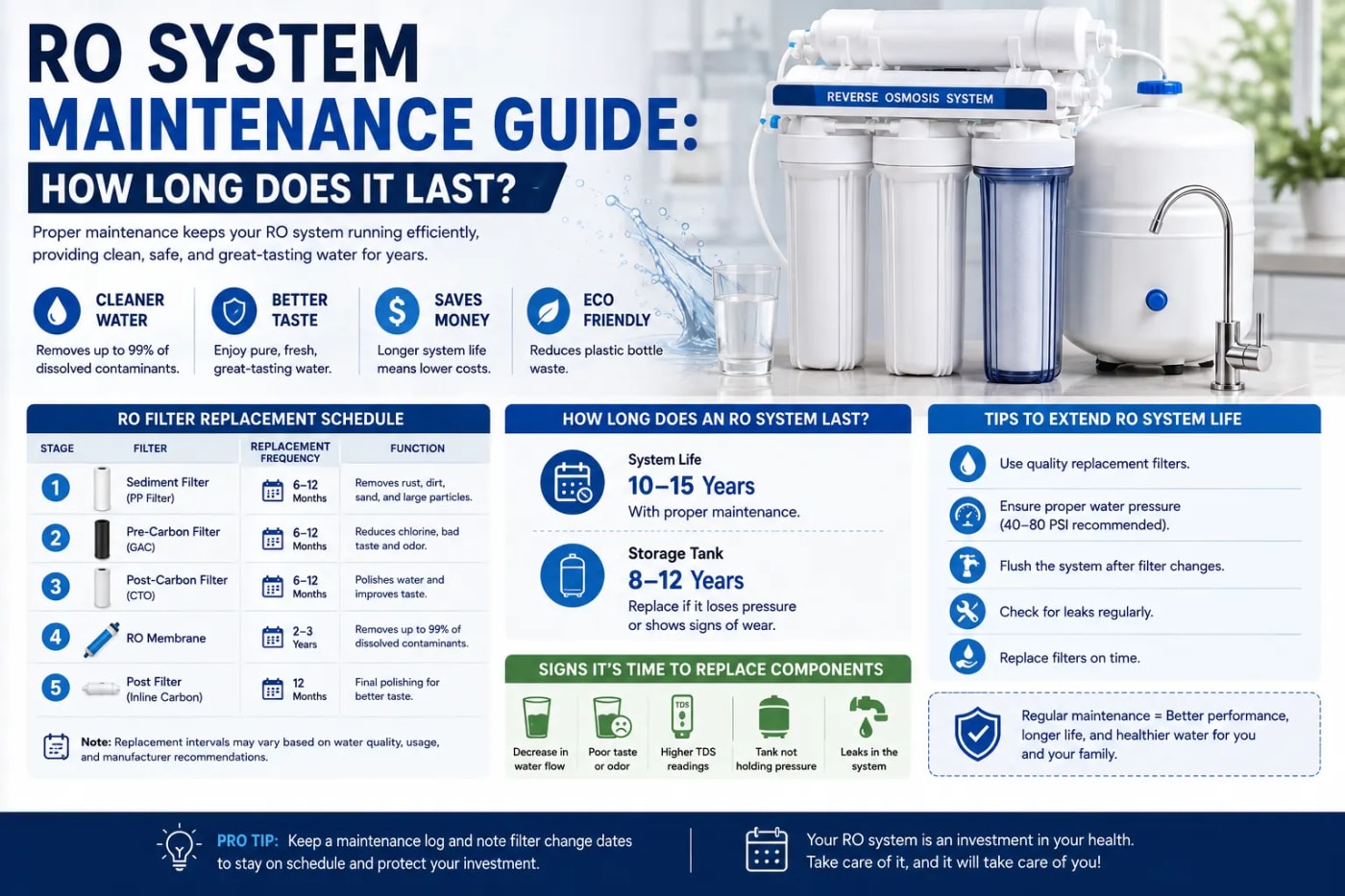
A properly maintained residential reverse osmosis system commonly lasts around 10 to 15 years. This figure refers to the overall system, including the fixed hardware such as the housing, manifold, and storage tank, not the individual filters and membrane inside it, which need replacement on a much shorter cycle throughout that period.
This range is not a guarantee that applies to every household. Feed-water quality, how consistently maintenance is performed, and how much water the household uses all shift a system's actual lifespan up or down from this general benchmark. A system that receives regular filter changes, prompt attention to leaks, and periodic sanitization tends to reach or exceed the upper end of this range, while a neglected system can fail well before it.
Which RO Components Determine How Long the System Remains Usable?
A reverse osmosis system is made up of several distinct components, each with its own expected service life. Understanding this structure explains why replacing a filter does not mean replacing the whole system, and why a system's overall age is not the same as any single part's age.
Main components in a typical RO system:
Sediment filter: Removes larger particles before water reaches the other stages.
Carbon prefilter: Removes chlorine and certain organic compounds ahead of the membrane.
RO membrane: The semi-permeable barrier that removes dissolved contaminants.
Post-filter: Polishes the water after it leaves the membrane and storage tank.
Storage tank: Holds treated water under pressure until it is used.
Housings: The casings that hold each filter cartridge.
Faucet: The dedicated tap that dispenses treated water.
Tubing and valves: Connect the components and control water flow through the system.
Each of these parts wears at a different pace. Filters and the membrane are consumables, meant to be replaced on a schedule, while the housings, tubing, faucet, and storage tank are built to last for most or all of the system's overall lifespan with proper care.
How Often Should Each RO Filter and Membrane Be Replaced?
Replacement intervals vary by component and by manufacturer, but general ranges give a useful starting point for planning maintenance.
The table below shows typical maintenance intervals for the main RO components:
Component | Typical maintenance interval | What it protects | Replacement trigger |
Sediment filter | Every 6 to 12 months | Protects downstream filters and the membrane from particulate damage | Reduced flow, visible discoloration, or manufacturer interval |
Carbon prefilter | Every 6 to 12 months | Protects the membrane from chlorine damage | Chlorine taste or odor returning, or manufacturer interval |
RO membrane | Every 2 to 5 years | Removes the majority of dissolved contaminants | Declining TDS rejection or manufacturer interval |
Post-filter | Every 6 to 12 months | Polishes taste and odor of stored water | Taste or odor changes, or manufacturer interval |
These ranges reflect commonly reported intervals across manufacturers, not a fixed rule every brand follows identically. Always check your specific system's manual for its stated intervals, since some manufacturers specify shorter or longer schedules for their particular filter and membrane designs.
How Does Feed-Water Quality Affect RO System Lifespan?
The quality of the water entering your RO system has a direct effect on how quickly its components wear out. Water with heavier contaminant loading places more strain on filters and the membrane, shortening the time between necessary replacements.
Major water-quality factors that affect component wear:
Sediment: Higher sediment levels load the sediment filter faster, requiring more frequent replacement.
Total dissolved solids (TDS): Higher TDS in the source water increases the workload on the RO membrane.
Hardness, calcium, and magnesium: These minerals can scale the membrane surface, reducing its performance and shortening its usable life.
Chlorine: Chlorine exposure can damage certain RO membranes if the carbon prefilter is not replaced on schedule.
Iron: Elevated iron levels can foul filters and membranes more quickly than cleaner source water.
Households on well water or water with known hardness, sediment, or chlorine issues should expect to replace components somewhat more often than the general intervals suggest, since these factors accelerate wear on the system's consumable parts.
How Does Water Usage Affect RO Filter and Membrane Life?
The volume of water a household treats also affects how quickly filters and the membrane wear out, separate from water quality itself. A household with lower daily water use pushes less total volume through the system, so components tend to last closer to the upper end of their typical replacement range. A household with heavier daily use, more people, more cooking, more direct drinking from the RO tap, pushes more volume through the same components, which shortens the time before replacement is needed.
This distinction matters because calendar age alone does not tell the whole story. A lightly used system might still perform well past its typical filter-change interval, while a heavily used system in the same household might need attention sooner than the general schedule suggests. Watching for the performance signs covered later in this guide, rather than relying on the calendar alone, gives a more accurate picture of when replacement is actually needed.
How Does Regular Maintenance Extend RO System Life?
Consistent maintenance protects both the consumable components and the fixed hardware of an RO system, directly extending how long the overall unit remains usable.
Maintenance actions that protect RO system life:
Timely filter changes: Replacing sediment, carbon, and post-filters on schedule prevents strain on the membrane.
Membrane monitoring: Periodically checking TDS rejection helps catch declining performance before it becomes a bigger problem.
Sanitization: Cleaning the internal water pathways and storage tank periodically prevents bacterial buildup.
Inspection of seals and connections: Checking O-rings, fittings, and tubing for wear helps catch small leaks before they cause damage.
Storage tank checks: Confirming the tank holds pressure correctly supports steady water flow and protects the tank itself.
Following manufacturer instructions: Manufacturer-specific guidance often reflects testing on that exact system design.
Many manufacturers recommend annual sanitization of the storage tank and internal pathways as part of this routine, alongside the filter and membrane replacement schedule already covered above.
How Can You Tell When an RO Membrane Needs Replacement?
An RO membrane rarely fails suddenly. Instead, it degrades gradually, and several performance indicators can signal that replacement time has arrived.
The table below maps common symptoms to possible membrane issues and how to verify them:
Symptom | Possible membrane issue | Verification method |
Declining TDS rejection | Membrane no longer filtering effectively | Compare treated-water TDS reading against source-water TDS |
Reduced production rate | Membrane fouling or scaling | Time how long the storage tank takes to fill |
Performance decline persists after prefilter replacement | The issue lies with the membrane, not upstream filters | Replace prefilters first, then recheck TDS and flow |
Rising treated-water TDS over time | Gradual membrane degradation | Track TDS readings over several months |
Manufacturer-specified thresholds vary by model. Some manufacturers specify replacement once TDS reduction falls below a certain percentage, such as 75 percent, for their specific system. Always check your exact model's documentation for its stated performance threshold rather than assuming a single number applies universally.
What Signs Show That an RO System Needs Maintenance or Repair?
Beyond membrane-specific symptoms, several broader signs indicate that an RO system needs attention somewhere in the system.
Troubleshooting checklist for general RO system problems:
Slow flow at the faucet: Can point to clogged filters, low feed pressure, or a storage tank pressure issue.
Low overall production: Water takes noticeably longer to refill the storage tank than usual.
Visible leaks: Any dripping or pooling around housings, tubing, or connections needs prompt attention.
Unusual taste or odor: Often signals exhausted carbon filters or a storage tank that needs sanitizing.
Continuously running drain flow: Water flowing to the drain constantly, even when the tank should be full, often points to a problem with the automatic shutoff or check valve.
Pressure problems: Feed water pressure that is too low or too high can prevent the system from operating correctly.
Continuous drain discharge in particular usually signals a valve or pressure problem rather than a membrane issue, so it is worth checking the shutoff valve and tank pressure before assuming the membrane needs replacement.
How Should an RO Storage Tank and Other Fixed Components Be Maintained?
The fixed hardware of an RO system, separate from the filters and membrane, also needs periodic attention to keep the system running reliably over its full lifespan.
Fixed-component maintenance checklist:
Storage tank condition: Check that the tank holds air pressure correctly when empty, since incorrect pressure affects flow and refill behavior.
Tank bladder: Inspect for signs of failure, such as the tank losing pressure quickly or water appearing at the air valve.
Housings: Check for cracks, wear, or difficulty sealing properly during filter changes.
O-rings: Inspect for cracking, flattening, or damage whenever a housing is opened.
Tubing and fittings: Look for kinks, cracks, or loose connections that could develop into leaks.
Faucet: Confirm the dedicated RO faucet operates smoothly and does not leak at its base.
Automatic shutoff valve: Confirm it properly stops water flow to drain once the tank is full.
Flow restrictor: Check that it maintains the correct ratio of treated water to reject water for your system design.
These components are inspected regularly and cleaned or replaced only when damage or malfunction appears, unlike filters and the membrane, which follow a scheduled replacement cycle regardless of visible condition.
How Often Should an RO System Be Sanitized?
Sanitizing an RO system is generally recommended on an annual basis for most residential systems, separate from routine filter replacement. Sanitization addresses the internal water pathways and storage tank specifically, since these areas can develop bacterial growth or biofilm over time even when filters are replaced on schedule.
When sanitization typically fits into a maintenance routine:
At the same time as an annual filter change: Combining these tasks saves time, since the system is already open for filter replacement.
After the system has sat unused for an extended period: Stagnant water increases the chance of bacterial buildup.
When taste or odor issues appear: These can sometimes trace back to the tank or internal pathways rather than the filters themselves.
Always follow the specific sanitization instructions provided by your system's manufacturer, including the correct sanitizing solution and concentration for your exact model, rather than assuming a generic household cleaning product is appropriate for the internal components of your RO system.
What Happens When RO Maintenance Is Delayed or Skipped?
Delayed or skipped maintenance sets off a predictable chain of consequences that builds over time rather than causing immediate failure.
The typical causal sequence when maintenance is neglected:
Sediment and carbon prefilters load up with particulates and chlorine byproducts beyond their intended capacity.
This loading restricts water flow and reduces pressure reaching the RO membrane.
The membrane experiences greater stress from unfiltered chlorine, sediment, or scaling minerals.
Membrane performance declines, showing up as reduced production and lower TDS rejection.
Continued neglect can lead to permanent membrane damage or failure of other components under the added strain.
This sequence explains why a small, inexpensive maintenance step, like replacing a sediment filter on schedule, protects a much more expensive component, the membrane, from premature failure. Skipping the cheap, routine steps tends to accelerate the need for costly repairs later.
When Should You Repair an RO System Instead of Replacing It?
Whether to repair a specific component or replace the entire system depends on several factors working together, not a single rule.
The table below compares repair and replacement scenarios:
Consideration | Favors repair | Favors full replacement |
Number of failing components | A single component has failed | Multiple components are failing at once |
Housing condition | Housings are intact and functional | Housings are cracked or damaged |
Leak severity | A minor, identifiable leak | Recurring leaks from multiple points |
Part availability | Replacement parts are readily available | Parts are discontinued or hard to source |
Failure pattern | This is the first failure of its kind | The same component keeps failing repeatedly |
Repair cost versus system age | Repair cost is low relative to remaining expected life | Repair cost approaches the cost of a new system |
Replacing a single filter, membrane, or valve is a routine part of ongoing maintenance and is fundamentally different from replacing the entire system. Repair generally makes sense when a single component has failed and the rest of the system remains sound, while full replacement becomes the more sensible option when multiple components are failing together or the housing itself is damaged.
What Factors Determine Whether an Old RO System Is Worth Replacing?
Deciding whether an aging RO system is worth replacing is a different question from deciding whether to repair a single failed part. This decision centers on the overall condition and value of the system as it approaches or exceeds its typical lifespan.
Checklist for evaluating an aging RO system:
Age of the fixed hardware: A system well past the typical 10 to 15 year benchmark is more likely to need broader attention.
Repeated leaks: Recurring leaks from different points suggest general wear across the housing and connections, not an isolated issue.
Multiple simultaneous failures: Several components failing around the same time often signals the system as a whole is reaching the end of its service life.
Obsolete parts: Difficulty finding replacement filters, membranes, or valves for an older model makes ongoing maintenance harder and more expensive.
Poor performance after maintenance: If replacing filters and the membrane does not restore expected performance, the underlying hardware may be the limiting factor.
Upgrade benefits: Newer systems may offer efficiency, waste-water ratio, or performance improvements worth factoring into the decision.
There is no single fixed age at which every RO system should be replaced. This checklist is meant to guide a judgment call based on your system's actual condition rather than a calendar deadline.
How Can You Keep an RO System Performing Reliably Between Maintenance Cycles?
Maintaining reliable performance between scheduled maintenance visits comes down to a few consistent habits that connect everything covered in this guide.
Practical habits for reliable RO performance:
Follow the manufacturer's schedule: Use the specific intervals provided for your system rather than a generic guideline alone.
Monitor changes in flow and taste: These are often the earliest signs that something needs attention.
Check TDS when appropriate: A rising TDS reading in treated water is a useful early indicator of membrane performance decline.
Address leaks early: Small leaks caught early are far easier to fix than damage caused by a leak left unattended.
Keep records of filter and membrane replacements: Tracking dates makes it easier to plan ahead and spot patterns in component wear.
The sections below connect this general maintenance overview to more focused guides for specific tasks, including filter replacement, membrane replacement, troubleshooting, and testing.
How Often Should You Change a Reverse Osmosis Filter?
Most RO prefilters and post-filters need replacement every 6 to 12 months, though the exact interval depends on your specific manufacturer and water conditions. For the complete replacement schedule and how to adjust it for your household, see our RO filter replacement guide.
How Often Should You Replace an RO Membrane?
RO membranes commonly need replacement every 2 to 5 years, though performance testing and manufacturer specifications often matter more than calendar age alone. For a full explanation of membrane replacement timing, see our RO membrane replacement guide.
How Do You Know When an RO Filter Is Clogged?
Reduced flow and pressure changes are common clues that a filter is clogged, though appearance alone is not always a reliable diagnostic. For a complete troubleshooting walkthrough, see our RO filter troubleshooting guide.
How Do You Test RO Water Quality With a TDS Meter?
Comparing your source-water TDS reading with your treated RO-water TDS reading gives you one useful performance indicator for your system. For the complete testing process, see our RO TDS testing guide.
How Do You Replace RO Filters Yourself?
Replacing RO filters yourself generally involves shutting off the feed water, depressurizing the system, removing the old cartridges, installing the correct replacements, checking seals, and flushing the system before use. For the complete step-by-step procedure, see our guide on how to replace RO filters.
How Do You Sanitize a Reverse Osmosis System?
Sanitizing an RO system is typically performed during an annual filter change or after extended periods without use, addressing the internal water pathways and storage tank. For the complete sanitization process specific to your system, see our guide on how to sanitize an RO system.
What Does an RO System Remove From Drinking Water?
What an RO system removes from drinking water depends on the specific membrane and any certified contaminant reduction claims for that exact model. For a complete breakdown of what reverse osmosis removes, see our guide on what reverse osmosis removes.
How Much Water Does an RO System Waste?
RO systems produce both a treated water stream and an untreated reject stream, and the actual ratio of wasted water varies substantially by system design and efficiency. For a complete explanation of RO water waste, see our RO water waste guide.
Conclusion
A well-maintained reverse osmosis system can reliably serve a household for 10 to 15 years, but that number only holds true when the consumable parts, filters, and membrane, receive regular attention on their own separate schedules. Feed-water quality and household usage both shape how quickly those components wear, while consistent maintenance, prompt leak repair, and periodic sanitization protect the fixed hardware for the long haul. Watching for the performance signs covered in this guide, rather than relying on the calendar alone, is the most reliable way to know when a component needs attention and when the whole system has reached the end of its useful life.