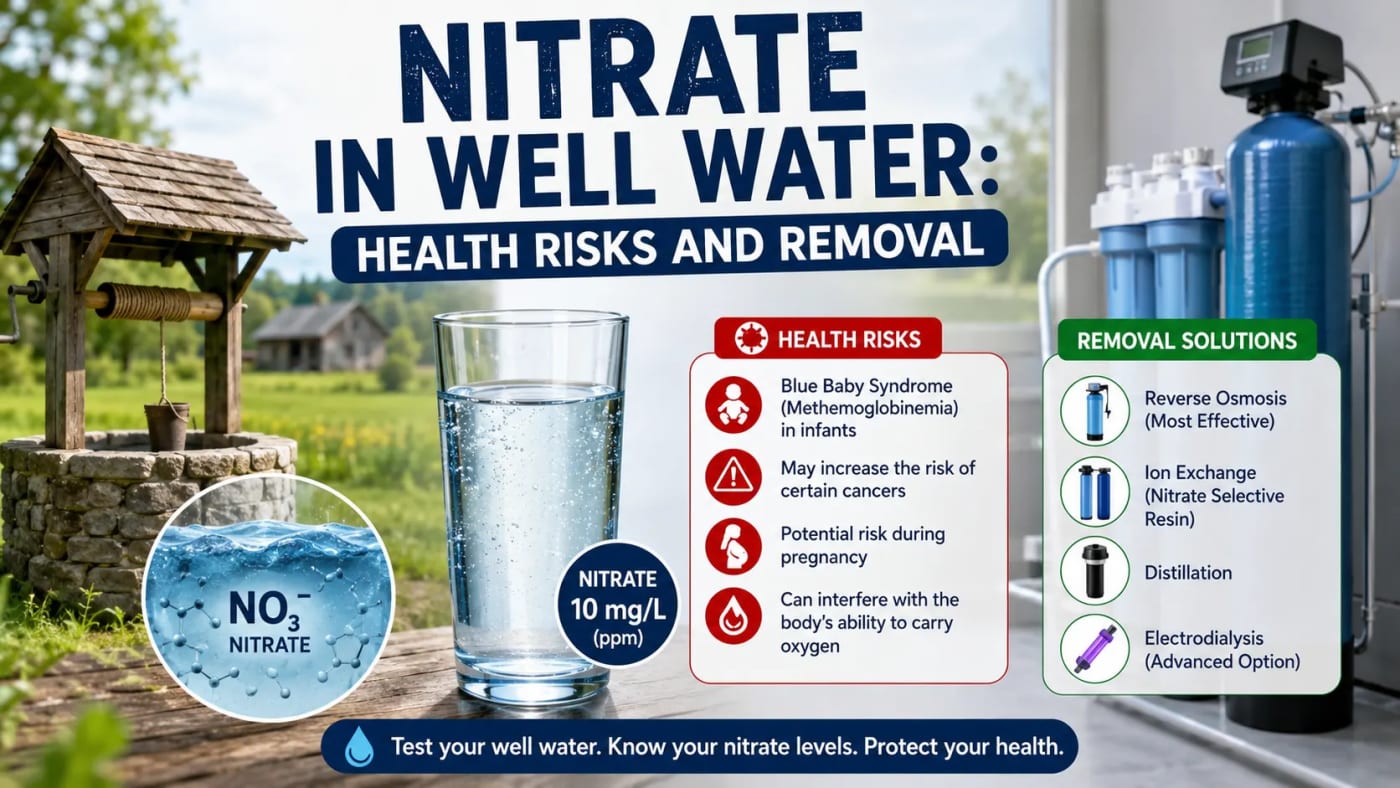
Nitrate in well water is a common but serious problem for homes that use private wells, and this article covers every part of the issue from start to finish. It explains how nitrate travels from surface sources such as fertilizer, manure and septic systems down through soil into groundwater, and why shallow or poorly sealed wells face the highest risk. It covers the health impact in clear terms, including how nitrate converts to nitrite in the body and why infants under six months face the greatest danger from methemoglobinemia. It states the exact unsafe threshold set by the EPA, at 10 mg/L nitrate-N, and explains the difference between nitrate and nitrate-N so lab results are read correctly. It walks through the full testing process, since taste and smell cannot detect nitrate, and lists the steps to take immediately after a high result, including why boiling water makes the problem worse rather than better. It compares the three proven removal methods, reverse osmosis, nitrate selective ion exchange and distillation, and explains how to choose between them based on household needs. It also covers ongoing maintenance and verification testing, source side prevention steps such as wellhead protection and septic care, and a final checklist to review before buying any treatment system. Read on for the complete path from contamination to a safe, tested, and properly maintained water supply.
How does nitrate get into private well water?
Nitrate gets into private well water through a chain of events that starts on the surface, moves through soil, and ends up in groundwater that feeds the well.
Nitrogen based substances break down into nitrate. Rain and irrigation water then carry this nitrate downward through the soil. Once it reaches the water table, it becomes part of the groundwater supply. Because nitrate dissolves easily and does not stick to soil particles, it travels through groundwater more freely than many other contaminants. This high mobility is the main reason nitrate shows up in wells located far from the original source.
Some wells face a higher risk than others. Shallow wells sit closer to the surface, so contaminants have less distance to travel before reaching them. Wells in sandy soil or fractured rock also allow water to move faster underground, giving nitrate less time to break down. A damaged casing or a poorly sealed wellhead creates a direct path for surface water, and the nitrate inside it, to enter the well.
Main sources of nitrate contamination:
Fertilizer: Nitrogen based fertilizer used on farms and lawns is a major nitrate source.
Manure and animal waste: Livestock operations release large amounts of nitrogen into nearby soil.
Septic systems: Household wastewater from septic tanks can leach nitrate into groundwater over time.
Agricultural runoff: Rain washes nitrogen from farmland into soil and nearby water sources.
Industrial sources: Certain industrial discharges add nitrogen compounds to local groundwater.
The EPA lists fertilizer, sewage and septic systems, and animal waste as important contributors to nitrate contamination in groundwater.
How does nitrate affect health after it enters drinking water?
Nitrate affects health mainly after it converts into nitrite inside the body. Nitrate itself is not the most dangerous part, but this conversion is. Once nitrate enters the body, certain conditions convert it into nitrite. Nitrite then binds to hemoglobin, the protein in blood that carries oxygen. This forms a compound called methemoglobin, which cannot carry oxygen properly. As methemoglobin builds up, the blood loses some of its ability to deliver oxygen to body tissues.
This condition is known as methemoglobinemia, often called blue baby syndrome. It gets this name because affected infants can develop a bluish tint to their skin, caused by low oxygen levels in the blood. Infants under six months face the highest risk. Their digestive systems convert nitrate to nitrite more easily than an adult digestive system does, and their bodies are less able to compensate for reduced oxygen delivery.
Pregnant women are another group that health agencies watch closely. Some research has looked at possible links between nitrate exposure and pregnancy outcomes, but these findings represent ongoing associations under study, not settled proof of cause and effect. People preparing infant formula, and anyone with certain existing health conditions that affect oxygen transport, also warrant extra caution.
Groups most vulnerable to nitrate exposure:
Infants under six months: Their bodies convert nitrate to nitrite more efficiently, raising methemoglobinemia risk.
Pregnant women: Nitrate exposure during pregnancy is an active area of health research.
People with certain medical conditions: Some conditions already reduce the blood's oxygen carrying capacity.
The EPA and CDC both confirm that acute methemoglobinemia risk in infants is the primary, well established health concern linked to nitrate in drinking water.
What nitrate level is unsafe in well water?
A nitrate level unsafe in well water is one at or above 10 mg/L, measured as nitrate nitrogen, according to the EPA. This number is called the Maximum Contaminant Level, or MCL. Nitrite has its own separate limit, set at 1 mg/L.
Understanding these numbers requires knowing two things. First, mg/L and ppm, or parts per million, mean the same thing when measuring substances dissolved in water. Second, there is a real difference between "nitrate as nitrogen," written as nitrate-N, and "nitrate" measured as the whole nitrate molecule. A lab report showing nitrate-N uses a different number than one showing total nitrate, even for the same water sample. Comparing a nitrate-N result against a total nitrate limit, or the reverse, gives a wrong interpretation of the risk.
The table below shows the verified EPA limits for nitrate and nitrite in drinking water:
Measurement | Unit | EPA Limit | Interpretation |
Nitrate (as nitrogen) | mg/L | 10 | Above this level is unsafe for drinking, especially for infants |
Nitrite (as nitrogen) | mg/L | 1 | Above this level is unsafe for drinking |
Always check which form your lab report uses before comparing it to these limits. If the report is unclear, ask the testing laboratory to confirm whether the result is nitrate-N or total nitrate.
How should you test a private well for nitrate?
You should test a private well for nitrate through a certified laboratory, since taste, smell and appearance cannot reveal nitrate contamination. Nitrate is colorless, odorless and tasteless, so a visual check or a sip of water gives no useful information about safety.
Follow these steps to test a private well properly.
Find a certified laboratory. Choose a lab accredited to test drinking water for nitrate. Many state health departments keep a list of approved labs.
Request a proper sample kit. The lab will supply a sterile container and instructions for correct sample collection.
Collect the sample correctly. Follow the lab's directions exactly, since a poorly collected sample can produce an inaccurate result.
Choose the right sampling point. Sample from a tap that draws directly from the well, before any treatment system, so the result reflects raw well water.
Send the sample promptly. Nitrate levels can change if a sample sits too long, so deliver it to the lab within the recommended time frame.
Review the result with the nitrate-N distinction in mind. Confirm whether the report shows nitrate-N or total nitrate before comparing it to safety limits.
Test for other contaminants if nitrate is high. An elevated nitrate result often justifies checking for bacteria too, since both can point to the same contamination pathway, such as a septic system or surface water intrusion.
Retest your well when any of these situations occur:
Annual testing: Test at least once a year, even without any known problem.
After flooding: Flooding can push surface contaminants into a well.
After well repairs: Repairs can disturb sediment or temporarily compromise the seal.
New wells: Always test a newly drilled or newly used well before relying on it.
Noticeable changes: Test again if water taste, smell or appearance changes, or if nearby land use changes.
The EPA recommends annual private well testing for nitrate and other basic water quality parameters.
What should you do after a high nitrate test result?
After a high nitrate test result, you should switch to a safe alternative water source right away for drinking, cooking and infant formula, while you plan a permanent solution. A high nitrate result means immediate action matters more than a slow response.
Stop using well water for infant formula immediately. This is the highest priority step, since infants face the greatest health risk.
Switch to bottled or another verified safe water source for drinking and cooking. Use this alternative until treatment is in place and confirmed effective.
Do not boil the water to try to fix it. Boiling evaporates water but leaves nitrate behind, which actually concentrates the nitrate level rather than reducing it.
Continue normal use for non ingestion activities. Bathing, laundry and cleaning generally do not carry the same ingestion based risk, though anyone with specific medical concerns should follow guidance from a health professional.
Contact your local health department. They can confirm next steps and may offer testing resources or guidance specific to your area.
Begin researching a permanent treatment or source solution. A one time switch to bottled water is not a long term fix, so plan for proper treatment.
Actions to avoid after a high nitrate result:
Do not boil the water for drinking. Boiling concentrates nitrate instead of removing it.
Do not assume filtration alone solves the problem. Many common filters do not remove nitrate at all.
Do not delay retesting after any fix. Confirm improvement with a new lab test rather than assuming a change worked.
The EPA specifically advises against using water above the 10 mg/L nitrate limit for infant formula or food, and warns that boiling high nitrate water increases nitrate concentration rather than lowering it.
Which methods remove nitrate from well water?
The methods that remove nitrate from well water are reverse osmosis, nitrate selective ion exchange, and distillation. Each works through a different mechanism and fits different situations.
Reverse osmosis pushes water through a semi permeable membrane that blocks nitrate and many other dissolved substances. It is commonly installed at a single point of use, such as a kitchen tap, and produces treated water for drinking and cooking. Reverse osmosis systems need regular membrane replacement and periodic performance checks to keep working correctly.
Nitrate selective ion exchange uses a resin that attracts nitrate ions and replaces them with chloride ions. This method can treat higher volumes of water, making it suitable for whole house use in some cases. The resin needs periodic regeneration with a salt solution, and it requires monitoring since capacity decreases as the resin absorbs more nitrate over time.
Distillation boils water into steam, then collects and cools that steam back into liquid form, leaving nitrate and other contaminants behind. This method removes nitrate effectively but treats water slowly and uses more energy than the other two options.
The table below compares the three proven nitrate removal methods:
Method | Mechanism | Typical Use | Maintenance |
Reverse osmosis | Membrane blocks nitrate ions | Point of use, drinking water tap | Regular membrane replacement |
Nitrate selective ion exchange | Resin swaps nitrate for chloride | Point of use or whole house | Periodic resin regeneration |
Distillation | Boiling and condensing water | Point of use, smaller volumes | Regular cleaning of unit |
Some common water treatment products do not remove nitrate, even though people sometimes assume they do.
Methods that do not remove nitrate:
Ordinary carbon filtration: Carbon filters target chlorine, odor and some organic compounds, not nitrate.
Sediment filtration: This removes visible particles, not dissolved nitrate.
Standard water softeners: These target hardness minerals like calcium and magnesium, not nitrate.
Boiling: As explained earlier, boiling concentrates nitrate rather than removing it.
The CDC identifies ion exchange, distillation and reverse osmosis as effective nitrate treatment technologies for drinking water.
How should you choose a nitrate treatment system?
You should choose a nitrate treatment system based on your nitrate concentration, how much treated water you need, and whether you want to treat one tap or the whole house. Selecting a system means matching these factors to the right technology, not just picking the most popular option.
Key factors to consider:
Nitrate concentration: Higher levels may need a more robust or higher capacity system.
Intended water use: Decide if you need treated water only for drinking and cooking, or for every tap in the home.
Point of use vs whole house: A point of use system treats water at one location, while a whole house system treats all water entering the home.
Flow demand: Consider how much water your household uses at once, since some systems handle high demand better than others.
Existing water chemistry: Other minerals or contaminants in your water can affect how well a treatment method performs.
Maintenance capacity: Some systems need more frequent attention than others, so consider what fits your routine.
Treatment verification: Choose a system that allows for easy monitoring and periodic testing of treated water.
A point of use system, such as a reverse osmosis unit under the kitchen sink, solves the problem of safe drinking and cooking water. A whole house system addresses a broader concern, treating water used for bathing, laundry and every tap in the home. These two setups solve different problems, so the right choice depends on which risks matter most for your household.
If nitrate selective ion exchange is the chosen method, confirm that the resin used is specifically nitrate selective, since standard softening resin does not target nitrate.
How do you maintain and verify nitrate removal?
You maintain and verify nitrate removal by testing the treated water on an ongoing basis, since installing equipment alone does not guarantee removal. A nitrate treatment system requires active monitoring, not a one time setup.
Steps to maintain and verify nitrate removal:
Test the treated water after installation. Confirm the system reduces nitrate to a safe level right from the start.
Compare influent and finished water results. Testing water before and after treatment shows exactly how much the system is removing.
Follow the manufacturer's maintenance schedule. Replace filters, membranes or resin according to the recommended timeline.
Monitor treatment capacity. Ion exchange resin loses effectiveness as it absorbs more nitrate, so track how much water has passed through the system.
Retest after any maintenance or suspected failure. A new filter or fresh resin should be confirmed effective with a follow up test.
Use an accredited lab for verification testing. Since health decisions depend on this result, accuracy matters more than convenience.
The table below shows a simple before and after comparison approach:
Stage | What to Test | Why It Matters |
Before treatment (influent) | Raw well water nitrate level | Establishes the baseline contamination level |
After treatment (finished water) | Treated water nitrate level | Confirms the system is reducing nitrate to a safe range |
For ion exchange systems, resin selection and regeneration frequency directly affect performance. Using the wrong resin type, or regenerating too infrequently, can allow nitrate to pass through untreated even while the system appears to be running normally.
How can you prevent nitrate from entering a private well?
You can prevent nitrate from entering a private well by addressing the contamination source, not just treating the water after it becomes contaminated. Treatment systems remove nitrate from water, but they do nothing to stop new nitrate from continuing to reach the well.
Prevention steps for private well owners:
Protect the wellhead. Keep the area around the well clean, graded away from the well, and free of stored chemicals or fertilizer.
Manage fertilizer and manure carefully. Apply fertilizer according to recommended rates and avoid heavy application near the well.
Maintain septic systems properly. Regular septic inspection and pumping reduces the chance of nitrogen leaching into groundwater.
Control drainage and runoff. Direct surface water away from the wellhead to reduce the chance of contaminated runoff reaching the well.
Inspect and seal the well casing. A damaged or poorly sealed casing creates a direct path for contamination.
Schedule professional well inspections. A qualified well contractor can identify vulnerabilities that are not visible from the surface.
In some cases, drilling a deeper or new well may reduce nitrate exposure, since deeper groundwater is sometimes less affected by surface contamination. This option depends heavily on local geology and should be considered a site specific decision, not a guaranteed fix for every property.
EPA and state guidance support wellhead protection and source control as key strategies for reducing nitrate contamination risk over the long term.
What should you check before choosing nitrate treatment?
Before purchasing any treatment equipment, gather the right information so the system you choose actually matches your situation.
Checklist before choosing a treatment system:
Current nitrate result: Know your exact nitrate level from a recent, accredited lab test.
Nitrate vs nitrate-N unit: Confirm which measurement your lab report uses.
Nitrite result: Check whether nitrite is also elevated, since it has its own separate limit.
Other water quality results: Review results for bacteria, hardness and other parameters that might affect treatment choice.
Well construction details: Know your well depth, casing condition and any recent repairs.
Intended water use: Decide if you need treatment for drinking only, or for the whole house.
Point of use or whole house need: Clarify this before comparing specific treatment products.
This checklist bridges your test results and your treatment decision. For deeper guidance on related topics, see the resources below.
What other contaminants should private wells be tested for?
Private wells should be tested for other contaminants beyond nitrate, including coliform bacteria, total dissolved solids and pH. The full list of recommended tests depends on local geology, nearby land use and any known contamination sources in your area. For complete guidance on this topic, see the Private Well Water Testing Guide.The EPA recommends annual testing for total coliform bacteria, nitrate, total dissolved solids and pH as a baseline for private well safety.
How often should private well water be tested?
Private well water should be tested at least once a year for nitrate and other recommended parameters. Test again after flooding, well repairs, drilling a new well, or any noticeable change in local conditions. For the full sample collection process, see the Private Well Water Testing Guide.
Does reverse osmosis remove nitrate from well water?
Reverse osmosis removes nitrate from well water and it is an established nitrate treatment technology. It is commonly used as a point of use system, though actual performance depends on the specific system and the water conditions in your home. For a complete guide, see Reverse Osmosis for Well Water.
Does a water softener remove nitrate?
A water softener does not remove nitrate when it is a standard hardness softener. Conventional softeners use cation exchange to remove calcium and magnesium, while nitrate removal requires a separate nitrate selective anion exchange resin. For a full comparison, see Water Softener vs Nitrate Filter.
Is well water safe for baby formula?
Well water is safe for baby formula only if nitrate stays below the EPA limit of 10 mg/L nitrate-N. Above that level, it should not be used for infant formula or food. The EPA specifically advises against using high nitrate well water for this purpose. For complete guidance, see Best Water for Baby Formula.
What is the difference between nitrate and nitrite?
The difference between nitrate and nitrite is that nitrate is written as NO3 and nitrite as NO2. They are related but separate compounds, each with its own EPA drinking water limit. The EPA sets 10 mg/L as nitrogen for nitrate and 1 mg/L as nitrogen for nitrite. For a full explanation, see Nitrate vs Nitrite in Drinking Water.
Conclusion
Nitrate contamination in private well water starts with fertilizer, manure, septic systems and other nitrogen sources, then travels through groundwater into the well itself. It cannot be seen, smelled or tasted, so testing through an accredited lab is the only reliable way to know your risk. A result at or above 10 mg/L nitrate-N calls for immediate action, especially for households with infants, followed by a proper long term treatment choice among reverse osmosis, nitrate selective ion exchange or distillation. Regular testing, correct system maintenance, and source protection together keep a private well safe for years to come.