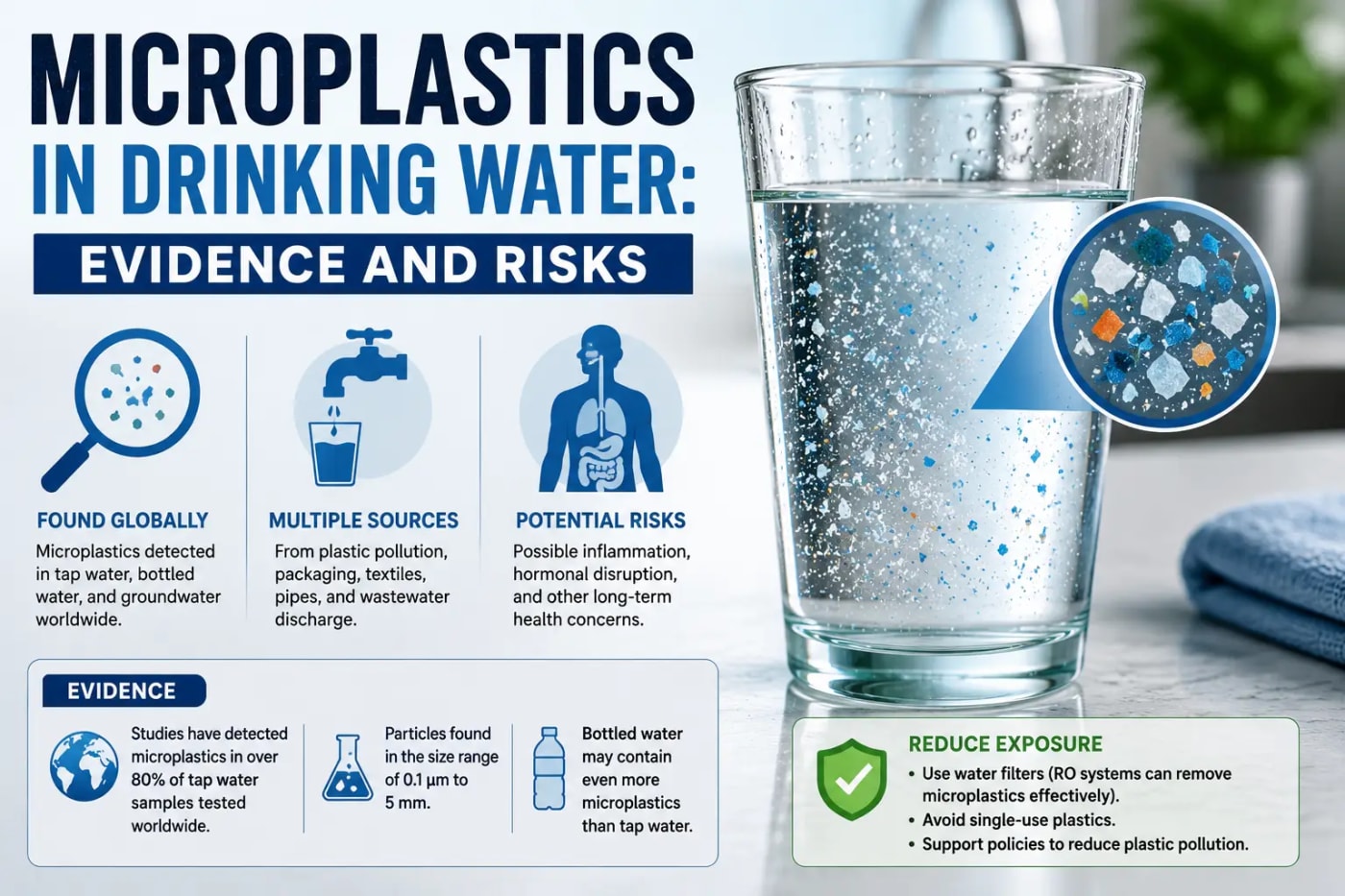
Microplastics in drinking water are tiny plastic particles and fibers that have been detected in both tap water and bottled water around the world. These particles can come from degraded plastic waste, synthetic textiles, packaging, and even the treatment and distribution systems that carry water into homes. In this article, you will learn what microplastics actually are, how they end up in drinking water, how common they are, what current health research says, how treatment plants and home filters handle them, and what practical steps you can take to reduce your exposure.
What Are Microplastics in Drinking Water?
Microplastics in drinking water are small plastic particles and fibers, generally defined as smaller than 5 millimeters, that have been found in tap water, groundwater, and bottled water. This size definition is widely used, though scientific definitions across studies are not yet fully standardized, which affects how results are compared.
It is important to separate this topic from the broader idea of plastic pollution in oceans or landfills. Microplastics in drinking water refer specifically to particles and fibers detected in water meant for human consumption, whether from a tap, a well, or a bottle. Contamination at this scale does not mean the water is visibly dirty, since these particles are far too small to see with the naked eye.
How Small Are Microplastics and Nanoplastics?
Microplastics and nanoplastics are separated mainly by size, and this size difference determines how easily each type can be detected and studied. Microplastics generally range from about 1 micrometer up to 5 millimeters. Nanoplastics are far smaller, typically described as less than 1 micrometer, based on definitions used by the FDA.
The table below shows a simple size comparison:
Particle type | Typical size range | Detection difficulty |
Microplastics | About 1 micrometer to 5 millimeters | Detectable with standard microscopy and spectroscopy |
Nanoplastics | Less than 1 micrometer | Much harder to detect, requires advanced analytical methods |
Since there is no single universal size standard across all research bodies, different studies sometimes use slightly different cutoff points, which is one reason reported findings can vary.
Which Plastic Forms Occur in Drinking Water?
The plastic forms that occur in drinking water include fibers, fragments, films, beads, and pellets, and researchers classify particles by shape because shape helps identify likely sources and behavior in water.
Common forms identified in drinking-water research:
Fibers: Thin, thread-like particles, often linked to synthetic textiles.
Fragments: Irregular broken pieces, typically from the breakdown of larger plastic items.
Films: Thin, flat sheet-like particles, often from packaging materials.
Beads: Small, rounded particles, sometimes originating from personal-care products or industrial processes.
Pellets: Small, uniform manufacturing particles, occasionally released during plastic production or transport.
Classifying particles by form is a research tool. It helps scientists compare findings across studies, rather than explaining exactly where every particle originated.
Where Do Microplastics in Drinking Water Come From?
Microplastics in drinking water come from a combination of environmental sources and the water system itself, from degrading plastic waste to packaging and distribution infrastructure. The pathway generally moves from source to water system, through treatment, and finally into distribution and the point of use.
How Do Plastic Sources Reach Water Supplies?
Plastic sources reach water supplies through both environmental routes and system-level routes, and it helps to view these as two separate paths that eventually meet.
Main pathways plastic particles travel through to reach water supplies:
Surface runoff: Rain washes plastic debris and fibers from roads, soil, and urban surfaces into rivers and lakes.
Wastewater discharge: Treated and untreated wastewater can carry microplastics, including fibers shed from washing synthetic clothing.
Degradation of larger plastic items: Sunlight, weathering, and physical wear break larger plastic debris into smaller fragments over time.
Synthetic textile fibers: Washing machines release small fibers from synthetic fabrics, which can enter wastewater systems.
Treatment and distribution infrastructure: Some research points to possible contribution from pipes, storage tanks, and system components, though this route is generally considered secondary to environmental input.
This section focuses on how particles travel into the water system. It is separate from packaging-related contamination, which relates specifically to bottled water and is addressed later in this article.
How Common Are Microplastics in Drinking Water?
Microplastics are common in drinking water in the sense that they have been detected in numerous studies across both tap and bottled sources, though there is no single universal average concentration that applies everywhere. Reported concentrations vary widely because of differences in water source, particle-size threshold, sample volume, analytical method, and reporting unit.
The table below shows selected verified findings from published research, labeled by their specific study context:
Water type | Sample context | Size threshold or method | Reported finding | Study year |
Bottled water | Multiple bottled water brands (US) | Stimulated Raman scattering, capturing particles down to nanometer scale | About 240,000 micro/nanoplastic particles per liter, roughly 90 percent identified as nanoplastics | 2024 |
Tap and source water | Various global systematic reviews | Varies by study, generally microplastic range | Wide range of reported particle counts, not reducible to one figure | Multiple, ongoing |
Every number in this table is study-specific. It reflects the conditions and methods of that particular study, not a fixed universal measurement that applies to all water everywhere.
Are Microplastics More Common in Bottled or Tap Water?
Microplastics have been reported at higher particle counts in some bottled water studies compared to some tap water studies, but this comparison cannot be reduced to one universal ratio, since detection methods and particle-size thresholds differ significantly between studies.
The table below compares bottled and tap water evidence at a high level:
Factor | Bottled water | Tap water |
Reported particle counts | Some studies report very high counts, including nanoplastics | Reported counts vary widely by source and study |
Detection method sensitivity | Advanced studies, such as the 2024 PNAS research, detect down to nanometer scale | Detection sensitivity varies by study and equipment |
Packaging contribution | Bottle material and cap can be a contributing source | Not applicable in the same way |
Regulatory oversight | FDA oversees bottled water safety | Public water systems are regulated separately |
The 2024 PNAS study found about 240,000 micro and nanoplastic particles per liter in the bottled water samples tested, with roughly 90 percent identified as nanoplastics. This finding applies specifically to the bottles and methodology used in that study. It should not be treated as a fixed number for every bottled water brand.
Which Plastic Polymers Are Found in Drinking Water?
The plastic polymers found in drinking water most often include polyethylene, polyethylene terephthalate, polypropylene, polystyrene, polyvinyl chloride, polyamide, and polyester or nylon fibers, depending on the study and water source.
The table below lists common polymers identified in drinking-water research:
Polymer | Abbreviation | Common use or context | Reported drinking-water relevance |
Polyethylene | PE | Packaging, plastic bags, bottle caps | Frequently identified in water samples |
Polyethylene terephthalate | PET | Plastic bottles, food containers | Commonly found in bottled water research |
Polypropylene | PP | Bottle caps, packaging | Regularly identified alongside PE |
Polystyrene | PS | Foam products, packaging | Detected in some water studies |
Polyvinyl chloride | PVC | Pipes, some packaging | Detected in select studies, linked to infrastructure |
Polyamide (nylon) | PA | Synthetic textiles | Linked to fiber contamination from laundry sources |
Polyester | — | Synthetic textiles | Linked to fiber shedding during washing |
Identifying the specific polymer helps researchers understand likely sources and characterize particle composition. It does not, on its own, indicate a specific health outcome.
How Much Microplastic Exposure Comes From Drinking Water?
Microplastic exposure from drinking water depends on the concentration of particles present, how much water a person consumes, and the particle-size range that a given study is able to detect. Exposure is not the same thing as occurrence, since a high particle count in a water sample does not automatically translate into a known or standardized human intake figure.
Particle counts alone also do not equal mass exposure or established health risk. A sample with many very small particles may represent a small total plastic mass, while a sample with fewer larger particles could represent a different mass entirely. Because analytical methods differ so much between studies, researchers generally avoid stating one universal daily intake number for the general population, and any specific calculation should always be tied to the exact study it came from, including its assumptions about water consumption and detection range.
What Health Effects Are Linked to Microplastics?
The health effects linked to microplastics are still under active research, and current evidence does not establish that the levels typically detected in food or water cause specific human diseases. It is important to separate different types of evidence when discussing this topic.
Types of evidence currently being studied:
Mechanistic evidence: Laboratory research explores potential biological pathways, including inflammation, oxidative stress, and possible endocrine-related interactions.
Animal evidence: Some animal studies show biological responses to plastic particle exposure under experimental conditions, though these conditions often do not directly reflect typical human drinking-water exposure.
Human evidence: Confirmed, causally established human health outcomes directly tied to microplastic exposure from drinking water have not yet been demonstrated in high-quality human studies.
The FDA's current position states that available evidence does not demonstrate that the levels of microplastics or nanoplastics currently found in food and water pose a risk to human health. This does not mean the topic is closed. It means that, as of now, a causal link between typical drinking-water exposure and specific disease outcomes has not been established through rigorous human research.
Can Nanoplastics Enter the Human Body More Easily?
Nanoplastics can potentially enter the human body more easily than larger microplastics because their extremely small size may allow them to interact with biological tissues and barriers differently. This is a key reason researchers study nanoplastics separately from larger microplastics.
Laboratory and experimental research, including work referenced in PNAS and discussed by sources such as Cleveland Clinic, has explored how very small particles might interact with cells and tissue barriers. It is essential to keep a clear line between laboratory or experimental findings and proven clinical effects in people. At this stage, the biological significance of nanoplastic exposure in humans remains an active area of study rather than a settled clinical conclusion.
How Are Microplastics Detected in Drinking Water?
Microplastics are detected in drinking water through a multi-step analytical process that begins with sample collection and ends with particle identification and counting. Understanding this process explains why different studies often report different results.
The detection process generally follows these steps:
Sample collection: Water is collected using standardized or study-specific protocols, which can vary in volume and method.
Filtration or concentration: The sample is filtered to concentrate particles for analysis, since raw water often contains particles at very low density.
Microscopy examination: Filtered material is examined under a microscope to identify visible particles and fibers.
Polymer identification: Techniques such as Fourier-transform infrared spectroscopy (FTIR) and Raman spectroscopy identify the specific plastic polymer type present.
Advanced quantification: For very small particles, including nanoplastics, thermal analysis or mass-spectrometry-based methods may be used for more precise measurement.
There is currently no single standardized sampling, detection, and characterization method used across all research globally, which is one of the central reasons study results are not always directly comparable.
Why Do Microplastic Studies Report Different Counts?
Microplastic studies report different counts mainly because of variation in methodology rather than because water itself varies dramatically between locations.
The table below shows common sources of variation and their effect on reported results:
Source of variation | Effect on reported result |
Particle-size cutoff | Studies detecting smaller particles report much higher counts |
Sample volume | Larger sample volumes can capture more particles, changing the reported concentration |
Sample contamination control | Poor contamination control can inflate reported counts |
Analytical sensitivity | More advanced equipment detects particles that older methods miss |
Polymer identification method | Different methods identify or miss different polymer types |
Reporting unit | Some studies report particles per liter, others report mass per liter, making direct comparison difficult |
Recognizing these variables helps explain why one study might report a few particles per liter while another reports hundreds of thousands, without either study necessarily being wrong.
How Do Water Treatment Plants Remove Microplastics?
Water treatment plants remove microplastics through a series of engineering steps, and removal effectiveness depends heavily on particle size, shape, polymer type, and water chemistry. Common stages include coagulation and flocculation, sedimentation, sand or media filtration, granular activated carbon, and membrane processes such as ultrafiltration.
Recent research examining ten treatment facilities reported removal rates above 97.5 percent for particles larger than 2 micrometers, primarily through chemically assisted granular media filtration or ultrafiltration. This finding reflects the specific facilities and conditions studied. It should be understood as a documented research result, not a guaranteed removal rate for every treatment plant everywhere, since local infrastructure, water chemistry, and particle characteristics all affect real-world performance.
Which Treatment Methods Capture Smaller Particles?
Treatment methods that capture smaller particles rely increasingly on membrane technology as particle size decreases, since standard filtration alone becomes less effective at very small scales.
A general size-capability comparison across membrane technologies:
Microfiltration: Effective against larger microplastic particles, but less effective against very fine particles.
Ultrafiltration: Captures a broader range of smaller particles than microfiltration, useful against many microplastics.
Nanofiltration: Targets even smaller particles and some dissolved substances, sitting between ultrafiltration and reverse osmosis in capability.
Reverse osmosis: Uses the finest membrane structure among these options, capable of addressing very small particles, though it should not be described as removing all particles under all conditions.
As particle size decreases toward the nanoplastic range, membrane-based treatment generally becomes more relevant than standard media filtration, though performance still depends on the specific system design and maintenance.
Can Boiling Reduce Microplastics in Drinking Water?
Boiling can reduce microplastics in drinking water under specific conditions, but boiling alone is not the same as the full process tested in the relevant 2024 research. The reported reduction came from a process involving boiling combined with filtration afterward, not from boiling by itself.
The mechanism relates to calcium carbonate, commonly known as limescale, which forms during boiling in hard water. This limescale can trap plastic particles, which are then removed when the water is filtered afterward, such as through a coffee filter.
The tested process generally followed these steps:
Boil the water: Heating the water encourages calcium carbonate to form, particularly in hard water.
Allow limescale formation: As the water cools slightly, calcium carbonate structures form and can trap surrounding plastic particles.
Filter the water: Passing the water through a filter removes the limescale along with the trapped particles.
The reported maximum reduction was about 90 percent, and this figure came specifically from hard-water experimental conditions. Soft-water samples in the same research showed a much lower reduction, since soft water contains far less calcium carbonate to form the limescale that traps particles. This means the effectiveness of this method depends heavily on local water hardness, and it should not be assumed to work the same way for every household.
How Can People Reduce Microplastic Exposure From Water?
People can reduce microplastic exposure from water through a combination of practical daily choices, though no current method promises complete elimination of plastic particles.
Practical actions to reduce microplastic exposure from drinking water:
Reduce single-use plastic bottle reliance: Where safe tap water is available, using a reusable container instead of bottled water can reduce one potential contact point.
Use certified filtration: Selecting a filtration system with a verified reduction claim relevant to your local water supply, based on resources such as NSF listings, targets specific contaminants rather than assuming universal removal.
Store bottled water properly: Keeping bottled water away from heat and direct sunlight avoids conditions that may accelerate plastic degradation.
Avoid unnecessary heat exposure to plastic containers: Avoiding heating water or beverages in plastic containers can reduce one potential source of particle release.
These actions can meaningfully reduce certain exposure points, but they do not guarantee zero microplastic exposure, since particles are present across many parts of the environment and water system.
What Does the US Regulate About Microplastics in Water?
The US currently regulates bottled water safety through the FDA, but there is no specific federal microplastic or nanoplastic limit for drinking water at this time. Public water systems fall under separate regulatory oversight, and microplastics are being studied as an emerging contaminant rather than treated as an already-regulated substance with an enforceable limit.
The table below shows the current regulatory status at a glance:
Agency | Responsibility | Current position on microplastics |
FDA | Bottled water safety | No specific microplastic or nanoplastic limit currently established |
EPA | Public drinking water systems | Reviewing microplastics as part of the 2026 Contaminant Candidate List (CCL6), an emerging-contaminant research and evaluation step, not an established maximum contaminant level |
This regulatory picture may continue to evolve as research develops. At present, inclusion on a contaminant candidate list represents a research and evaluation stage, not a finalized enforceable standard.
What Should Consumers Do About Microplastics in Water?
Consumers should approach microplastics in water by first understanding their local water source, then identifying which contaminants are actually relevant to that source, before choosing any specific filtration method. This section acts as a bridge from the science already explained above to the specific practical questions covered next.
Detecting microplastics in a water sample does not automatically mean that water is unsafe to drink, since current health evidence has not established that typical detected levels cause specific harm. At the same time, eliminating every single plastic particle from drinking water is not currently a realistic standard for most households, given how widespread these particles are across water systems and packaging.
NSF recommends starting with your local water-quality report, since this tells you which contaminants are actually present in your specific water supply. From there, filtration decisions can be based on verified claims tied to your actual water conditions, rather than choosing a product based on general marketing claims alone.
Which Water Filters Remove Microplastics?
Water filters remove microplastics based on the specific filtration technology used, the particle size it targets, and whether the product carries a verified reduction claim. NSF listings include specific products tested against microplastics-reduction claims, which gives a more reliable reference point than general marketing language. For a full comparison of filter types and specific product options, see [Best Water Filters for Microplastics].
Does Reverse Osmosis Remove Microplastics?
Reverse osmosis does remove a significant portion of microplastics because its membrane structure is fine enough to capture very small particles, though it should not be described as removing 100 percent under all conditions. Membrane performance can be affected by maintenance and system condition over time. For a complete explanation of reverse osmosis systems, see [Reverse Osmosis Water Filters].
Do Activated Carbon Filters Remove Microplastics?
Activated carbon filters are primarily designed for adsorbing dissolved contaminants rather than physically capturing plastic particles, so their microplastic performance depends on the physical filtration stage built into the specific product. Not all carbon filters offer the same level of particle removal. For more detail on how these filters work, see [Activated Carbon Water Filters].
Is Bottled Water Better Than Filtered Tap Water?
Bottled water is not automatically better than filtered tap water, since both have documented microplastic findings in published research, and their regulatory and contaminant profiles differ. The better choice depends on your local tap water quality and the specific filtration or bottled product involved. For a detailed comparison, see [Bottled Water vs Tap Water].
How Can You Test Water for Microplastics?
Testing water for microplastics requires laboratory-based analysis, since standard home water-test kits are not designed to reliably quantify microplastic particles. Sampling protocols and analytical-method limitations affect result accuracy even in professional testing. For a broader overview of water-quality testing, see [How to Test Water Quality].
Can You Remove Microplastics From Water at Home?
Removing microplastics from water at home is possible to some degree through appropriate filtration, and in specific conditions, through boiling followed by filtration. Performance depends heavily on particle size and the specific technology used, so results vary by household and water source. For a complete removal guide, see [How to Remove Microplastics From Water].
Conclusion
Microplastics have been detected in both tap and bottled drinking water, though reported levels vary widely depending on the study, the water source, and the detection method used. Current health evidence, including the FDA's stated position, does not establish that typical detected levels cause specific human health harm, even though research into potential biological pathways continues. Treatment plants and certain home filtration methods can reduce microplastic particles significantly, though no current method guarantees complete removal. The most useful approach for most households is understanding the local water source, following verified filtration claims where relevant, and staying informed as research on this topic continues to develop.