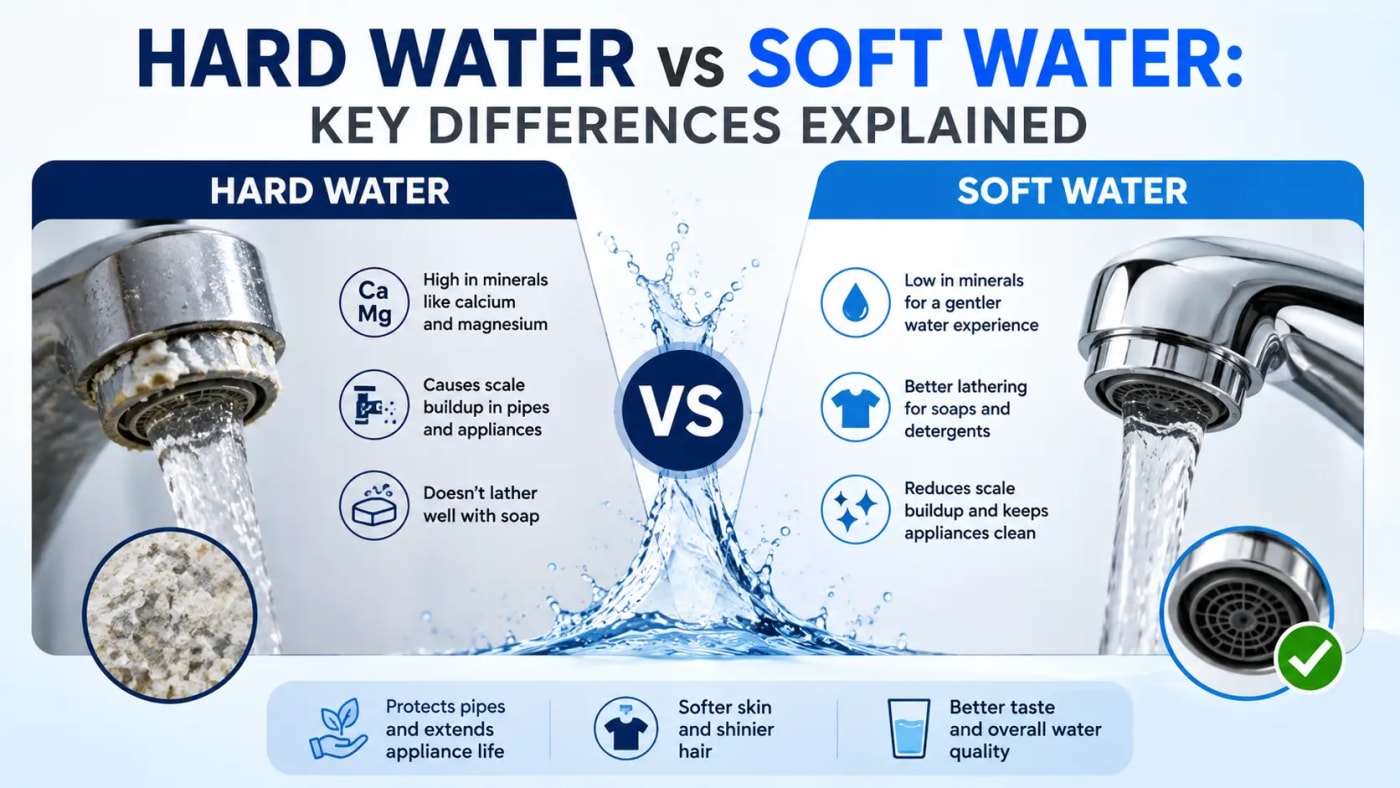
The main difference between hard water and soft water is mineral content. Hard water carries a high amount of dissolved calcium and magnesium, while soft water contains very little of these minerals or none at all. This one factor changes how water tastes, how it cleans, how it treats skin and hair, and how it affects pipes and appliances over time. In this article, you will learn how hardness is measured, how to spot the signs of hard water at home, what softening actually does to water, and how to decide which type of water fits your household best.
How does mineral content make water hard or soft?
Mineral content makes water hard or soft based on how much calcium and magnesium it carries. As water moves through soil and rock, it picks up these minerals. Water with high levels of calcium and magnesium is called hard water. Water with low levels is called soft water.This mineral content is often expressed as calcium carbonate equivalent, since calcium and magnesium levels are usually combined into one number for easy comparison.
It is worth stating clearly: hardness is not a sign that water is dirty or unsafe. It is simply a measure of mineral composition. A glass of hard water and a glass of soft water can both be clean and safe to drink. The difference lies in what dissolved minerals are present, not in contamination.
How are hard and soft water measured?
Hard and soft water are measured using a few common units, and understanding these units helps you read a water report or a test kit result correctly.
The table below shows the main units used to measure water hardness:
Unit | What it means | Typical use |
mg/L | Milligrams of mineral per liter of water | Common on water utility reports |
ppm | Parts per million, numerically equal to mg/L | Used interchangeably with mg/L |
CaCO₃ equivalent | Combined calcium and magnesium expressed as calcium carbonate | Standard scientific measurement |
Grains per gallon (gpg) | Older US unit, one grain equals about 17.1 mg/L | Common on water softener packaging |
Since ppm and mg/L represent the same value, you do not need to convert between them. To convert grains per gallon to mg/L, multiply by 17.1.
What hardness levels define soft and hard water?
The hardness levels that define soft and hard water fall into a fixed set of ranges, from soft to very hard. These ranges help you understand where your water stands and whether treatment might be useful.
The table below shows the standard hardness classification:
Classification | mg/L or ppm | Grains per gallon |
Soft | 0 to 60 | 0 to 3.5 |
Slightly hard | 61 to 120 | 3.5 to 7 |
Moderately hard | 121 to 180 | 7 to 10.5 |
Hard | 181 to 250 | 10.5 to 14.6 |
Very hard | Above 250 | Above 14.6 |
Most household water in the United States falls somewhere between slightly hard and hard. Very hard water is less common but does occur in areas with limestone-rich groundwater.
How can you tell if your water is hard?
You can tell if your water is hard by watching for a set of visible signs around your home. These signs are useful clues, but they do not tell you the exact hardness level. Only a test can give a precise number.
Common signs of hard water include:
White spots on dishes: Mineral deposits dry on glassware and dishes after washing, leaving a cloudy film.
Scale buildup: A chalky white or gray crust forms inside kettles, faucets, and showerheads over time.
Reduced soap lather: Soap and shampoo produce less foam and rinse away less easily.
Soap scum: A sticky residue forms in sinks, tubs, and on shower doors.
Stiff laundry: Clothes washed in hard water can feel rough or stiff after drying.
Dry skin after showers: Skin can feel tight or dry, since soap does not rinse off as completely.
If you notice several of these signs together, your water is likely hard. A test still gives you the most reliable answer, and it is covered later in this article.
How does hard water affect soap and cleaning?
Hard water affects soap and cleaning by reacting chemically with soap instead of letting it lather freely. Calcium and magnesium in hard water react with soap and form an insoluble compound, commonly known as soap scum, instead of a clean lather. As a result, more soap is needed to get the same cleaning effect.
Practical cleaning effects of hard water:
Less foam: Shampoo, dish soap, and laundry detergent produce noticeably less lather.
Higher soap use: Households often use more soap and detergent to compensate, which raises costs.
Spots on glassware: Dishes and glasses come out of the dishwasher with visible water spots.
Fabric residue: Laundry detergent can leave a slight film on fabric, making clothes feel less soft.
Rinsing difficulty: Soap residue is harder to rinse away completely from skin, hair, and surfaces.
Soft water does not create this reaction, so soap lathers more easily and rinses away cleanly with less product.
How does hard water affect plumbing and appliances?
Hard water affects plumbing and appliances by leaving mineral scale inside pipes and equipment over years of use. This buildup is most noticeable on surfaces that heat water, since heat speeds up mineral deposit formation.
The table below shows how hard water typically affects different home components:
Home component | Typical hardness effect |
Water heater | Scale builds on heating elements, reducing efficiency and lifespan |
Pipes | Mineral deposits narrow the inside of pipes, reducing water flow over time |
Dishwasher | Scale forms on internal parts and leaves spots on dishes |
Washing machine | Reduced detergent efficiency and possible buildup on internal components |
Faucets and showerheads | Visible white crust forms around openings, sometimes reducing water flow |
Coffee makers and kettles | Scale collects quickly due to repeated heating |
Over many years, this buildup can shorten the lifespan of appliances and reduce their efficiency, which is one of the main practical reasons households consider treating hard water.
How do hard and soft water differ for skin and hair?
Hard and soft water differ for skin and hair mainly in how completely soap rinses away after washing. With hard water, soap reacts with minerals and leaves a slight residue on skin and hair, even after rinsing. This residue can make hair feel coated or make skin feel dry and tight.
With soft water, soap rinses away completely. This creates a different sensation: skin can feel slippery or smooth immediately after rinsing, since no residue and no soap film remain to create resistance against the fingers. This slippery feeling is often mistaken for soap being left behind, but it actually means soap has fully rinsed off.
A quick comparison of the skin and hair experience:
Hard water: Soap residue remains, hair can feel coated, skin can feel tight or dry after washing.
Soft water: Soap rinses completely, skin can feel slippery right after rinsing, hair often feels softer.
Neither experience causes harm on its own. The difference is about sensation and soap behavior, not about skin damage.
How do hard and soft water differ for drinking?
Hard and soft water differ for drinking mainly in taste and mineral content, not in basic safety. Hardness itself is not generally considered a health hazard at the levels typically found in tap water. In fact, calcium and magnesium in hard water can contribute a small amount to daily mineral intake.
Taste is a separate matter from safety. Some people notice a slightly different taste in hard water due to its mineral content, while others cannot tell a difference at all. Taste preference varies from person to person and does not indicate which water is better for health.
It is inaccurate to claim that hard water is universally healthier than soft water, or the other way around. Hardness level and drinking water safety are two separate topics, and a water source can be perfectly safe regardless of where it falls on the hardness scale.
How does softened water differ from naturally soft water?
Softened water differs from naturally soft water in chemical makeup, even though both are described as soft. Naturally soft water forms when water passes through areas with low mineral content in the soil and rock. It never picks up much calcium or magnesium in the first place.
Softened water, on the other hand, starts out as hard water and goes through a treatment process. During this process, calcium and magnesium are replaced with sodium or potassium ions through a method called ion exchange. The water becomes soft in terms of calcium and magnesium content, but it now contains added sodium or potassium that naturally soft water would not have.
This distinction matters most for people who are watching their sodium intake, which is explained further below.
What are the main differences between hard and soft water?
The main differences between hard and soft water cover mineral content, cleaning behavior, appliance impact, taste, and treatment needs. After looking at each part of this topic separately, here is a direct side-by-side comparison.
The table below summarizes the main differences between hard and soft water:
Attribute | Hard water | Soft water |
Mineral content | High calcium and magnesium | Low or no calcium and magnesium |
Soap and lather | Produces less lather, needs more soap | Lathers easily, needs less soap |
Scale buildup | Common on pipes, appliances, and fixtures | Rare or minimal |
Appliance impact | Can shorten appliance lifespan over years | Generally reduces scale-related wear |
Skin and hair feel | Can feel dry, residue can remain | Can feel slippery, residue rinses away |
Taste | Sometimes noticeable mineral taste | Often described as neutral |
Sodium content | None added | Can be higher if softened through ion exchange |
Treatment need | May need softening for scale problems | Usually needs no treatment for hardness |
This table brings together the practical differences already explained in the sections above, without introducing new claims.
When should you consider softening hard water?
You should consider softening hard water when scale buildup, soap problems, or appliance wear become a regular issue in your home. Softening is a practical household decision, not a requirement for every home with hard water. Many households with moderately hard water manage fine without a softener.
A useful general reference point is that hardness above about 7 grains per gallon, or around 120 mg/L, is where a softener can start to make a noticeable difference for appliance performance and cleaning results. This is a guideline, not a strict rule, and the right decision depends on your specific water hardness level, your appliances, and how much scale buildup or soap performance issues you are experiencing.
Signs that softening may be worth considering:
Frequent scale buildup: Kettles, faucets, or shower fixtures need regular descaling.
High soap and detergent use: You use noticeably more soap, shampoo, or laundry detergent than expected.
Appliance wear: Water heaters or dishwashers show reduced performance earlier than expected.
Persistent spotting: Dishes and glassware consistently show water spots even after washing.
How does a water softener change hard water?
A water softener changes hard water through a process called ion exchange, which removes hardness minerals and replaces them with sodium or potassium. The process follows a clear sequence of steps.
The process works in this order:
Hard water enters the softener: Water containing calcium and magnesium flows into a tank filled with resin beads.
Ion exchange takes place: The resin beads attract and hold calcium and magnesium, releasing sodium or potassium ions into the water in their place.
Softened water flows out: Water leaving the tank now has low calcium and magnesium content, but slightly higher sodium or potassium content.
Resin becomes saturated over time: After softening a certain volume of water, the resin beads become full of calcium and magnesium and can no longer exchange ions effectively.
Regeneration restores the resin: A concentrated salt or potassium solution flushes through the resin, replacing the collected calcium and magnesium with fresh sodium or potassium, so the cycle can start again.
This cycle repeats automatically in most modern softeners, based on water usage or a set schedule.
What should you know before drinking softened water?
Before drinking softened water, you should know that it contains more sodium than the original hard water, since ion exchange softening replaces calcium and magnesium with sodium. The amount of sodium added depends on how hard the original water was. Water that started out very hard will show a larger sodium increase after softening compared to water that started out only slightly hard.
For most people, this added sodium is small compared to daily sodium intake from food. However, people following a sodium-restricted diet should take this into account and speak with a healthcare provider about their specific water source, since individual dietary needs vary. Some households also choose to keep one untreated tap for drinking and cooking, separate from the softened water supply used for cleaning and bathing.
How can you test your home's water hardness?
You can test your home's water hardness through your water utility report, a home test kit, or a certified laboratory. Testing gives a precise hardness number, instead of relying only on visible signs like spots or soap residue.
Common ways to test water hardness:
Water utility report: If your water comes from a public supply, your utility publishes an annual water quality report that usually lists hardness level.
Home test kit: Test strips or drop-based kits are available at hardware stores and give a quick estimate of hardness.
Laboratory testing: A certified water testing lab gives the most accurate and detailed result, including exact mineral content.
Checking your local water report or requesting a test is a reliable first step before deciding whether softening makes sense for your household.
Which water is better for your home?
Which water is better for your home depends on what you value most, since there is no single winner between hard and soft water. The better choice depends on your priorities around cleaning, appliances, taste, and sodium intake.
The table below matches common concerns with the water type that usually addresses them:
Concern | Preferred approach |
Preserving natural mineral content in drinking water | Hard water, left untreated |
Reducing scale in pipes and appliances | Softened water |
Minimizing soap and detergent use | Softened water |
Avoiding added sodium in drinking water | Hard water, or a separate untreated drinking tap |
Extending appliance lifespan | Softened water |
Simplicity, with no treatment system to maintain | Hard water, if scale problems are minor |
Use this table as a starting point, then weigh it against your specific hardness test result and household priorities.
What is the difference between a water filter and a softener?
The difference between a water filter and a softener is what each one removes from water. A softener specifically targets hardness minerals, calcium and magnesium, and removes them through ion exchange. A filter, depending on its technology, targets different substances entirely, such as sediment, chlorine, certain chemicals, or, in some systems, biological contaminants.
It is worth noting clearly that a standard water softener does not remove parasites, bacteria, or viruses from water. Softening and disinfection are two separate functions, and a softener alone should not be relied on for water safety from biological contaminants.
How does a water softener work?
A water softener works by using resin beads to exchange calcium and magnesium for sodium or potassium through ion exchange, then regenerating the resin using a salt or potassium solution once it becomes saturated. For a full breakdown of resin types, tank sizing, salt use, and maintenance schedules, see our complete [Water Softener Guide].
What is the best water softener for hard water?
The best water softener for hard water depends on your hardness level, daily household water use, preferred regeneration method, and efficiency rating. Water- and salt-efficient models with recognized certification are generally a stronger long-term choice. For detailed product comparisons and buying advice, see [Best Water Softeners for Hard Water].
Does reverse osmosis remove hard water minerals?
Reverse osmosis does reduce some hard water minerals, but it is a different treatment approach from softening. It pushes water through a fine membrane and can reduce many dissolved substances, including some hardness minerals, but it is not designed or sized the same way as a dedicated softener for whole-house hardness treatment. For a full explanation of when to choose one system over the other, see [Reverse Osmosis vs Water Softener].
How can you test water hardness at home?
You can test water hardness at home using a hardness test strip or a drop-based test kit, both available at most hardware stores. These give a quick reading you can compare against the hardness classification table earlier in this article. For a complete step-by-step testing guide, see [How to Test Water Hardness at Home].
What are the benefits of a water softener?
The benefits of a water softener include reduced scale buildup, easier soap and detergent use, and added protection for plumbing and appliances against long-term hardness damage. For a deeper look at each benefit, see [Water Softener Benefits].
Is softened water safe to drink?
Softened water is safe to drink for most people, though it does contain more sodium than the original hard water due to the ion exchange process. People on sodium-restricted diets should review their specific water source. For sodium calculations and setup advice, see [Is Softened Water Safe to Drink?].
What are the signs of hard water in a home?
The signs of hard water in a home include scale buildup around faucets and fixtures, white spots on dishes and glassware, and soap that will not lather easily. For a complete checklist, see [Signs of Hard Water in Your Home].
Conclusion
Hard water and soft water differ mainly in mineral content, and this single difference shapes everything from cleaning results to appliance lifespan and drinking water taste. Hard water carries calcium and magnesium, which can cause scale and reduce soap performance, while soft water lacks these minerals and rinses more completely, though softened water does add some sodium. Neither type is automatically better for every home. The right choice depends on your test results, your appliances, and what matters most to your household.