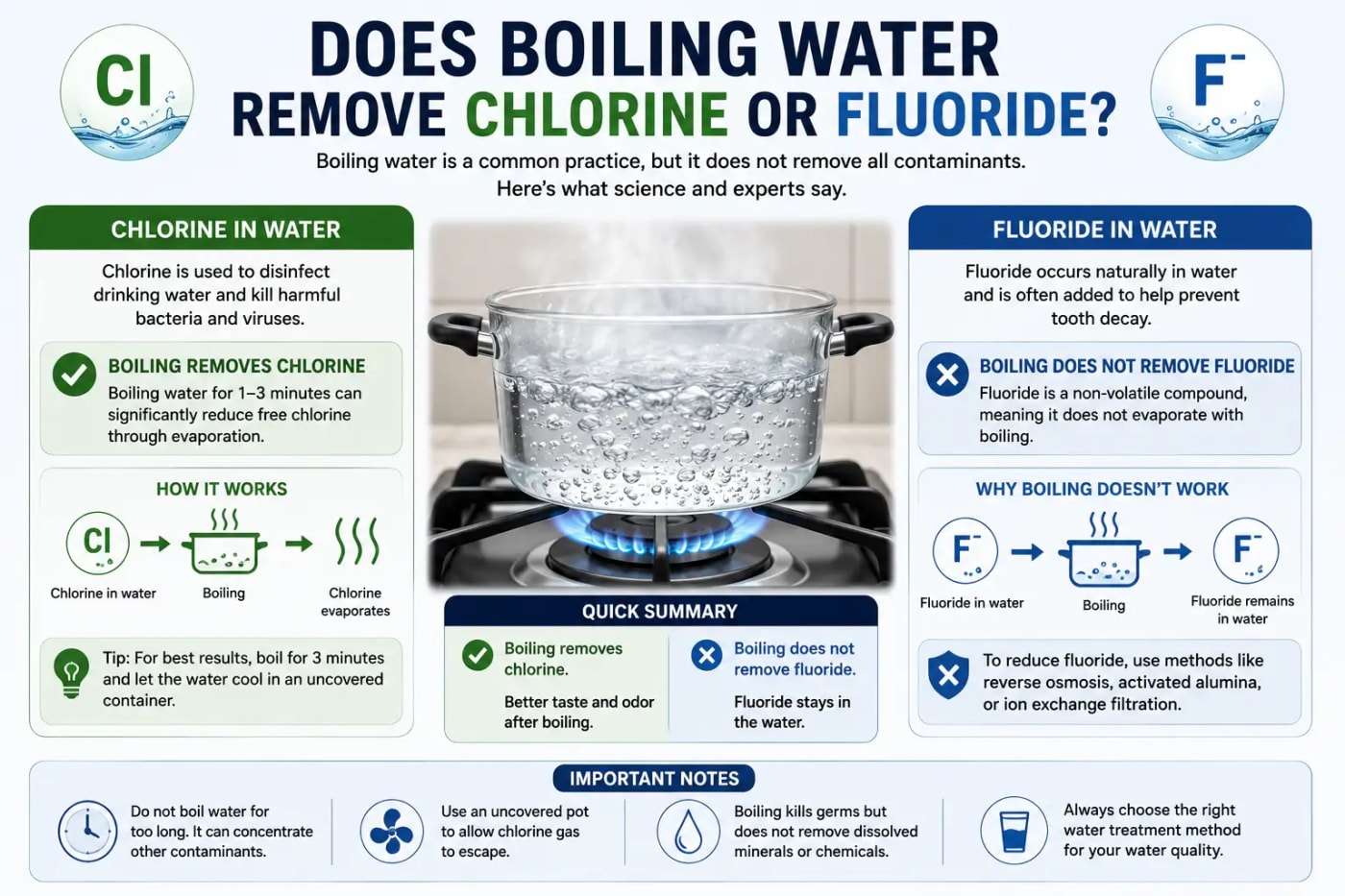
Boiling water removes free chlorine but does not remove fluoride, and these two outcomes happen for different scientific reasons. Chlorine and fluoride behave very differently when water is heated, since one can escape as a gas while the other stays dissolved in the liquid. In this article, you will learn how boiling affects chlorine and fluoride differently, why chloramine behaves differently from free chlorine, what boiling actually accomplishes in drinking water, and which treatment methods actually match each specific contaminant.
How Does Boiling Change Chlorine and Fluoride in Water?
Boiling changes chlorine and fluoride in water very differently, because it turns water into vapor while each dissolved substance follows its own chemical behavior. Free chlorine is a volatile substance, which means it can escape into the air as water heats up. Fluoride is a dissolved ion that stays in the liquid, since it is not volatile in the same way.
The table below shows this basic contrast:
Substance | Behavior during boiling | General outcome |
Free chlorine | Volatile, can evaporate or off-gas with heat | Levels in the water tend to decrease |
Fluoride | Non-volatile dissolved ion, stays in the liquid | Levels in the water remain, and can even become more concentrated |
This single contrast, volatile versus non-volatile, explains most of the confusion people have about whether boiling "cleans" water of these two substances.
Why Does Boiling Reduce Free Chlorine in Water?
Boiling reduces free chlorine in water because free chlorine is volatile and escapes from water as it heats up. As water temperature rises, dissolved free chlorine gradually leaves the water and moves into the surrounding air, which is also why boiled water and heated tap water can sometimes have a noticeably different smell compared to cold tap water.
This explanation applies specifically to free chlorine, not to every chlorine-based disinfectant used in water treatment. There is no single verified universal percentage that applies to every boiling situation, since actual reduction depends on starting chlorine concentration, water volume, boiling duration, and other water conditions.
How Does Heat Drive Free Chlorine Out of Water?
Heat drives free chlorine out of water through a process called volatilization, where rising temperature allows dissolved chlorine to convert into a gas and leave the water. Greater surface exposure to air during heating also allows more chlorine to escape.
Boiling duration affects how much chlorine escapes, but official guidance does not establish one fixed universal boiling time that reliably removes chlorine from any given batch of household water, since starting concentration and other conditions vary. It is also important not to confuse this chlorine-reduction effect with microbial disinfection, since boiling for disinfection purposes follows separate guidance focused on killing microorganisms rather than reducing chlorine.
Why Does Boiling Not Remove Chloramine Like Free Chlorine?
Boiling does not remove chloramine like free chlorine because chloramine, specifically monochloramine, is chemically more stable and persistent than free chlorine. The EPA states that boiling does not remove monochloramine from water.
Many water utilities use chloramine as a secondary disinfectant specifically because it lasts longer in the distribution system than free chlorine. That same persistence is why the volatilization behavior seen with free chlorine during boiling does not apply the same way to chloramine.
Why Does Fluoride Stay in Water During Boiling?
Fluoride stays in water during boiling because it exists as a dissolved, non-volatile ion, meaning it does not turn into a gas and escape the way free chlorine does. During boiling, water itself converts into vapor and leaves the container, while fluoride remains behind in the liquid that is left.
The EPA supports this basic principle: boiling does not remove fluoride from water. Heat alone does not provide a mechanism for fluoride to separate from the water, since fluoride has no volatility pathway comparable to free chlorine's ability to off-gas.
How Does Boiling Affect Fluoride Concentration?
Boiling affects fluoride concentration by potentially increasing it, since water volume decreases through evaporation while the fluoride itself does not leave with that evaporated water. As less water remains, the same amount of fluoride is now present in a smaller volume, which raises the concentration.
A simple example of this effect:
Stage | Water volume | Fluoride amount | Resulting concentration |
Before boiling | 1 liter | Fixed amount present in the original water | Original concentration |
After boiling (volume reduced by evaporation) | Less than 1 liter | Same fixed amount, since fluoride does not evaporate | Higher concentration in the remaining water |
This example illustrates the general mechanism rather than a fixed number that applies to every boiling scenario, since the exact increase depends on how much water volume is actually lost during boiling.
Does Longer Boiling Remove More Fluoride From Water?
Longer boiling does not remove more fluoride from water, since boiling never creates a mechanism for fluoride removal in the first place. Extending boiling time simply evaporates more water, which can further concentrate the fluoride that remains rather than reducing it.
The relevant variable here is water evaporation, not some fluoride-removal reaction that strengthens over time. Treating longer boiling as a fluoride-reduction strategy is a misunderstanding of what is actually happening chemically during the process.
What Does Boiling Actually Remove From Drinking Water?
Boiling actually removes microorganisms from drinking water, since its primary documented purpose is disinfection rather than chemical contaminant removal. CDC and EPA guidance both position boiling as an effective method against bacteria, viruses, and protozoa under appropriate conditions.
The table below distinguishes what boiling addresses from what it does not:
Substance type | Effect of boiling |
Bacteria | Generally inactivated through sufficient heat exposure |
Viruses | Generally inactivated through sufficient heat exposure |
Protozoa | Generally inactivated through sufficient heat exposure |
Free chlorine | Reduced through volatilization and evaporation |
Chloramine | Not effectively removed |
Fluoride | Not removed, and can become more concentrated |
Other dissolved chemical contaminants | Generally not removed through boiling alone |
This table makes clear that boiling should be understood primarily as a microbial disinfection method, not as a general-purpose contaminant-removal process.
How Does Boiling Differ From Water Filtration?
Boiling differs from water filtration in the basic mechanism each one uses: boiling relies on heat and disinfection, while filtration physically or chemically separates specific targeted contaminants from water. This difference is exactly why the right treatment method has to match the specific contaminant a person is trying to address.
The table below compares these mechanisms at a high level:
Method | Core mechanism | Best suited for |
Boiling | Heat-based disinfection | Bacteria, viruses, and protozoa |
Activated carbon filtration | Adsorption of certain dissolved substances | Chlorine taste and odor, among other targeted contaminants |
Reverse osmosis | Membrane-based separation | A broad range of dissolved substances, including some chemical contaminants |
Distillation | Evaporation with vapor collected separately | Non-volatile dissolved substances, including fluoride |
Detailed treatment alternatives for specific contaminants are covered in the dedicated resources linked later in this article.
Which Water Treatment Matches the Contaminant You Want to Remove?
The water treatment that matches the contaminant you want to remove depends entirely on which substance is actually present, since no single method addresses every contaminant equally well. Matching the right treatment to the right contaminant is the central decision point once boiling has been ruled out as a chemical-removal solution.
A general contaminant-to-treatment framework:
Free chlorine: Carbon-based treatment, such as activated carbon filtration, may be an appropriate option.
Chloramine: Treatment specifically designed and rated for chloramine is needed, since standard chlorine-focused methods do not perform the same way against it.
Fluoride: Treatment with a verified fluoride-reduction claim is required, such as an appropriately certified reverse osmosis system or another specialized method.
NSF/ANSI 58 includes an optional fluoride-reduction claim specifically for reverse osmosis systems, which means not every RO system is automatically certified for fluoride reduction. Checking a product's specific certification and performance claim is essential, rather than assuming any filter or treatment system handles every contaminant equally.
Which Water Filters Remove Fluoride?
Water filters that remove fluoride are generally reverse osmosis systems and other fluoride-specific treatment technologies carrying a verified fluoride-reduction claim. Standard charcoal or activated-carbon filtration should not automatically be assumed to remove fluoride, since the EPA specifically states that typical charcoal-based systems do not remove it. For a complete list of filtration options that do address fluoride, see [Water Filters That Remove Fluoride].
Do Activated Carbon Filters Remove Chlorine?
Activated carbon filters do remove chlorine in many cases, since this type of filtration is commonly used specifically for chlorine taste and odor reduction. Exact performance still depends on the specific filter design and its certification. For a detailed comparison of chlorine-focused filters, see [Best Water Filters for Chlorine].
Does Reverse Osmosis Remove Fluoride?
Reverse osmosis can reduce fluoride, according to CDC guidance, though the specific system used should carry a verified fluoride-reduction claim under NSF/ANSI 58 rather than being assumed capable by default. For a full explanation of how RO systems handle fluoride, see [Does Reverse Osmosis Remove Fluoride?].
Does Distillation Remove Fluoride From Water?
Distillation does remove fluoride from water, unlike simple boiling, because distillation collects and condenses water vapor separately from the original liquid, leaving non-volatile substances such as fluoride behind in the source container. CDC supports this distinction between ordinary boiling and distillation. For a complete explanation of the distillation process, see [Does Distillation Remove Fluoride?].
How Does Chlorine Differ From Chloramine in Tap Water?
Chlorine differs from chloramine in tap water mainly in persistence, since chloramine is more difficult to remove and is used by many utilities specifically as a longer-lasting secondary disinfectant. This is why a chlorine-focused removal method may not perform the same way against chloramine. For a full comparison of removal approaches for each, see [Chlorine vs Chloramine: How to Remove Each One].
How Does Boiling Compare With Distilling Water?
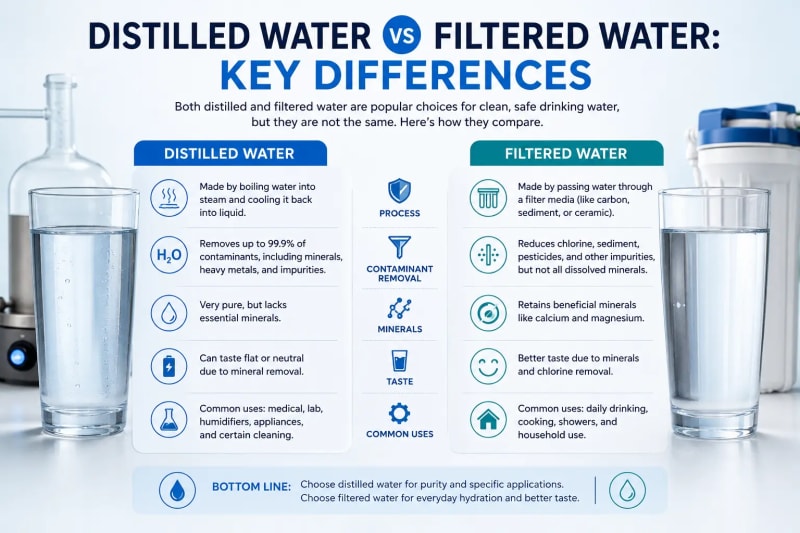
Boiling compares with distilling water in one key practical way: boiling keeps the remaining liquid in the same container as the water evaporates away, while distillation captures the escaping vapor and condenses it separately into a new, distinct batch of water. This difference is exactly why distillation can remove fluoride while ordinary boiling cannot. For a deeper comparison of these processes, see [Distilled Water vs Filtered Water].
Conclusion
Boiling water reduces free chlorine because chlorine is volatile and escapes as water heats up, but it does not remove fluoride, since fluoride is a non-volatile dissolved ion that stays behind in the remaining water and can even become more concentrated. Chloramine behaves differently from free chlorine and is not effectively removed through boiling either. Boiling remains most valuable as a disinfection method against bacteria, viruses, and protozoa, not as a chemical treatment solution. For chlorine, chloramine, or fluoride specifically, the right approach is choosing a treatment method with a verified performance claim that actually matches the contaminant you are trying to remove.