Chlorine and chloramine are both used by water utilities to disinfect drinking water, but they behave very differently once they reach your tap, and that difference changes how each one should be removed. Chlorine, often called free chlorine, is more reactive and breaks down faster, while chloramine, most commonly monochloramine, is formed by combining chlorine with ammonia and stays stable for much longer in the distribution system. This stability makes chloramine noticeably harder to remove using the same simple methods that work well against chlorine. This article explains that core difference, compares the treatment methods available, including activated carbon, catalytic carbon, reverse osmosis and chemical neutralization, and walks through contact time, identification, verification and application specific choices. The goal is to help you match the correct removal method to the correct disinfectant, rather than assuming one method works equally well for both.
How do chlorine and chloramine differ in drinking water?
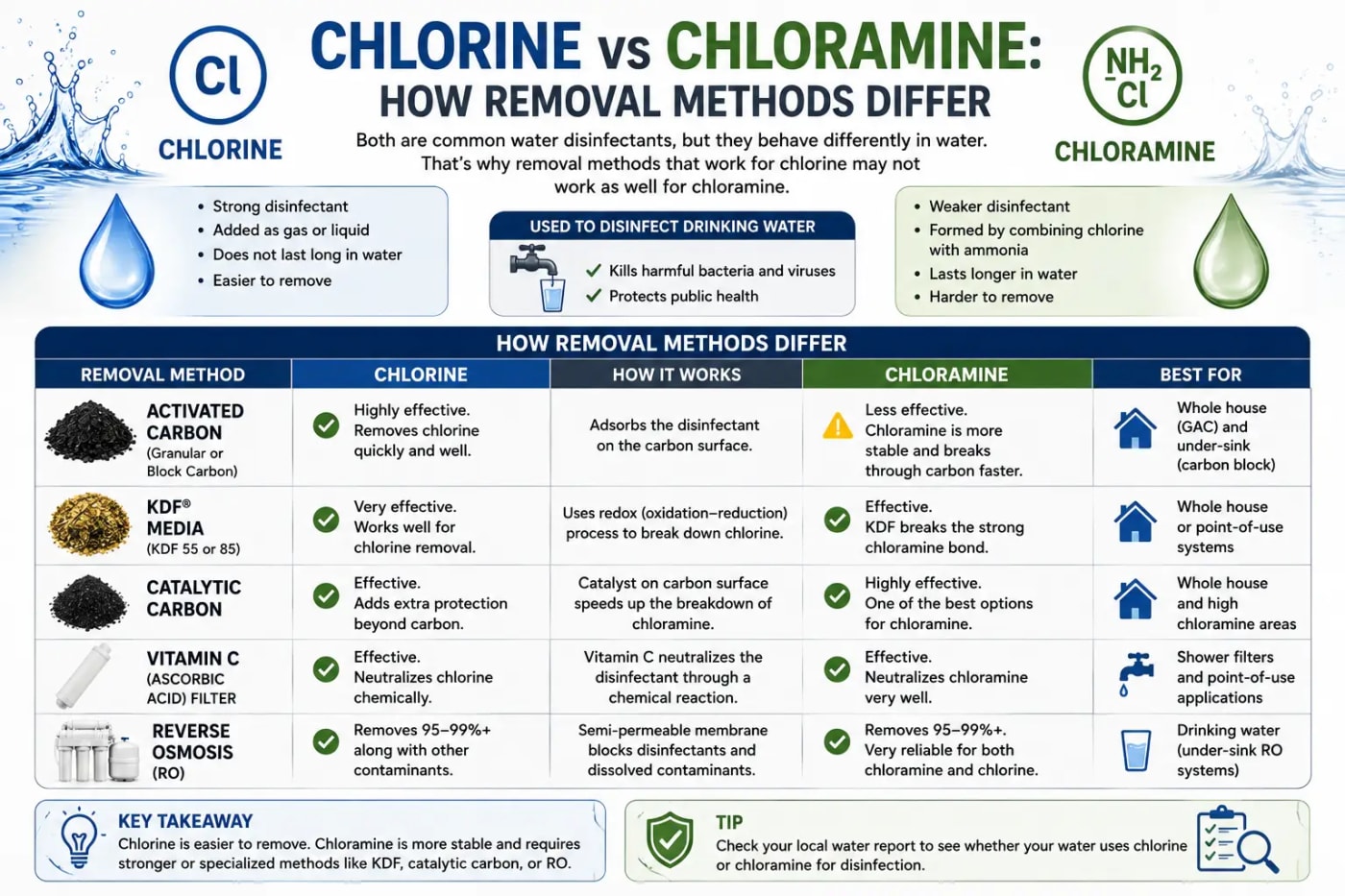
Chlorine and chloramine differ in drinking water mainly through their chemical composition, stability and behavior once they leave the treatment plant. Chlorine is added directly as a disinfectant and reacts relatively quickly with organic matter and other substances in water. Chloramine, most often present as monochloramine, is created intentionally by combining chlorine with ammonia, producing a disinfectant that reacts more slowly and remains active for a longer period as water travels through the distribution system.
The table below compares chlorine and chloramine across key attributes:
Attribute | Chlorine (Free Chlorine) | Chloramine (Monochloramine) |
Composition | Chlorine compound alone | Chlorine combined with ammonia |
Disinfectant behavior | Reacts quickly | Reacts more slowly, more stable |
Persistence in distribution system | Lower, breaks down faster | Higher, remains active longer |
Taste and odor | Often more noticeable | Often less noticeable |
Filtration implications | Generally easier to remove | Generally harder to remove, requires specific media |
Utilities choose between these disinfectants based on their distribution system needs, water chemistry and regulatory requirements. According to EPA and CDC guidance, both disinfectants are considered effective at controlling microorganisms in drinking water, but their differing chemical behavior directly affects how home treatment systems need to be designed to remove them.
Why is chloramine harder to remove than chlorine?
Chloramine is harder to remove than chlorine mainly because of its greater chemical stability, which makes it react more slowly with standard treatment media.
Chlorine is more reactive and more volatile, meaning it breaks down and reacts with treatment media relatively easily. Chloramine, by contrast, is more stable and less reactive, which means it passes through standard treatment media without breaking down as readily. This difference in reactivity is the central reason a treatment method effective against chlorine does not automatically perform the same way against chloramine.
Activated carbon illustrates this difference clearly. Standard activated carbon works well against chlorine because chlorine reacts readily with the carbon surface. Chloramine requires a carbon surface with different reactive properties, along with a longer contact time between water and the carbon media, to achieve meaningful reduction. This is why catalytic carbon, engineered with a more reactive surface chemistry, plays an important role specifically for chloramine treatment.
Which methods remove chlorine and chloramine from water?
Methods that remove chlorine and chloramine from water vary significantly in how well each one performs against the two disinfectants, so no single method should be assumed effective for both without checking its specific design and certification.
The table below compares common treatment methods for chlorine and chloramine:
Method | Chlorine Suitability | Chloramine Suitability | Key Limitation | Appropriate Use Case |
Standard activated carbon | Effective | Limited, unless specifically designed for chloramine | Chloramine requires longer contact time and different carbon surface chemistry | General chlorine taste and odor reduction |
Catalytic activated carbon | Effective | More effective than standard carbon | Performance still depends on contact time and system sizing | Chloramine reduction in point-of-use or whole-house systems |
Reverse osmosis | Can contribute to reduction as part of a system | Not a universal or guaranteed chloramine solution on its own | Membrane can be damaged by chlorine or chloramine without proper pretreatment | Broader contaminant removal alongside chlorine or chloramine pretreatment |
Chemical neutralization | Effective in specific dosing applications | Effective in specific dosing applications | Requires correct chemical dosing and monitoring | Specialized applications such as aquarium or dialysis water |
Boiling | Limited effect, not a reliable removal method | Limited effect, not a reliable removal method | Does not reliably remove either disinfectant | Not recommended as a primary removal method |
Standing water | Some reduction of chlorine over time | Minimal reduction of chloramine | Chloramine remains stable even after extended standing | Not a reliable removal method for either disinfectant, especially chloramine |
The EPA's guidance on monochloramine specifically cautions against assuming that methods like boiling, standing water or a standard reverse osmosis system reliably remove chloramine, since chloramine's stability limits the effectiveness of these approaches compared to chlorine.
How does activated carbon remove chlorine and chloramine?
Activated carbon removes chlorine and chloramine through a reaction between the disinfectant and the carbon surface, but the two disinfectants respond differently depending on the type of carbon used.
Standard activated carbon works effectively against chlorine because chlorine reacts readily with the carbon surface during the contact time available as water passes through. Chloramine requires catalytic activated carbon, a form of carbon engineered with a different surface structure that reacts more effectively with the more stable chloramine molecule. Pentair specifically distinguishes standard activated carbon from catalytic activated carbon on this basis, and cautions that a product's chlorine reduction claim should never be assumed to also apply to chloramine reduction.
Factors that affect activated carbon performance for both disinfectants:
Contact time: Longer contact time between water and carbon media improves reduction performance, particularly for chloramine.
Flow rate: Faster water flow reduces the time available for the disinfectant to react with the carbon surface.
Carbon characteristics: The type, quality and surface structure of the carbon media directly affect its ability to reduce chlorine versus chloramine.
System sizing: A properly sized system provides enough carbon volume and contact time for the intended disinfectant and flow rate.
How does contact time affect chloramine reduction?
Contact time affects chloramine reduction directly, since chloramine's chemical stability means it needs more time interacting with treatment media to achieve meaningful reduction compared to chlorine.
Faster water flow through a filter reduces the amount of time available for chloramine to react with the carbon surface, which lowers overall reduction performance. This sensitivity to flow rate and system design is a key reason chloramine treatment systems often require larger carbon volume or a specific system design compared to a chlorine only system. No single universal contact time figure applies across every system, since actual performance depends on the specific media, chloramine concentration, flow rate and target reduction level, so verified product specifications should guide expectations rather than a general assumption.
How can you tell whether your water contains chlorine or chloramine?
You can tell whether your water contains chlorine or chloramine most reliably by checking with your local water utility, rather than relying on taste or smell.
Your local water utility publishes an annual Consumer Confidence Report, which typically identifies the disinfectant type used, along with relevant disinfectant residual information and other water quality details. The CDC specifically recommends checking this annual water quality report to determine which disinfectant your utility uses.
Information to look for when identifying your disinfectant type:
Disinfectant type: Confirm whether your utility uses chlorine, chloramine or another disinfection method.
Disinfectant residual: Review the reported residual level, which indicates how much disinfectant remains in the water reaching your home.
Relevant water quality details: Check for any additional notes your utility provides regarding disinfection practices or recent changes.
Taste or the practice of letting water stand overnight should not be treated as a definitive test for identifying which disinfectant is present, since these observations do not reliably distinguish between the two.
How can you verify that a water filter removes chloramine?
You can verify that a water filter removes chloramine by checking its specific certification and reduction claims, since a chlorine reduction claim does not automatically mean the same filter reduces chloramine.Chlorine reduction and chloramine reduction should be treated as two separate claims, each requiring its own verification. NSF/ANSI 42 is the certification standard most relevant here, and NSF confirms that this standard includes distinct claims for chlorine reduction and chloramine reduction separately.
Checklist for verifying a chloramine reduction claim:
Check the certification standard. Confirm the filter carries an NSF/ANSI 42 certification or an equivalent recognized standard.
Check the specific claim listed. Look specifically for a chloramine reduction claim, not just a general chlorine reduction claim.
Review the product listing details. Confirm the listing specifies chloramine reduction performance, since some products only list chlorine reduction.
Avoid assuming equivalence. Treat chlorine and chloramine reduction as separate performance claims that each require their own verification.
Which chlorine or chloramine removal method fits different water uses?
The chlorine or chloramine removal method that fits best depends on the specific water use, since drinking water, whole-house treatment and specialized applications each carry different requirements.
The table below compares removal considerations across different water uses:
Water Use | Key Consideration | Typical Approach |
Drinking water, point of use | Taste, odor and disinfectant reduction at a single tap | Activated carbon or catalytic carbon filter designed for the specific disinfectant present |
Under-sink systems | Balancing flow rate with adequate contact time | Carbon based filtration sized for household demand |
Whole-house systems | Treating water at the point where it enters the home | Larger media volume to maintain contact time at higher flow rates |
Shower filtration | Addressing disinfectant exposure during bathing | Filters designed specifically for shower flow rates and temperature |
Aquarium water | Removing disinfectant before adding water to fish tanks | Chemical dechlorination products designed for aquarium use |
Dialysis water | Removing chemical disinfectants before use in medical treatment | Specialized treatment systems following medical facility protocols |
The CDC specifically notes that fish, reptiles and amphibians should not be kept in water containing chlorine or chloramine, and that dialysis water requires removal of chemical disinfectants before use, reflecting the specific sensitivity of these applications compared to typical household drinking water use.
What should you check before choosing a chlorine or chloramine filter?
Before choosing a chlorine or chloramine filter, work through the following decision checklist to match the filter to your actual water and household needs.
Decision checklist for choosing a chlorine or chloramine filter:
Identify the disinfectant type. Confirm through your water utility whether your water contains chlorine, chloramine or another disinfectant.
Identify your target contaminant. Confirm whether disinfectant reduction is your main concern or whether other contaminants also need addressing.
Review the filter media. Confirm whether the filter uses standard activated carbon, catalytic activated carbon or another treatment media.
Check for a chloramine specific claim. If chloramine is present, confirm the product specifically claims chloramine reduction, not chlorine reduction alone.
Confirm certification. Look for NSF/ANSI 42 certification or an equivalent recognized standard supporting the specific claim you need.
Check flow rate requirements. Confirm the filter can maintain adequate contact time at your household's typical water flow rate.
Check capacity and service life. Confirm how much water the filter can treat before requiring replacement.
Confirm installation type. Decide whether a point of use, under-sink or whole-house installation fits your needs.
Match the filter to your intended application. Confirm the filter is appropriate for drinking water, whole-house use or any specialized application you have in mind.
Why does identifying the disinfectant matter before choosing a filter?
Identifying the disinfectant matters before choosing a filter because the correct filter choice starts with knowing whether your water utility uses chlorine or chloramine. A filter well suited for chlorine reduction may perform poorly against chloramine, and choosing based on the wrong assumption can leave the actual disinfectant largely untreated.
Once you know which disinfectant is present, you can move forward with confidence toward the specific filter category suited to your situation, whether that is an activated carbon filter for chlorine, a catalytic carbon filter for chloramine, or a broader system addressing both alongside other water quality goals.
What are the best activated carbon filters for chlorine removal?
The best activated carbon filters for chlorine removal are those using standard activated carbon media with an appropriate contact time and flow rate for reliable free chlorine reduction. For a full comparison of activated carbon filter types, specifications and buying criteria, see Activated Carbon Water Filters.
What are the best chloramine water filters?
The best chloramine water filters are those specifically designed and certified for chloramine reduction, typically using catalytic carbon rather than standard activated carbon, along with an NSF/ANSI 42 chloramine specific claim. For a complete guide to choosing a chloramine filter, see Best Chloramine Water Filters.
How do NSF/ANSI 42 water filters compare?
NSF/ANSI 42 water filters compare based on their specific reduction claims, since this certification standard covers separate claims for chlorine and chloramine reduction rather than a single combined claim. For a deeper explanation of NSF/ANSI 42, along with related standards such as NSF/ANSI 53 and 401, see NSF/ANSI 42 Water Filters.
How does reverse osmosis compare with carbon filtration?
Reverse osmosis compares with carbon filtration as a broader dissolved contaminant removal method, typically used alongside carbon pretreatment rather than as a standalone chlorine or chloramine solution. Reverse osmosis membranes can be damaged by chlorine or chloramine without proper pretreatment, and current EPA guidance does not support treating ordinary reverse osmosis as a universal monochloramine removal answer. For a complete guide to reverse osmosis performance, prefiltration and system selection, see Reverse Osmosis Water Filters.
How can you choose a whole-house water filter?
You can choose a whole-house water filter by focusing on flow rate, capacity and media volume needed to treat water at the point it enters your home, rather than a point of use solution serving a single tap. For a complete guide to whole-house filter selection, see Whole-House Water Filters.
Conclusion
Chlorine and chloramine both disinfect drinking water, but chloramine's greater chemical stability makes it noticeably harder to remove than chlorine using the same standard methods. Standard activated carbon works well for chlorine, while chloramine generally requires catalytic carbon, longer contact time and a system specifically designed and certified for chloramine reduction. Start by identifying your disinfectant type through your local water utility's Consumer Confidence Report, then match your filter choice to that specific disinfectant, confirming certification and reduction claims before you buy. This approach ensures your treatment system actually addresses the disinfectant present in your water, rather than relying on an assumption that one method works equally well for both.