
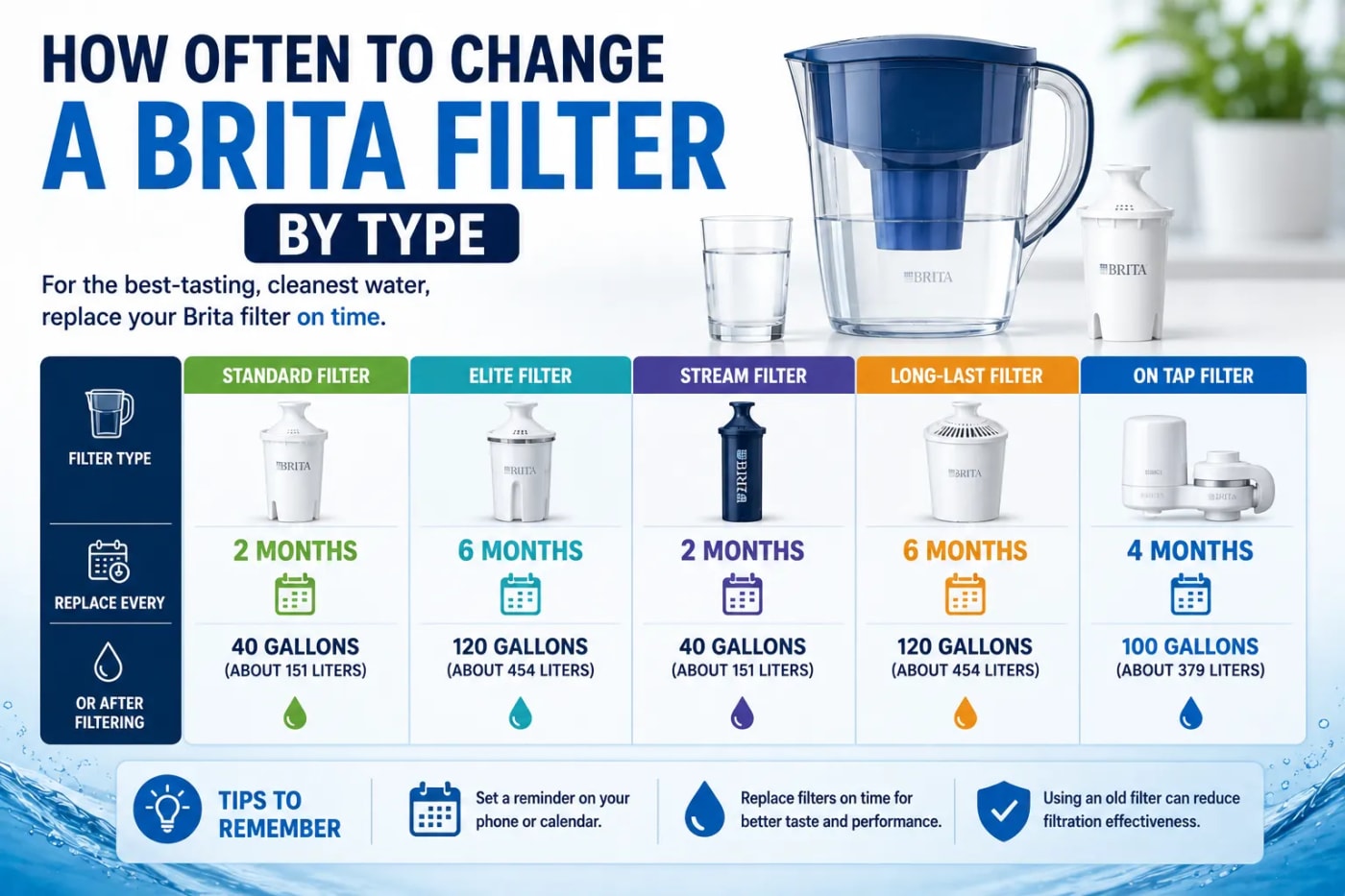
How often you change a Brita filter depends on which filter type you own, since Brita rates each product for a different gallon capacity and calendar estimate. Replacement frequency also shifts with your household's usage level and local water hardness. Brita currently identifies separate replacement intervals for the Original filter, the Elite filter, the Stream filter, its filtering water bottles, and its faucet filter systems. This article walks through each product's replacement schedule, explains what affects filter life, and covers how to know when a filter is actually due for replacement.
RoundupBuyer’s Guides
How Often to Change a Brita Filter by Type
Share
In-Depth Reviews
#1Best Overall / Most Popular
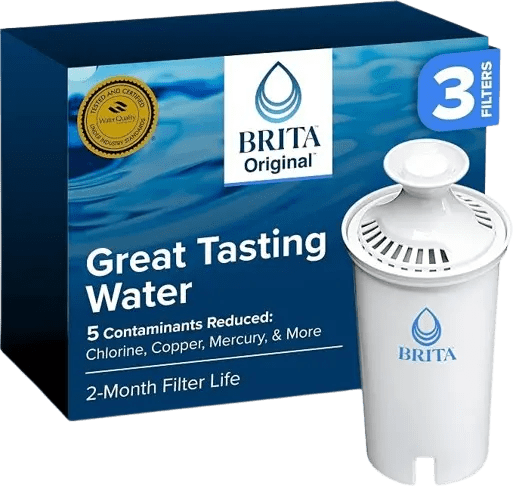
Brita Original Replacement Filter, 3-Pack
$15.99
Key Features
The standard white cartridge that fits nearly every Brita pitcher and dispenser except Stream the same filter this article rates at 40 gallons and 2 months. With by far the largest review base of any Brita product, it's the safest default pick for most households.
Reasons to Buy
- WQA/NSF certified for chlorine, copper, mercury, cadmium
- Fits all Brita pitchers/dispensers except Stream
- No presoak needed, quick install
- Affordable
Reasons Not to Buy
- Shortest lifespan in the lineup (40 gallons/2 months)
- Not certified for lead reduction (unlike Elite)
- More frequent reordering than Elite
- SmartLight indicator only works if your pitcher model supports it
Specs at a Glance
| Brand | External Testing Certification | Material | Product Dimensions | Item Weight | Capacity | Compatibility |
|---|---|---|---|---|---|---|
| BRITA | WQA | Plastic | 2.31"D x 2.31"W x 4.12"H | 12.8 ounces | 40 gallons | All Brita pitchers/dispensers except Stream |
This is the white cartridge filter that fits into nearly every Brita pitcher and dispenser except Stream. Water passes through activated carbon and ion exchange resin, reducing chlorine taste and odor along with copper, mercury, and cadmium. Each filter is rated for 40 gallons, about two months under average household use.
#2Best for Lead Reduction
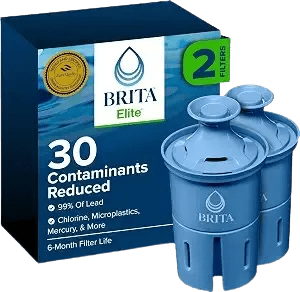
Brita Elite Replacement Filter (Blue), 2-Pack
$29.77
Key Features
The long-life upgrade from Original same 6-month, 120-gallon capacity this article documents, built with Advanced Carbon Core Technology to reduce 99% of lead plus 30+ contaminants. Highest monthly purchase volume of any Brita filter here.
Reasons to Buy
- Reduces 99% of lead the only filter in the lineup certified for this
- Lasts 3x longer than Original (120 gallons/6 months)
- Reduces 30+ contaminants including pharmaceuticals, pesticides
- Fewer replacements needed per year, better long-term value
Reasons Not to Buy
- Higher upfront cost than Original per filter
- Not compatible with Stream pitchers
- Older pitcher models may not track its longer capacity correctly
- Overkill if lead isn't a concern in your water
Specs at a Glance
| Brand | External Testing Certification | Material | Product Dimensions | Item Weight | Capacity | Compatibility |
|---|---|---|---|---|---|---|
| BRITA | NSF | Plastic | 4.66"D x 2.34"W x 5.34"H | 3.84 ounces | 120 gallons | All Brita pitchers/dispensers except Stream |
The Elite filter uses a denser carbon core than the Original, which is what lets it last three times longer while adding lead reduction to the mix. Water passes through this Advanced Carbon Core, which is certified to reduce 99% of lead along with 30+ other contaminants including microplastics, pharmaceuticals, and pesticides. Rated for 120 gallons, about six months.
#3Best for Stream Pitchers
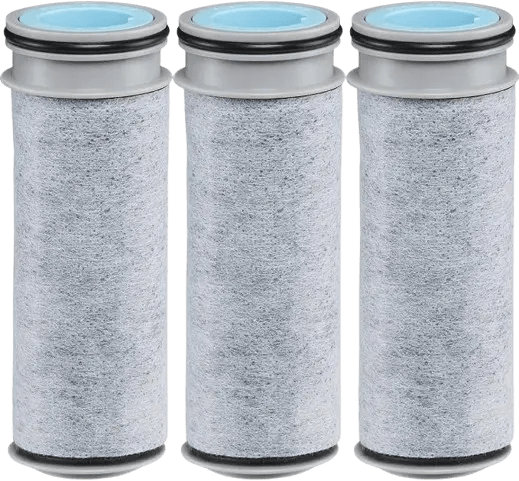
Brita Stream Replacement Filter, 3-Pack
$
Key Features
The exclusive filter-as-you-pour cartridge for Stream pitchers only matching this article's 40-gallon, 2-month schedule. Not interchangeable with Original or Elite, so Stream owners need this exact filter.
Reasons to Buy
- Filter-as-you-pour technology, no waiting to drink
- Removes over 90% of chlorine taste and odor
- No black flecks thanks to innovative carbon form
- Easy click-in, click-out replacement
Reasons Not to Buy
- Only works with Stream pitchers, zero cross-compatibility
- Same short 40-gallon/2-month life as Original
- Not certified for lead reduction
- Smaller review base than Original
Specs at a Glance
| Brand | External Testing Certification | Material | Product Dimensions | Item Weight | Capacity | Compatibility |
|---|---|---|---|---|---|---|
| BRITA | FDA | Plastic | 6.85"D x 1.93"W x 4.41"H | 3.2 ounces | 40 gallons | Brita Stream pitchers only |
Built specifically for Stream pitchers, this filter uses a dual-layer carbon design that filters water as it pours instead of requiring a wait, unlike Original or Elite. It reduces chlorine taste and odor along with Class VI particulates. Rated for 40 gallons, about two months, but it cannot be swapped into a non-Stream pitcher since the housing and flow design are different.
#4Best for On-the-Go
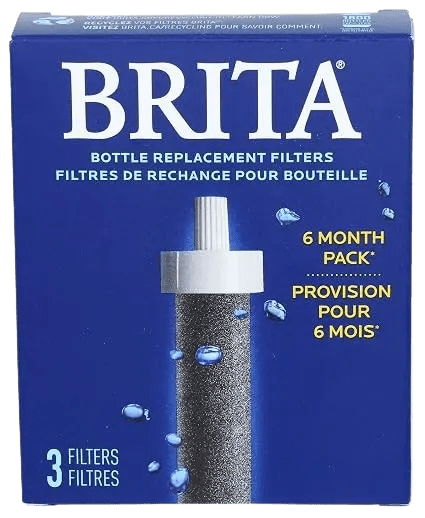
Brita Water Bottle Replacement Filters, 3-Pack
$11.97
Key Features
The cartridge for Brita's filtering bottles, matching this article's 64-oz-per-day usage basis and 40-gallon/2-month schedule. Cheapest per-filter cost in the lineup, built for portable, on-demand filtering.
Reasons to Buy
- Fits all Brita filtering water bottle types
- Lowest per-filter cost
- Easy 15-second rinse-and-insert replacement
- Reduces chlorine taste/odor while retaining minerals/electrolytes
Reasons Not to Buy
- Different usage basis (64 oz/day) than pitchers, so timing feels less predictable
- Same short 40-gallon/2-month capacity as Original
- No lead reduction certification
- Bottle-specific, not usable in any pitcher/dispenser
Specs at a Glance
| Brand | Material | Product Dimensions | Capacity | Package Information | Compatibility | Special Feature |
|---|---|---|---|---|---|---|
| BRITA | Plastic | 3.63"L x 1.06"W x 4.44"H | 40 gallons | Bottle | All Brita filtering water bottles | Reduces Plastic Waste |
This cartridge fits directly into the straw assembly of Brita's filtering water bottles rather than a pitcher reservoir. It reduces chlorine taste and odor and Class VI particulates as water passes through on each sip. Its 40-gallon, two-month rating is based on a 64-ounce daily usage assumption, a different basis than the 11-glasses-per-day estimate used for pitchers, dispensers, and faucet systems.
#5Best for On-Demand Filtration
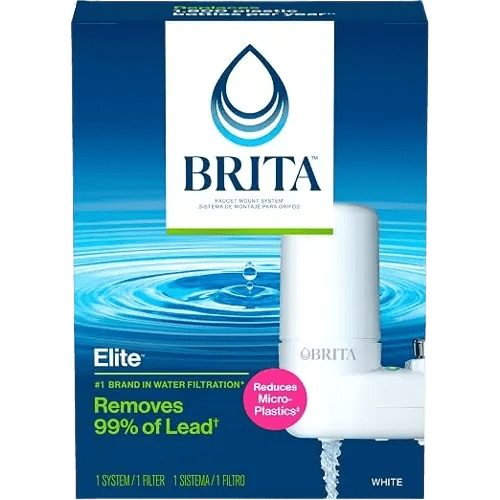
Brita Faucet Filter Replacement (SAFF-100/FF-100), White, 1 Count
$22.86
Key Features
The faucet-mount cartridge matching this article's 100-gallon, 4-month schedule the longest single-filter interval in the Brita lineup outside Elite. No pitcher or storage needed, filters instantly at the tap.
Reasons to Buy
- Longest single-use interval besides Elite (100 gallons/4 months)
- Reduces 99% of lead, plus chlorine, asbestos, benzene
- No pitcher or storage step, filters on demand
- One-click replacement with status indicator
Reasons Not to Buy
- Not compatible with pull-out or spray-style faucets
- Requires faucet mount hardware, not just a drop-in cartridge
- Smallest review base
Specs at a Glance
| Brand | External Testing Certification | Material | Capacity | Approximate Interval | Compatibility | Colors Available |
|---|---|---|---|---|---|---|
| BRITA | NSF, ANSI | Plastic | 100 gallons | 4 months | Basic and Complete Brita tap systems | White, Chrome |
This cartridge snaps directly into a faucet-mounted housing, filtering water on demand as it leaves the tap instead of sitting in a pitcher reservoir. It reduces 99% of lead along with chlorine taste and odor, asbestos, and benzene. Rated for 100 gallons, about four months, the longest single-filter interval in the lineup after Elite, and it applies to both the SAFF-100 and FF-100 models identically.
How Does Brita Filter Type Determine Replacement Frequency?
Brita filter type determines replacement frequency because each product carries its own rated gallon capacity, and that capacity converts into a different calendar estimate based on average household use.
Variables that determine a filter's replacement schedule:
Filter type: Original, Elite, Stream, bottle, or faucet system, each built with a different rated capacity.
Rated gallon capacity: The volume of water a specific filter is designed to treat before performance declines.
Product category: Whether the filter is used in a pitcher, dispenser, bottle, or faucet system, which affects the usage assumption behind the calendar estimate.
Calendar estimate: Brita's translation of gallon capacity into an approximate number of months, based on average household consumption.
The sections below cover the specific schedule for each filter type in detail.
How Often Should You Change a Brita Original Filter?
You should change a Brita Original filter about every 40 gallons, or roughly every 2 months, under Brita's average household usage estimate.The Original filter, sometimes still recognized by its earlier name, the Standard filter, is the white filter cartridge found in Brita's classic pitchers and dispensers. Brita bases the 40-gallon and 2-month estimate on typical household water use. Households with hard water may find that filter performance declines faster in practice, which can shorten the practical replacement interval below the standard estimate.
Quick facts: Brita Original Filter
Attribute | Value |
Rated capacity | 40 gallons |
Approximate calendar interval | 2 months |
Common name | Original, formerly Standard |
How Often Should You Change a Brita Elite Filter?
You should change a Brita Elite filter about every 120 gallons, or roughly every 6 months, under Brita's average household usage estimate.The Elite filter is rated to last three times as long as the Original filter in terms of gallon capacity, which is why its calendar interval stretches to about 6 months instead of 2. As with the Original filter, Brita notes that hard-water households may need more frequent replacement than the standard estimate suggests, since hardness can affect how quickly a filter's performance declines in real-world use.
How Often Should You Change a Brita Stream Filter?
You should change a Brita Stream filter about every 40 gallons, or roughly every 2 months, matching the same capacity and calendar interval as the Original filter. Stream filters are designed specifically for Brita Stream pitchers, and they cannot be swapped with Original or Elite filters, since each is built for a different pitcher design and filtration flow.
Compatibility note:
Stream filters: Fit only Brita Stream pitchers, and are not interchangeable with Original or Elite filters.
How Often Should You Change a Brita Bottle Filter?
You should change a Brita Premium Filtering Water Bottle filter about every 40 gallons, or roughly every 2 months, based on an assumed daily usage of 64 ounces.
This 64-ounce daily assumption is specific to bottle usage and differs from the daily consumption assumption Brita uses for pitchers, dispensers, and faucet systems. Because bottle usage patterns differ from a shared household pitcher, it is worth keeping this separate usage basis in mind rather than assuming the bottle follows the same daily consumption pattern as other Brita products.
Quick facts: Brita Bottle Filter
Attribute | Value |
Rated capacity | 40 gallons |
Approximate calendar interval | 2 months |
Usage basis | 64 ounces per day |
How Often Should You Change a Brita Faucet Filter?
You should change a Brita faucet filter about every 100 gallons, or roughly every 4 months, which applies to both the SAFF-100 and FF-100 faucet filter systems.Both models share the same rated capacity and calendar estimate, so there is no need to treat them as separate schedules. As with the pitcher-based filters, this estimate reflects average household usage, and Brita notes that hard water may call for earlier replacement than the standard 4-month interval.
What Are the Brita Filter Replacement Times by Type?
The Brita filter replacement times by type are summarized in the table below, consolidating the capacity, calendar estimate, and usage basis for every current product.
The table below shows Brita filter replacement times by type:
Filter Type | Rated Capacity | Approximate Interval | Usage Basis |
Original | 40 gallons | 2 months | 11 glasses per day |
Elite | 120 gallons | 6 months | 11 glasses per day |
Stream | 40 gallons | 2 months | 11 glasses per day |
Bottle | 40 gallons | 2 months | 64 ounces per day |
Faucet (SAFF-100 / FF-100) | 100 gallons | 4 months | 11 glasses per day |
How Does Water Usage Affect Brita Filter Life?
Water usage affects Brita filter life because the calendar estimate for each filter is built on an assumed daily consumption level, and actual usage above or below that assumption changes how quickly the rated gallon capacity is reached.
Brita's official timing for pitchers, dispensers, and faucet systems is based on an average of 11 glasses of water per day, while bottle timing is based on 64 ounces per day. A household that drinks noticeably more water than these assumptions, or uses filtered water for cooking as well as drinking, will reach a filter's gallon capacity sooner than the calendar estimate suggests. A smaller household using less water than the assumption may find their filter lasts longer than the stated interval in actual months, even though the gallon capacity remains the more reliable measure.
When Can Hard Water Shorten Brita Filter Life?
Hard water can shorten Brita filter life whenever the local water supply carries higher mineral content than the average conditions Brita's estimates are built around.Brita explicitly advises hard-water users that their filters may need more frequent replacement than the standard schedule suggests. Brita's official guidance does not publish a specific shortened schedule for hard water, such as an exact number of weeks, so it is best to treat the standard interval as an upper bound in hard-water areas rather than a fixed guarantee.
Practical implications of hard water for filter replacement:
Shorter practical intervals: Expect to replace filters somewhat sooner than the standard calendar estimate.
Watch performance, not just the calendar: Flow rate and taste can decline faster under hard-water conditions.
Check your local water report: Knowing your water hardness level helps you judge how much earlier to plan for replacement.
How Do Brita Indicators Tell You When to Replace a Filter?
Brita indicators tell you when to replace a filter through built-in tracking systems that estimate remaining filter life based on how much water has passed through, or the amount of time since installation.
Common Brita indicator types:
Electronic indicators: Built into certain pitchers and dispensers, tracking usage electronically.
SmartLight indicators: A specific electronic indicator system Brita uses on select products to signal when replacement is due.
Volumetric indicators: Track the number of fills or pours to estimate remaining filter capacity.
Sticker indicators: A simple sticker where you write the installation date, used as a manual reminder rather than an automatic tracker.
The indicator must correspond to the correct filter type to give an accurate reading. Some older pitcher models do not correctly track the Elite filter's longer capacity, since they were originally designed around the Original filter's shorter interval, so always confirm your pitcher model supports the specific filter you are using.
What Should You Do When a Brita Filter Is Due for Replacement?
When a Brita filter is due for replacement, follow the correct preparation and installation steps for your specific filter type, since these steps differ across products.
General replacement steps:
Identify the correct filter: Confirm the exact filter type your pitcher, dispenser, bottle, or faucet system requires.
Remove the old filter: Take out the expired cartridge from its housing.
Prepare the new filter: Follow the specific preparation instructions for your filter type, since Original, Elite, Stream, bottle, and faucet filters each have their own preparation steps.
Install the new filter: Place the prepared filter into the housing according to your product's instructions.
Reset or activate the indicator: Reset any electronic indicator, or update your sticker with the new installation date, so tracking starts fresh.
How Can You Tell a Brita Filter Needs Attention?
You can tell a Brita filter needs attention by watching for practical signs, though these signs should be treated as secondary observations rather than a replacement for Brita's official schedule.
Practical signs a filter may need attention:
Indicator status: A red or expired reading on an electronic or sticker indicator.
Unusual taste: A noticeable change in taste compared with normal filtered water.
Slower filtration: Water taking noticeably longer to pass through the filter than when it was new.
These observations are useful secondary signals, but taste alone does not prove a filter is exhausted, since taste can be affected by several factors. Manufacturer guidance based on gallon capacity and calendar estimates remains the more reliable basis for replacement timing.
What Happens When You Keep Using a Brita Filter Too Long?
When you keep using a Brita filter too long, its filtration performance declines below what the product is designed to deliver, which is the main reason Brita recommends timely replacement.Brita's guidance centers on maintaining expected filtration performance rather than describing a specific safety failure. Using a filter well past its rated capacity means it is less able to reduce the substances it is designed to address, since its filtration media becomes less effective as it approaches and passes its rated capacity.
How Should You Track Your Next Brita Filter Change?
You should track your next Brita filter change using the method that matches your specific product, whether that is an electronic indicator, a sticker calendar, or simply noting your installation date.
Ways to track your next filter change:
Use the built-in indicator: Rely on SmartLight or another electronic indicator if your pitcher or dispenser includes one.
Use a sticker calendar: Write the installation date on the provided sticker if your product does not include electronic tracking.
Note the installation date manually: Keep a simple written or digital reminder if neither built-in option applies to your product.
How Does Brita Filter Maintenance Affect Replacement Timing?
Brita filter maintenance affects replacement timing indirectly, since cleaning the pitcher or system is a separate task from replacing the filter cartridge itself, though both contribute to overall water quality.
Regular cleaning of the pitcher or dispenser components keeps the surrounding system in good condition, but it does not extend or replace the need for cartridge replacement on its own schedule. The filter cartridge itself is not cleaned and reused as part of normal maintenance. Understanding this distinction helps connect filter replacement to the broader topic of keeping your Brita system in good working order.
How Do You Change a Brita Filter Correctly?
You change a Brita filter correctly by following the specific preparation and installation steps for your product type, since Original, Elite, Stream, bottle, and faucet systems each involve different steps. For the complete step-by-step procedure, see: How to Change a Brita Filter.
How Do Brita Filters Work?
Brita filters work through a combination of filtration media that reduces certain substances as water passes through the cartridge, with the exact contaminant-reduction performance varying by filter type. For a complete explanation of the filtration mechanism, see: How Brita Filters Work.
How Do You Clean a Brita Pitcher?
You clean a Brita pitcher by hand-washing the pitcher and dispenser components periodically, after removing the filter first, since the filter itself should never be washed and reused. For a complete cleaning guide, see: How to Clean a Brita Pitcher.
What Does Each Brita Filter Remove?
Each Brita filter removes a different set of substances, since Original, Elite, Stream, bottle, and faucet filters carry different certified contaminant-reduction claims. For the full contaminant breakdown by filter type, see: What Does a Brita Filter Remove?
How Do Brita Filters Compare With Each Other?
Brita filters compare with each other mainly through product compatibility and rated replacement capacity, since Original, Elite, Stream, bottle, and faucet filters are each built for a different product and gallon capacity. For a complete side-by-side comparison, see: Brita Filter Comparison.
How Do You Recycle Used Brita Filters?
You recycle used Brita filters through specific recycling programs and options designed for used filter cartridges, rather than placing them in standard household recycling. For a complete guide to disposal and recycling options, see: How to Recycle Brita Filters.
Conclusion
Replacement timing for a Brita filter always comes back to which product you own. The Original and Stream filters call for replacement around every 40 gallons or 2 months, the Elite filter stretches to about 120 gallons or 6 months, the bottle filter follows a 64-ounce daily assumption over roughly 2 months, and the faucet systems land around 100 gallons or 4 months. Actual usage and local water hardness can shift these intervals shorter, so pairing your product's rated schedule with your pitcher's built-in indicator, or a simple installation-date reminder, gives you the most reliable way to know exactly when your next filter change is due.
Share