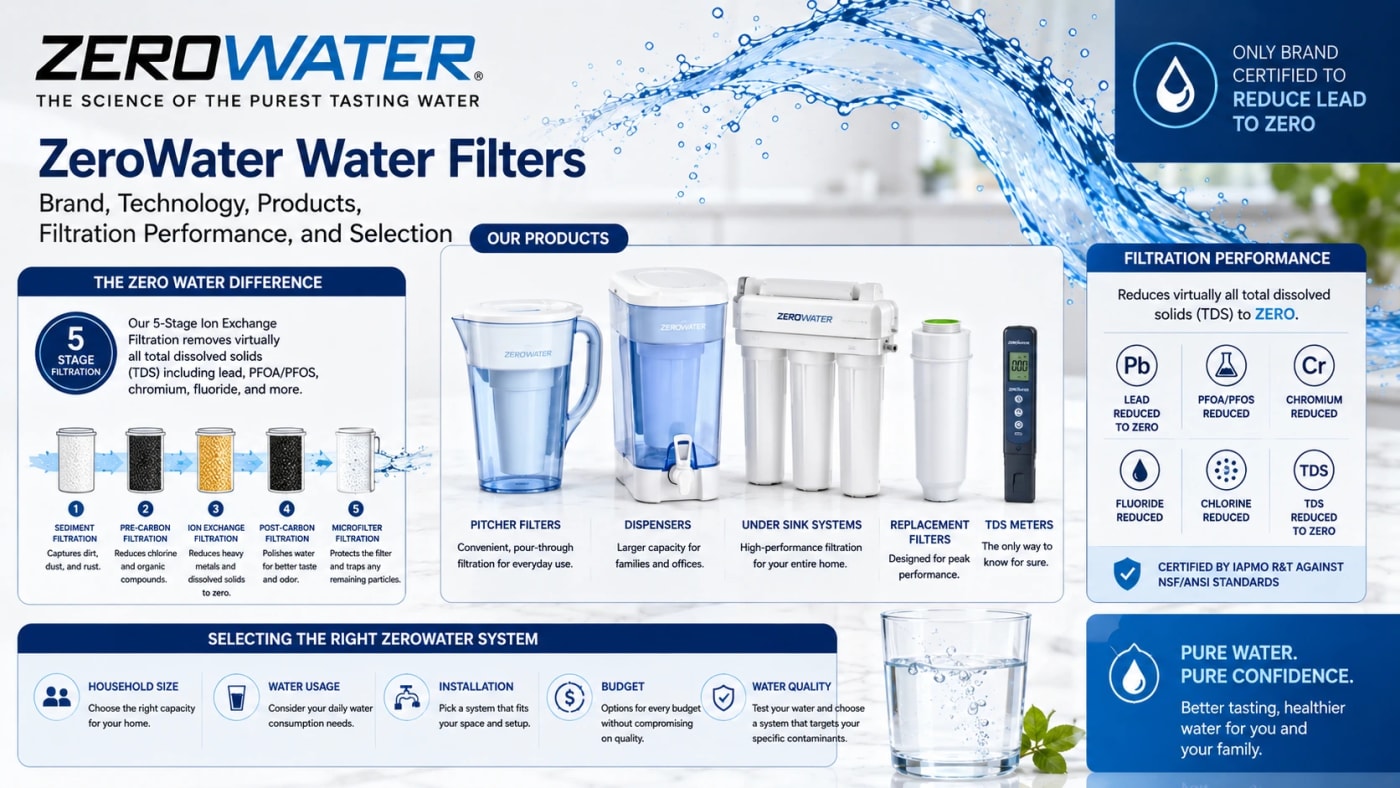
ZeroWater filters use a 5 stage ion exchange system built to reduce total dissolved solids in tap water to near zero. ZeroWater is not one single filter. The brand now operates under the name Culligan ZeroWater, and its product line covers pitchers, dispensers, faucet filters, and accessories, each with its own filtration goal. This guide explains the brand identity, the filtration technology, the product formats, and what each one actually removes.
What Is ZeroWater and How Does It Relate to Culligan?
ZeroWater is known for its 5 stage ion exchange filtration system. The brand became part of the Culligan family in 2020, and the product line now carries the combined name Culligan ZeroWater. ZeroWater operates as a distinct brand under the Culligan umbrella, keeping its focus on ion exchange filtration and TDS reduction while gaining access to Culligan's wider resources. Two related product lines exist today. The legacy ZeroWater line uses the original 5 stage filter design. The newer Culligan with ZeroWater Technology line uses a redesigned filter with a top down installation method and an expanded certification list. These two filter types are not compatible with each other.
What Types of ZeroWater Products Are Available?
ZeroWater products cover several distinct formats, and each one serves a different filtration goal or use pattern.
ZeroWater product categories:
5 stage pitchers and dispensers: Countertop or refrigerator gravity systems that reduce TDS to near zero using ion exchange
Ready Read models: A pitcher or dispenser with a built in TDS display for a visible, always on reading
EcoFilter: A filter cartridge without a plastic shell, built to reduce chlorine taste and odor
ExtremeLife faucet mount: A faucet mounted filter that reduces lead, PFOA, PFOS, and chlorine, without targeting 0 TDS
Replacement filters: Cartridges for pitchers and dispensers that restore performance after a cartridge is exhausted
TDS meters and accessories: Handheld or dock mounted meters that measure total dissolved solids
Starter kits: A pitcher or dispenser bundled with filters and a meter for a complete entry point
A household that wants the lowest possible TDS reading needs a 5 stage pitcher or dispenser. A household that mainly wants better tasting water without full ion exchange may consider the EcoFilter instead.
How Does ZeroWater's 5 Stage Filtration System Work?
The 5 stage system processes tap water through five sequential stages, and each stage targets a different type of material.
The 5 stage filtration process:
Mesh filter screen: Removes larger suspended solids from the water
Foam distributor: Spreads incoming water evenly so later stages filter it consistently
Activated carbon and fine filter screen: Removes organic contaminants, including chlorine and substances affecting taste and odor
Ion exchange resin: A mixed bed of cation and anion resin beads that removes dissolved ions from the water
Ultra fine mesh screen: Catches any remaining fine particles before the water exits the filter
Ion exchange is the core technology in this sequence. The resin bed contains positively charged cation beads and negatively charged anion beads. Dissolved ions in the water get captured by these beads and exchanged for other ions of a similar charge. This is the mechanism that allows the filter to reduce total dissolved solids far below what a simple carbon filter can achieve.
What Does 000 TDS Mean on a ZeroWater Meter?
A reading of 000 means the meter detects almost no dissolved ionic solids in the water sample. TDS stands for total dissolved solids, reported in parts per million. The meter measures the electrical conductivity of dissolved ions in water, since these ions carry a charge.
A common misunderstanding needs correction here. A 000 TDS reading does not mean the water contains zero contaminants. The meter cannot detect uncharged particles, such as certain organic contaminants, and it cannot detect undissolved particles, such as bacteria. A TDS reading gives information about dissolved ionic material only, not a complete safety profile of the water.
Which Contaminants Can ZeroWater Filters Reduce?
Claims differ by product line and by certification status, so they should not be treated as a single brand wide guarantee.
The table below groups the main substances by category and notes the certification basis on the legacy 5 stage system.
Substance Category | Examples | Certification Basis |
Metals | Lead, chromium, mercury | IAPMO certified under NSF/ANSI 53 |
Chlorine taste and odor | Chlorine | IAPMO certified under NSF/ANSI 42 |
PFAS group | PFOA, PFOS | IAPMO certified under NSF/ANSI 53 |
Fluoride | Fluoride | Independently lab tested, 99 percent reported reduction, not IAPMO or NSF certified on the legacy line |
Total dissolved solids | Salts, minerals, metals, ions | Brand reported 99.6 to 99.9 percent reduction |
The newer Culligan with ZeroWater Technology line expands this list further, adding certification for total PFAS along with select pharmaceuticals and pesticides. Always check the specific certification document for the exact model in use.
How Do ZeroWater Product Formats Differ?
Each product format is designed to do something different, and the EcoFilter and ExtremeLife faucet mount should not be judged against the 0 TDS expectation set by the pitcher and dispenser line.
The table below compares the three main ZeroWater filtration formats.
Attribute | 5 Stage Pitcher or Dispenser | EcoFilter | ExtremeLife Faucet Mount |
Filtration objective | Reduce TDS to near zero | Reduce chlorine taste and odor | Reduce lead, PFOA, PFOS, and chlorine |
Installation | Gravity fed, no plumbing needed | Fits into compatible pitchers and dispensers | Mounts directly onto a kitchen faucet |
Expected TDS outcome | Near 0 TDS on a fresh filter | Not designed to reach 0 TDS | Not designed to reach 0 TDS |
Filter capacity | About 20 to 25 gallons, varies with source water | Varies by cartridge | About 400 gallons, roughly 6 months |
Monitoring method | TDS meter, replace at 006 or higher | No TDS based monitoring | Filter life indicator light |
How Should You Choose Between Pitchers, Dispensers, and Faucet Filtration?
The right format depends on household size, available space, dispensing needs, and filtration objective.
Choosing the right format:
Small household, limited fridge space: A pitcher
Larger household, higher daily water use: A dispenser with larger capacity
Preference for permanent faucet based filtration: The ExtremeLife faucet mount
Priority on the lowest possible TDS reading: A 5 stage pitcher or dispenser
Priority on chlorine taste only, without full ion exchange: An EcoFilter compatible pitcher or dispenser
Preference for a visible, always on TDS display: A Ready Read pitcher or dispenser
Need for portability, such as travel or a dorm room: A compact pitcher format
How Long Do ZeroWater Filters Last?
Filter life on the legacy 5 stage line generally runs around 20 to 25 gallons before replacement is needed. This range shifts significantly with incoming TDS level and household consumption.
What affects filter life:
Incoming TDS level: Higher incoming TDS uses up the ion exchange resin faster
Water chemistry: Local water treatment and source composition affect how quickly resin becomes exhausted
Household consumption: Higher daily use processes more gallons, shortening calendar time between replacements
Total gallons processed: Filter life is tied to volume, not just calendar days
A household with low TDS tap water may get a filter life closer to 40 gallons, while a household with high TDS tap water may see a filter exhausted in under 15 gallons.
How Do You Know When to Replace a ZeroWater Filter?
The filter indicates replacement time through the included TDS meter reading, along with taste and smell changes.
Steps to check and replace a filter:
Test the filtered water regularly using the included TDS meter
Replace the filter once the reading hits 006 or higher, or when the light indicator turns on
Remove the exhausted filter and install a new one before continuing to use the pitcher or dispenser
An exhausted filter can cause a sour, acidic, or fishy taste and smell even before the meter reading climbs, since the ion exchange resin can begin releasing previously captured material once fully exhausted.
What Ownership Factors Should You Consider?
Several factors affect the long term experience of owning a ZeroWater system, beyond the initial purchase price.
Ownership factors to weigh:
Replacement filter consumption: Filters need replacement more often than simple carbon pitcher filters
Filter packs and subscriptions: ZeroWater offers subscription based filter delivery, which can include free shipping
Maintenance routine: Pitchers and dispensers need regular hand washing with mild soap, rinsing, and drying
Storage: Dispensers and pitchers can be stored in the refrigerator or on the counter
Warranty terms: The pitcher, dispenser, and TDS meter carry a 90 day manufacturing defect warranty, and filter cartridges carry a shorter, separate warranty
Plastic construction: ZeroWater products are made from BPA free plastic
Retailer availability: Widely sold through major US retailers including Amazon, Target, Walmart, Home Depot, Lowe's, Kroger, and H-E-B