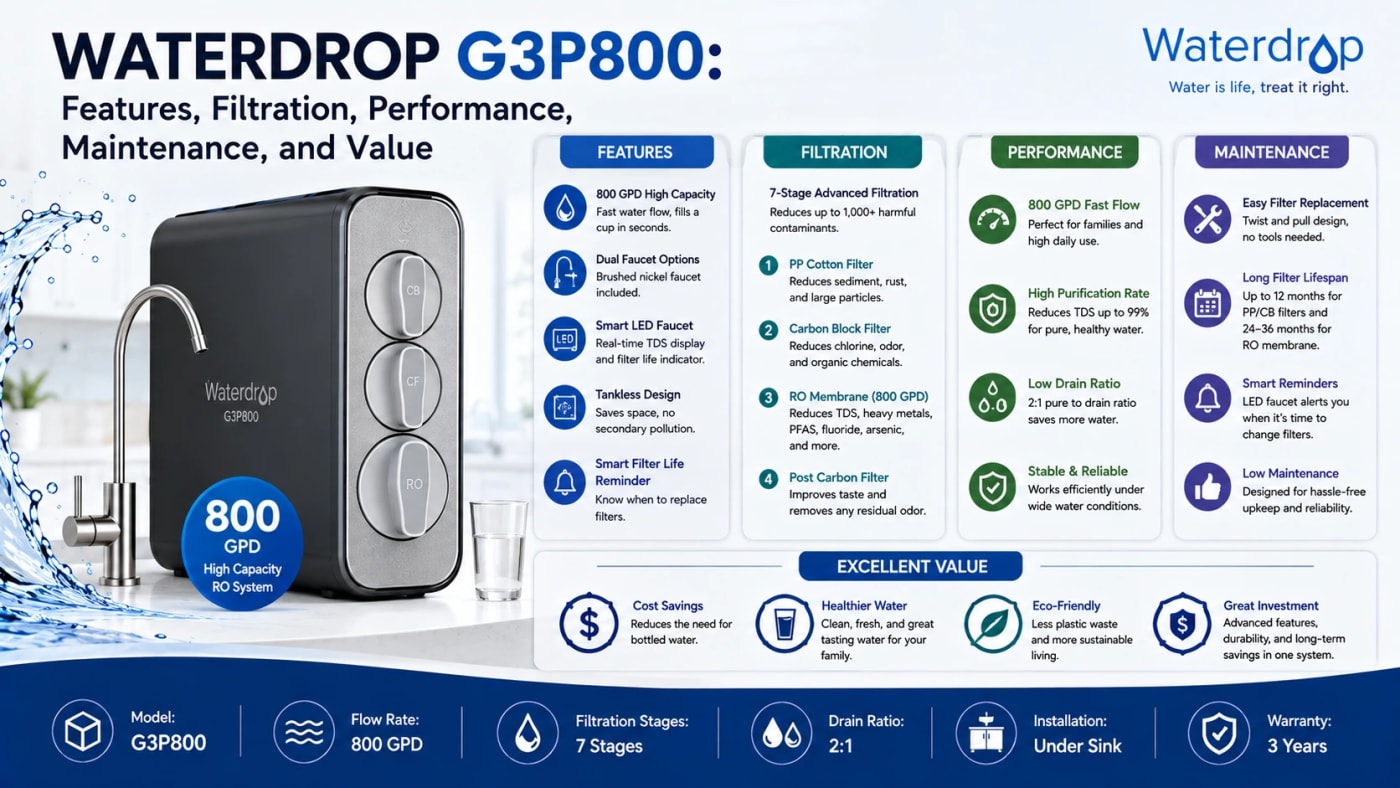
Waterdrop G3P800 is a tankless under-sink reverse osmosis system built for households that want high water output without waiting for a storage tank to refill. This review covers the system from every angle: its core features and physical specifications, its multi-stage filtration process, certified and manufacturer-stated contaminant reduction, real-world performance including output speed and wastewater ratio, smart faucet monitoring, installation requirements, filter maintenance and ongoing cost, owner experience, and practical limitations. Each section below breaks down one attribute in detail, so a buyer gets a full and honest picture of the G3P800's value before deciding if it fits their kitchen.
What are the Waterdrop G3P800's core specifications and physical requirements?
The Waterdrop G3P800's core specifications and physical requirements define what the system needs before installation and what it delivers once running. The unit is a tankless reverse osmosis system, which means it produces filtered water on demand instead of storing it in a pressurized tank. It uses a multi-stage filtration process and connects to a dedicated faucet at the sink.
This table shows the core specifications of the Waterdrop G3P800:
How does the Waterdrop G3P800 filtration system process water from inlet to faucet?
The Waterdrop G3P800 filtration system processes water through several stages before it reaches the faucet. Water enters the system and passes through sediment and carbon pre-filters first. These stages remove larger particles, sand, rust, and chlorine taste and odor from the incoming water.
After pre-filtration, water moves through the reverse osmosis membrane. The membrane pore size is rated at 0.0001 micron, which is fine enough to block dissolved contaminants, heavy metals, and many other particles that pre-filters cannot catch.
Following the membrane stage, water passes through post-filtration. Depending on configuration, this can include additional carbon polishing or a UV stage for extra disinfection. Because the system is tankless, a built-in booster pump pushes water through the membrane on demand and delivers it directly to the faucet. The system also runs automatic flushing cycles to clean the membrane and extend its working life.
Filtration flow, step by step:
Sediment pre-filter: Removes sand, dust, and larger particles.
Carbon pre-filter: Removes chlorine taste, odor, and organic compounds.
RO membrane (0.0001 micron): Removes dissolved solids, heavy metals, and fine contaminants.
Post-filtration: Polishes the water for final taste and quality.
Booster pump and tankless delivery: Pushes water on demand straight to the faucet.
Automatic flushing: Cleans the membrane surface to reduce fouling.
Which contaminants does the G3P800 reduce, and which reductions are independently certified?
The contaminants the G3P800 reduces fall into different evidence categories, and buyers should understand the difference between certified claims and general marketing claims. Not every substance listed in product marketing carries the same level of independent verification.
The IAPMO certificate for the WD-G3P800, issued under NSF/ANSI 58, lists specific certified reductions. Separately, Waterdrop markets additional reduction claims for the system that are not part of that certified listing.
This table shows contaminant reduction claims and their verification level:
Contaminant | Claim type | Verification source | Notes |
TDS (Total Dissolved Solids) | Certified | IAPMO, NSF/ANSI 58 | Listed on official certificate |
Fluoride | Certified | IAPMO, NSF/ANSI 58 | Listed on official certificate |
Cadmium | Certified | IAPMO, NSF/ANSI 58 | Listed on official certificate |
Hexavalent chromium | Certified | IAPMO, NSF/ANSI 58 | Listed on official certificate |
Selenium | Certified | IAPMO, NSF/ANSI 58 | Listed on official certificate |
Barium | Certified | IAPMO, NSF/ANSI 58 | Listed on official certificate |
Radium 226/228 | Certified | IAPMO, NSF/ANSI 58 | Listed on official certificate |
PFOA/PFOS | Manufacturer claim | Waterdrop marketing | Not part of the IAPMO certified list |
Lead | Manufacturer claim | Waterdrop marketing | Not part of the IAPMO certified list |
Other heavy metals | Manufacturer claim | Waterdrop marketing | General RO performance claim |
Buyers who need proof for a specific contaminant should check the certified list first. Claims outside that list still reflect general reverse osmosis performance, but they do not carry the same independent documentation.
The G3P800's 800 GPD output, flow speed, and wastewater ratio describe how the system performs day to day, and how that performance compares with real household use. The 800 GPD rating means the system can produce up to 800 gallons of filtered water in a 24 hour period under ideal conditions. Because the design is tankless, water comes out fast. Waterdrop states the system can fill a 6 oz cup in about 5 seconds.
The system uses a 3:1 pure-to-drain ratio, meaning it produces 3 parts filtered water for every 1 part sent to drain during normal filtration. This ratio is more efficient than older RO systems that waste much more water per gallon produced.
Real household use can differ from the rated specification. Automatic flushing cycles, which protect the membrane, add extra water to the drain beyond the standard 3:1 ratio during normal filtration. Community reports from users have specifically raised this point as something to expect rather than treat as a defect.
This table shows rated specification against real-world considerations:
Metric | Rated specification | Real-world consideration |
Daily output | 800 GPD | Achieved under ideal pressure and feed water conditions |
Fill speed | 6 oz in about 5 seconds | Consistent with tankless, on-demand design |
Pure-to-drain ratio | 3:1 | Automatic flushing adds extra drain water beyond this ratio |
Wastewater source | Standard filtration process | Flushing cycles are a separate, additional factor |
How does the G3P800 smart faucet monitor TDS and filter life?
The G3P800 smart faucet monitors TDS and filter life through a digital display built into the faucet itself. TDS stands for Total Dissolved Solids, and the display shows a live reading of water quality as it comes out of the tap. This lets users see filtration performance in real time instead of guessing.
The same display also tracks filter life. As each cartridge approaches the end of its rated capacity, the faucet shows a notification so the user knows a replacement is due soon.
What the smart faucet display tells the user:
Live TDS reading: Shows current water quality at the point of use.
Filter life status: Tracks how much life remains in each cartridge.
Replacement alerts: Notifies the user when a filter needs changing.
Water quality monitoring: Gives ongoing feedback without extra testing tools.
What installation conditions does the G3P800 require under a kitchen sink?
The installation conditions the G3P800 requires under a kitchen sink cover space, water connections, drainage, and power. Waterdrop markets the unit as a do-it-yourself installation system. Independent review documentation, however, records more detailed physical requirements that buyers should confirm before purchase.
Kitchen requirements checklist:
Cabinet clearance: Enough depth, height, and width under the sink to fit the unit and allow airflow.
Cold water connection: A shutoff valve or adapter point to connect the system to the home water line.
Drain connection: A drain saddle or connection point at the sink drain pipe for wastewater.
Faucet installation: An extra hole in the sink or countertop for the dedicated RO faucet, or use of an existing hole.
Electrical outlet: An accessible outlet near the installation area, since the tankless design uses a booster pump that needs power.
Access for maintenance: Enough open space to reach the unit later for filter changes.
Waterdrop markets the process as roughly a 30 minute DIY installation. In practice, some households need to drill a new hole for the faucet or adjust existing plumbing, which can add time and may call for basic plumbing skills.
How often do the G3P800 filters need replacement, and what does ownership cost?
The G3P800 filters need replacement on different schedules depending on the cartridge, and ownership cost depends on how often each one is changed. The system uses separate cartridges for pre-filtration, carbon filtration, and the RO membrane, each rated for a specific gallon capacity or time period, whichever comes first.
This table shows filter maintenance schedule and cost:
Filter | Function | Expected life | Notes |
G3-N1CF | Sediment and carbon pre-filter | Up to 6 months or 550 gallons | Removes larger particles and chlorine taste |
G3-N3CB | Carbon block filter | Up to 12 months or 1,100 gallons | Further reduces taste, odor, and organics |
G3P800-N2RO | RO membrane | Up to 24 months or 2,200 gallons | Core filtration stage for dissolved contaminants |
Actual filter life depends on incoming water quality and household usage. Homes with harder or more contaminated feed water tend to use filter capacity faster than the rated estimate. Buyers should check current Waterdrop pricing for each cartridge to calculate an accurate annual cost, since pricing changes over time.
What do owners and independent testers report about the G3P800's taste, noise, reliability, and daily use?
Owners and independent testers report a mix of results about the G3P800's taste, noise, reliability, and daily use, and it helps to separate verified lab testing from individual owner experiences. Independent testing has found strong contaminant reduction performance and highlighted the tankless design as a practical advantage over older tank-based systems, since it saves cabinet space and delivers water faster.
Owner reports add a different layer of information. Many users describe good tasting water and simple day to day operation. Other owners report issues such as pump noise during operation, occasional pump problems, and mixed experiences with customer service response times.
This table shows independent testing versus owner reports:
Category | Independent testing findings | Owner reports |
Contaminant reduction | Strong performance confirmed | Generally satisfied with taste and clarity |
Space and design | Tankless design saves cabinet space | Appreciated by owners with small cabinets |
Noise | Not the primary testing focus | Some owners report noticeable pump noise |
Reliability | Not systematically measured | Mixed, includes both smooth use and pump complaints |
Support experience | Not part of lab testing | Mixed reports on service response |
What should buyers understand about the G3P800's limitations before choosing it?
Buyers should understand several practical limitations of the G3P800 before choosing it, beyond the specifications already covered on this page.
Key limitations and what they mean for buyers:
Electricity dependence: The booster pump needs a power outlet, so the system cannot run during a power outage.
Installation complexity: DIY installation is possible, but drilling a faucet hole or adjusting plumbing can require extra skill and time.
Wastewater from flushing: Automatic flushing adds drain water beyond the rated 3:1 ratio, which slightly increases total water use.
No remineralization by default: The standard configuration does not add minerals back into the water, so buyers who want that must add a separate filter.
Proprietary filters: Replacement cartridges are Waterdrop specific, which limits filter sourcing options.
Price: The system costs more upfront than basic tank-based RO systems.
Reported service concerns: Some owners describe slower or inconsistent customer support experiences.
None of these points make the system unsuitable on their own. They are practical factors that affect the total cost and convenience of ownership.
Who is the Waterdrop G3P800 best suited to based on its capacity, features, and ownership requirements?
The Waterdrop G3P800 is best suited to buyers based on capacity needs, feature preferences, and willingness to manage ongoing filter costs.
Good fit for:
High-output households: Families or heavy water users who want fast, on-demand filtered water without a storage tank.
Limited cabinet space: Buyers whose under-sink area cannot fit a traditional tank-based RO system.
Buyers who want monitoring: Users who value real-time TDS and filter-life tracking on the faucet display.
Buyers prioritizing certified performance: Households that want NSF/ANSI 58 certified reduction for specific contaminants.
Requires closer evaluation for:
Untreated well water users: The system is designed for treated municipal tap water, not raw well water.
Users highly sensitive to wastewater: Anyone who wants zero extra drain water beyond the rated ratio should account for automatic flushing.
Is the Waterdrop G3P800 worth buying for its price and long-term ownership cost?
The Waterdrop G3P800 is worth buying for its price and long-term ownership cost if a household values fast tankless output, certified contaminant reduction, and smart monitoring enough to justify the higher upfront price and proprietary filter costs. Based on the specifications and evidence covered on this page, the system performs well for households that need high daily output and space savings. Pricing is dynamic and should be checked at the time of purchase. For a full cost breakdown and value analysis, see the dedicated guide: Waterdrop G3P800: Is It Worth It?
How does the Waterdrop G3P800 compare with the G3P600?
The Waterdrop G3P800 compares with the G3P600 mainly on production capacity and water efficiency. The G3P800 offers 800 GPD capacity with a 3:1 pure-to-drain ratio, while the G3P600 offers 600 GPD capacity with a 2:1 pure-to-drain ratio. The G3P800 suits households that want higher daily output and better water efficiency, while the G3P600 suits smaller households with lower demand. For a full side by side breakdown, see: Waterdrop G3P800 vs G3P600.
How do you install the Waterdrop G3P800 under a kitchen sink?
Installing the Waterdrop G3P800 under a kitchen sink involves connecting the water supply line, the drain line, the dedicated faucet, the tubing between components, and the power outlet for the booster pump. Waterdrop advertises approximately 30 minute DIY installation. Independent reviews note that drilling a faucet hole and managing leak points can make the actual process longer for some households. For the complete step by step process, see: Waterdrop G3P800 Installation Guide.
How do you replace the Waterdrop G3P800 filters and reset the filter indicator?
Replacing the Waterdrop G3P800 filters and resetting the filter indicator is designed to be a task the owner can handle without a technician. Each cartridge is built for straightforward removal and replacement, and the smart system tracks filter status through the faucet display. For the full replacement procedure and indicator reset steps, see: Waterdrop G3P800 Filter Replacement Guide.
Does the Waterdrop G3P800 need a remineralization filter?
The Waterdrop G3P800 needs a remineralization filter only if the buyer wants minerals added back into the water after RO filtration. The standard configuration does not include remineralization. Waterdrop offers a separate remineralization filter as an add-on, and independent testing found measurable differences in water characteristics between configurations with and without it. For the full comparison and guide, see: Waterdrop G3P800 Remineralization Filter Guide.
Is the Waterdrop G3P800 suitable for well water or untreated water?
The Waterdrop G3P800 is suitable for well water or untreated water only with proper pretreatment. The system itself is built for treated, municipal potable feed water. Product documentation specifies this use case, and independent reviews caution against connecting the system directly to untreated well water without pretreatment. Buyers on well water should evaluate their water quality and pretreatment needs first. See: Best RO Systems for Well Water and Well Water Pretreatment Guide.