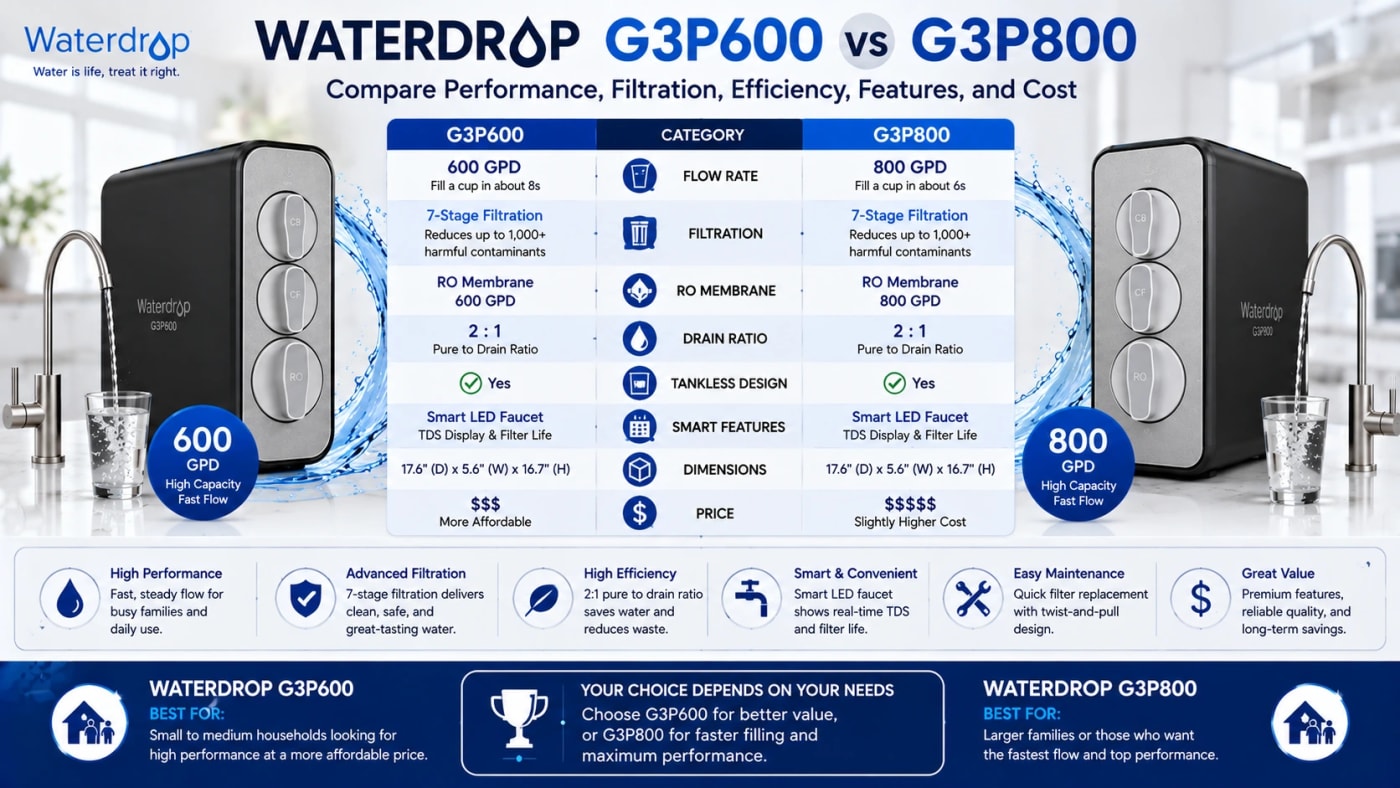
How does the filtration architecture differ between the G3P600 and G3P800?
The filtration architecture between the G3P600 and G3P800 differs mainly in what the extra stages on the G3P800 actually do, not just how many stages exist. Both systems use a CF pre sediment and carbon block filter to catch large particles and reduce chlorine taste. Both also use a CB activated carbon filter for finer chemical reduction, followed by an RO membrane rated at 0.0001 micron that blocks dissolved solids, heavy metals, and many organic compounds. The G3P800 adds a UV sterilizer stage that the G3P600 does not have. A higher stage count on its own does not mean stronger core filtration, because the CF, CB, and RO stages already perform the main contaminant reduction work on both models. The extra stages on the G3P800 mostly come from splitting filtration steps further and adding the UV layer.
Filtration components shared and unique between the two systems:
CF filter: Removes sediment, rust, and large particles, present on both models.
CB filter: Reduces chlorine, taste, and odor, present on both models.
RO membrane: Blocks dissolved solids and heavy metals down to 0.0001 micron, present on both models.
UV sterilizer: Targets bacteria and viruses, present only on the G3P800.
Which contaminant reduction capabilities are shared by the G3P600 and G3P800?
The contaminant reduction capabilities shared by the G3P600 and G3P800 cover the chemical and physical contaminants that both RO membranes are built to reduce. Waterdrop states that both systems reduce total dissolved solids (TDS), chlorine, fluoride, lead, arsenic, chromium, and PFAS related substances such as PFOA and PFOS. These figures come from Waterdrop's own performance data sheets and third party lab testing such as SGS. A manufacturer stating that a system reduces a contaminant is not the same as an independent lab confirming an exact percentage for a specific water sample, so exact reduction rates depend on local water conditions and should be checked against the official performance data sheet for each model. No RO system removes every possible substance in tap water, and no claim in this article should be read as an absolute guarantee.
What additional protection does the G3P800 UV stage provide?
The additional protection the G3P800 UV stage provides comes from microbial treatment that works differently from the RO membrane. The UV lamp inside the G3P800 targets bacteria and viruses that may pass through in trace amounts, and Waterdrop states it activates automatically during water flow. This stage solves a different problem than dissolved contaminant reduction. The RO membrane physically blocks particles by size. The UV light instead damages the DNA of microorganisms so they cannot reproduce. Waterdrop does not describe this as making water universally sterile, and this article does not either. UV protection is most relevant for households concerned about biological contamination in their water supply, such as those using well water or older plumbing.
How do the G3P600 and G3P800 differ in certification scope?
The G3P600 and G3P800 differ in certification scope mainly through one added standard. NSF/ANSI certification confirms that a water treatment product meets specific tested performance claims. The table below lists the certifications currently shown on the official US product pages for each model.
This table shows the NSF/ANSI certification scope for each model.
NSF/ANSI Standard | What it covers | G3P600 | G3P800 |
NSF/ANSI 42 | Chlorine, taste, and odor reduction | Yes | Yes |
NSF/ANSI 53 | Health related contaminants such as lead and PFAS | No | Yes |
NSF/ANSI 58 | TDS reduction through reverse osmosis | Yes | Yes |
NSF/ANSI 372 | Lead free material compliance | Yes | Yes |
The G3P800 carries NSF/ANSI 53 certification and the G3P600 does not. This is the clearest documented certification gap between the two models. Older listings and third party retailer pages sometimes show different wording for the G3P600, so the current model specific documentation on the official Waterdrop page should always be checked before making a certification based decision.
How does 600 GPD compare with 800 GPD for real world dispensing speed?
600 GPD compared with 800 GPD for real world dispensing speed comes down to how fast water leaves the faucet, not how clean it becomes. GPD stands for gallons per day, and it measures how much filtered water a system can produce in 24 hours under test conditions. A higher GPD rating mainly affects speed and volume, not contaminant removal quality.
This table shows cup fill time for each model based on Waterdrop's published data.
Model | Output | Time to fill a 6 oz cup |
G3P600 | 600 GPD | Around 8 seconds |
G3P800 | 800 GPD | Around 5 seconds |
This speed difference matters most when filling pitchers, large pots for cooking, or multiple bottles back to back. For a single glass of water at a time, the difference is barely noticeable. Household size and habits determine whether faster dispensing is worth paying for, and there is no fixed household size that makes one model automatically correct for everyone.
How does the 2:1 G3P600 drain ratio compare with the 3:1 G3P800 ratio?
The 2:1 G3P600 drain ratio compared with the 3:1 G3P800 ratio shows how much water goes down the drain to produce each unit of filtered water. Pure to drain ratio describes the relationship between filtered water produced and wastewater released. A 2:1 ratio on the G3P600 means the system sends two parts purified water to the faucet for every one part sent to the drain. A 3:1 ratio on the G3P800 means three parts purified water reach the faucet for every one part sent to drain.
This table shows the practical difference using a simple 10 gallon example.
Model | Ratio | Wastewater for 10 gallons purified |
G3P600 | 2:1 | 5 gallons |
G3P800 | 3:1 | About 3.3 gallons |
The G3P800 sends less water down the drain for the same amount of purified water produced. Real world ratios shift with feed water pressure, temperature, and the condition of the incoming water supply, so these numbers represent manufacturer rated benchmarks rather than a fixed outcome in every home.
How do the smart faucets and monitoring features compare between the two models?
The smart faucets and monitoring features compare closely between the two models because both systems ship with a smart LED faucet. Both the G3P600 and G3P800 display real time TDS readings and filter life status directly on the faucet screen. This lets a household see water quality and know when a filter needs replacing without checking manually. A TDS reading on its own does not prove that water is fully safe, because TDS measures dissolved mineral content and not specific contaminants like bacteria or PFAS. It works as a general water quality indicator, not a full safety test. No model specific extra monitoring functionality beyond this shared faucet display is confirmed on the current official product pages.
How do filter replacement schedules and ongoing filter costs compare?
Filter replacement schedules and ongoing filter costs compare closely in schedule but differ slightly in yearly cost. Both systems use the same three filter types and similar replacement intervals, since they share the CF and CB filter design.
This table shows filter replacement intervals and average annual cost for each model.
Filter type | Replacement interval | G3P600 annual cost | G3P800 annual cost |
CF filter | Every 6 months | Included in total | Included in total |
CB filter | Every 12 months | Included in total | Included in total |
RO filter | Every 24 months | Included in total | Included in total |
Average annual total | — | 144.97 dollars | 159.97 dollars |
Actual replacement timing depends on household usage volume and the quality of the incoming source water, so heavy daily use can shorten these intervals. Both systems use a twist and pull filter design that Waterdrop states takes about 3 seconds to swap, making routine maintenance simple for most households.
How do the G3P600 and G3P800 compare in installation, cabinet space, and power requirements?
The G3P600 and G3P800 compare almost identically in installation, cabinet space, and power requirements because both share the same tankless body. Both models measure 18.11 by 5.67 by 17.73 inches and weigh 32.4 lb, and both need a nearby electrical outlet to run the pump and smart faucet display.
Installation requirements checklist for both models:
Electrical outlet: Required near the installation point to power the system.
Drain connection: Required, using the included adjustable drain saddle.
Cabinet clearance: About 1 inch of space recommended around the unit to reduce vibration noise.
Water line connection: Standard cold water supply line connection under the sink.
Countertop faucet installation: A hole in the countertop or sink deck for the smart faucet, using an existing hole where possible.
Both systems fit the same general under sink footprint, so a kitchen that already accommodates one model will generally accommodate the other without extra cabinet modification.
How do purchase price and long term value differ between the G3P600 and G3P800?
Purchase price and long term value differ between the G3P600 and G3P800 mainly in upfront cost, since the G3P800 costs several hundred dollars more at checkout. At the time of writing, the G3P600 lists around 539 dollars regular price, while the G3P800 lists around 999 dollars regular price, with the G3P800 more often shown at a discounted 759 dollar sale price. Annual filter costs run 144.97 dollars for the G3P600 and 159.97 dollars for the G3P800, a smaller gap than the purchase price difference. These prices change based on promotions and time of year, so always confirm the live price before ordering.
The extra spend on the G3P800 buys three specific things: higher 800 GPD output for faster dispensing, a 10 stage configuration built around a 3:1 water efficient drain ratio, and the added NSF/ANSI 53 certification along with UV sterilization. There is no universal winner between the two models. The right choice depends on whether those three specific upgrades matter enough for a given household to justify the price gap.
How do the G3P600 and G3P800 differ for refrigerator and ice maker connections?
The G3P600 and G3P800 differ for refrigerator and ice maker connections mainly in the pressure and accessory setup needed, rather than in a fixed rule about which model works better. Tankless RO systems generally produce water on demand rather than storing pressurized water in a tank, so connecting either model to a refrigerator or ice maker can require an additional pressure tank accessory to maintain steady flow. Waterdrop lists its PMT pressure tank as compatible with both the G3P600 and the G3P800.
What to check before connecting either model to a refrigerator or ice maker:
Line pressure: Confirm the refrigerator manufacturer's minimum water pressure requirement.
Pressure tank need: Check whether a PMT pressure tank accessory is required for stable ice maker performance.
Tubing compatibility: Confirm the refrigerator's water line connector matches the RO system's output fitting.
Distance from unit: Longer tubing runs can reduce pressure reaching the appliance.
How do water source and feed water conditions affect the choice between G3P600 and G3P800?
Water source and feed water conditions affect the choice between the G3P600 and G3P800 mainly through pre filtration needs, rather than a strict rule based on GPD rating. Waterdrop states that well water requires additional pre filtration before entering either system. Waterdrop's published operating conditions for the G3 series include water pressure between 14.5 and 87 psi, temperature between 41 and 100 degrees Fahrenheit, pH between 6.5 and 8.5, turbidity below 1 NTU, TDS below 750 ppm, and hardness below 7 grains per gallon.
This table shows the operating conditions Waterdrop specifies for feed water.
Condition | Recommended range |
Water pressure | 14.5 to 87 psi |
Water temperature | 41 to 100 degrees Fahrenheit |
pH level | 6.5 to 8.5 |
Turbidity | Below 1 NTU |
TDS | Below 750 ppm |
Hardness | Below 7 grains per gallon |
The G3P800 is not automatically the correct choice for well water just because it costs more. What actually matters is whether the source water carries elevated microbial risk, in which case the UV stage on the G3P800 becomes more relevant, combined with proper pre filtration on either model.
Which household priorities determine whether the G3P600 or G3P800 differences actually matter?
Household priorities that determine whether the G3P600 or G3P800 differences actually matter come down to translating the technical specifications into real world needs. The list below brings together every attribute already covered in this comparison into a simple decision framework.
Priorities to weigh before choosing between the G3P600 and G3P800:
Daily water demand: Moderate use favors the G3P600, heavy or frequent use favors the G3P800.
Dispensing speed: Faster fills matter more for large pots, pitchers, or frequent refills, favoring the G3P800.
Wastewater efficiency: Lower water waste per gallon produced favors the G3P800's 3:1 ratio.
Certification scope: Households wanting NSF/ANSI 53 health related contaminant certification should choose the G3P800.
UV preference: Extra biological protection through UV sterilization is exclusive to the G3P800.
Purchase budget: A lower upfront cost favors the G3P600.
Ownership cost: Annual filter costs are close between both models, so this factor rarely decides the choice alone.
Which G3P600 or G3P800 features matter most for moderate daily drinking and cooking demand?
The G3P600 or G3P800 features that matter most for moderate daily drinking and cooking demand center on dispensing speed at a level that still works fine for filling a glass, a kettle, or a cooking pot without long waits. For a household mainly using RO water for drinking and cooking, the G3P600's 600 GPD output and roughly 8 second cup fill time keep pace with typical daily use. The lower 539 dollar price point also reduces upfront cost without giving up core filtration through the CF, CB, and RO stages. Certification through NSF/ANSI 42, 58, and 372 already covers taste, odor, TDS reduction, and lead free material safety for this use case.
Which G3P600 or G3P800 features matter most for high volume dispensing and water efficiency needs?
The G3P600 or G3P800 features that matter most for high volume dispensing and water efficiency needs center on the direct link between the 800 GPD output and the 3:1 pure to drain ratio working together. A household filling multiple pitchers, running a coffee station, or using RO water constantly through the day benefits from both the faster 5 second cup fill and the lower wastewater output per gallon produced. These two features compound each other, since faster output combined with less wasted water reduces both waiting time and water bills for high volume households.
What should you know about the Waterdrop G3P600 before buying it?
What you should know about the Waterdrop G3P600 before buying it starts with its 8 stage filtration, 600 GPD output, and 2:1 pure to drain ratio at a lower price point than the G3P800. Its main strength is a strong balance between filtration depth and cost for moderate household demand. Its main limitation is the lack of UV sterilization and NSF/ANSI 53 certification, which matter more for households concerned about biological contaminants. It fits small to medium households using RO water mainly for drinking and cooking. For full specifications, current pricing, and customer reviews, visit the dedicated Waterdrop G3P600 product page.
What should you know about the Waterdrop G3P800 before buying it?
What you should know about the Waterdrop G3P800 before buying it starts with its 800 GPD output, 10 stage filtration, 3:1 pure to drain ratio, and UV sterilizer stage that the G3P600 does not include. It also carries NSF/ANSI 53 certification in addition to the standards shared with the G3P600. This model fits larger households, high volume water use, or anyone prioritizing added biological protection and lower wastewater output. For full specifications, current pricing, and customer reviews, visit the dedicated Waterdrop G3P800 product page.
How should you compare the G3P600 and G3P800 with other under sink RO systems?
How you should compare the G3P600 and G3P800 with other under sink RO systems starts by treating them as two options within a much wider under sink RO category, not as the only two systems worth considering. Waterdrop also sells other series such as the X Series and G5 Series with different GPD ratings, stage counts, and price points. Households with different budget ranges, space constraints, or filtration priorities may find a better fit outside the G3 series entirely. For a broader look at under sink RO options and how to select the right category of system, visit the main under sink reverse osmosis hub page.
How does remineralization fit with the G3P600 and G3P800?
Remineralization fits with the G3P600 and G3P800 as an optional add on rather than a built-in feature on either standard model. Neither the standard G3P600 nor the standard G3P800 remineralizes water by default. Waterdrop offers the MNR35 external remineralization filter as a compatible accessory for the G3 series, including the G3P600 and G3P800. Remineralization is not the core difference between these two models, since both handle it the same way through the same optional accessory. For a deeper explanation of how remineralization works and whether it fits a specific household, visit the dedicated remineralization and mineral water page.
How do G3P600 and G3P800 replacement filters differ?
G3P600 and G3P800 replacement filters differ mainly in the RO filter, since the CF and CB filters are shared across the G3 series while the RO membrane filter is model specific to each system. This means a G3P600 owner needs the RO filter designed for the G3P600, and a G3P800 owner needs the RO filter designed for the G3P800, while both can use the same CF and CB replacement filters. For exact filter part numbers, current pricing, and step by step replacement instructions, visit the dedicated Waterdrop G3 filter replacement page.