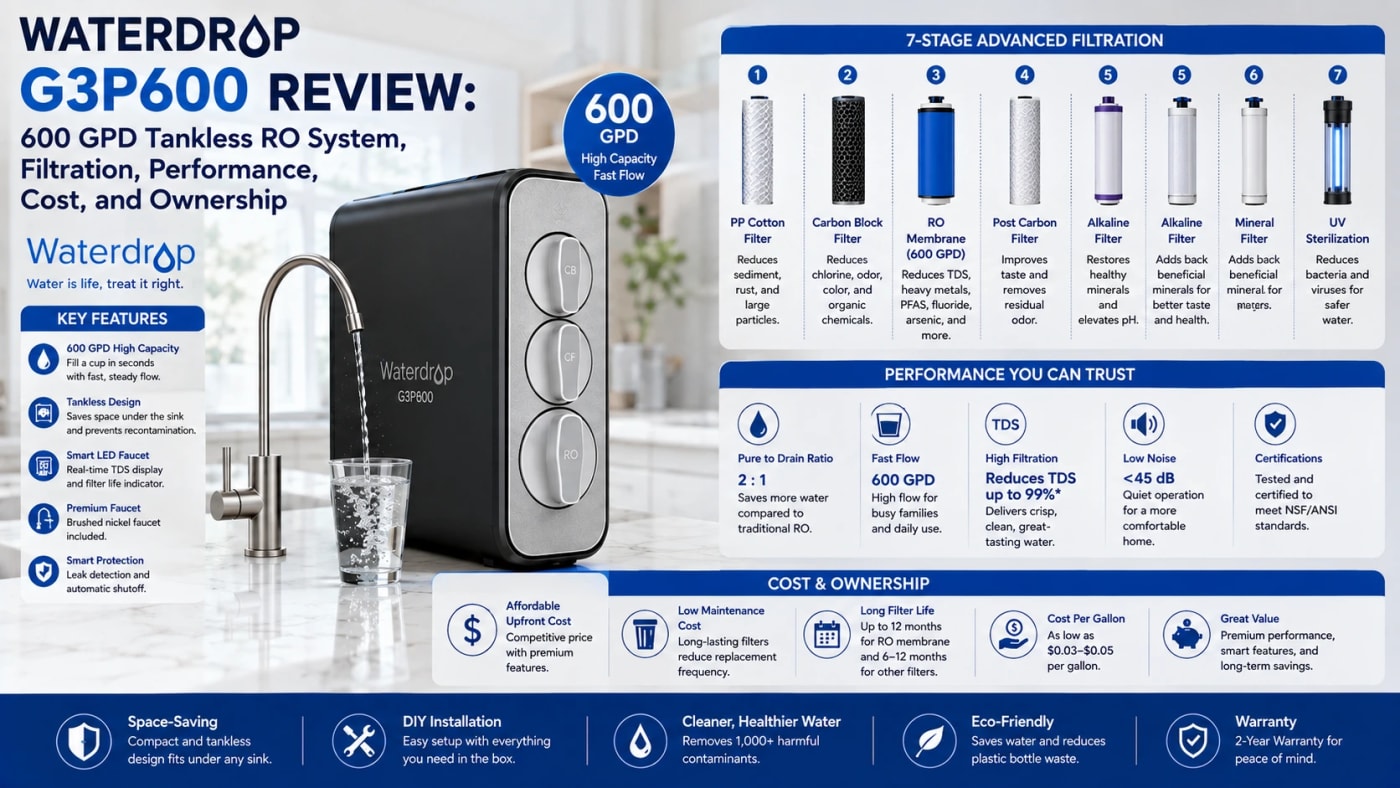
Waterdrop G3P600 is a tankless under-sink reverse osmosis system rated at 600 gallons per day, built for households that want steady daily filtered water without a bulky storage tank. This review looks at the system from every angle: its physical specifications, its multi-stage filtration process, certified and manufacturer-stated contaminant reduction, real-world water production speed, wastewater efficiency, smart faucet monitoring, filter replacement schedule, long-term ownership cost, installation requirements, appliance compatibility, taste and mineral changes, and common owner-reported issues. Each section below breaks down one attribute in detail, so a buyer gets a full and honest picture before deciding if the G3P600 fits their kitchen.
What are the key Waterdrop G3P600 specifications and physical dimensions?
The key Waterdrop G3P600 specifications and physical dimensions describe the unit before installation begins. The system is a tankless under-sink reverse osmosis unit that connects to a dedicated smart faucet.
This table shows the core specifications of the Waterdrop G3P600:
How does the Waterdrop G3P600 filtration system process drinking water?
The Waterdrop G3P600 filtration system processes drinking water through a sequence of stages before it reaches the faucet. Feed water enters the unit and passes through pre-filtration first. This stage removes sediment, dust, and larger particles that could damage later stages.
Water then moves through carbon filtration, which reduces chlorine taste, odor, and organic compounds. After that, water reaches the reverse osmosis membrane. Waterdrop rates this membrane at 0.0001 micron, fine enough to block dissolved contaminants and fine particles that carbon filtration cannot remove.
Filtration flow, step by step:
Feed water intake: Tap water enters the system from the cold water line.
Pre-filtration: Removes sediment and larger particles.
Carbon filtration: Reduces chlorine, taste, and odor.
RO membrane (0.0001 micron): Removes dissolved solids and fine contaminants.
Product water delivery: Filtered water reaches the smart faucet on demand.
Which contaminants does the Waterdrop G3P600 reduce according to its testing and certification data?
The contaminants the Waterdrop G3P600 reduces according to its testing and certification data fall into different levels of documentation. TDS, or Total Dissolved Solids, is one of the primary measurements used to judge overall reduction performance.
This table shows contaminant reduction based on available performance data:
Contaminant | Applicable standard or test | Reduction result | Qualification |
TDS | Performance test data | Significant reduction confirmed | Verified through manufacturer test documentation |
Chlorine | Carbon filtration performance data | Reduced through pre-filtration stage | Standard carbon filter function |
PFOA/PFOS | Performance test data | Reduction reported | Confirm current certification status before relying on this claim |
Fluoride | Performance test data | Reduction reported | Result depends on source water fluoride level |
Additional contaminants | Manufacturer performance documentation | Reduction reported | Treated as general RO performance claims unless separately certified |
Which NSF and IAPMO certifications does the Waterdrop G3P600 have?
The NSF and IAPMO certifications the Waterdrop G3P600 has depend on the exact documentation published at the time of purchase. Waterdrop product pages have referenced NSF/ANSI 42, 58, and 372 in some listings, while other Waterdrop documentation references NSF/ANSI 42, 53, and 58.
What each standard generally covers:
NSF/ANSI 42: Covers aesthetic effects, such as chlorine taste and odor reduction.
NSF/ANSI 53: Covers health-related contaminant reduction claims.
NSF/ANSI 58: Covers reverse osmosis system performance, including TDS reduction.
NSF/ANSI 372: Covers lead-free material compliance.
Buyers should check the current certification document listed on the official Waterdrop product page or packaging at the time of purchase, since certification listings can differ between product page versions.
How fast does the Waterdrop G3P600 produce purified water in everyday use?
The Waterdrop G3P600 produces purified water in everyday use because of its tankless design. The system is rated at 600 GPD, meaning it can produce up to 600 gallons of filtered water in a 24 hour period under ideal conditions.
Waterdrop states the system fills a small cup in approximately 6.5 to 8 seconds, depending on the specific product page version. This manufacturer figure describes on-demand output speed rather than long-term daily volume. Independent, real-world timing can vary based on household water pressure and feed water conditions.
How much wastewater does the Waterdrop G3P600 produce during operation?
The wastewater the Waterdrop G3P600 produces during operation is defined by its rated 2:1 pure-to-drain ratio. This means the system produces two parts filtered water for every one part sent to drain during normal filtration.
This table shows the rated wastewater ratio and what it means:
Term | Meaning |
Pure-to-drain ratio | 2:1 |
Interpretation | Two gallons of filtered water for every one gallon sent to drain |
Automatic flushing | Adds extra drain water beyond the standard 2:1 ratio |
User reports | Some owners describe more drain water than the rated ratio suggests |
Automatic flushing cycles clean the RO membrane and are separate from the standard filtration ratio. Community discussions among owners have raised this as a factor to expect, not as a guaranteed measurement for every household.
What does the Waterdrop G3P600 smart faucet actually monitor?
The Waterdrop G3P600 smart faucet actually monitors two main things: water TDS level and filter life. The faucet has a digital display that shows a live TDS reading as water passes through the tap.
This displayed number is a general indicator, not a complete water-quality report. TDS measures dissolved solids only, and it does not detect every contaminant type on its own. Some owners have reported that the on-faucet TDS reading does not always match results from a separate handheld meter. This is worth noting as an owner-reported observation rather than a confirmed defect.
What the smart faucet display tells the user:
Live TDS reading: Shows a general water quality indicator at the faucet.
Filter life reminder: Alerts the user when a cartridge is due for replacement.
Ongoing monitoring: Removes the need for manual testing in daily use.
How often do the Waterdrop G3P600 filters need to be replaced?
The Waterdrop G3P600 filters need to be replaced on different schedules depending on the cartridge type. The system uses a CF filter, a CB filter, and an RO membrane, each rated by time or gallon capacity, whichever comes first.
This table shows the filter replacement schedule:
Filter | Role | Expected life |
CF filter | Sediment and carbon pre-filtration | Up to 6 months or 550 gallons |
CB filter | Carbon block filtration | Up to 12 months or 1,100 gallons |
RO membrane | Core reverse osmosis filtration | Up to 24 months or 2,200 gallons |
Actual filter life depends on source water quality and household usage. Homes with harder or more contaminated feed water tend to reach filter capacity sooner than the stated estimate.
What does it cost to maintain the Waterdrop G3P600 over time?
The cost to maintain the Waterdrop G3P600 over time depends on filter replacement frequency and current filter pricing. Waterdrop lists an average annual filter cost of about 144.97 dollars on its comparison material. This figure is based on standard replacement intervals for the CF, CB, and RO cartridges.
Individual filter prices can change over time, so buyers should check current listed prices on the official Waterdrop product page before calculating their own annual cost. Households with harder source water should budget for filters that need replacement sooner than the stated intervals.
How difficult is the Waterdrop G3P600 to install and maintain?
The Waterdrop G3P600 is not difficult to install and maintain, based on Waterdrop's stated setup process. Installation involves connecting the unit under the kitchen sink to the cold water line, the drain line, the dedicated faucet, and a nearby power outlet.
Waterdrop states the installation process takes approximately 30 minutes. Filter replacement is designed to be quick as well, with Waterdrop describing a twist and pull process that takes about 3 seconds per cartridge, without extra tools.
Basic installation and maintenance requirements:
Water connection: Cold water line with a shutoff valve or adapter.
Drain connection: A drain saddle or connection point at the sink drain pipe.
Faucet installation: A dedicated hole for the RO faucet, or use of an existing hole.
Power outlet: An accessible outlet for the booster pump.
Filter access: Enough clearance to reach and replace cartridges without tools.
Can the Waterdrop G3P600 connect to a refrigerator, ice maker, or existing faucet?
The Waterdrop G3P600 can connect to a refrigerator, ice maker, or existing faucet in some setups, depending on the household's plumbing and the specific connection method used. The system comes with its own dedicated RO faucet as the standard setup.
This table shows common connection scenarios:
Connection type | Consideration |
Dedicated RO faucet | Standard setup included with the system |
Existing three-way faucet | Can work in some kitchens, but compatibility should be confirmed first |
Refrigerator or ice maker line | Possible in some configurations, often needs extra tubing and fittings |
Pressure or buffer tank | Needed in some refrigerator or ice maker setups to maintain steady flow |
Buyers who want a refrigerator or ice maker connection should confirm the current compatibility instructions on the official Waterdrop product page before purchase, since exact requirements can differ by kitchen setup.
What taste and water-mineral changes should you expect from the Waterdrop G3P600?
The taste and water-mineral changes to expect from the Waterdrop G3P600 come from how reverse osmosis filtration works. RO filtration reduces dissolved minerals along with contaminants, since the membrane does not separate beneficial minerals from unwanted particles.
Some owners prefer the taste of standard RO output. Others prefer added minerals back in the water and choose a remineralization or alkaline filter option if Waterdrop offers one for this system. This choice affects taste and TDS reading after filtration, but it does not change the core contaminant reduction performance.
Standard versus remineralized water, at a glance:
Standard RO water: Lower TDS reading, minerals largely removed along with contaminants.
Remineralized water: Minerals added back after RO filtration, which can change taste and raise the TDS reading slightly.
What problems do Waterdrop G3P600 owners report after installation?
The problems Waterdrop G3P600 owners report after installation vary by household, and they should be read as individual experiences rather than guaranteed outcomes.
Commonly reported issues:
Excessive wastewater: Some owners report more drain water than the rated 2:1 ratio suggests, often linked to automatic flushing.
Low flow: A few owners describe slower than expected flow at the faucet.
TDS display disagreement: Some owners report the faucet TDS reading does not match a separate handheld meter.
Faucet delay: A short delay before filtered water reaches full flow, reported by some users.
Power related issues: Since the pump needs electricity, a few owners report problems tied to outlet access or power interruption.
Leaks or filter seating concerns: Some owners report leaks during initial setup, often linked to filter cartridges not seated correctly.
What should you check before deciding whether the Waterdrop G3P600 fits your kitchen?
You should check several practical details before deciding whether the Waterdrop G3P600 fits your kitchen.
Kitchen readiness checklist:
Cabinet dimensions: Confirm enough depth, height, and width under the sink for the unit.
Power availability: Confirm an accessible electrical outlet near the installation area.
Desired flow: Compare the 600 GPD rating against household daily water needs.
Faucet setup: Decide between the included dedicated faucet or an existing three-way faucet.
Refrigerator requirements: Confirm compatibility instructions if a refrigerator or ice maker connection is planned.
Filter budget: Review current filter prices and expected replacement intervals.
Source water conditions: Check whether the home uses treated municipal water, since this affects performance and filter life.
Is the Waterdrop G3P600 worth buying for your household?
The Waterdrop G3P600 is worth buying for your household if its features match your specific needs, already covered on this page.
Best fit for:
Households wanting tankless under-sink RO: Buyers who prefer on-demand filtered water without a storage tank.
Users wanting high rated output: Households with steady daily water needs matching the 600 GPD capacity.
Buyers who value smart monitoring: Users who want live TDS and filter-life tracking at the faucet.
Compact installation needs: Kitchens with limited under-sink space.
Less suitable for:
Whole-house filtration needs: Households that need filtered water at every tap in the home, not just the kitchen sink.
Users who want zero wastewater: Anyone who cannot accept any drain water from the flushing process.
Buyers avoiding electricity dependent systems: Households that want a filtration system with no power requirement.
Buyers avoiding ongoing filter costs: Anyone unwilling to budget for scheduled cartridge replacement.
How does the Waterdrop G3P600 compare with other Waterdrop reverse osmosis systems?
The Waterdrop G3P600 compares with other Waterdrop reverse osmosis systems mainly on capacity, mineralization, ratio, and cost. Waterdrop's own comparison material places the G3P600 at 600 GPD, the G3P800 at 800 GPD, and the G5P700A at 700 GPD, each with different mineralization and ratio configurations.
This table shows a quick comparison across Waterdrop models:
Model | Rated capacity | Pure-to-drain ratio | Notable difference |
G3P600 | 600 GPD | 2:1 | Standard tankless configuration |
G3P800 | 800 GPD | 3:1 | Higher output, more efficient ratio |
G5P700A | 700 GPD | Varies by configuration | Different mineralization option available |
Buyers deciding between these models should weigh daily water needs against price and available features, since higher capacity models generally cost more.
What is a reverse osmosis water filter and how does RO filtration work?
A reverse osmosis water filter is a system that forces water through a semi-permeable membrane to remove dissolved solids and contaminants. RO filtration works by using pressure to push water through this membrane, leaving contaminants behind and passing purified water through. For a full explanation of the process, see: What Is Reverse Osmosis?
How often should reverse osmosis filters be replaced?
Reverse osmosis filters should be replaced based on either time passed or gallons filtered, whichever limit comes first. Pre-filters typically need replacement sooner than the RO membrane itself. For the complete general maintenance schedule across RO systems, see: Reverse Osmosis Filter Replacement Guide.
What contaminants can reverse osmosis systems remove from drinking water?
Reverse osmosis systems can remove several contaminant categories from drinking water, including dissolved solids, certain heavy metals, and specific chemical compounds, depending on membrane rating and certification. For the full breakdown of contaminant categories, see: What Does Reverse Osmosis Remove?
What is the difference between reverse osmosis and other water filtration methods?
The difference between reverse osmosis and other water filtration methods comes down to filtration depth. Reverse osmosis removes dissolved particles at a molecular level, while carbon filtration, sediment filtration, and water softening each target specific particle types or minerals instead. For the full comparison, see: Reverse Osmosis vs Other Water Filtration Methods.
What are the best reverse osmosis systems for different household needs?
The best reverse osmosis systems for different household needs depend on factors like output capacity, tank versus tankless design, and budget. The G3P600 is one tankless option among several choices available for different household sizes and water demands. For the full comparison across models and brands, see: Best Reverse Osmosis Water Filters.