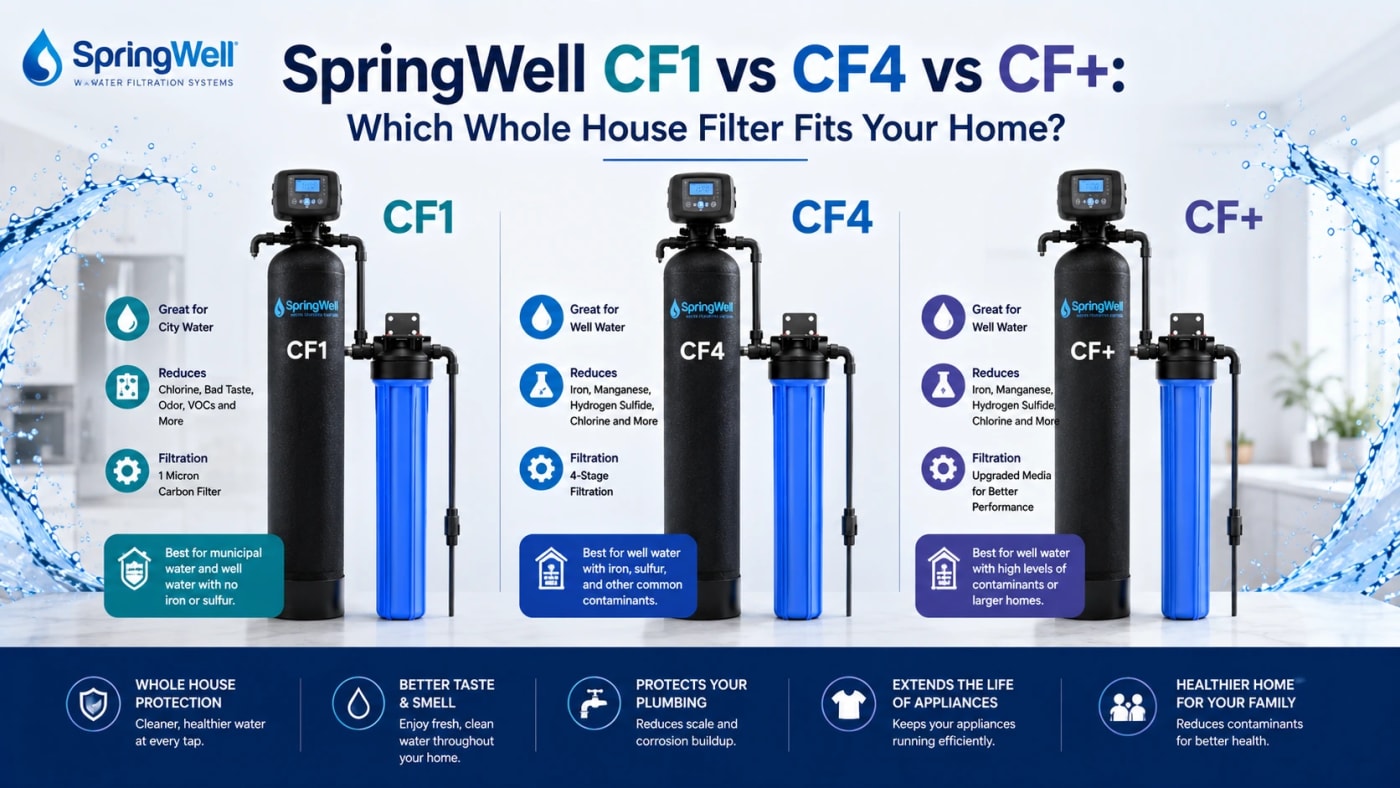
The CF1, CF4, and CF+ are three sizes within SpringWell's whole house filtration line, and the right one depends on your bathroom count and peak simultaneous water use, not on filtration strength, since all three use identical media. This guide compares flow rate, bathroom capacity, physical size, maintenance, and cost, so you can match the right size to your actual home.
How Do CF1, CF4, and CF+ Compare Across Core Specifications?
The table below shows the current core specifications for all three models side by side.
Specification | CF1 | CF4 | CF+ |
Bathroom range | 1 to 3 | 4 to 6 | 7 or more |
Service flow rate | 9 GPM | 12 GPM | 20 GPM |
Rated capacity | 1,000,000 gallons | 1,000,000 gallons | 1,000,000 gallons |
Tank width | 9 inches | 10 inches | 13 inches |
Tank height | 48 in, 52 in with head | 54 in, 58 in with head | 54 in, 58 in with head |
Connection size | 1 inch | 1 inch | 1.5 inches |
Sediment replacement | Every 6 to 9 months | Every 6 to 9 months | Every 6 to 9 months |
Media replacement | Around 10 years | Around 10 years | Around 10 years |
Do All Three Models Provide the Same Filtration?
Yes. SpringWell markets all three as size options within one product, not as separate filtration technologies. Each is a point of entry system using the same three part media setup, sediment filtration for larger particles, catalytic carbon for chlorine and chloramine, and KDF media for contaminant reduction and bacterial control. A larger tank does not mean stronger filtration. The CF+ does not purify water more thoroughly than the CF1, since both use identical media in the same sequence. The larger tanks exist to handle higher water volume at once, not to remove more contaminants per gallon.
How Does Flow Rate Change Under Real Household Demand?
Flow rate moves from 9 GPM on the CF1, to 12 GPM on the CF4, up to 20 GPM on the CF+. This number represents how much water the system can process per minute without a noticeable pressure drop.
Typical fixture draw:
A single shower: About 2 GPM
A washing machine: About 3 GPM
A kitchen sink: About 1.5 GPM
Two showers running together with a washing machine can reach close to 7 to 9 GPM, right at the edge of what the CF1 handles comfortably. A household that regularly stacks several fixtures at once during busy mornings benefits from the extra buffer the CF4's 12 GPM rating provides. The CF+ exists mainly for very large homes or light commercial use rather than a typical single family home.
How Do Bathroom Count and Peak Use Determine the Right Model?
Suggested model by household situation:
1 to 3 bathrooms, typical daily use: CF1
3 bathrooms, larger family with frequent simultaneous showers: CF4, for extra flow buffer
4 to 6 bathrooms: CF4
7 or more bathrooms, or very high simultaneous demand: CF+
A three bathroom home with five or more residents often benefits from stepping up to the CF4, since more residents usually means more simultaneous fixture use during peak hours.
How Do the Models Differ in Tank Size and Plumbing Connections?
The CF1 measures 9 inches wide and 48 inches tall, or 52 inches with the control head. The CF4 measures 10 inches wide and 54 inches tall, or 58 inches with the head. The CF+ measures 13 inches wide and 54 inches tall, or 58 inches with the head. The CF1 and CF4 both use a 1 inch connection. The CF+ steps up to a 1.5 inch connection, since its higher flow rate needs a wider pipe.
How Does Maintenance Differ Across the Three Models?
Maintenance follows the same schedule across all three. Every model needs the sediment pre filter replaced every 6 to 9 months, the only routine task across the ownership period. The main media across all three is rated for 1,000,000 gallons, translating to roughly 10 years for typical households, though some SpringWell documentation cites a 6 year window tied to the same gallon figure. Both numbers point to the same underlying capacity. A larger tank in the CF4 or CF+ does not automatically mean longer media life, since all three share the same 1,000,000 gallon rating.
How Do the Models Compare in Price?
Based on SpringWell's published pricing checked in 2026, the CF1 lists at approximately 1,160 dollars, the CF4 at approximately 1,294 dollars, and the CF+ at approximately 2,142 dollars. Prices change over time, so confirm current pricing directly on SpringWell's site. The price difference should be judged against flow capacity and physical size, not filtration quality, since all three use identical media. A household correctly sized for a CF1 gains no filtration benefit from paying more for a CF4 or CF+.
When Is CF4 or CF+ More Appropriate Than CF1?
Situations where stepping up makes sense:
More bathrooms: A count beyond the CF1's 1 to 3 range
Large household: Several people regularly showering or running appliances at the same time
Expansion plans: Adding a bathroom or increasing household size soon
Higher daily consumption: A larger property with higher overall water use, even within a 3 bathroom footprint
Commercial or multi unit use: Continuous, overlapping water demand throughout the day
What Limitations Apply to All Three Models?
Limitations across CF1, CF4, and CF+:
Not built for microbiologically unsafe water: None of the three models disinfect bacteria or viruses
Not a water softener: All three filter contaminants but do not reduce hardness from calcium and magnesium
Not certified for every contaminant claim: PFAS, lead, and similar claims should be checked against current documentation
Not a complete well water solution: None of the three are the primary treatment for iron, manganese, or sulfur
Many households pair a CF system with reverse osmosis for drinking water or UV for microbiological safety when their water situation includes concerns beyond standard carbon and KDF filtration.
What Should You Check Before Buying a SpringWell Whole House Filter?
Pre purchase checklist:
Confirm your water source, municipal or well
Identify your water quality problem through a utility report or private test
Estimate your peak demand by counting fixtures used at once during busy hours
Confirm your installation space has clearance for the tank height and connection size
Decide whether softening, UV, or point of use reverse osmosis should be added alongside your CF system
Quick Answers to Common CF1 vs CF4 vs CF+ Questions
Does the SpringWell CF series remove hard water minerals? No. All three models filter chemical and organic contaminants using carbon and KDF media, but none of them function as a water softener.
Does SpringWell CF filtration need reverse osmosis for drinking water? Whole house filtration treats water throughout the home, while point of use reverse osmosis targets a single tap for drinking and cooking, reducing a wider range of dissolved contaminants. Many households pair a CF system with an under sink RO unit.
Does the SpringWell CF series need UV purification? Only when the water source carries a microbiological risk. SpringWell states the CF system should not be used where water is known to be microbiologically unsafe.
How should you choose a SpringWell system for well water? Start by understanding your specific water chemistry, since well water problems differ from municipal water problems. SpringWell's own documentation advises consulting customer service before installing a standard CF system on well water.