
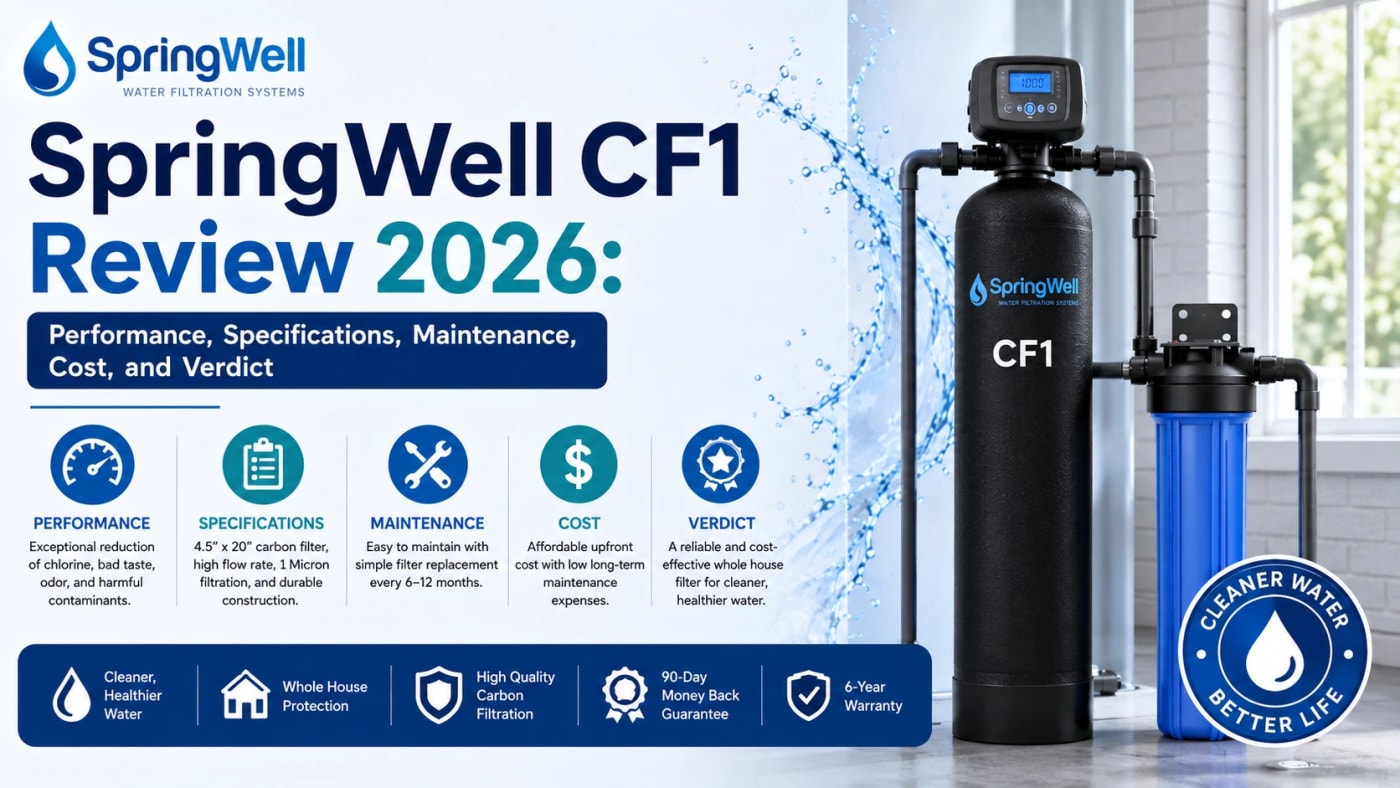
The SpringWell CF1 is a whole house water filter designed primarily for homes on municipal water that want to reduce chlorine, chloramine, sediment, taste, odor, and other contaminants before water reaches individual taps.
It is the smallest model in SpringWell's CF whole-house line, sized for homes with 1–3 bathrooms and rated at 9 gallons per minute (GPM). The system combines catalytic carbon, KDF media, an upflow contact design, and 5-micron sediment filtration.
The main attraction is low routine maintenance. SpringWell currently rates the main media for 1,000,000 gallons or up to 10 years, while the sediment filter requires periodic replacement. However, buyers should understand an important distinction: SpringWell's separate performance warranty guarantees chlorine and chloramine reduction for 6 years or 1,000,000 gallons. The 10-year replacement interval and 6-year performance guarantee are therefore not the same claim.
Our Research-Based Verdict
Water Filter Way Rating: 4.7/5
The SpringWell CF1 is best suited to a 1–3 bathroom home on treated municipal water where chlorine, chloramine, taste, odor, sediment, or disinfection byproducts are the main concerns.
Its strongest advantages are the 9 GPM service flow, long-life media bed, low routine maintenance, passive operation without electricity, and the use of catalytic carbon and KDF rather than relying on disposable whole-house carbon cartridges.
The biggest limitation is that the CF1 is often presented online as if it solves virtually every water-quality problem. It does not.
It is not a water softener, does not meaningfully reduce total dissolved solids, is not designed as a primary fluoride filter, and should not be relied on for microbiologically unsafe water without additional treatment.
Another important consideration is certification. SpringWell says the system uses certified components, but its current product page does not claim that the complete CF1 is independently certified as a finished system for its contaminant-reduction performance. Current independent certification checks likewise report no finished CF1 listing under SpringWell in the major NSF, WQA, or IAPMO product directories.
How Water Filter Way Evaluated the CF1
Water Filter Way does not claim to have conducted laboratory or hands-on testing of the SpringWell CF1.
This review is based on current SpringWell specifications, warranty and maintenance documentation, published certification information, independent third-party testing, current pricing information, and comparisons with other whole-house filtration systems.
Where results come from another laboratory or reviewer, they are identified as third-party evidence rather than presented as our own testing.
SpringWell CF1 Key Specifications
Specification | SpringWell CF1 |
|---|---|
System type | Whole-house / point-of-entry filter |
Recommended water source | Municipal / city water |
Home size | 1–3 bathrooms |
Service flow rate | 9 GPM |
Capacity | 1,000,000 gallons |
Tank width | 9 inches |
Tank height | 48 inches; approximately 52 inches with head |
Connection size | 1 inch |
Operating pressure | 25–80 PSI |
Operating temperature | 36–120°F |
Main treatment media | Catalytic carbon + KDF |
Sediment filtration | 5 micron |
Sediment filter interval | About 6–9 months per CF1 specification |
Main media replacement | 10 years or 1,000,000 gallons per current product specification |
Performance guarantee | 6 years or 1,000,000 gallons for stated chlorine/chloramine performance |
Electricity required | No for the standard CF1 |
Drain/backwash required | No conventional regeneration cycle |
Water softening | No |
SpringWell's current specifications confirm the CF1's 9 GPM service rate, 1–3 bathroom sizing, 1-million-gallon capacity, 1-inch connection, 25–80 PSI operating range, and 36–120°F temperature range.
Who Is the SpringWell CF1 Designed For?
The CF1 is a point-of-entry whole house water filtration system.
Instead of filtering only kitchen drinking water, it connects to the home's main water line so treated water can reach showers, faucets, washing machines, and other fixtures.
It makes the most sense for homes that receive municipally treated water containing chlorine or chloramine.
The CF1 is the smallest model in the CF family and is officially sized for 1–3 bathrooms.
It is less appropriate when the main problem is untreated well water, severe iron or manganese, hydrogen sulfide, hardness, fluoride, very high dissolved solids, or microbiological contamination.
How Does the SpringWell CF1 Filtration System Work?
SpringWell calls its four-stage approach ActivFlo.
The system combines an upflow contact design, KDF media, catalytic carbon, and a 5-micron sediment filter. SpringWell says the design increases contact between water and filtration media while minimizing channeling through the tank.
KDF Media
KDF is a copper-zinc filtration medium.
In the CF1, it works alongside carbon and is intended to support chlorine reduction and treatment of certain contaminants found in municipal water.
KDF should not be interpreted as proof that the complete CF1 is certified for every metal or contaminant commonly associated with KDF media.
Catalytic Carbon
Catalytic carbon is one of the most important parts of the CF1.
Unlike ordinary activated carbon, catalytic carbon is particularly relevant when municipal water contains chloramine, which can be more difficult to reduce than free chlorine.
SpringWell also markets the carbon stage for substances including chlorine, chloramine, VOCs, pesticides, herbicides, taste, and odor.
Upflow Contact Design
The CF1 uses an upflow media configuration intended to increase water-to-media contact and reduce channeling.
This matters because carbon performance depends partly on sufficient contact between the water and media.
5-Micron Sediment Filter
A 5-micron sediment stage captures larger particles such as sand, silt, clay, and similar sediment.
This also helps protect the main media from excessive particulate loading.
What Does the SpringWell CF1 Reduce?
The safest way to understand CF1 performance is to separate manufacturer claims, warranty-backed claims, independent testing, and third-party certification.
Chlorine and Chloramine
These are the CF1's strongest use cases.
SpringWell markets the system specifically for city water containing chlorine and chloramine. Its warranty page goes further and states that its carbon performance is guaranteed to reduce chlorine and chloramine below minimum detection levels for 6 years or 1 million gallons, subject to the stated water conditions.
Outside laboratory results also provide useful supporting evidence.
Quality Water Lab reported that total trihalomethanes in its real-home testing went from 31.83 ppb before installation to below the reporting limit in a later treated-water sample. The reviewer appropriately notes that source water changes over time, so this was real-world evidence rather than a controlled before-and-after laboratory challenge test.
WaterFilterGuru separately reported that chlorine detected before filtration was no longer detected after treatment in its testing, while also noting which contaminant claims it could and could not evaluate.
These are third-party results—not Water Filter Way testing.
PFAS, PFOA and PFOS
SpringWell currently includes PFAS, PFOA and PFOS among the substances it markets the CF whole-house system to reduce.
However, buyers should distinguish that marketing claim from a finished-product certification.
If PFAS is the primary reason you are purchasing a filtration system, review the latest performance documentation for the exact system and compare it with SpringWell's dedicated PFAS filtration system before deciding.
VOCs, Pesticides and Herbicides
SpringWell also markets the catalytic carbon stage for VOCs, pesticides and herbicides.
These are plausible applications for carbon filtration, but the exact reduction of an individual chemical depends on concentration, water chemistry, flow, media condition, and contact time.
Do not interpret the presence of a substance on a marketing list as a guaranteed percentage reduction for every household.
Is the SpringWell CF1 NSF Certified?
This point needs careful wording.
SpringWell says it uses certified components in its whole-house systems. Its product page does not currently state that the complete assembled CF1 has finished-system NSF/ANSI certification for its contaminant-reduction claims.
Independent certification checks published in 2026 likewise report that they could not locate a finished CF1 listing under SpringWell in the NSF, WQA, or IAPMO product directories.
That does not mean the system cannot reduce contaminants.
It means buyers should distinguish between:
Certified components: individual materials or parts that meet specified standards.
Manufacturer performance claims: reductions SpringWell says the CF1 provides.
Independent testing: results produced by outside reviewers or laboratories.
Finished-system certification: third-party certification of the complete product for specific performance claims.
Those categories are not interchangeable.
Is 9 GPM Enough for a 1–3 Bathroom Home?
SpringWell rates the CF1 at 9 GPM service flow and recommends it for homes with 1–3 bathrooms.
Bathroom count is useful, but simultaneous demand matters more.
For example, a shower, washing machine, dishwasher, and kitchen faucet operating at the same time create a much larger flow requirement than one shower running by itself.
For most smaller homes, 9 GPM provides reasonable whole-house capacity. A household that regularly operates many fixtures simultaneously may benefit from moving to a larger CF model.
SpringWell CF1 vs CF4 vs CF+
Model | Recommended Home Size | Service Flow | Capacity |
|---|---|---|---|
CF1 | 1–3 bathrooms | 9 GPM | 1,000,000 gallons |
CF4 | 4–6 bathrooms | 12 GPM | 1,000,000 gallons |
CF+ | 7+ bathrooms | 20 GPM | 1,000,000 gallons |
These are SpringWell's current published sizing specifications.
Choose based on peak household demand rather than buying a larger model simply because its GPM number is higher.
How Long Does the SpringWell CF1 Media Last?
This is where older reviews can become confusing.
SpringWell's current product specification and replacement-media page state:
10 years or 1,000,000 gallons before main media replacement.
But SpringWell's warranty page separately guarantees the stated chlorine and chloramine performance for:
6 years or 1,000,000 gallons.
These should not be merged into one statement.
The simplest interpretation is:
Media replacement specification: up to 10 years or 1 million gallons.
Published chlorine/chloramine performance guarantee: 6 years or 1 million gallons.
Actual life can also depend on source-water quality and household water consumption.
How Often Should the Sediment Filter Be Replaced?
SpringWell's CF1 specification says the sediment filter should be replaced every 6–9 months.
Its dedicated replacement-filter page says the 10-inch Stage 1 sediment cartridge lasts up to 6 months.
Because sediment loading varies dramatically between homes, a six-month schedule is a reasonable conservative starting point.
Replace it earlier if pressure falls or the source water carries unusually heavy sediment.
How Difficult Is the SpringWell CF1 to Install?
The CF1 is more involved than a countertop or under-sink cartridge filter because it must be installed on the home's main water line.
You need enough room for a tank approximately 9 inches wide and 52 inches high including the head, plus space for the sediment-filter housing and plumbing.
The system uses a 1-inch connection.
A capable DIY homeowner may be able to install it, but cutting into the main water line is not the ideal first plumbing project.
Professional installation is worth considering when the home has complicated plumbing, limited installation clearance, unfamiliar pipe materials, or local code requirements.
The standard CF1 itself does not require electricity.
Does the SpringWell CF1 Reduce Water Pressure?
SpringWell markets the system as being designed to maintain household pressure and publishes a 9 GPM service rating for the CF1.
Independent long-term testing by Quality Water Lab reported pressure moving from around 68 PSI to 65 PSI after several years of use, without the reviewer describing a meaningful day-to-day pressure problem.
That result belongs to that specific installation and should not be treated as a universal three-PSI prediction.
Pipe diameter, incoming pressure, simultaneous demand, filter condition, and installation quality can all affect real-world flow.
What Does the SpringWell CF1 Not Treat Well?
The CF1 should not be confused with a universal purification system.
Hard Water
The CF1 does not soften water.
It does not remove enough calcium and magnesium to solve hardness or scale. Hard-water homes need a separate water softener or conditioner.
Total Dissolved Solids
The CF1 is not a reverse osmosis system and is not designed to substantially lower TDS.
Fluoride
Fluoride is not one of the CF1's primary treatment targets.
If meaningful fluoride reduction is required, use technology specifically designed and independently documented for that purpose, such as an appropriate point-of-use reverse osmosis system.
Bacteria and Viruses
SpringWell explicitly warns against using the system where water is microbiologically unsafe.
A UV purification system or other appropriate disinfection step may be needed where microbiological contamination is a concern.
Well-Water Problems
The CF1 is primarily a city-water filter.
Well water with iron, manganese, sulfur, heavy sediment, or microbiological problems should be tested first and matched to appropriate treatment rather than assuming the CF1 will solve those issues.
How Much Does the SpringWell CF1 Cost?
This is one area where hard-coding a single number can make a review outdated quickly.
During our September 2026 research, different current SpringWell pages displayed promotional starting prices around $1,105 to $1,160, before optional installation components or add-ons.
Promotions and configuration pricing change, so buyers should check the official CF1 product page for the current price rather than relying on an old review price.
Routine ownership costs are much simpler.
The main recurring expense is the sediment cartridge. SpringWell currently sells replacement sediment filters separately, while the main carbon/KDF media has a much longer service interval.
Professional installation, future media replacement, optional UV treatment, and optional water-conditioning equipment should also be included when estimating total ownership cost.
SpringWell Warranty and Return Policy
SpringWell currently advertises a lifetime warranty against defects for covered components under specified conditions.
The return policy deserves closer attention.
SpringWell currently states that unused, uninstalled branded products may be returned within six months, while approved non-defective returns can carry a 10% restocking fee. Refused or specially handled returns can be subject to a fee of up to 25%. Installed systems are generally handled through the company's performance/support process rather than the standard unused-product return policy.
Read the latest policy before purchasing because return and warranty conditions can change.