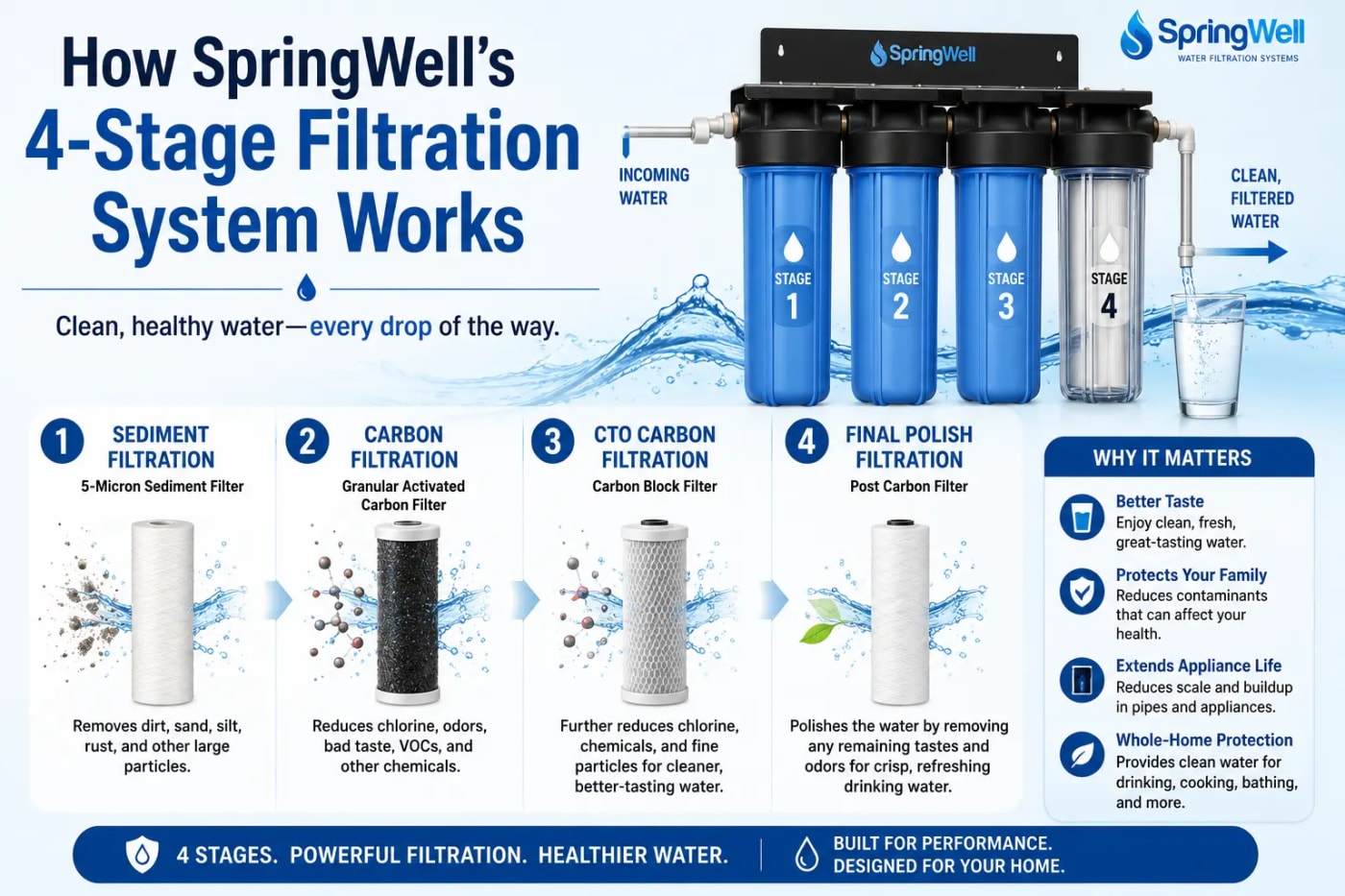
SpringWell's 4-Stage Filtration System works by combining four separate treatment functions into one connected process, so water is not cleaned by a single filter but by a coordinated sequence of chemical, physical, and design-based steps. The system uses KDF media, catalytic carbon, a specialized flow design, and sediment filtration to target different contaminant types at different points in the water's path. This article explains how water moves through the system, what each function does, and how the four parts work together to treat water for an entire home.
How Does Water Move Through SpringWell's Four Filtration Functions?
Water Move Through SpringWell's Four Filtration Functions in a set order, starting the moment water enters the home and ending when it reaches a household fixture. This is called point-of-entry filtration, since the system treats water before it splits off to any faucet, shower, or appliance.
SpringWell has described its four functions using different naming conventions over time, so a household should check current product documentation rather than assume one fixed stage-numbering system applies to every unit sold.
The general path water follows through the system:
Incoming municipal water: Water enters the whole house filter before reaching any household plumbing.
Filtration media: Water passes through KDF media and catalytic carbon, which target different chemical and organic contaminants.
Flow design: The ActivFlo upflow design increases contact time between water and the filtration media.
Sediment filtration: A final filter removes physical particles before treated water reaches household outlets.
This process turns incoming water into treated water available at every tap in the home.
What Does the KDF Media Do Inside the SpringWell Filter?
KDF Media Do Inside the SpringWell Filter works through a chemical process rather than physical trapping. KDF stands for Kinetic Degradation Fluxion, and it is a copper-zinc media that treats certain contaminants through a reaction called redox, short for oxidation-reduction.
What KDF media generally addresses:
Chlorine: KDF reduces chlorine through a redox reaction rather than through adsorption.
Certain heavy metals: The copper-zinc composition can interact with select metals present in water.
KDF handles this chemical treatment role separately from carbon filtration. It does not perform adsorption the way carbon does, and it does not independently remove every contaminant listed in general SpringWell marketing material. It is one part of a larger filtration process.
How Does Catalytic Carbon Remove Contaminants From the Water?
Catalytic Carbon Remove Contaminants From the Water through adsorption, a process where contaminants stick to the surface of the carbon material. This mechanism is different from the redox reaction used by KDF media.
Standard carbon filters typically struggle with chloramine, a chemical some municipalities use instead of, or alongside, chlorine for disinfection. Catalytic carbon is built to handle chloramine more effectively than standard carbon.
Contaminant categories catalytic carbon commonly targets:
Chlorine and chloramine: Catalytic carbon adsorbs both, while many standard carbon filters handle only chlorine well.
VOCs: Volatile organic compounds are organic chemicals that can affect taste and safety.
Pesticides and herbicides: Catalytic carbon can adsorb certain agricultural chemical residues.
Taste and odor compounds: Organic material that affects how water tastes and smells gets adsorbed here.
Carbon filtration does not remove every possible contaminant, so buyers should not assume a single filter type solves every water-quality issue.
How Does the ActivFlo Design Improve Contact With Filtration Media?
ActivFlo Design Improves Contact With Filtration Media by directing water upward through the tank instead of letting it flow straight down. This upflow pattern keeps water in contact with the KDF and carbon media for a longer period, which directly affects how thoroughly that media can treat the water passing through it.
Without a design like this, water can find a path of least resistance through the media, a problem known as channeling. Channeling reduces contact between water and the media, which lowers filtration effectiveness. SpringWell's documentation describes the ActivFlo design as reducing channeling and increasing contact time between water and the media bed.
This function is not a chemical treatment stage on its own. It is an engineering feature that improves how effectively the KDF and catalytic carbon media can do their jobs.
What Does the 5-Micron Sediment Filter Capture?
5-Micron Sediment Filter Capture physical particles rather than dissolved chemicals. A micron is a unit of measurement for particle size, and a 5-micron filter catches particles down to that size.
Particles a sediment filter commonly captures:
Sand: Larger particles that can enter municipal or well water systems.
Silt: Fine mineral particles that can cloud water.
Clay: Very fine particles that contribute to water cloudiness.
Rust: Particles that can come from aging pipes or water infrastructure.
This stage protects the plumbing and appliances in a home from grit and debris. It does not perform chemical treatment, which is why it works alongside, not instead of, KDF and catalytic carbon.
How Do the Four Filtration Functions Work Together?
Four Filtration Functions Work Together by dividing the treatment job into four distinct tasks: physical particle control, chemical treatment, organic contaminant adsorption, and optimized contact between water and media.
The table below shows how each function contributes to the overall filtration process:
Filtration function | Primary mechanism | Main target | Role in overall process |
KDF media | Redox reaction | Chlorine and select heavy metals | Chemical treatment of specific contaminants |
Catalytic carbon | Adsorption | Chloramine, VOCs, pesticides, herbicides, taste and odor | Organic contaminant removal and taste improvement |
ActivFlo design | Upflow contact optimization | Media contact time | Improves how effectively KDF and carbon can treat water |
Sediment filter | Physical filtration | Sand, silt, clay, rust | Protects the system and removes visible particles |
This division of labor is the reason the system is described as four connected functions rather than one single filter doing everything at once.
Which Contaminants Can SpringWell's Four-Stage System Target?
Contaminants Can SpringWell's Four-Stage System Target depend on which filtration mechanism is doing the work. Grouping contaminants by mechanism gives a clearer picture than one long unsorted list.
The table below organizes targeted contaminants by the mechanism responsible for treating them:
Contaminant or category | Relevant filtration mechanism | Why it is targeted |
Chlorine | KDF media | Redox reaction reduces chlorine |
Chloramine | Catalytic carbon | Catalytic carbon adsorbs chloramine more effectively than standard carbon |
PFAS, PFOA, PFOS | Catalytic carbon and KDF | Product documentation identifies these forever chemicals as targeted contaminants |
VOCs, pesticides, herbicides | Catalytic carbon | Adsorption removes many organic chemical residues |
Sediment (sand, silt, clay, rust) | Sediment filter | Physical filtration captures particles |
SpringWell's current product page markets chlorine, chloramine, PFAS, PFOA, and PFOS reduction, and identifies KDF, catalytic carbon, and sediment filtration as the mechanisms responsible. Marketing claims and independently verified performance are not always identical, so a buyer concerned about a specific contaminant should check current, published testing data for confirmation.
How Does the Filter Maintain Water Flow While Treating the Whole House?
Filter Maintain Water Flow While Treating the Whole House by matching model size to household water demand. Because this is a point-of-entry system, it must handle the full water demand of a household without slowing flow at the tap.
Current SpringWell CF model flow rates:
CF1: Rated at 9 GPM, suited to smaller households.
CF4: Rated at 12 GPM, suited to larger households.
CF+: Rated at 20 GPM, suited to commercial-scale demand.
GPM stands for gallons per minute, and it measures how much water the system can treat while maintaining normal household pressure. Choosing a model with a flow rate that matches household demand helps avoid a noticeable pressure drop at multiple fixtures.
What Happens to the Water After It Passes Through the Filtration System?
Water After It Passes Through the Filtration System continues into the home's plumbing exactly as untreated water would, except now it has passed through KDF, catalytic carbon, the ActivFlo design, and sediment filtration. Treated water reaches every fixture connected to the home's plumbing, including showers, faucets, and water-using appliances. Because the system sits at the point of entry, there is no separate treatment step needed at each fixture.
Does the Four-Stage Filter Disinfect Water or Remove Every Contaminant?
Four-Stage Filter Disinfect Water or Remove Every Contaminant is a boundary worth understanding clearly. Filtration and disinfection are not the same process. This SpringWell system is built to filter chemical and organic contaminants along with sediment. It is not built to disinfect water that is microbiologically unsafe.
SpringWell's own product documentation states that the whole house filter should not be used on water that is microbiologically unsafe, and it offers UV treatment as a separate optional add-on. UV disinfection targets bacteria and other microorganisms using ultraviolet light, which is a different function from the chemical and physical filtration this four-stage system performs. A household with confirmed microbial contamination needs a dedicated disinfection method, not just this filtration system on its own.
What Maintenance Keeps the Four-Stage System Working Properly?
Maintenance Keeps the Four-Stage System Working Properly depends on which component is involved, since each one wears differently over time.
The table below shows maintenance needs by component:
Component | Maintenance | Manufacturer interval |
Sediment filter | Cartridge replacement | Every 6 to 9 months |
Main filtration media (KDF and catalytic carbon) | Full media replacement | Every 10 years or 1,000,000 gallons, whichever comes first |
Replacement media documentation from SpringWell also covers activation, soaking, and flushing steps required when replacing the main filtration media. Following manufacturer instructions during replacement helps the new media perform as intended from the start.
Why Does the Four-Stage Design Matter for Municipal Water Treatment?
Four-Stage Design Matter for Municipal Water Treatment because different contaminants need different treatment mechanisms. Chlorine responds well to a redox reaction, chloramine responds better to catalytic carbon adsorption, and sediment needs physical filtration rather than any chemical process. A single filter type cannot address all of these at once, which is why the four-function design pairs several mechanisms together rather than relying on one filtration method for everything.
What Is the Difference Between SpringWell Filtration and Water Softening?
Difference Between SpringWell Filtration and Water Softening comes down to what each system solves. Filtration targets chemical contaminants, organic compounds, and sediment. It does not remove hardness minerals such as calcium and magnesium. SpringWell sells a separate salt-based water softener specifically for hardness removal. For a full comparison, see SpringWell water filter vs water softener.
Does SpringWell's CF1 Remove Fluoride From Drinking Water?
SpringWell's CF1 Remove Fluoride From Drinking Water is limited, since its KDF and catalytic carbon media are not primarily built to target fluoride. Households specifically concerned about fluoride reduction typically need a different filtration technology, such as reverse osmosis, depending on the exact product and its verified testing results. For detailed guidance, see How to remove fluoride from drinking water.
Does SpringWell CF1 Remove Bacteria and Viruses?
SpringWell CF1 Remove Bacteria and Viruses is something it does not do on its own. SpringWell states that the whole house filter should not be used where water is microbiologically unsafe, and it offers UV purification as a separate optional treatment for bacteria and viruses. For a full explanation, see Best whole-house water filter for bacteria and viruses.
How Does SpringWell CF1 Compare With Reverse Osmosis?
SpringWell CF1 Compare With Reverse Osmosis comes down to a difference in system type. The CF1 is a point-of-entry, whole house filter, while reverse osmosis is typically a point-of-use system installed at a single tap. These are different technologies built for different purposes. For a detailed comparison, see SpringWell CF1 vs reverse osmosis.
How Often Should a SpringWell Sediment Filter Be Replaced?
SpringWell Sediment Filter Be Replaced on a schedule SpringWell currently sets at every 6 to 9 months. Replacement frequency can vary based on local water quality and household water use. For full replacement instructions, see SpringWell sediment filter replacement guide.
Conclusion
SpringWell's four-stage system treats water using four different mechanisms working together rather than one filter doing every job. KDF handles a chemical redox reaction, catalytic carbon adsorbs organic contaminants like chloramine and VOCs, the ActivFlo design improves contact time between water and the media, and the sediment filter removes physical particles. Understanding what each stage actually does, rather than treating the system as a single generic filter, helps a household know what the system covers and where a separate solution, such as UV disinfection or a water softener, may still be needed.