
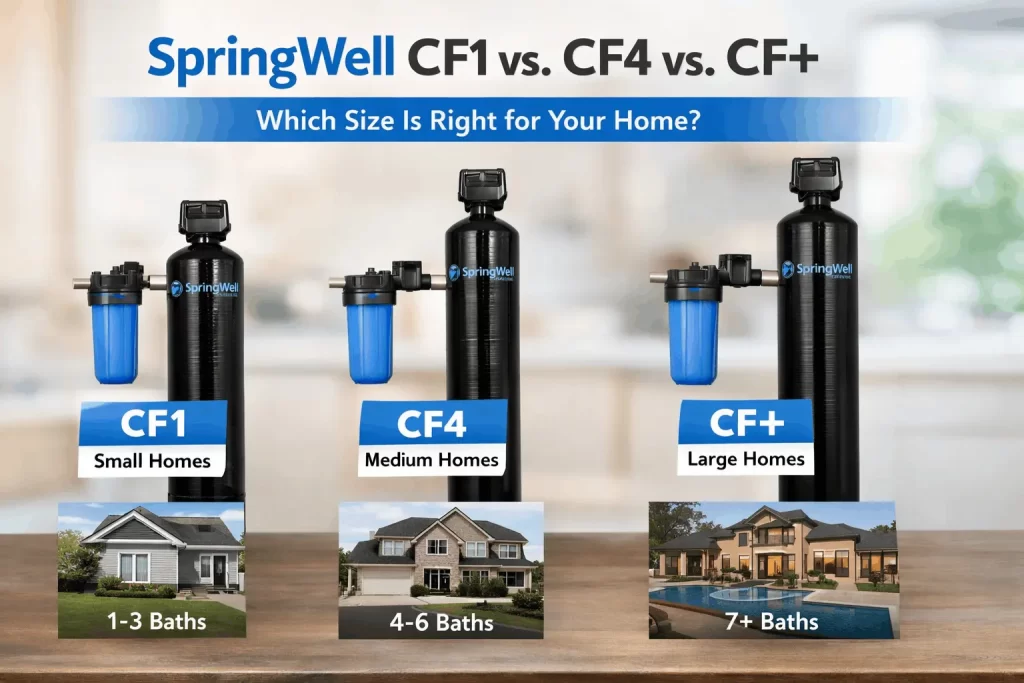
The most important thing to understand before you buy is that the filtration technology and final water quality are identical across all three models. Either the entry-level CF1 or the massive CF + will offer the same 4-stage catalytic carbon and KDF media blend. Only the flow rate differs between the two systems: how many gallons of water the system can push through your pipes per minute without losing pressure.
How to pick the right size to avoid overspending or low water pressure. We answer the commonest question first: How do you deal with only three bathrooms? We’ll look at things like whether you run the dishwasher when someone showers and whether the smaller model will fit your home or you need to downsize.
We also highlight a physical difference between the models that many people do not even notice until the box arrives. The largest model, the CF+, is much larger than the others and will take up a lot of floor space in your garage or basement. Know the measurements now to avoid a headache (and possibly a return fee) on installation day.
You are able to pick a yes or no checklist at the end of this page. We would like to give you a system that will keep your water pressure strong while the whole family gets dressed each morning. You can pick your model confidently and stop second-guessing yourself.
| SpringWell CF Series | CF1 | CF4 | CF+ |
|---|---|---|---|
| Bathrooms | 1-3 bathrooms | 4-6 bathrooms | 7+ bathrooms / commercial |
| Flow Rate | 9 GPM | 12 GPM | 20 GPM |
| Tank Height | ~54 inches | ~60 inches (6 inches taller) | Wider tank — most floor space |
| Pipe Connection | 1-inch FPT | 1-inch FPT | 1.5-inch FPT (different) |
| PVC Nipples Needed | 3x 1-inch | 3x 1-inch | 3x 1.5-inch |
| Filtration Quality | IDENTICAL to CF4 and CF+ | IDENTICAL to CF1 and CF+ | IDENTICAL to CF1 and CF4 |
| Annual Maintenance | ~$30-40/year | ~$30-40/year | ~$30-40/year |
| Media Life | 10 years / 1,000,000 gallons | 10 years / 1,000,000 gallons | 10 years / 1,000,000 gallons |
| Warranty | Lifetime | Lifetime | Lifetime |
| Price (2026) | Check Price | Check Price | Check Price |
What Exactly Changes Between the CF1, CF4, and CF+?
Remember that the filtration technology is identical across all three CF models. The CF1, CF4, and CF+ use the same 4-stage ActivFlo system, the same KDF media, and the same catalytic carbon. These remove exactly the same contaminants at the same level with the same 1,000,000-gallon capacity. A larger model does not produce “cleaner” water or remove more chemicals; the water quality is the same whether you spend $1,000 or $1,600.
The only real differences are physical and performance-based:
- Flow Rate
This is the big one. The CF1 provides 9 gallons per minute (GPM), the CF4 provides 12 GPM, and the CF+ provides 20 GPM. A higher flow rate simply means you can run more showers and appliances at the same time without feeling a drop in water pressure.
- Tank Size
To handle more water, the tanks get bigger. The CF₄ is about 6 inches taller than the CF1, and the CF⁺ has a significantly wider tank that takes up much more floor space.
- Price
Because the tanks and media volume are larger, the price increases. The CF1 typically costs around $1,040, the CF4 around $1,200, and the CF+ jumps to $1,600+.
Paying for better filtration isn’t paying for better filtration. You’re paying to use more water at once. If your home peak demand is within 9 GPM, the CF1 is practically identical to the CF4 but saves you roughly $160.
You Have 3 Bathrooms: Do You Actually Need the CF₄?
For most 3-bathroom homes, the SpringWell CF1 (9 GPM) is more than enough. However, the correct choice depends on your household’s simultaneous water use habits, not just the number of toilets in your house.
To understand if 9 GPM is enough, you have to look at what’s running at the same time. Here is the average flow rate for common household fixtures:
- Standard Shower: 2.0 GPM
- Washing Machine: 3.0 GPM
- Kitchen Faucet: 1.5 GPM
- Dishwasher: 1.5 GPM
If you run two showers (4 GPM), the washing machine (3 GPM), and the kitchen sink (1.5 GPM) all at once, your total demand is 8.5 GPM. This fits perfectly within the CF1’s 9 GPM limit without any loss in water pressure.
When to Upgrade to the CF4
You should consider the CF₄ (12 GPM) if your home fits any of these scenarios:
- High Occupancy: You have 5 or more people living in a 3-bathroom home, and it’s common for all three showers to run at once during the morning rush.
- Luxury Fixtures: You use high-flow “rain” showerheads that pull 2.5 GPM or more each.
- Large Households: You frequently run the irrigation system, the laundry, and multiple showers simultaneously.
The Rule of Thumb: If you have 4 people or fewer, save your money and buy the CF1. If you have 5 or more people, the CF4 provides a comfortable 12 GPM buffer that ensures no one gets a “pressure surprise” in the shower.
Is the SpringWell CF+ Only for Commercial Properties?
No, the CF+ is not just for offices or restaurants. It is built for the harsh conditions of commercial settings but is also the standard for large residential homes with 7 or more bathrooms.
When a Homeowner Needs 20 GPM
For a massive home, the bathroom count is really a way of counting how many people might use water at once. If you have a huge family or often have visitors over, you could easily have four showers running while the dishwasher and washing machine are in the middle of their cycles.
- 4 showers (8 GPM) + laundry (3 GPM) + dishwasher (1.5 GPM) = 12.5 GPM.
- This scenario would exceed the CF₄’s 12 GPM limit, causing a noticeable drop in shower pressure. The CF+ provides a massive 20 GPM ceiling, ensuring the pressure stays consistent even during these high-traffic “peak” hours.
When the CF4 is the Smarter Buy
If you have a 5- to 6-bathroom home with 3 or 4 people inside, your “peak demand” will never exceed 12 GPM. “The CF+ is basically wasted capacity here. You would be paying a $300-$400 premium for a larger tank that does nothing to improve your experience.
Do not buy by room number; buy by room type. Buy by the number of people. If you rarely use more than 3 high-flow fixtures at a time, buy the CF4 and sock away the extra cash.
Does a Bigger CF Tank Filter Your Water Better?
No. A bigger CF tank does not filter your water more thoroughly, nor does it produce “purer” water than the smaller models. All three systems, the CF1, CF4, and CF+, deliver identical filtration quality.
Why Tank Size Doesn’t Equal Purity
The larger tanks in CF₄ and CF⁺ are for volume and not intensity. Imagine it as a highway: four lanes can carry more cars at once than two lanes (CF1), but the speed limit and destination remain the same.
- Every model uses the exact same blend of high-grade catalytic carbon and KDF media.
- SpringWell’s ActivFlo upflow design ensures that every gallon of water spends the same amount of time touching the filter media, regardless of the tank’s width or height.
So if you purchase the CF4 thinking it tastes much better or is “cleaner” than if you purchased the CF1, you are let down. Paying for flow capacity is paying for another level of filtration. If your home’s peak water use is under the CF1’s 9 GPM cap, your tap water will look like the more expensive CF+ model.
Is the Price Difference Between CF1, CF4, and CF+ Worth It?
The price difference between SpringWell models is purely a reflection of flow capacity. The CF1 typically retails for $1,040, the CF4 for roughly $1,200 (a $160 premium), and the CF+ jumps to $1,600+ ($560 more than the base model).
What Are You Paying For?
Every extra dollar spent above the CF1 price buys you higher gallons-per-minute (GPM) capacity.
- CF4: You are paying $160 more for 3 extra GPM (12 vs. 9).
- CF+: You are paying $560 more for 11 extra GPM (20 vs. 9).
You are not paying for better filtration, a longer warranty, or lower annual maintenance costs. Those remain identical across all three units.
When is the premium justified?
- The CF4 is worth the extra $160 if: You have 4–6 bathrooms, OR your household has 5+ people who all try to shower at the exact same time every morning.
- The CF+ is worth the extra $560 if: You have 7+ bathrooms, a massive multi-generational household, or a commercial property (like a small bed-and-breakfast).
If you have 3 bathrooms and 4 or fewer people, start with the CF1. Independent WaterFilterGuru testers confirmed the CF1 can operate in standard multi-fixture mode with zero pressure drop. If your family runs three showers and the laundry at once, you probably don’t need the CF4.
Is the CF+ Harder to Install Than the CF1 or CF4?
Yes, the CF+ has one very specific technical difference that makes installation more difficult if you are not prepared for it. While the CF1 and CF4 are for standard residential plumbing, the CF+ is for the higher water demands of massive homes and commercial spaces.
The Pipe Size Difference
The most important thing to check before you order is the size of your main water line.
- CF1 and CF4: These models use 1-inch FPT (female pipe thread) connections. This is the standard size for most modern U.S. homes. To install them, you typically just need two 1-inch x 3-inch PVC nipples to bridge the gap between your pipes and the filter.
- CF+: This model uses 1.5-inch FPT connections. Because it is designed to move 20 gallons of water per minute, it requires much larger pipes to maintain that flow.
You cannot “plug it in” if your home has a 1-inch standard main water line, but you need the CF+ high capacity. Your plumber will need to install reducing adapters between your 1-inch pipes and the 1.5-inch filter ports. This isn’t “hard” for a pro, but it means you’ll need to buy extra fittings that aren’t in the standard box.
Check your main water shut-off valve before you purchase the CF +. If the pipe looks like it will be 1 inch wide, it is probably 1 inch; it is wider than a quarter. If it’s very wide (nearly golf ball width), you might have a 1.5-inch line. For 1-inch lines only, we recommend checking with a plumber whether the CF+ is worth the extra fitting work or whether the 12 GPM CF₄ is better for your pipes.
Can You Replace a CF1 with a CF4 Later If Your Needs Change?
Yes, CF1 can be swapped for CF4 later when water demand is higher, for example, if you renovate and you add bathrooms or your family expands. Because both systems use 1-inch FPT connections, the existing plumbing should stay put while you swap the tanks. But remember this is a complete system replacement, not a modular add-on. No one can simply “add a section to a CF1” to make it a CF4. If you plan on growing your household over the next 2-3 years, then buying the CF4 now is cheaper than two separate systems and two professional installations.
Does the CF Series Annual Cost Change If You Have More Bathrooms?
No, the annual maintenance cost is the same as for CF1, CF4 & CF⁺.. All three models use the 5-micron sediment pre-filter cartridge. Whatever the tank size, the filters should be changed every 6-9 months for about $30-$40 annually. The CF+ can handle a higher flow rate without requiring more frequent filter changes. For long-term ownership budgeting purposes, simply add about $400 in filter costs over 10 years to the upfront price of whichever model you choose.
What If You Have a 3-Bathroom Home with a Large Family: CF1 or CF4?
With 3 bathrooms and 5 or more people living in the house, the CF4 wins. In a large household, all three showers may run simultaneously in the morning rush. The sum of three standard showers (6 GPM) and a washing machine (3 GPM) reaches 9 GPM, the absolute limit of the CF1. At that peak, you might feel less water pressure. CF4’s 12 GPM capacity provides a 3 GPM buffer for strong pressure when the house is busiest.
Does the CF Series Work With a Water Softener or Salt-Free Conditioner?
Yes, all CF models can be combined with a softening agent or a salt-free conditioner. In the standard setup, the CF filter is installed first in the line. This lets the carbon strip away chlorine and chloramine before the water reaches your softener, which protects the expensive resin of the softener from chemical damage. For those with hard water, SpringWell has a discounted “combo” that includes the CF filter and FutureSoft conditioner bundled together. And remember, the CF series does not soften water by itself; calcium & magnesium will pass through the carbon media unchanged.
