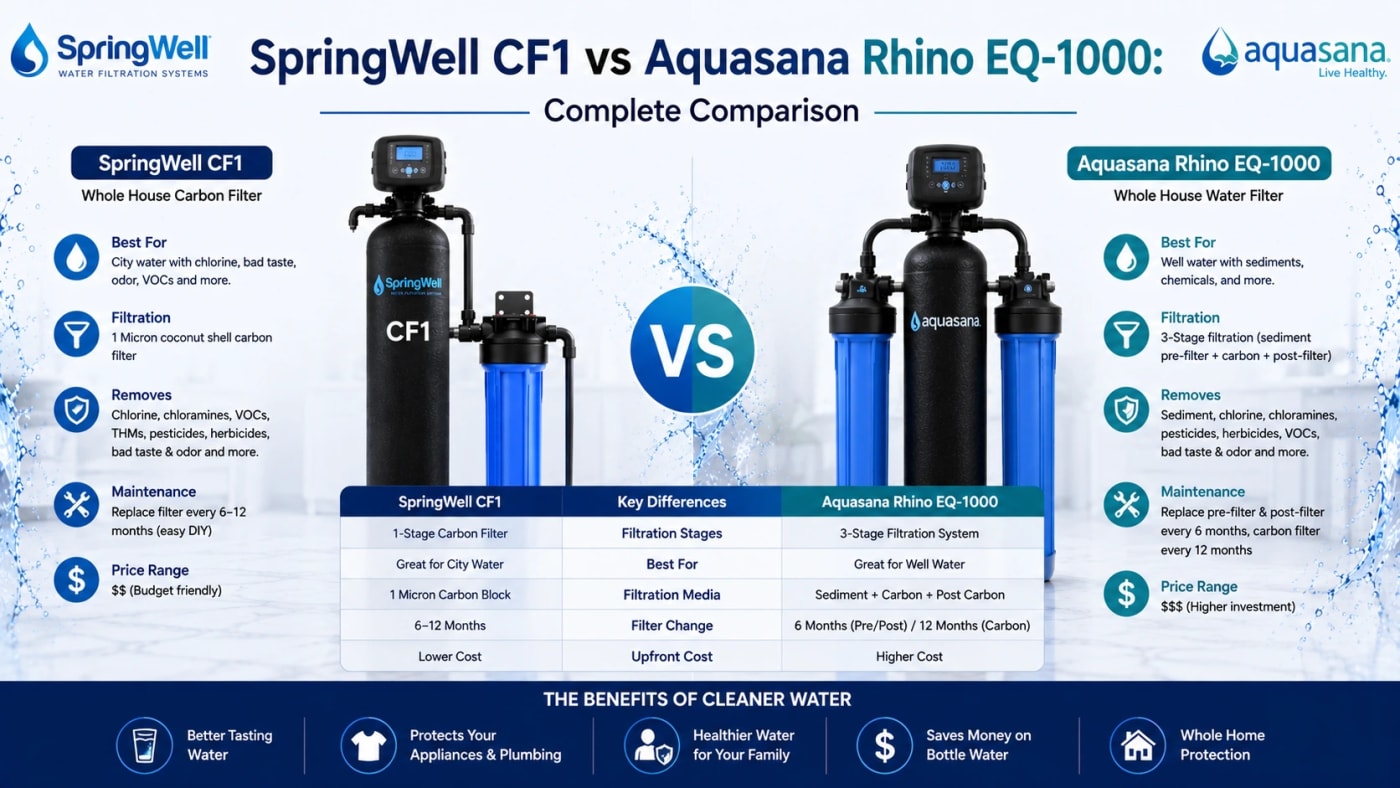
The SpringWell CF1 and the Aquasana Rhino EQ-1000 are both whole house point of entry water filters, and the CF1 fits homes wanting a higher flow rate and lower long term maintenance cost, while the EQ-1000 fits homes wanting a certified chlorine result and a well established professional install process. This guide compares both systems across filtration design, contaminant reduction, certification, flow rate, maintenance, cost, installation, and warranty.
How Do the Two Systems Compare at a Glance?
The table below shows a quick side by side overview of both systems.
How Do the Two Systems Differ in Filtration Design?
The CF1 uses a single upflow tank built around catalytic carbon and KDF media, paired with a separate sediment pre filter. The EQ-1000 uses a two tank design, with one tank holding a copper zinc mineral stone layer and a second tank holding a carbon based media, plus a sediment pre filter. Both are point of entry units, treating all water entering the home rather than water at a single tap.
Filtration media by system:
SpringWell CF1: Catalytic carbon combined with KDF media in a single upflow tank, plus a 5 micron sediment pre filter replaced separately
Aquasana EQ-1000: A copper zinc mineral stone layer in the first tank, a carbonized coconut shell carbon layer in the second tank, plus a sediment pre filter cartridge
Both rely on carbon as the main contaminant reduction layer, and both add a mineral or metal based layer ahead of the carbon stage.
SpringWell uses an upflow tank, meaning water enters from the bottom and moves upward, which is intended to reduce channeling, a pattern where water repeatedly follows the same narrow path instead of passing through the full media volume. Aquasana splits filtration across two separate tanks in sequence. Exact contact time figures are not published by either manufacturer, so this remains a design comparison rather than a lab measured one.
Which Contaminants Can Each System Reduce?
Both systems target chlorine, chloramine, some chemical contaminants, and sediment. A marketing claim on a product page is not the same as a certification from an independent lab.
Contaminant claims by system:
Chlorine: SpringWell states around 99.6 percent from manufacturer testing. Aquasana is independently tested to NSF/ANSI 42 at 97 percent
Chloramine: SpringWell claims reduction through catalytic carbon, per manufacturer statement. Aquasana's standard EQ-1000 is not built specifically for chloramine, and Aquasana sells a dedicated Rhino Chloramines model instead
PFAS, PFOA, PFOS: SpringWell states reduction of 70 to 85 percent, referencing independent third party testing. Aquasana lists this as a reduced contaminant on its product documentation, a manufacturer claim
VOCs: Both list this as reduced on the product page, a manufacturer claim for both
Heavy metals: SpringWell claims reduction through KDF media. Aquasana reduces this through copper zinc mineral stone, with some models carrying NSF/ANSI 53 testing
Sediment: Both remove this through a pre filter cartridge, standard mechanical filtration rather than a certification claim
Chlorine and chloramine behave differently in a filter. Chlorine is reduced fairly easily by standard activated carbon. Chloramine holds together more strongly and needs catalytic carbon with longer contact time. Aquasana's 97 percent chlorine result carries a direct NSF/ANSI 42 certification. SpringWell's higher figure comes from the manufacturer rather than a published independent chloramine specific certification.
What Certification and Testing Support Each System's Claims?
NSF/ANSI 42 covers chlorine, taste, and odor reduction. NSF/ANSI 53 covers health related contaminants such as certain heavy metals and organic chemicals. NSF/ANSI 61 confirms tank materials are safe to contact water, separate from any contaminant removal claim.
Evidence strength, from strongest to weakest:
Certified reduction: A claim tested and certified under a named NSF/ANSI standard by an accredited lab
Independent performance testing: Lab testing by a third party, referenced by the manufacturer, without a formal certification number attached
Manufacturer claim: A statement on a product page with no outside testing referenced, the weakest type of evidence
How Do the Rated Flow Rates Affect Household Demand?
The CF1 is rated at 9 GPM, the EQ-1000 at 7 GPM. A higher GPM rating does not mean better filtration, it means the system supplies more water per minute without a pressure drop when several fixtures run together.
A 3 bathroom home running one shower, one dishwasher, and one washing machine at the same time can use close to 7 to 9 GPM combined. A system rated at 9 GPM has more room before pressure drops, while a system rated at 7 GPM sits closer to its limit. A 1 to 2 bathroom home typically stays well under 7 GPM, so both systems perform similarly in daily use.
How Much Capacity and Media Life Does Each System Provide?
Both list 1,000,000 gallons as the headline capacity figure. SpringWell states its performance guarantee for chlorine and chloramine reduction lasts 6 years or 1,000,000 gallons, whichever comes first, though independent reviewers report the main carbon media commonly performing for close to 10 years. Aquasana states its tank is rated for 1,000,000 gallons or up to 10 years. Actual service life depends on daily household water use and source water quality.
What Maintenance Does Each System Need?
Maintenance schedule by system:
SpringWell CF1: The 5 micron sediment pre filter is commonly replaced every 6 to 9 months, using a generic filter size available from hardware stores. The main media is not on a regular schedule and lasts for years under normal use
Aquasana EQ-1000: The pre filter and, where included, the post filter are commonly replaced every 2 to 3 months, using proprietary cartridges ordered through Aquasana
A neglected sediment filter causes a drop in water pressure across the whole house, so using the correct replacement cartridge size matters for both systems.
How Difficult Is Installation for Each System?
The CF1 is generally less difficult to install as a DIY project, while the EQ-1000 is more commonly installed by a licensed plumber. SpringWell ships its systems with a DIY installation kit and states that most homeowners with basic plumbing skills can complete the install in half a day. Aquasana documentation states that its warranty terms are tied to professional installation, so using a licensed plumber is the safer route to keep full coverage in place.
Which System Has the Stronger Warranty?
Warranty terms by system:
SpringWell CF1: Lifetime warranty on the tank and control valve against manufacturing defects, plus a 6 month money back guarantee. Consumable parts and damage from incorrect self installation are excluded
Aquasana EQ-1000: A 10 year limited warranty on the system, plus a 90 day satisfaction guarantee. Full warranty terms depend on correct installation, and several reviewers note professional installation is the safer path
Which System Costs Less to Own Over Its Useful Life?
Cost of ownership by system, for reference only:
SpringWell CF1: Upfront price commonly falls between 900 and 1,100 dollars. Ongoing cost is mainly the sediment pre filter, priced around 15 to 25 dollars and replaced twice a year, putting annual maintenance near 30 to 40 dollars
Aquasana EQ-1000: Upfront price commonly falls between 900 and 1,600 dollars, depending on the kit. Ongoing cost includes proprietary pre filters and post filters, replaced every 2 to 3 months, putting annual maintenance closer to 100 to 150 dollars
Several independent five year cost comparisons show the SpringWell CF1 finishing lower in total ownership cost, even when its upfront price is similar to or slightly higher than the Aquasana base kit.
Which Homeowners Fit Each System Best?
Best fit by scenario:
A 1 to 3 bathroom home wanting the highest flow rate: SpringWell CF1, since its 9 GPM rating handles simultaneous fixture use with more headroom
A smaller home wanting documented NSF/ANSI 42 chlorine certification: Aquasana Rhino EQ-1000, since its chlorine result carries a direct certification number
A homeowner wanting the lowest long term maintenance cost: SpringWell CF1, due to its lower cost, widely available sediment pre filter
A homeowner wanting a bundled salt free conditioner from one brand: Aquasana Rhino EQ-1000, since Aquasana offers combined kits
A homeowner planning a confident DIY install: SpringWell CF1, given its DIY focused installation kit
A homeowner preferring a professional installed system with long standing support: Aquasana Rhino EQ-1000