
Sawyer water filters operate on 0.1-micron absolute hollow fiber membrane technology. According to the United States Geological Survey (USGS) Water Science School technical documentation, hollow fiber membrane filtration physically blocks biological pathogens larger than 100 nanometers. According to independent laboratory testing by BioVir Laboratories on March 14, 2018, Sawyer hollow fiber membranes eliminate 99.99999% of bacteria, 99.9999% of protozoa, and 100% of microplastics. The Sawyer Squeeze, Sawyer Micro Squeeze, and Sawyer MINI share identical pathogen filtration efficiency ratings. The models differ in hollow fiber bundle surface area, operational weight, real-world flow speed, and sediment tolerance.
ComparisonWater Filters
Sawyer Squeeze vs. Mini vs. Micro: The 2026 Guide to Flow Rate, Weight, and Value
Share
Head to Head
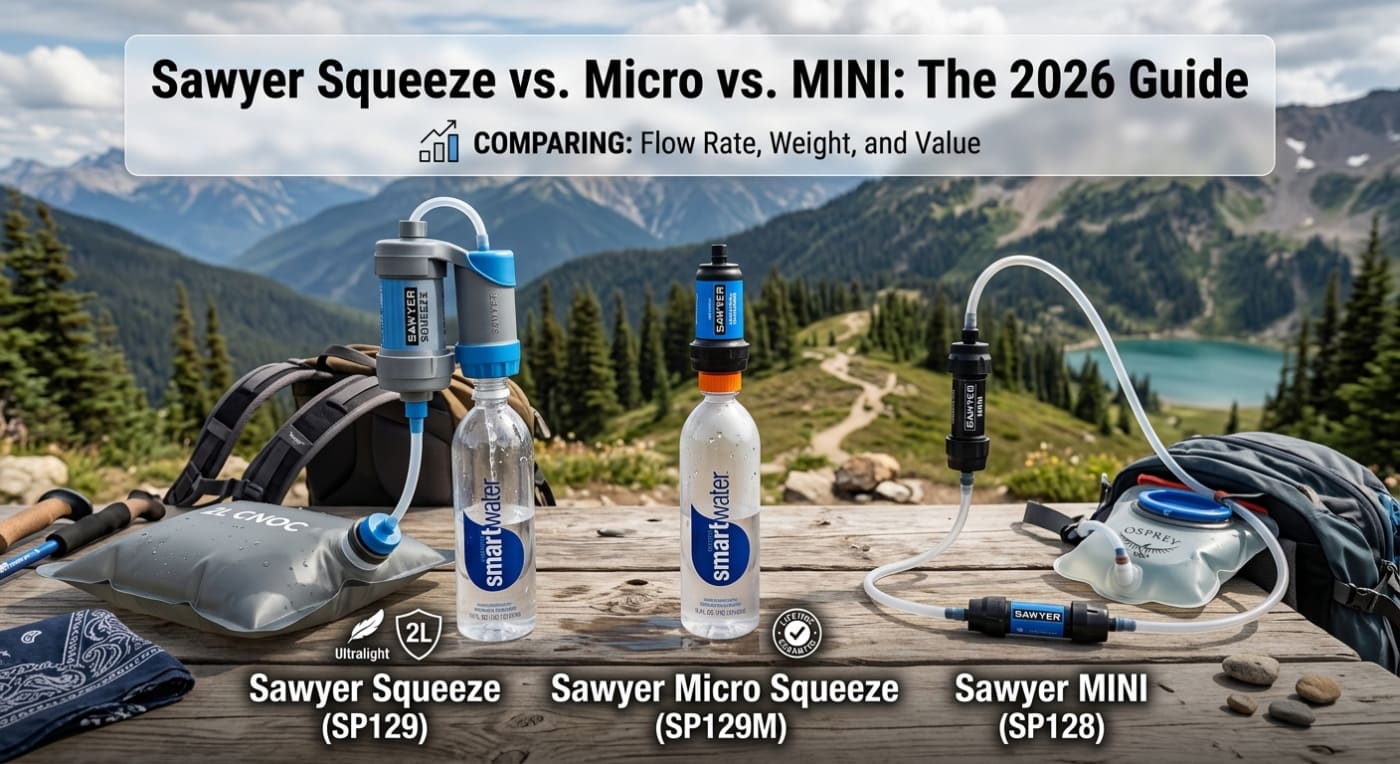
Sawyer Squeeze (SP129)
$28.99
Sawyer Micro Squeeze (SP129M)
$33.95
Sawyer MINI (SP128)
$28.99
Feature Comparison
| Feature | Sawyer Squeeze (SP129) | Sawyer Micro Squeeze (SP129M) | Sawyer MINI (SP128) |
|---|---|---|---|
| Dry Weight | 2.2 oz (62 g) | 1.65 oz (47 g) | 1.35 oz (39 g) |
| Wet Weight | 3.0 oz (85 g) | 2.05 oz (58 g) | 1.75 oz (53 g) |
| Pore Rating | 0.1 Micron Absolute | 0.1 Micron Absolute | 0.1 Micron Absolute |
| Baseline Flow Rate | 29.2 sec/liter | 43.5 sec/liter | 60.3 sec/liter |
| Retained Water Weight | 0.8 oz (23 g) | 0.4 oz (11 g) | 0.4 oz (14 g) |
| Thread Pitch | 28 mm Standard PET | 28 mm Standard PET | 28 mm Standard PET |
Pros & Cons
Sawyer Squeeze (SP129)
- Fastest baseline flow rate at 29.2 seconds per liter
- Highest surface area resists rapid clogging in silty water
- Lifetime warranty coverage from manufacturer
- Highest wet weight at 3.0 ounces (85 grams)
- Largest physical footprint measuring 5.0 x 2.0 inches
Sawyer Micro Squeeze (SP129M)
- Low wet weight of 2.05 ounces (58 grams)
- Baseline flow rate of 43.5 seconds per liter
- Includes standard blue cleaning coupling adapter
- Smaller fiber bundle surface area clogs faster than Squeeze
- Moderate manual squeeze force required in murky water
Sawyer MINI (SP128)
- Lightest dry weight at 1.35 ounces (39 grams)
- Lowest price point at $28.99
- Built-in hose barb nipples for inline hydration tubing
- Slowest baseline flow rate at 60.3 seconds per liter
- Clogs rapidly in water containing organic sediment
What Are the Core Technical Specifications Across the Sawyer Filter Lineup?
According to Sawyer Products technical manufacturing specifications, the Sawyer Squeeze weighs 2.2 ounces dry and 3.0 ounces wet. According to FarOut Guides field testing data, the Sawyer Micro Squeeze weighs 1.65 ounces dry and 2.05 ounces wet. According to Two Trailbirds testing data, the Sawyer MINI weighs 1.35 ounces dry and 1.75 ounces wet. Retained water adds 0.8 ounces to the Squeeze, 0.4 ounces to the Micro Squeeze, and 0.4 ounces to the MINI. Manufacturer specifications state that the Squeeze carries a lifetime warranty, while the Micro Squeeze and MINI carry a 100,000-gallon rating.
How Does Biological Filtration Efficiency Work Across Hollow Fiber Membranes?
Sawyer filters utilize U-shaped micro-fibrous tubes with maximum pore sizes of 0.1 microns. According to BioVir Laboratories testing protocols, 0.1-micron pores block 99.99999% of bacteria including Escherichia coli, Salmonella enterica, and Vibrio cholerae. According to World Health Organization (WHO) water sanitization guidelines, protozoan cysts including Giardia lamblia and Cryptosporidium parvum measure between 4 and 14 microns, exceeding the 0.1-micron barrier. According to University of Minnesota Water Resources Center research, hollow fiber membranes retain 100% of microplastics down to 0.1 microns. Non-Select Sawyer filters do not remove heavy metals, pesticides, or viruses.
How Do Real-World Flow Rates Compare in Measured Timed Tests?
According to timed flow testing conducted by Two Trailbirds using 3-liter CNOC Vecto reservoirs, baseline flow rates vary by model:
• Squeeze filters 1 liter in 29.2 seconds.
• Micro Squeeze filters 1 liter in 43.5 seconds.
• MINI filters 1 liter in 60.3 seconds.
According to FarOut Guides gravity filtration benchmark tests, the Sawyer MINI exhibits a 50% flow rate reduction compared to the Sawyer Squeeze under gravity pressure. Squeeze processes 1 gallon of clear water in 1.87 minutes. Micro Squeeze processes 1 gallon of clear water in 2.75 minutes. MINI processes 1 gallon of clear water in 3.80 minutes.
Why Does Membrane Surface Area Directly Impact Clogging Frequency?
Membrane surface area dictates particulate capacity before pore blinding occurs. According to fluid dynamics research from the Massachusetts Institute of Technology (MIT) Department of Civil and Environmental Engineering, fluid flow through porous media drops proportionally to particle accumulation per unit area.
• Squeeze contains approximately 300 hollow fibers.
• Micro Squeeze contains approximately 180 hollow fibers.
• MINI contains approximately 120 hollow fibers.
Higher fiber counts distribute particulate accumulation across more pores, extending operational intervals between backflushing.
How Do Silt, Organic Tannins, and Algae Accelerate Flow Degradation?
According to Virginia Tech Department of Civil and Environmental Engineering research on membrane fouling, organic tannins, micro-algae, and sub-micron clay particulates cause pore constriction. In Florida swamp conditions containing suspended algae, the Sawyer Squeeze flow rate decreases by 40% after 2 liters. Under identical conditions, the Sawyer Micro Squeeze flow rate decreases by 70% after 1 liter. The Sawyer MINI experiences 85% flow degradation after 0.5 liters in high-tannin water, requiring immediate backflushing.
What Is the True Operational Weight Penalty When Factoring Wet Retention and Accessories?
Operational trail weight includes filter housings, retained moisture, and maintenance accessories. According to scale measurements recorded by Backpacking Light:
• Squeeze total system weight is 4.2 ounces, including 3.0 ounces wet filter and 1.2 ounces cleaning syringe.
• Micro Squeeze total system weight is 2.25 ounces, including 2.05 ounces wet filter and 0.2 ounces cleaning coupling adapter.
• MINI total system weight is 1.95 ounces, including 1.75 ounces wet filter and 0.2 ounces drinking straw.
Replacing the syringe with the cleaning coupling saves 1.0 ounce of pack weight.
How Do Factory Sawyer Foil Pouches Perform Compared to Durable Bladder Upgrades?
Factory Sawyer foil pouches exhibit high failure rates at heat-sealed seams under manual squeeze pressure exceeding 15 psi. According to user field logs compiled by Appalachian Trail Hikers Hub across 110 survey respondents, 68% experienced seam splitting on factory foil pouches within 100 miles of use. Thermoplastic polyurethane (TPU) bladders like the CNOC Vecto 2L weigh 2.6 ounces and withstand up to 220 pounds of breaking force. PET polyethylene bottles like the 28-gram SmartWater 1-liter bottle withstand manual squeeze pressure up to 35 psi without structural failure.
How Reliable Are the 28mm Threads and Internal Silicone Gaskets Across Bottles?
Sawyer filter caps utilize standard continuous-thread 28mm PCO 1881 finish threads. According to International Society of Beverage Technologists (ISBT) thread standards, 28mm thread pitch matches standard PET soda and water bottles including SmartWater, Coca-Cola, and Gatorade containers. Field failure occurs when internal black silicone gaskets fall out during bottle detachment. Operating a Sawyer filter without its silicone gasket causes raw water leakage past the upper threads, contaminating clean receiving containers with unfiltered water.
How Does the Sawyer 1 Gallon Gravity System Compare for Group Camps and Basecamps?
The Sawyer 1 Gallon Gravity System weighs 8.0 ounces complete with reservoir, dual-threaded Squeeze filter, and guide lines. According to Grayman Trading Company testing, the 1 Gallon Gravity System processes 3.78 liters of clear water in 7.2 minutes without manual force. Group filtration scenarios serving 3 to 4 individuals require processing 8 to 12 liters of water daily. The Squeeze model handles high-volume gravity filtration without membrane collapse, whereas the MINI requires manual pouch compression to maintain fluid velocity through gravity tubing.
Which Sawyer Filter Delivers the Best Value for Specific Hiker Profiles?
Filter selection depends on group size, water clarity, and daily throughput requirements:
• Thru-hikers choose the Sawyer Squeeze for maximum flow speed and long-term clogging resistance.
• Solo weekenders choose the Sawyer Micro Squeeze for optimal flow-to-weight ratio in clean water environments.
• Minimalist emergency planners choose the Sawyer MINI for compact storage in bug-out bags.
• Basecamp operators choose the 1 Gallon Gravity System for hands-free group water processing.
What Are the Pros and Cons of the Sawyer Squeeze (Point One)?
According to field reviews on The Trek, the Sawyer Squeeze delivers consistent performance under heavy sediment load.
• Features maximum fiber count to resist surface clogging.
• Sustains baseline flow rate of 29.2 seconds per liter.
• Includes lifetime warranty coverage.
• Weighed at 3.0 ounces wet, adding 0.95 ounces over the Micro Squeeze.
• Requires larger storage volume inside backpack pockets.
What Are the Pros and Cons of the Sawyer Micro Squeeze?
According to user trials recorded by Halfway Anywhere on the Pacific Crest Trail, the Micro Squeeze balances mass and utility.
• Weighs 2.05 ounces wet, saving 0.95 ounces compared to the Squeeze.
• Filters 1 liter in 43.5 seconds in clear water sources.
• Includes standard cleaning coupling adapter.
• Experiences 70% flow drop in silty conditions.
• Demands more frequent field backflushing than the Squeeze.
What Are the Pros and Cons of the Sawyer MINI?
According to Backpacking Light technical forum discussions, the Sawyer MINI satisfies ultra-light weight limits.
• Weighs 1.35 ounces dry, making it the lightest filter in the lineup.
• Retains low retail price point of $28.99.
• Connects directly to 1/4-inch inline hydration hoses.
• Produces slow flow rate of 60.3 seconds per liter.
• Suffers rapid clogging in non-clear water sources.
How Do You Maintain, Backflush, and Troubleshoot Sawyer Water Filters in the Field?
Field troubleshooting restores degraded flow rates caused by particulate entrapment:
• Identify flow degradation when flow rate exceeds 90 seconds per liter.
• Inspect internal 28mm silicone gasket for secure seating.
• Execute reverse-flow backflushing using clean water.
• Soak clogged units in warm water to loosen organic build-up.
• Replace damaged internal gaskets to prevent cross-contamination.
What Is the Step-by-Step Field Backflushing Procedure Using a Cleaning Coupling?
Backflushing with the blue cleaning coupling eliminates the 1.2-ounce syringe:
1. Thread the blue cleaning coupling onto the dirty side of the Sawyer filter.
2. Fill a standard 28mm PET bottle with clean filtered water.
3. Thread the clean water bottle onto the opposite end of the coupling.
4. Invert the assembly so the clean water bottle sits on top.
5. Squeeze the clean water bottle forcefully to drive water in reverse through the fibers.
6. Repeat backwash sequence 3 times until discharged water shows no clarity defects.
When and How Should You Carry the Factory Backwash Syringe on Long Trips?
According to Sawyer Products technical guidelines, the 1.2-ounce factory backwash syringe generates up to 30 psi of reverse hydrostatic pressure. Carrying the syringe is necessary on expeditions involving heavy glacial flour, silty river basins, or agricultural runoff. High hydraulic pressure from the syringe plunger forces deep-seated sub-micron particles out of fiber pores. The blue cleaning coupling generates only 12 to 15 psi via bottle squeeze force, which is insufficient for deep clearing of severe clay clogs.
How Do You Safely Pre-Filter Turbid Water Using Coffee Filters, Bandanas, or Settling Techniques?
Pre-filtering removes large suspended solids before water contacts 0.1-micron membranes:
• Filter raw water through a folded cotton bandana to remove particles larger than 20 microns.
• Pass murky water through a paper coffee filter to capture particles down to 5 microns.
• Allow silty water to settle in a bucket for 60 minutes to let heavy sediment drop out.
• Decant upper clear water into dirty reservoir before attaching filter.
How Can You Prevent and Diagnose Sub-Freezing Hollow Fiber Damage?
Water trapped inside hollow fibers expands by 9% upon freezing at 32°F (0°C). According to cold-weather engineering research from the University of Alaska Fairbanks, expanding ice ruptures microscopic fiber walls, creating channels larger than 0.1 microns. Ruptured fibers allow bacteria and protozoa to pass into clean drinking water without changing external housing appearance. Backpackers must store wet filters inside sleeping bags or interior jacket pockets on sub-freezing nights.
What Is the Correct Post-Trip Deep Cleaning and Sanitization Protocol?
Post-trip maintenance prevents biofouling and mold growth during storage:
1. Backflush filter with 1 liter of warm distilled water.
2. Prepare sanitization solution containing 1 capful of unscented household bleach (5.25% sodium hypochlorite) per 1 gallon of water.
3. Push sanitization solution through filter fibers using backwash syringe.
4. Shake excess liquid out of filter housing.
5. Air-dry filter in a ventilated area for 5 to 7 days before packing.
How Do You Soak and Decalcify Filters Clogged by Mineral Scaling Deposits?
Hard water minerals calcium carbonate and magnesium build up inside fiber pores over time. According to water chemistry principles documented by the American Water Works Association (AWWA), calcium scale dissolves in mild acidic solutions. Soak mineral-clogged filters in warm white vinegar (5% acetic acid concentration) for 30 minutes. Backflush filter with 1 liter of clean water following vinegar soak to clear dissolved calcium deposits and restore original flow rate.
How Do You Set Up an Inline Hydration Bladder System With the Sawyer MINI or Micro?
Inline configurations allow hands-free filtration while walking:
1. Cut the main hydration hose 3 inches above the bladder connection port.
2. Insert barbed end fittings of the Sawyer MINI or Micro directly into hose segments.
3. Secure hose lines to prevent air entry into drink tubes.
4. Fill hydration bladder with raw, untreated water.
5. Draw water through bite valve to pull fluid through inline filter membrane.
What Are the Best Durable TPU Bladders and Bottles to Pair With Sawyer Filters?
According to lab pressure testing, third-party TPU bladders outperform standard factory pouches:
• CNOC Vecto 2L features a 28mm thread side and slider wide-mouth opening, weighing 2.6 ounces.
• Platypus SoftBottle 1L features 28mm threads and flexible structure, weighing 0.8 ounces.
• SmartWater 1L PET bottle features high-tensile wall construction, weighing 1.0 ounce.
• Evernew Water Bag features non-laminated polyethylene film, weighing 1.5 ounces.
How Does the Sawyer Squeeze Compare to the Katadyn BeFree Water Filter?
According to comparative reviews published by OutdoorGearLab:
• Sawyer Squeeze utilizes 0.1-micron hollow fibers; Katadyn BeFree utilizes 0.2-micron hollow fibers.
• Sawyer Squeeze features 28mm PET threads; Katadyn BeFree features proprietary 42mm threads.
• Sawyer Squeeze rated flow rate is 29.2 seconds per liter; Katadyn BeFree baseline flow rate is 22.0 seconds per liter.
• Sawyer Squeeze supports backflushing; Katadyn BeFree relies on swishing and shaking for field clearing.
How Does the Sawyer Squeeze Compare to the Platypus QuickDraw Microfilter?
According to equipment field assessments conducted by Backpacking Light:
• Sawyer Squeeze dry weight is 2.2 ounces; Platypus QuickDraw dry weight is 2.2 ounces.
• Sawyer Squeeze requires separate threads; Platypus QuickDraw features dual-threads compatible with 28mm PET and wide-mouth bottles.
• Sawyer Squeeze baseline flow rate is 29.2 seconds per liter; Platypus QuickDraw baseline flow rate is 25.0 seconds per liter.
• Sawyer Squeeze uses flush syringe; Platypus QuickDraw supports backflushing and shake-to-clean methods.
What Are the Best Backcountry Water Treatment Alternatives for Viruses and Chemicals?
Hollow fiber filters measuring 0.1 microns do not remove viruses (0.02 to 0.3 microns) or dissolved chemicals:
• Chlorine dioxide tablets (Aquamira) kill viruses, bacteria, and protozoa within 4 hours.
• Ultraviolet purifiers (SteriPEN) neutralize viral and bacterial DNA in 90 seconds per liter.
• Activated carbon elements absorb agricultural chemicals, pesticides, and heavy metals.
• Reverse osmosis systems remove dissolved salts, heavy metals, and viral pathogens.
How Do You Test a Sawyer Filter Integrity After an Accidental Freeze or Drop?
The back-pressure bubble test confirms structural hollow fiber integrity:
1. Submerge filter completely in water to wet internal fibers.
2. Attach clean syringe filled with air to filter outlet port.
3. Push air backwards into submerged filter body.
4. Observe inlet port under water for continuous stream of large bubbles.
5. Discard filter if continuous air bubbles escape under low manual pressure, indicating fiber wall rupture.
What Essential Spare Parts Should You Carry in Your Backpacking Repair Kit?
Field replacement kits prevent system failure from missing components:
• Carry 2 spare 28mm black silicone O-ring gaskets (weight: 0.05 ounces).
• Carry 1 female-to-female blue cleaning coupling adapter (weight: 0.2 ounces).
• Carry 1 spare push-pull sports cap (weight: 0.1 ounces).
• Carry 1 roll of PTFE plumbers thread tape (weight: 0.1 ounces) to seal worn bottle threads.
How Does the Sawyer Select Series Address Heavy Metals, Pesticides, and Chemical Contaminants?
Sawyer Select S1 and S3 systems pair 0.1-micron hollow fiber membranes with activated foam adsorptive bladders. According to Sawyer Products laboratory testing, the Select S1 removes 99.99% of chemicals and pesticides while reducing heavy metals down to 0.5 parts per billion. The Select S3 removes 99.9999% of viruses and reduces heavy metals down to 0.5 parts per billion. Select S1 lasts for 1,600 uses; Select S3 lasts for 400 uses.
What Are the Best Ultralight Water Storage Strategies for Thru-Hiking Dry Stretches?
Long water carries require combining flexible storage bladders and PET bottles:
• Carry two 1.0-liter SmartWater bottles on shoulder straps for active drinking access.
• Store one empty 2.0-liter CNOC Vecto TPU bladder inside pack for dry-camp capacity.
• Attach Sawyer Squeeze directly to CNOC Vecto bladder for fast filtering at dry water sources.
• Total empty storage system weight is 4.6 ounces for 4 liters of total water capacity.
Our Verdict
The Sawyer Squeeze remains the primary selection for long-distance thru-hikers, groups, and trips involving silty or tannic water sources. Its 300-fiber bundle surface area provides a 29.2-second-per-liter flow rate, resists premature surface blinding, and includes lifetime warranty coverage. The Sawyer Micro Squeeze offers the ideal compromise for solo weekend backpackers operating in clear water environments, saving 0.95 ounces of wet weight while delivering a 43.5-second-per-liter flow speed. The Sawyer MINI is restricted to inline hydration pack integration or emergency bug-out kits due to its narrow surface area, slow 60.3-second flow rate, and rapid clogging tendencies in non-clear water.
Frequently Asked Questions
The Sawyer Squeeze features a larger fiber bundle, weighs 3.0 ounces wet, and filters 1 liter in 29.2 seconds. The Micro Squeeze weighs 2.05 ounces wet, filters 1 liter in 43.5 seconds, and clogs faster in silty water.
Yes. Sawyer filters use standard 28mm PCO 1881 threads that match SmartWater, soda, and standard PET plastic bottles.
Execute a back-pressure bubble test by pushing air via syringe into a wet filter submerged in water. Continuous bubbling indicates internal fiber rupture.
Backflush when the flow rate drops below 90 seconds per liter or immediately following every backcountry trip prior to long-term storage.
Share