
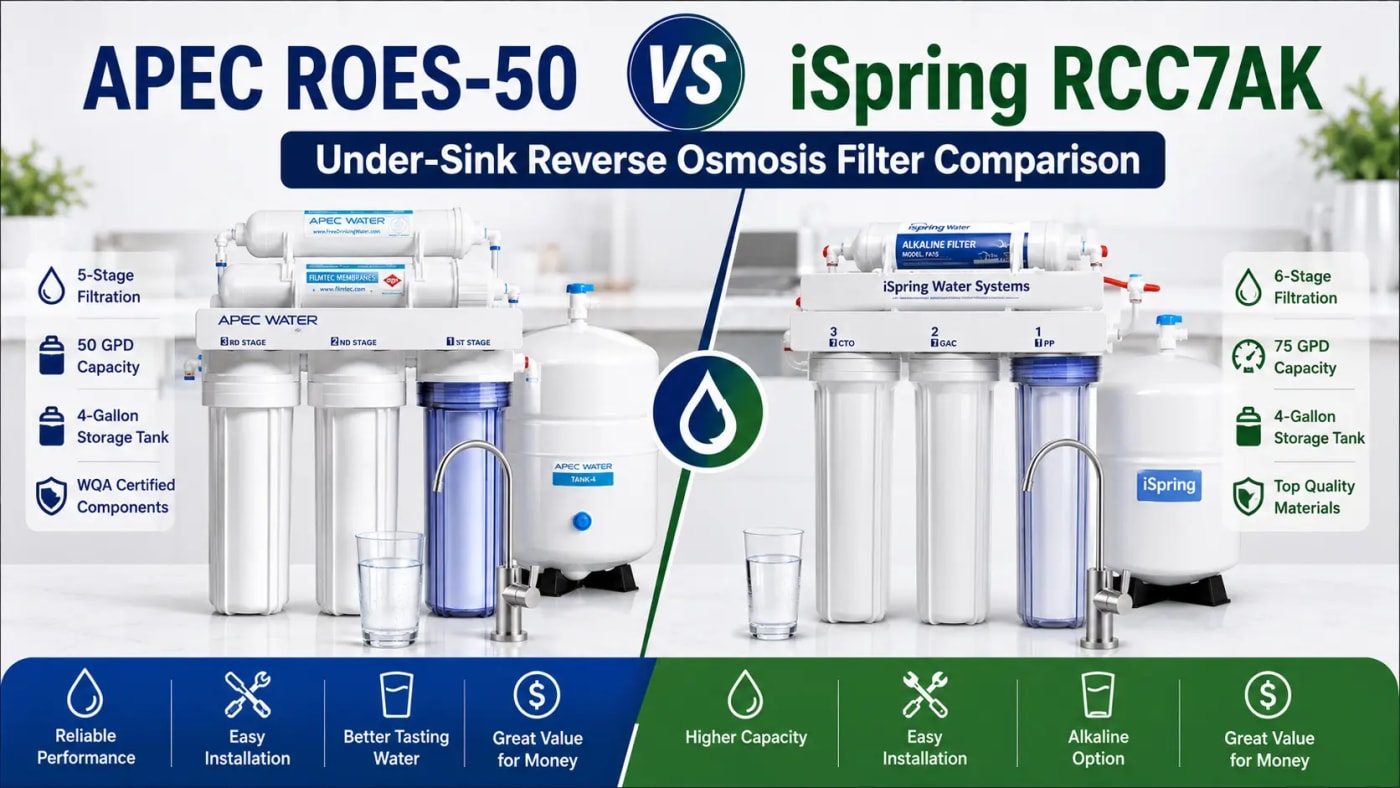
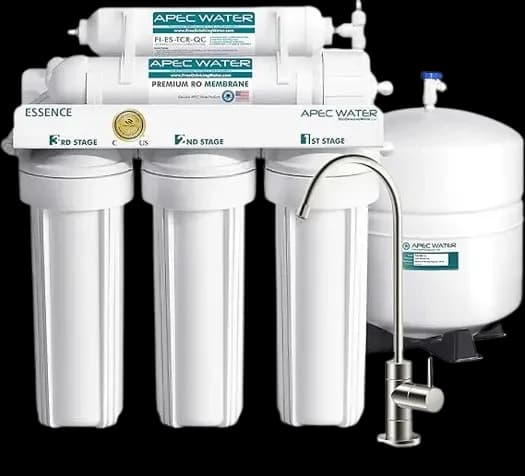
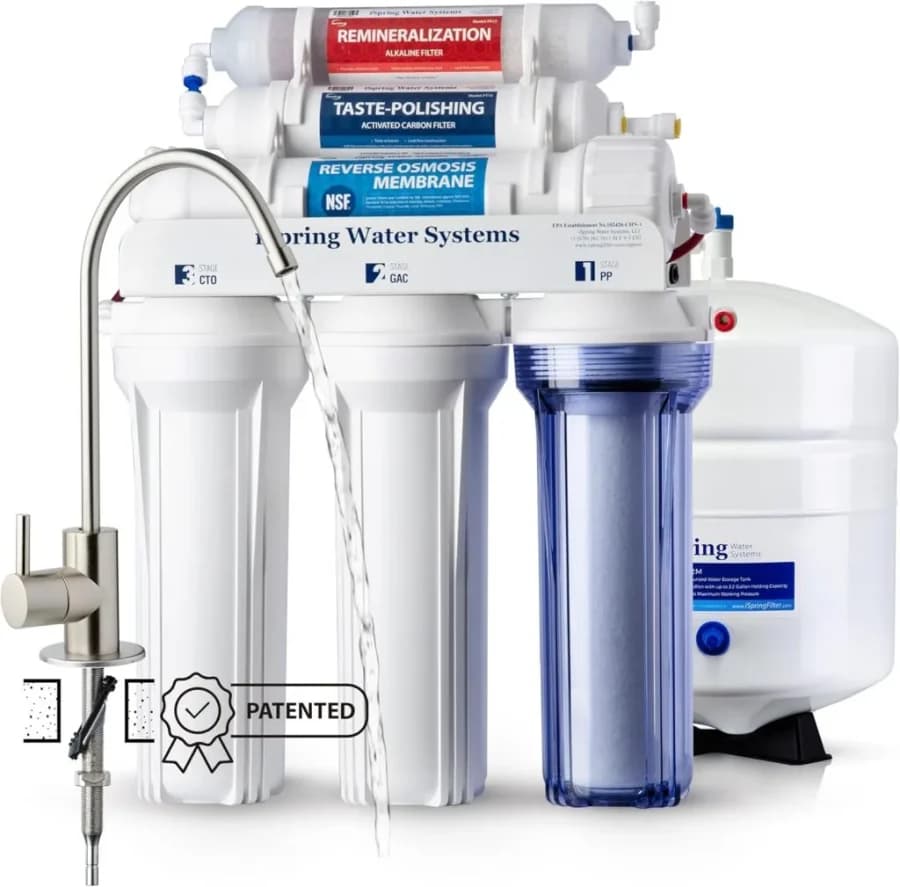
The APEC ROES-50 and the iSpring RCC7AK represent the two most common paths in home water treatment: ultra-pure 5-stage filtration versus a 6-stage process that adds minerals back for a better flavor. Both systems are top-selling residential options that fit under a standard kitchen sink and typically retail for under $250. If purity is your goal for cooking or special applications, the APEC delivers near-zero TDS water. But if you think standard reverse osmosis water is too "flat" or too "acidic," the iSpring has a stage for remineralization to get you that natural spring water taste again, crisp and balanced.
Head-to-Head Summary
Feature | APEC ROES-50 | iSpring RCC7AK |
Current Price | $230.99 | $234.00 – $241.99 |
Daily Output (GPD) | 50 GPD | 75 GPD |
Filtration Stages | 5 Stages | 6 Stages |
TDS Output | ~5–10 ppm | ~25–45 ppm (Post-Mineral) |
Wastewater Ratio | 3:1 | 3:1 to 2:1 |
Remineralization | No | Yes (Alkaline pH+) |
Certification | WQA Gold Seal (NSF 58) | NSF/ANSI 58 |
Annual Filter Cost | ~$75 – $80 | ~$95 – $110 |
Warranty | 2-Year Limited | 1-Year (Extendable) |
What Is the Difference Between 5-Stage and 6-Stage Reverse Osmosis Filtration?
The most important thing to understand is that 5-stage and 6-stage systems are nearly identical: they share the same first five steps. In both the APEC 5-stage RO and the iSpring 6-stage RO, the core purification happens within the first four stages. If you are choosing between them, you aren't choosing a higher level of safety; you are choosing how your water tastes.
The Shared Foundation (Stages 1–5)
Both systems follow this exact sequence to strip contaminants away:
Stage 1
A sediment prefilter (5 micron) catches rust, dust, and sand to protect the rest of the system.
Stages 2 & 3
A GAC carbon block and a CTO carbon block work together to "soak up" chlorine and chemicals that ruin the flavor and damage the membrane.
Stage 4
The TFC membrane (0.0001 micron) is the heart of the machine. It physically blocks 99% of lead, arsenic, and fluoride.
Stage 5
A post-carbon polishing filter gives the water one last refresh as it leaves the storage tank to ensure it's odorless.
The 6th Stage: Calcite Remineralization
The "extra" stage of an iSpring is the calcite remineralization stage. Since reverse osmosis is so effective, the minerals that give water "body" are removed, often leaving water slightly acidic. In this 6th stage, calcite is dissolved back into the water for an RO water pH of 7.5-8.5.
There is a myth that the more stages, the cleaner the water is. In fact, this spring extra stage has no effect on contaminant rejection but restores minerals and flavor. For pure, crisp water, there are 5 stages. The 6th stage is well worth the small cost if you like your mineral water soft and rounded.
Does the iSpring RCC7AK Actually Produce Alkaline Water?
Yes, the iSpring RCC7AK does produce alkaline water, but it’s important to distinguish between "alkaline" and "ionized" water. This system uses a chemical process, not electricity, to change the water’s profile.
Why Is Standard RO Water Acidic?
The water produced by standard reverse osmosis systems like the APEC ROES-50 typically has a pH of 5.5 - 6.5. It happens because the membrane removes minerals normally used as a "buffer." Once those minerals are gone, the water takes carbon dioxide from the air, and the PH drops. This explains the "flat" or "sharp" APEC Roes-50 flat water taste described in many user reviews.
The iSpring Alkaline Stage
The iSpring alkaline system solves this problem with its sixth stage: a calcite filter. As the purified water leaves the storage tank, it flows through a cartridge filled with calcium carbonate (CaCO₃).
pH Elevation: Through CaCO₃ dissolution, the water picks up small amounts of calcium and magnesium, raising the spring pH to 7.5–8.5.
TDS Increase: You will notice your RO water PH level isn't the only thing that changes. Your TDS reading will likely rise by 15–30 ppm. This isn't a filtration failure; it’s the intentional addition of minerals back into permeate to create that balanced flavor.
It's a natural remineralization process, not an electric water ionizer! It is just a way of imagining how water takes up minerals as it runs over rock in a stream. If you trust the APEC brand but want this mineral balance, the APEC ROES-PH75 alkaline is the direct equivalent; the base ROES-50 cannot deliver this taste profile.
Which System Removes More Contaminants: ROES-50 or RCC7AK?
When comparing the APEC ROES-50 vs. iSpring RCC7AK contaminant removal, it is important to realize that both systems use a high-rejection TFC membrane as their engine. Because of this, both units offer a nearly identical TDS rejection rate of 96% to 99%. However, because they handle the final "polishing" stage differently, the numbers on your handheld TDS meter will look very different.
Purity vs. Re-mineralization
APEC ROES-50 ppm output: And this system is built for purity! Users see 5 to 10 ppm output usually. The product strips almost all minerals from the water, which is why it is awarded the WQA Gold Seal. This certification proves that the system was built safely and that rejection targets were met.
iSpring RCC7AK TDS: After initial filtration, the iSpring water measures about 10-14 ppm. The TDS increases to 25-45 ppm after passing through the 6th stage calcite filter, however. It's an intentional increase; the system is adding calcium and magnesium back into the water for balance.
Removing the Invisible Stuff
Both systems are heavy hitters against common tap water threats:
Lead removal RO system
Both provide ≥99% reduction, making them safe for homes with old plumbing.
Arsenic and Fluoride
You can expect ~95% arsenic reduction and ~96% fluoride rejection from both models.
Pharmaceuticals and VOCs
The APEC ROES-50 has a slight edge here in terms of documented claims. It specifically markets its ability to remove trace drugs, hormones, and pharmaceuticals, a major concern for city dwellers on Reddit’s drinking water.
Even though the iSpring is NSF/ANSI 58 certified for TDS reduction, APEC's WQA Gold Seal status is considered the "gold standard" for buyers who want lab-verified proof that their system is removing the broadest range of chemicals.
How Do Their Flow Rates and Daily Output Affect Household Use?
While the iSpring RCC7AK 75 GPD rating looks significantly higher than the APEC ROES-50 GPD spec, these numbers are laboratory maximums measured at 77°F and 65 PSI. In a real-world kitchen where water is colder and pressure is lower, your RO system's daily output will be lower.
Real-World Output vs. Rated GPD
At a typical household pressure of 50–60 PSI, you can expect the APEC to produce roughly 35–40 gallons per day, while the iSpring produces closer to 50–60 gallons.
Storage Tank Capacity
Both systems use a standard 3.2-gallon storage tank. However, because of the internal air bladder, you actually get about 2 to 2.5 gallons of usable water at once.
Tank Refill Time
If you drain the tank completely to fill a large pasta pot, the APEC takes about 2 to 3 hours to refill, while the iSpring’s higher-capacity membrane can do it in about 1.5 to 2 hours.
Who Needs the Extra GPD?
For an RO system for a family of 4 that only drinks water and does light cooking (2–3 gallons per day), both systems are more than enough. The extra speed of the iSpring 75 GPD membrane really only matters if:
You have a large family (5+ people).
You connect the system to a refrigerator ice maker or water dispenser.
You use the water for high-volume hobbies like hydroponics or large aquariums.
The 40 PSI Minimum
Both units require a 40 PSI minimum RO feed pressure. Low pressure means both will have a high wastewater ratio and a trickle-like flow. When your pressure is low, skip both base units and get the pump-equipped versions: either the iSpring RC7P or APEC RO PERM.
Which System Is Easier to Install for a DIY Homeowner?
If you are a first-time installer, the APEC ROES-50 installation is generally the easier one. APEC provides photo-illustrated directions and well-organized color-coded tubing to ease "routing anxiety." Most homeowners said the project took 2 to 3 hours.
It is also solid, but as a 6-stage system, the alkaline filter requires one more tubing connection, as shown in the iSpring RCC7AK install guide. Even though iSpring comes with all the fittings and a drain saddle included, the documentation is a little more text-heavy and may take 2.5 to 3.5 hours for the average DIYer to set up.
The 5 Main Connection Points
Regardless of which system you choose, you will need to manage these five standard connections:
Cold Feed T-Adapter: Placed on your under-sink cold water supply valve.
Drain Saddle: Mounted to your sink’s drain pipe to dispose of wastewater.
Storage Tank Valve: Connects the system to the pressurized tank.
Dedicated Faucet: Installed through an RO faucet hole size of 1-3/8 inches (you may need to drill this if you don't have an extra hole).
Drain Line: The 1/4-inch tubing that runs from the system to the drain saddle.
Common Install Failures to Avoid
Reddit’s r/DIY and Amazon reviews highlight two major mistakes that lead to system failure:
Failure 1: Poor Drain Saddle Placement
A common error is mounting the saddle below the P-trap. This "siphons" dirty sink water back into the RO unit, causing foul odors and slow drainage. Placement of your RO drain saddle must always be vertical or horizontal above the P-trap bend.
Failure 2: The Supply Valve Pierce:
Some APEC t-fitting installation problems involve the saddle valve not fully piercing the copper supply pipe. If you turn everything on and get no water, don't think the unit is broken; the needle probably hasn't punctured the line fully.
Both systems have John Guest push-fit fittings, which are easy to use: Push the tube in till it seats and then pull back a little to lock. Just square up your cuts and clean them to avoid the most common under-sink drip.
What Are the Real Annual Costs After the Initial Purchase?
When you buy a reverse osmosis system, the sticker price is only the beginning. Over time, the APEC vs. iSpring annual cost depends on how many filters you have to swap and how often your local water "beats them up." On average, the APEC ROES-50 is cheaper to run, costing approximately $75–$80 per year, while the iSpring RCC7AK runs closer to $95–$110 per year.
The Breakdown
APEC ROES-50 (5-Stage)
You’ll replace the first three pre-filters every 12 months (roughly $30). The post-carbon filter and the RO membrane replacement cost ($40–$50) only happen every 2 to 3 years. This keeps your maintenance simple and predictable.
iSpring RCC7AK (6-Stage)
This system has two extra expenses. First, the calcite cartridge replacement ($15–$20) must be done every year to keep the water alkaline. Second, because iSpring uses a clear housing for the first stage, many users in high-sediment areas find they need to swap the pre-filters every 6 months instead of 12, which can double their yearly spending.
The 10-Year Total Cost of Ownership (TCO)
If you look at the RO system's 10-year cost, the gap becomes clear. Including the initial purchase and all scheduled replacements, the APEC ROES-50 will cost you roughly $950, while the iSpring RCC7AK will total about $1,250. Interestingly, that $300 difference is exactly what it would cost to buy APEC’s own premium alkaline model, the ROES-PH75.
If you go with the iSpring, look for the iSpring RCC7AK filter bundle. Buy a 3-year supply pack for about $160 upfront and save almost 40% on your annual maintenance cost compared to buying filters individually.
Which System Wastes Less Water?
For reverse osmosis efficiency, the iSpring RCC7AK 2:1 ratio is a clear winner over the APEC 3:1 waste ratio. In RO, waste is water that is rinsed off a membrane and down the drain. Both systems are tank-based models, but the newer membrane design from iSpring produces less RO drain under standard conditions.
The Real-World Numbers
To understand the impact, let's look at a typical family using 2 gallons of purified water per day for drinking and cooking.
APEC ROES-50
At a 3:1 ratio (which can drop to 5:1 if your feed water psi is low), you will send roughly 6 to 10 gallons to the drain daily. That totals 2,190 to 3,650 gallons per year.
iSpring RCC7AK
At its more efficient 2:1 ratio, it drains only 4 gallons per day, totalling about 1,460 gallons per year.
Does This Affect Your Water Bill?
In terms of the RO system water bill impact, the difference is surprisingly small. At average U.S. water rates, the APEC costs about $15–$20 per year in waste, while the iSpring costs about $8–$10. For most homeowners, a $10 annual difference isn't a primary reason to choose one over the other.
Who Should Care About Water Waste?
The annual drain water volume matters most to two types of buyers:
Eco-Conscious Homeowners
If reducing your environmental footprint is a priority, saving 2,000 gallons of water a year is a significant "green" win.
Well Water Users
If you are on a private well and septic system, every gallon of waste puts extra work on your pump and adds volume to your drainage field.
If water conservation is your absolute top priority, you should look beyond both of these models toward a tankless RO water waste leader like the Waterdrop G3P600, which offers a much tighter 1:1.5 ratio.
Which Brand Has Stronger Water Filter Certifications?
In water filtration, there is a big difference between a product being "tested" and "certified." Though both meet NSF ANSI 58, the US benchmark for reverse osmosis performance, the level of independent verification is different for the flagship models.
The WQA Gold Seal
The WQA gold seal certification is widely considered the highest level of assurance in the industry. It means a system didn't just pass a one-time lab test; it is also listed in the WQA certified product directory and undergoes regular factory audits to ensure every unit off the line meets the same strict standards.
APEC ROES-50
This system carries the full WQA gold seal, certifying it against NSF/ANSI 58 for both performance (contaminant rejection) and material safety (ensuring the plastic doesn't leak chemicals into your water).
iSpring RCC7 (Base 5-Stage)
Like the APEC, the base iSpring model is WQA Gold Seal certified, a solid budget pick.
iSpring RCC7AK (6-Stage Alkaline)
While the system is tested and certified by NSF International for its core filtration, it does not always carry the same WQA Gold Seal as the base model. This is usually because the 6th-stage alkaline filter is a special add-on and requires separate, expensive certification.
Certified vs. Lab-Tested
If a brand claims it was "tested to NSF standards," it may just mean they sent one unit to a private laboratory once. With "WQA Gold Seal Certified," a third party, such as the Water Quality Association, owns the results and stakes their reputation on them.
For the average home, either system is safe. But if you live in an immunocompromised household or must produce official documentation for a rental property or insurance, the APEC WQA gold seal provides the strongest, most transparent paper trail of safety.
Is APEC Actually Made in the USA and Does iSpring Qualify Too?
In 2026, when shopping for an RO system, "Made in USA" is often loosely used. There is a difference between manufacturing (the actual filters themselves) and assembly (the pre-made parts put together). Both brands have solid American footprints but differ in their claims.
APEC: US-Assembled with US-Made Primary Filters
It is APEC that has the more specific domestic claim. It manufactures its main filtration components, the carbon blocks and high-rejection TFC membrane, within the US. The final systems are designed, engineered, and assembled at their ISO 9001-certified facility in City of Industry, California. Some smaller parts, like plastic fittings and metal tanks, are imported from overseas partners, but the "engine" is a domestic product mainly.
iSpring: US-Assembled with Global Components
ISpring discloses its supply chain worldwide. The systems are assembled in the USA at an FDA-registered and NSF-accredited facility in Alpharetta, Georgia. But the individual parts, the filters, housings and membranes typically come from Taiwan and China, specialized manufacturers like iSpring say they add value through US-based quality control & customer support, not domestic filter manufacturing.
Does Origin Affect Water Quality?
Technically, no. In the water industry, the country of origin is less important than NSF/ANSI 58 certification. As long as a system passes this standard, it has been lab-proven to remove contaminants regardless of where it was built.
The practical decision is
If you want to support US domestic manufacturing of the actual filter media, APEC is the stronger choice.
If you simply want a system that is inspected and assembled in the USA with local customer support, both APEC and iSpring qualify equally.
Which Brand Has Better Customer Support and Warranty?
When looking at the after-sales experience, iSpring wins on support accessibility and warranty depth. Both systems are reliable, but iSpring bills itself as "installation-friendly," a safety net that APEC's less traditional support model just can't quite match.
Warranty
APEC ROES-50 Warranty: APEC provides a standard 1-year limited warranty against manufacturing defects. If you register your product within eight weeks, they usually extend this to 2 years. Beyond that, you get lifetime technical support; you pay for replacement parts.
iSpring RCC7AK Warranty: iSpring also starts with a 1-year warranty, but they are the only major brand in the sub-$250 category to offer optional 3-year and 5-year extended warranties that cover both parts and labor. This makes the iSpring a "buy it for life" contender for those willing to pay a small upfront fee for long-term peace of mind.
Support: Live Chat vs. Documentation
The biggest difference is how you get help when you’re under the sink with a leaking tube.
APEC Support
APEC heavily relies on its quality documentation and email support. Although their manuals rival any in the business, users on Reddit say you can barely get a live human on the phone during peak hours.
iSpring Support
iSpring has live chat and phone support. Homeowners praise iSpring technicians for being available to walk them through drilling a hole or mounting the drain saddle steps in real time across Amazon Q1 and 1A threads.
For the experienced DIYer who wants a solid manual and a 2-year guarantee, APEC is fine. But for your first RO install, and you want live chat support plus a 5-year parts/labor warranty, iSpring is a better bet.
Which One Should You Actually Buy: APEC or iSpring?
Choosing between these two depends entirely on your priority: pure lab-grade water or a balanced, "bottled water" taste. Here is the direct verdict for your household:
The "Taste First" Buyer
For drinking and coffee, the iSpring RCC7AK has a "flat" or acidic profile. Its 75 GPD output and alkaline remineralization stage impart a spring water flavor that the base APEC model lacks.
Purity and Provenance" Buyer
Buy the APEC ROES-50 for maximum contaminant removal and peace of mind with US-manufactured filters. It holds the industry's highest WQA Gold Seal certification for near-zero TDS (5 ppm). For this purity + minerals upgrade to APEC ROES PH75.
The Low-Pressure Home
Buy neither base model if you have a home water pressure below 60 PSI—they will waste water and fill slowly. Instead, buy an iSpring RCC7P electric pump or an APEC RO-PERM non-electric pump to test your system.
How does the APEC ROES-50 specifically compare to the iSpring RCC7AK?
The APEC ROES-50 vs. iSpring RCC7AK comparison centers on the trade-off between maximum purity and mineral-balanced flavor. The iSpring RCC7AK gives a higher 75 GPD output and includes a 6th remineralization stage for better taste, while the APEC ROES-50 gives a low TDS output of around 5 ppm with a WQA Gold Seal certification. You can go with the RCC7AK for daily output with "spring water" flavor or the ROES-50 for the highest documented purity and certification requirements.
Is the APEC ROES-PH75 a better choice if you want alkaline water from APEC?
The APEC ROES-PH75 is the brand's premium 6-stage model that adds a calcite remineralization stage to solve the "flat" taste common in the base ROES-50. While it matches the iSpring RCC7AK in alkaline output, it typically retails for $300–$330, making the iSpring a significantly better value for budget-conscious buyers. If you specifically require WQA-certified US manufacturing and want alkaline water, the ROES-PH75 is the correct model to compare against the iSpring flagship.
Which system is better for homes with low water pressure?
Neither the ROES-50 nor the RCC7AK performs well above 60 PSI. When home pressure is below 40 PSI, you will see a big drop in low-pressure RO output and a much higher wastewater ratio. For these homes, skip base models and go with an iSpring RCC7P with an electric pump or an APEC RO-PERM with a non-electric permeate pump. Test your home pressure before you buy with a USD 15 gauge to avoid the biggest installation regret.
What does NSF/ANSI 58 actually certify in a reverse osmosis system?
NSF/ANSI 58 is simply the US standard that verifies an RO system's material safety and its ability to reduce certain contaminants like lead or arsenic. WQA Gold Seal results are independently verified and listed in a public directory, although "lab-tested" claims are not uncommon. This documentation is required for immunocompromised people or rental properties that require official proof of water safety.
How do APEC and iSpring compare for long-term reliability?
Both brands have an excellent long-term review history, with many units lasting 10–15 years when pre-filters are replaced annually. APEC brings a 25-year track record of serving commercial and government clients, while iSpring maintains near-perfect ratings across thousands of verified residential reviews. The most common failures for both aren't brand-specific but include installation leaks, membrane neglect, or the natural failure of the RO storage tank bladder after 5–7 years of use.
When should you consider a tankless or high-flow RO system instead?
Traditional systems like the ROES-50 store water in a 3.2-gallon tank, a bottleneck for large families or those connecting to a refrigerator ice maker. Tankless high-flow RO systems like the Waterdrop G3P600 provide 400-600 GPD on demand while consuming little under-sink space. Though tankless units eliminate concerns about stagnant tank water, they typically cost twice as much up front and require an electrical outlet to operate.