
PUR filters reduce chlorine taste, common metals, and in select faucet models, lead, using activated carbon and ion exchange technology. PUR is not one single filter. The brand builds its range around four product categories, and each one carries its own certified contaminant list. This guide explains the product types, how the filtration works, which contaminants each filter reduces, and how to maintain a PUR system.
RoundupBuyer’s Guides
PUR Water Filters: What Each Product Removes and How to Choose the Right One
Share
Our Top Picks
In-Depth Reviews
#1Best for Small Households
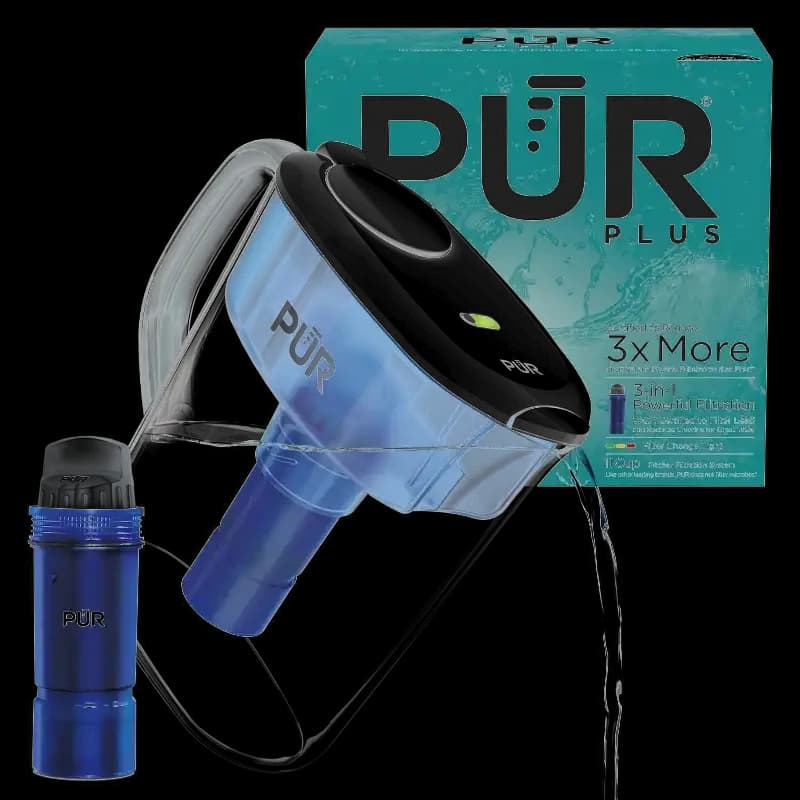
PUR PLUS 11-Cup Water Pitcher, CR1111WLCR
Key Features
A fridge-friendly pitcher built around PUR's core two-stage filtration activated carbon for taste and odor, plus ion exchange for lead reduction. Comes with a 6-month filter supply and a change-light indicator, making it a low-maintenance daily option for small to medium households.
Reasons to Buy
- WQA certified to reduce lead and other impurities
- Comes with 6 months of filters included
- Filter Change Light removes guesswork on replacement timing
- Dishwasher safe, easy to clean
- LockFit design prevents unfiltered water mixing in
Reasons Not to Buy
- 11-cup capacity may be tight for larger households
- Manual, gravity-fed slower than a faucet system
- No microplastics or PFAS certification like the faucet line
Specs at a Glance
| Brand | Purification Method | Material | Capacity | Installation Type |
|---|---|---|---|---|
| PUR | Activated Carbon | Plastic | 11 cups | Countertop |
For everyday tap water at home, the 11-Cup pitcher pairs activated carbon with ion exchange, since tap water needs both taste correction and metal reduction. Carbon handles chlorine taste and odor, while ion exchange targets lead and other harmful impurities. The filter lasts up to 40 gallons, about two months, and ships with a 6-month supply to start.
#2Best for On-Demand Filtration
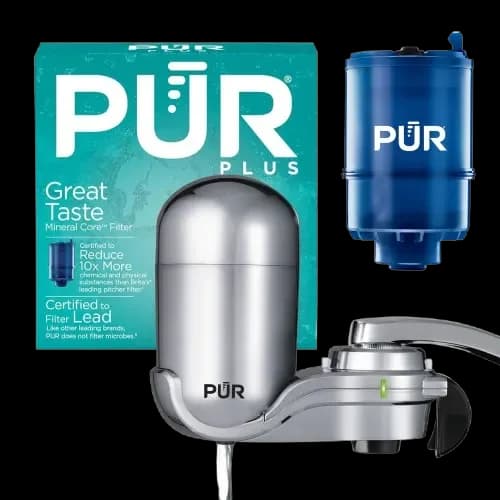
PUR PLUS Vertical Faucet Mount Water Filtration System, Chrome
$31.06
Key Features
this faucet-mounted system filters water the moment it leaves the tap using a 3-in-1 carbon and ion exchange cartridge. It's the only PUR format in this roundup certified for a full 70-contaminant reduction list, including lead, making it the strongest single-filter pick for anyone who wants filtered water on demand.
Reasons to Buy
- NSF/WQA certified to reduce 70 contaminants, including lead
- No storage needed filters instantly at the tap
- Tool-free install with on/off lever for filtered vs. unfiltered water
- Long-lasting: 100 gallons or 3 months per filter
Reasons Not to Buy
- Not compatible with pull-out, handheld, or sprayer faucets
- Pricier per-unit than a basic pitcher
- Requires a compatible external-aerator faucet
- Filter replacement is a separate ongoing cost
Specs at a Glance
| Brand | Purification Method | Material | Capacity | Installation Type |
|---|---|---|---|---|
| PUR | Activated Carbon, Ion Exchange | Multi | 100 gallons | Faucet Mount |
For instant filtered water without any storage step, the faucet system uses the same carbon-plus-ion-exchange combination as PUR's pitchers, but delivers it directly at the tap. Carbon reduces chlorine taste and odor, while ion exchange targets lead and other metals. The filter is rated for 100 gallons, about three months, and only fits faucets with a standard external aerator.
#3Best for Large Households
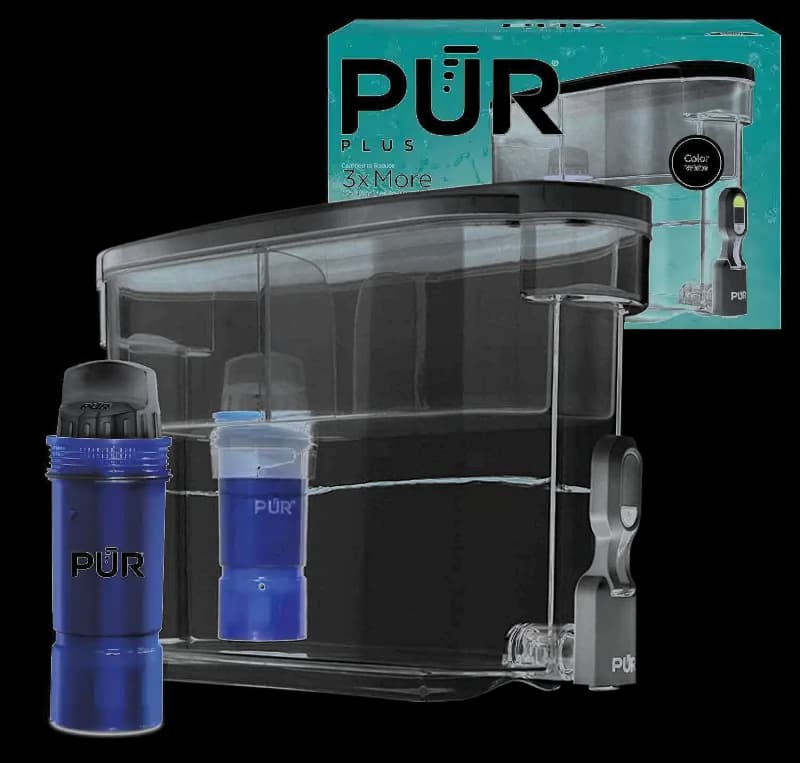
PUR PLUS 30-Cup Water Filter Dispenser, White
$39.99
Key Features
The step up from a pitcher for households that go through water fast same lead-reducing carbon and ion exchange filtration, just scaled to a 30-cup capacity with a space-saving slim design built to fit in a standard fridge door or shelf.
Reasons to Buy
- WQA certified to reduce lead and microplastics
- Large 30-cup capacity cuts down refill frequency
- Pull-down spout allows pouring while still filtering
- Change-light indicator for easy maintenance tracking
- Dishwasher safe and space-saving slim design
Reasons Not to Buy
- Larger footprint than a pitcher, needs more fridge space
- Same 2-month filter life despite higher volume use
- Freestanding design takes up more counter/fridge space
- No faucet or on-demand option still gravity-fed
Specs at a Glance
| Brand | Purification Method | Material | Capacity | Installation Type |
|---|---|---|---|---|
| PUR | Activated Carbon, Ion Exchange | Plastic | 1.88 gallons (30 cups) | Freestanding |
For medium to large households, the 30-Cup dispenser uses the same core carbon and ion exchange filtration as PUR's pitchers, just at higher volume. Carbon reduces chlorine taste and odor while ion exchange reduces lead and other metal contaminants. The filter lasts up to 40 gallons, about two months, matching PUR's standard pitcher and dispenser replacement schedule.
#4Best Value / Essential Restock
PUR PLUS Replacement Filter, 6-Month Supply, 3-Count (PPF951K3)
$18.39
Key Features
The genuine PUR Plus replacement cartridge that keeps every pitcher and dispenser in this lineup running at rated performance. A 3-pack covers roughly six months of use, and it's the single highest-rated, most-purchased product across the whole PUR range.
Reasons to Buy
- WQA certified to reduce lead and other substances
- NSF certified to reduce microplastics and chlorine
- LockFit design ensures a secure, no-mix seal
Reasons Not to Buy
- Replacement only needs an existing PUR pitcher/dispenser
- Per-filter cost adds up over a year of ownership
- Not compatible with PUR faucet mount systems (pitcher/dispenser only)
Specs at a Glance
| Brand | Purification Method | Material | Item Weight | External Testing Certification |
|---|---|---|---|---|
| PUR | Activated Carbon, Ion Exchange | Plastic | 531 g | NSF, WQA |
This is the replacement cartridge behind every PUR pitcher and dispenser in the lineup the same two-stage carbon and ion exchange filtration, sold separately for ongoing use. Carbon reduces chlorine taste and odor while ion exchange reduces lead and other metal contaminants. Each filter lasts up to 40 gallons, about two months, and the 3-pack covers roughly six months before the next restock.
What Types of PUR Water Filtration Systems Are Available?
PUR organizes its catalog around four product categories. Each one plays a different role in a household water routine.
PUR product categories:
Pitchers: Store a small volume of filtered water in the refrigerator
Dispensers: Store a larger volume of filtered water for multiple people
Faucet systems: Filter water on demand straight from the tap
Replacement filters: Keep pitchers, dispensers, and faucet systems working over time
A pitcher holds a modest volume and fits on a refrigerator shelf. Water is poured through the top and filters down by gravity. A dispenser works the same way but holds several gallons, so a larger household refills less often. A faucet system skips storage completely, since water filters the moment it leaves the tap.
What Sizes of PUR Pitchers and Dispensers Are Available?
PUR pitchers and dispensers come in different sizes to match household size.
PUR pitcher and dispenser sizes:
7 cup pitcher: Best for individuals or small households
11 cup pitcher: Best for small to medium households
30 cup dispenser: Best for medium to large households
44 cup dispenser (about 2.75 gallons): Best for large households or frequent entertaining
How Does PUR Filtration Technology Work?
PUR filtration relies on two core stages present in every filter, plus a third stage found only in PUR PLUS products.
How water moves through a PUR filter:
Water passes first through activated carbon, which traps chemical contaminants through adsorption
Water then passes through ion exchange material, which swaps harmful metal ions for less reactive ones
In PUR PLUS filters, water passes over a Mineral Core stage, which adds natural minerals for taste
Activated carbon is the reason PUR filters reduce chlorine taste and odor, along with certain organic chemicals. Ion exchange targets dissolved metals such as lead and mercury that carbon alone handles less effectively. Mineral Core is a taste feature, not a contaminant reduction feature, since PUR positions it purely for a crisper drinking result.
Which Contaminants Do PUR Filters Reduce?
Contaminant coverage differs across the PUR range, and no single filter reduces every contaminant on the list.
The table below shows how contaminant coverage differs across PUR filter types.
Filter Type | Lead | Chlorine Taste and Odor | Microplastics | Mercury and Select Metals |
Basic pitcher and dispenser filter | Not certified | Certified | Not certified | Certified |
PUR PLUS pitcher filter | Not standard | Certified | Certified | Certified |
Faucet filter, standard and PLUS | Certified | Certified | Certified in select models | Certified |
Lead reduction is a certified feature of PUR faucet filters, not a claim across the full pitcher and dispenser range. PUR faucet filters, in both standard and PLUS versions, are certified by NSF and WQA to reduce 70 contaminants including lead. Among pitcher filters, only the PUR PLUS Lead Reducing line carries a lead certification. Basic PUR pitcher filters do not carry this claim.
What Do PUR Filters Not Remove?
Some contaminants sit outside what activated carbon and ion exchange were built to handle.
Contaminants PUR filters do not remove:
Bacteria, viruses, and other microbes
Fluoride, since fluoride ions are too small for carbon or ion exchange to capture
Mold and fungi, which are not a certified claim on PUR pitcher filters
Anyone concerned about microbiological safety or fluoride levels needs a different filtration technology entirely, since PUR's design was never built for those specific contaminants.
How Are PUR Filters Certified for Contaminant Reduction?
PUR filters are certified by NSF and WQA, two independent organizations that test filters against published standards. A certification links three things together, the certifying body, the specific filter model, and the exact contaminant claim being tested.
What each NSF standard covers:
NSF/ANSI 42: Covers taste and odor improvements such as chlorine reduction
NSF/ANSI 53: Covers health related contaminants, including lead on models specifically certified for it
NSF/ANSI 401: Covers emerging or trace contaminants, including certain pharmaceuticals
A filter certified for one contaminant under a standard is not automatically certified for every other claim under that same standard. Checking the exact model number on a current performance data sheet is the most reliable way to confirm what a specific filter covers.
How Long Do PUR Filters Last Before Replacement?
Filter life differs by product type, and mixing up the two schedules is a common ownership mistake.
PUR filter replacement schedule:
Pitcher and dispenser filter: Replace every 2 months, up to 40 gallons
Faucet filter, standard and PLUS: Replace every 3 months, up to 100 gallons
Many PUR pitchers, dispensers, and faucet systems include a filter change light that turns red when a replacement is due. If a system does not have a light, following the two month or three month schedule keeps the filter within its rated performance window.
How Should a PUR Filter Be Installed Before First Use?
Every PUR filter needs a short preparation step before its first use, and the process depends on the product type.
Steps to prepare and install a PUR filter:
Rinse or soak the new pitcher or dispenser filter as instructed for its specific model
Hand wash the pitcher or dispenser body, lid, and pour tray with mild soapy water, then rinse well
Insert the filter into the tray and push down until it locks into place
For a faucet system, remove the existing aerator from the faucet first
Attach the faucet system directly, or use one of the three included adapters if it does not fit
Run cold water through a new faucet filter briefly to flush out initial carbon residue
A PUR PLUS pitcher filter should be soaked in cold water for 15 minutes before installation. A basic PUR pitcher filter usually needs only a brief rinse.
Which Faucets Work With a PUR Faucet System?
PUR faucet systems are built for standard faucets with an external or internal threaded aerator, and each system ships with three adapters to widen compatibility.
Faucet compatibility:
Standard faucet with external threading: Compatible
Standard faucet with internal threading: Compatible using an included adapter
Pull out sprayer faucet: Not compatible
Handheld sprayer faucet: Not compatible
Pull out and handheld faucets, where the sprayer head detaches from the base, cannot accept the mounting hardware a PUR system relies on. This is a firm compatibility limit, not a minor inconvenience.
What Operating Conditions Should PUR Filters Be Used Under?
PUR filters are built for cold tap water only. Running hot water through a filter can damage its internal materials, and PUR advises against water above 82 degrees Fahrenheit, or 28 degrees Celsius. PUR systems should not be used with water that is microbiologically unsafe or of unknown quality, unless the water has been properly disinfected, since PUR filters do not filter microbes.
Quick Answers to Common PUR Questions
Does PUR remove lead from drinking water? PUR faucet filters, both standard and PLUS, are certified by NSF and WQA to reduce lead as part of a 70 contaminant certification. Among pitchers, only the PUR PLUS Lead Reducing line carries this certification.
Does PUR remove PFAS from water? Some current PUR PLUS faucet filter listings are certified to reduce total PFAS alongside lead, tested under applicable NSF and ANSI standards. Checking the current performance data sheet for the exact model is the safest way to confirm this claim.
Does PUR remove fluoride from water? No. PUR filters do not remove fluoride, and no current PUR filter is certified for this claim. Fluoride is a small, dissolved ion that activated carbon and ion exchange are not designed to capture.
Can you use generic replacement filters in a PUR system? A generic filter may physically fit a PUR system, but PUR filters are the only ones certified and tested to the stated reduction claims. A third party cartridge is not guaranteed to deliver the same water quality even if it fits the housing.
Why is a PUR water filter running slowly? Slow flow usually points to filter age, trapped air, or sediment clogging. Removing the filter and shaking it can restore flow if trapped air is the cause. If flow stays slow, the filter has likely reached the end of its rated capacity.
Share