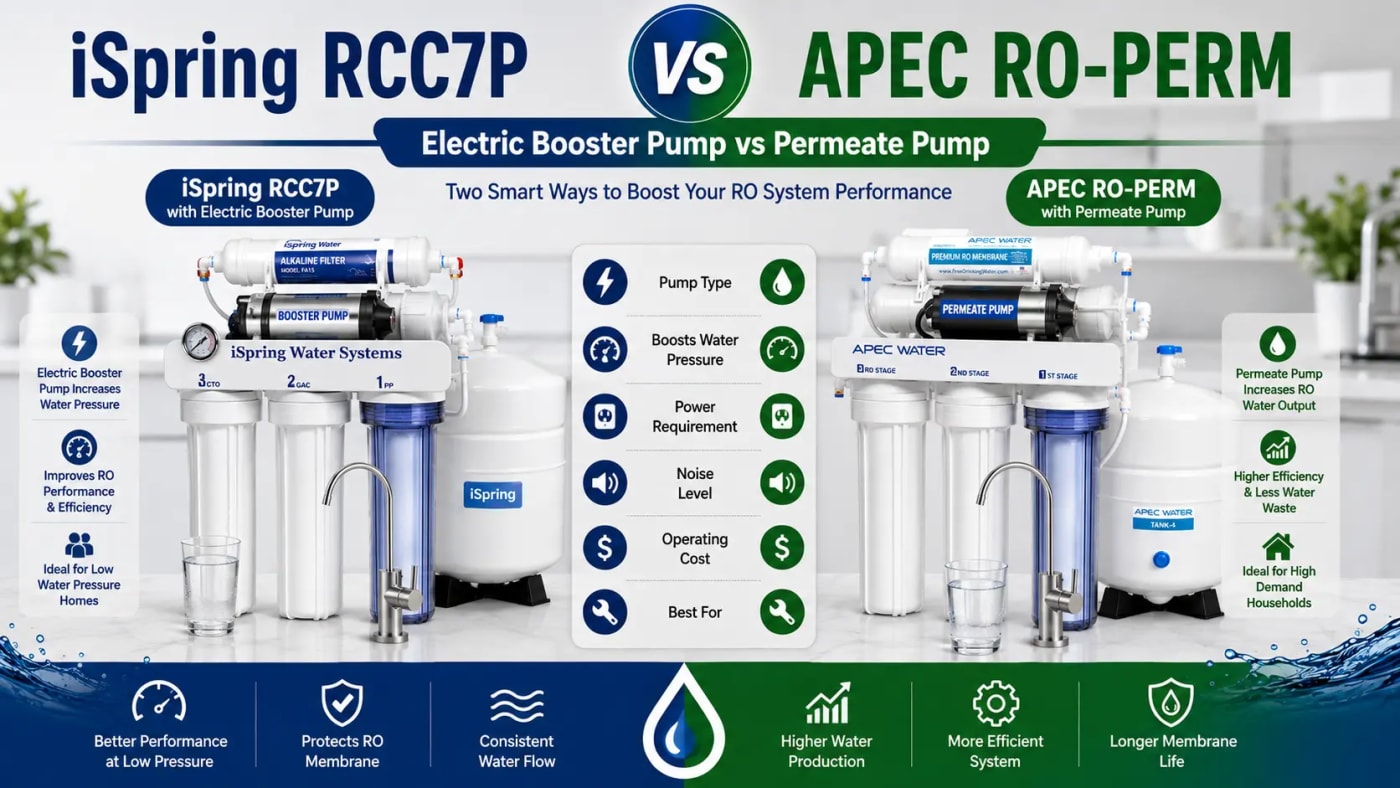
The sections below explain each attribute in detail, one at a time.
How do the RCC7P and RO-PERM use different pump technologies to handle low water pressure?
Reverse osmosis needs enough feed pressure to push water through the RO membrane. When feed pressure is too low, the membrane produces less filtered water and more reject water. Both the RCC7P and RO-PERM address this problem, but they solve it in different ways.The RCC7P uses an electric booster pump. This pump sits inline before the RO membrane and raises the incoming water pressure directly. It needs a power outlet to run. The pump works continuously to keep pressure at the membrane high enough for steady production.
The RO-PERM uses a non-electric permeate pump instead. This pump does not raise the feed pressure at the membrane. It uses the energy of the outgoing reject water to help move filtered water into the storage tank faster. It also reduces the backpressure that builds up inside the tank as the tank fills. This backpressure is one of the main reasons RO production slows down over time.
Key terms to understand before comparing further:
Feed pressure: the water pressure entering the RO system from the home supply line.
RO membrane: the filter layer that separates clean water from contaminants.
Permeate: the clean, filtered water that passes through the membrane.
Reject water: also called brine or waste water, this is the water that carries away contaminants and exits through the drain line.
Storage tank backpressure: pressure that builds inside the storage tank as it fills, which slows further production.
In short, the RCC7P pushes more pressure into the system. The RO-PERM removes a barrier that normally holds production back. Both aim for the same result through different mechanics.
How does each RO system perform across 30, 40, 50, and 60 PSI feed water conditions?
Feed pressure is the single biggest factor in RO performance. A system rated for high output at 60 PSI will not produce the same amount of water at 30 PSI. Manufacturer data for both systems confirms this.APEC states that RO-PERM works across a 30 to 85 PSI range, and the company markets it specifically for homes in the 30 to 50 PSI range. iSpring states that the RCC7P booster pump becomes especially important once feed pressure drops below 40 PSI.
This table shows how feed pressure affects each system based on available manufacturer data.
Feed Pressure | RCC7P Behavior | RO-PERM Behavior |
30 PSI | Booster pump activates to raise pressure at the membrane | Rated output drops to 45 GPD |
40 PSI | Booster pump remains active, described by iSpring as the threshold point | Operates within its stated 30 to 50 PSI target range |
50 PSI | Booster pump may run less often depending on home plumbing | Upper edge of APEC's recommended range |
60 PSI | Normal RO operation with booster support as needed | Rated output reaches 90 GPD |
Homes with feed pressure consistently under 40 PSI tend to see the clearest benefit from a booster pump. Homes closer to the 50 to 60 PSI range give the permeate pump more room to work as intended.
How do the RCC7P and RO-PERM compare in rated RO water production and tank refill speed?
GPD stands for gallons per day. It measures how much filtered water an RO membrane can produce under specific test conditions, not the actual flow rate at the faucet. This distinction matters because GPD numbers from different brands are only comparable when the test pressure is the same.iSpring rates the RCC7P at 75 GPD. APEC rates the RO-PERM at 90 GPD at 60 PSI and 45 GPD at 30 PSI. APEC also states that the permeate pump fills the storage tank 2 to 3 times faster than a standard non pumped system.
The faucet flow rate a person actually feels depends on tank pressure, tubing size, and how full the tank already is, not on the GPD rating alone. A higher GPD number means the membrane can refill the tank faster after use. It does not mean water comes out of the faucet at that rate continuously.
How does the RO-PERM permeate pump change wastewater and storage tank efficiency compared with the RCC7P?
Every RO system produces reject water alongside filtered water. The ratio between the two is a key efficiency measure for buyers who want to reduce water waste, especially on well systems connected to a septic tank.APEC states that RO-PERM conserves up to 80 percent more water compared with a standard, non-pumped RO system. iSpring states that the RCC7P currently reaches up to a 1.5 to 1 ratio of filtered water to wastewater.
These two figures use different baselines and different test methods. APEC compares RO-PERM against a standard non pumped system. iSpring states its own filtered to waste ratio directly. Because the baselines differ, these numbers should not be read as a direct head to head score. A 1.5 to 1 ratio means 1.5 parts filtered water for every 1 part wastewater. A higher first number in this ratio always means less water is wasted.The permeate pump in the RO-PERM reduces back pressure in the tank, which naturally reduces reject water output as the tank fills. The RCC7P relies on its booster pump to maintain steady membrane pressure, which supports its own stated ratio.
How do the RCC7P and RO-PERM differ in electricity use, pump noise, and under sink requirements?
This attribute affects where each system can be installed and what it needs from the space under the sink.The RCC7P requires electrical power for its booster pump. iSpring confirms this in its product specifications. A nearby outlet is needed, and the pump runs on a low voltage transformer.The RO-PERM uses a non-electric pump. APEC confirms the pump runs on hydraulic energy from the system itself, with no outlet needed. This makes it a simpler option for cabinets without power access.
Retailer and community reports, not manufacturer specifications, mention that permeate pumps can make a repeated clicking sound during operation. This sound comes from the pump's internal valve cycling as it moves water. It is a normal part of how the pump works, though some users notice it more than others depending on cabinet size and how sound travels in the kitchen.
This table shows the practical difference in setup requirements.
Requirement | RCC7P | RO-PERM |
Electrical outlet needed | Yes | No |
Pump sound | Quiet electric motor hum | Clicking sound during valve cycles, per user reports |
Cabinet flexibility | Limited by outlet location | Not limited by outlet location |
How do the RCC7P and RO-PERM compare in 5 stage RO filtration and membrane configuration?
Both systems use 5 stages of filtration, but the filters at each stage are not identical.
This table shows the stage by stage configuration for each system.
Stage | RCC7P | RO-PERM |
1 | PP sediment filter | Sediment filter |
2 | GAC and KDF filter | Carbon block filter |
3 | CTO carbon block filter | Carbon block filter |
4 | RO membrane | FilmTec TFC RO membrane |
5 | Final inline GAC filter | Coconut shell post carbon filter |
The RCC7P combines GAC and KDF media in its second stage, which iSpring states gives added protection against chemical contaminants beyond a single carbon block. The RO-PERM uses two dedicated carbon block stages before the membrane, plus a coconut shell carbon filter after it for taste polishing. Both designs follow the same 5 stage principle, sediment removal, carbon filtration, membrane separation, and taste finishing, but the order and material choices differ.
Which contaminants do the RCC7P and RO-PERM claim to reduce, and how should those claims be interpreted?
Both manufacturers publish contaminant reduction claims for their systems. These claims describe what the system is designed to remove under normal conditions, not a guarantee for every water source.iSpring states the RCC7P reduces up to 99 percent of over 1,000 contaminants, including lead, chlorine, fluoride, arsenic, and PFAS. APEC lists a similar up to 99 percent reduction claim for RO-PERM, covering chlorine, taste and odor issues, VOCs, fluoride, arsenic, lead, nitrates, and heavy metals.
A longer contaminant list does not automatically mean stronger performance. Actual contaminant reduction depends on the membrane used, the condition of the feed water, and whether the specific claim has been tested and certified by an independent body such as NSF or WQA. Buyers concerned about a specific contaminant, such as arsenic or PFAS, should check for a certification that names that exact contaminant rather than relying on the general percentage claim alone.
How do the RCC7P and RO-PERM compare for well water and private well pressure conditions?
Well water systems often have pressure that changes throughout the day depending on pump cycles and household demand. This variability is one of the main reasons buyers with well water look at pumped RO systems in the first place.APEC positions RO-PERM specifically around the 30 to 50 PSI range common in many well systems. iSpring positions the RCC7P booster pump as most useful once pressure drops below 40 PSI, which also overlaps with typical well pressure ranges.
Neither system solves every well water problem on its own. Wells with high iron, sulfur smell, or heavy sediment usually need a separate pretreatment step before the RO system, regardless of which pump technology is chosen. Well owners on a septic system should also measure how much reject water their chosen system sends to the drain, since this water enters the septic tank along with regular household wastewater.
Testing actual feed pressure at the kitchen sink before buying is the most reliable way to match either system to a specific well.
How do the RCC7P and RO-PERM compare for installation, fittings, storage tanks, and refrigerator connections?
Both systems fit under a standard kitchen sink cabinet and include a dedicated faucet, storage tank, and connection kit.
What is included with each system:
RCC7P: dedicated faucet, storage tank, push to connect fittings, color coded tubing, and a full installation kit.
RO-PERM: dedicated designer faucet, 4 gallon storage tank, John Guest quick connect fittings, color coded tubing, and a full installation kit.
Both brands use quick connect style fittings, which allow tubing to be inserted without special tools. This makes both systems accessible for a typical do it yourself installation. Either system can also be connected to a refrigerator or ice maker line using standard splitter kits sold separately by most RO accessory suppliers. Available cabinet space should be checked first, since the storage tank and filter housings both need floor or wall space under the sink.
How do replacement filters, RO membranes, and maintenance differ between the RCC7P and RO-PERM?
Ongoing filter changes are a normal part of owning any RO system. The schedule and cost depend on the filter set each brand sells.iSpring sells replacement cartridge sets for the RCC7P, with pre filters and post filters typically replaced every 6 to 12 months and the RO membrane replaced roughly every 2 years. APEC sells a dedicated RO-PERM and RO-90 compatible filter set, following a similar general replacement pattern for pre filters, carbon blocks, and the membrane.
What routine maintenance looks like for both systems:
Check and replace sediment and carbon pre filters on the schedule stated in the owner's manual.
Replace the RO membrane based on usage and water quality, not on a fixed calendar alone.
Watch for slower tank fill times, which often signal a filter or pump nearing the end of its service life.
Keep the permeate pump or booster pump area accessible for occasional inspection.
Exact annual filter cost depends on current retail pricing from each brand, which changes over time. Buyers should check the current filter set price on the manufacturer's own product page before comparing long term cost between the two systems.
Which ownership factors matter most when choosing between the RCC7P and RO-PERM?
The decision between these two systems comes down to a small number of factors already covered above. This section brings them together without introducing anything new.
This table shows how each factor points toward one system or the other, based on the household condition it fits best.
Factor | Favors RCC7P | Favors RO-PERM |
No outlet available under sink | No | Yes |
Feed pressure often below 40 PSI | Yes | Neutral |
Feed pressure mostly in 30 to 50 PSI range | Neutral | Yes |
Priority on lowest possible water waste | Neutral | Yes, per APEC's conservation claim |
Preference for a fully electric, motor driven pump | Yes | No |
Sensitivity to a repeated clicking sound | Yes | No |
Neither system is the better choice in every home. The right pick depends on measured feed pressure, outlet access under the sink, and how much a household values water conservation versus a fully powered pump.
What does your water pressure and household setup indicate before choosing between these two pumped RO filters?
Before choosing between the RCC7P and RO-PERM, three inputs need to be confirmed. These inputs determine which parts of the comparison above matter most for a specific home.
Three inputs to confirm before buying:
Measured feed pressure: the actual PSI reading at the kitchen cold water line, not an estimate.
Water source: municipal supply or private well, since well water often has more pressure variation.
Household usage: how many people use the system daily, which affects how much tank refill speed matters.
Once these three inputs are known, the comparison sections above can be applied directly. Low measured pressure combined with no outlet access points toward the permeate pump design. Low pressure combined with available outlet space keeps the booster pump design on the table as well.
What water pressure should a reverse osmosis system have for your home?
RO systems perform best within a manufacturer specified pressure range. Measuring household pressure before buying prevents a mismatch between the system and the home supply. Normal residential pressure usually falls between 40 and 80 PSI, while anything consistently below 40 PSI is considered low pressure for RO purposes. For full PSI testing steps and troubleshooting, see the dedicated guide on water pressure for RO systems.
How does a reverse osmosis permeate pump reduce water waste?
A permeate pump uses the energy in the outgoing reject water to help push filtered water into the storage tank. This reduces the backpressure that normally slows production as the tank fills, which lowers the amount of reject water needed for the same amount of filtered water. For a full explanation of how permeate pumps work across different RO brands, see the dedicated guide on reverse osmosis permeate pumps.
How much water does a reverse osmosis system waste per gallon of purified water?
RO water waste is usually expressed as a ratio, such as 1 to 1 or 3 to 1, showing wastewater compared with filtered water. Actual wastewater amount changes based on system design, feed pressure, and membrane age. For full ratio calculations and system comparisons, see the dedicated guide on RO water waste ratio.
How does a reverse osmosis booster pump improve low pressure filtration?
A booster pump raises feed pressure directly at the RO membrane using an electric motor. Higher pressure at the membrane improves both production speed and contaminant rejection rate. For a full breakdown of booster pump types and when they are needed, see the dedicated guide on RO booster pumps.
How should you test your tap water before choosing a reverse osmosis filter?
Feed pressure and water quality are two separate measurements. Pressure affects how fast an RO system produces water. Water quality, including TDS level and specific contaminants present, affects which filter stages and certifications actually matter for a household. For full testing steps, see the dedicated guide on water testing for RO systems.