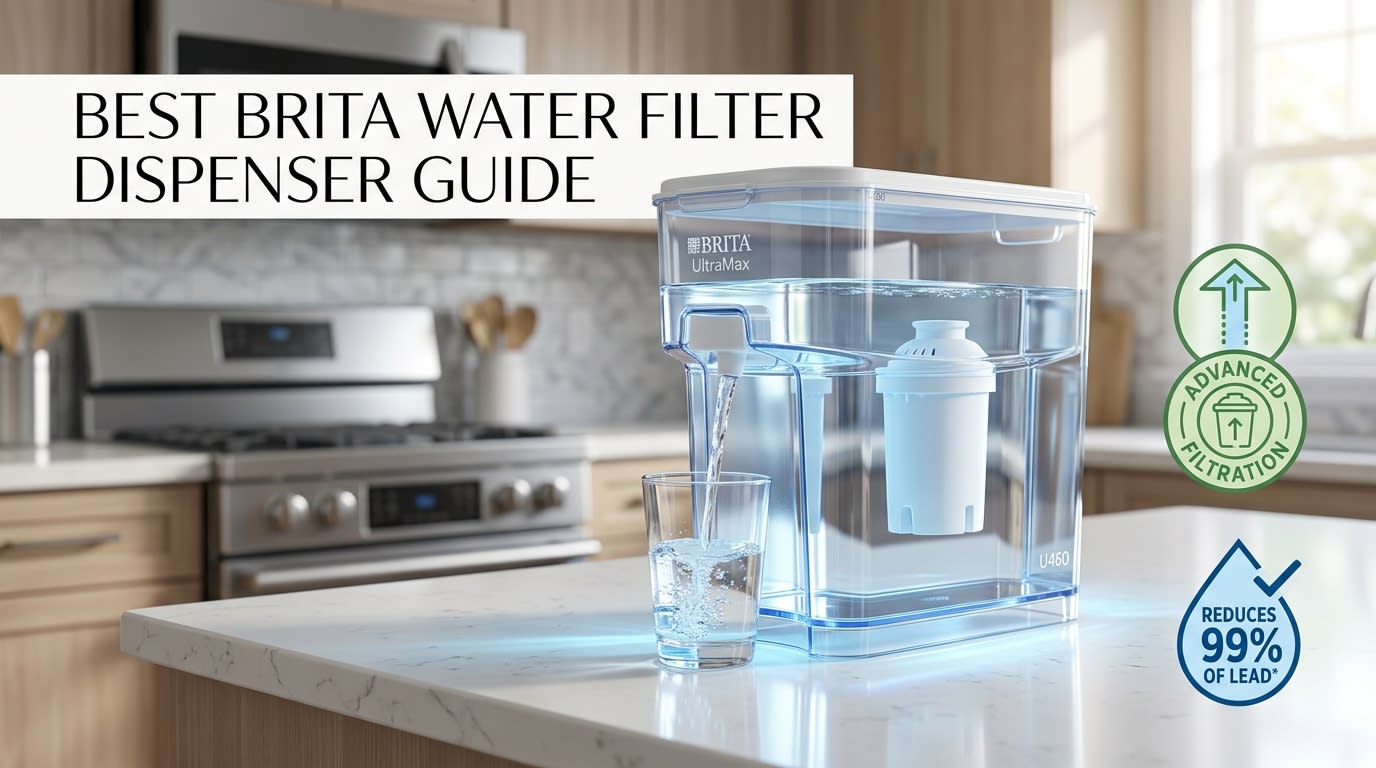
Choosing the best Brita water filter dispenser is about more than choosing the largest reservoir. The right model depends on how much filtered water your household uses, how much refrigerator space you have, which filter it uses, how often the filter needs to be replaced, and which contaminants the specific cartridge is designed to reduce.
Brita offers several dispenser configurations, including larger UltraMax models and smaller-capacity options. The main differences to consider are capacity, filter configuration, replacement interval, dimensions, and the filter's documented performance claims.
This guide compares the main Brita dispenser options and explains what to look for before buying so you can choose a model that fits your household and daily water use.
Quick Comparison: Brita Water Filter Dispensers
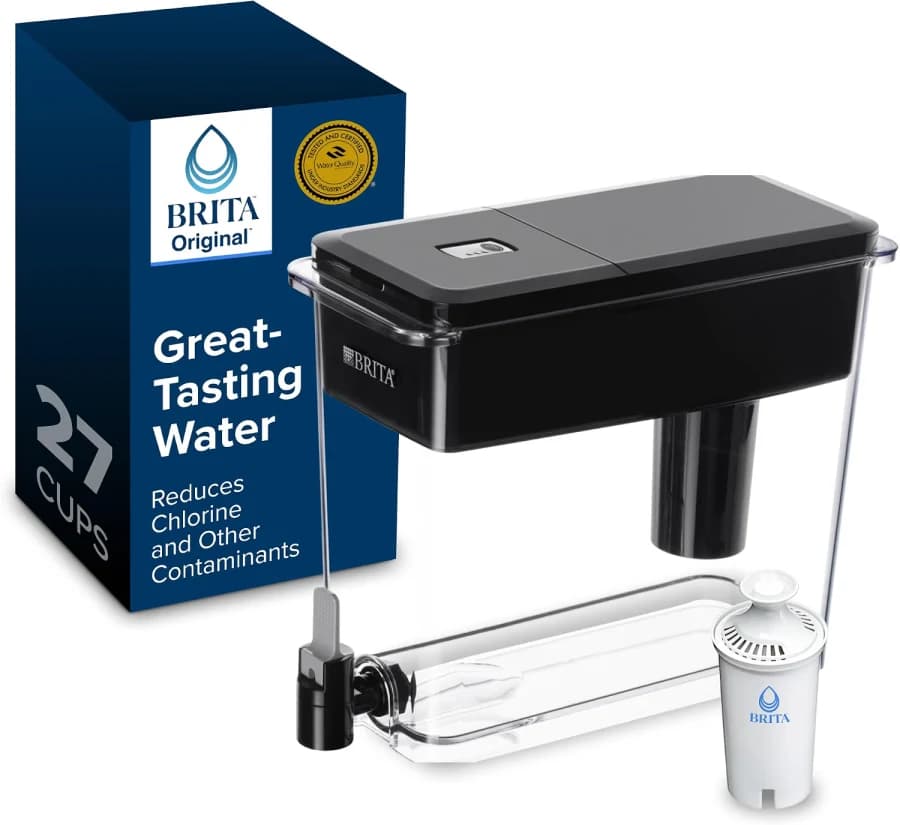
Brita UltraMax 27-Cup + Standard Filter
$44
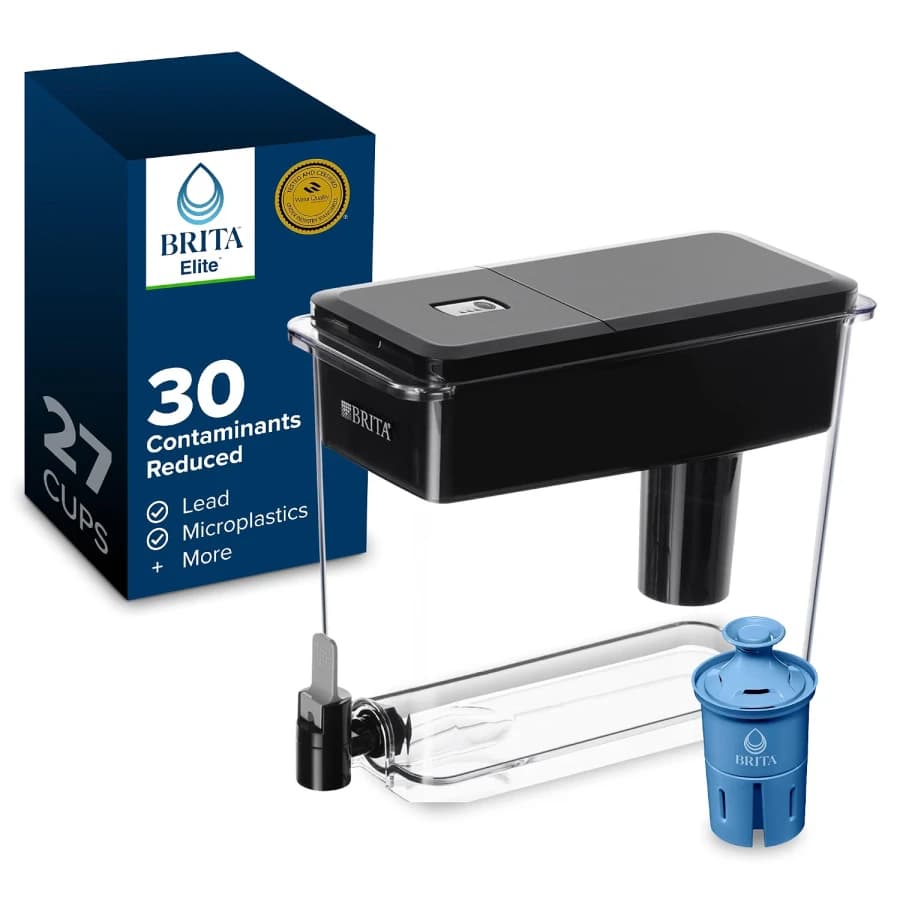
Brita UltraMax 27-Cup + Elite Filter
$32
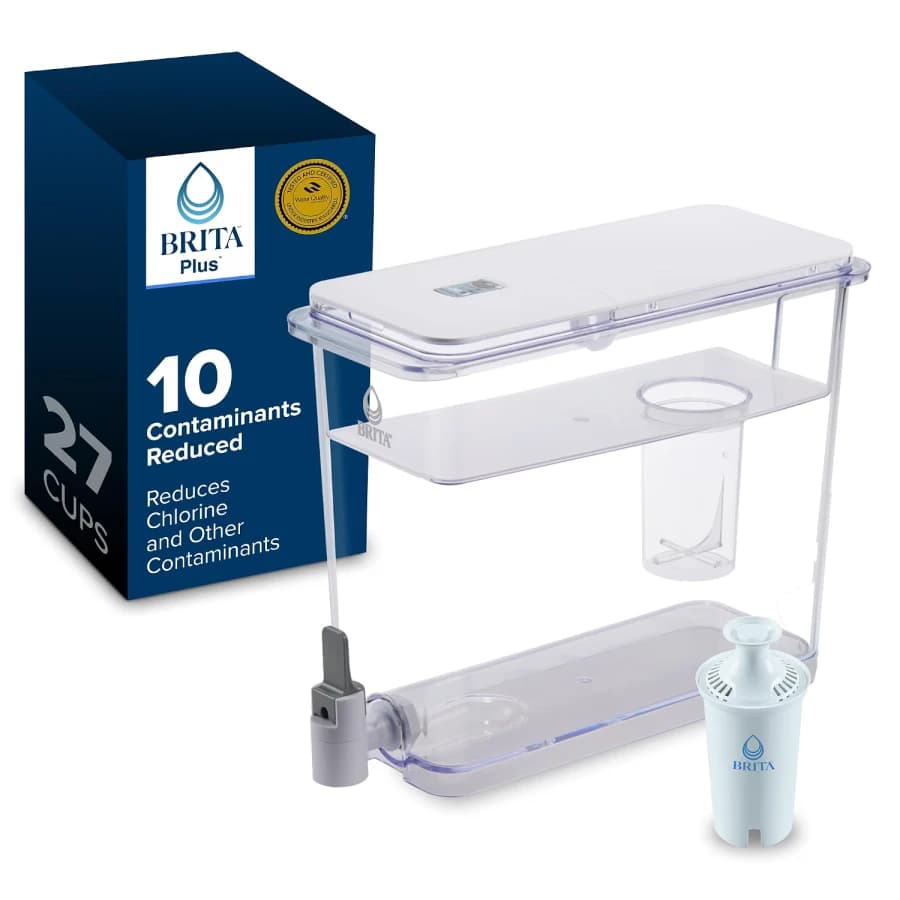
Brita UltraMax 27-Cup + BritaPlus Filter
$44
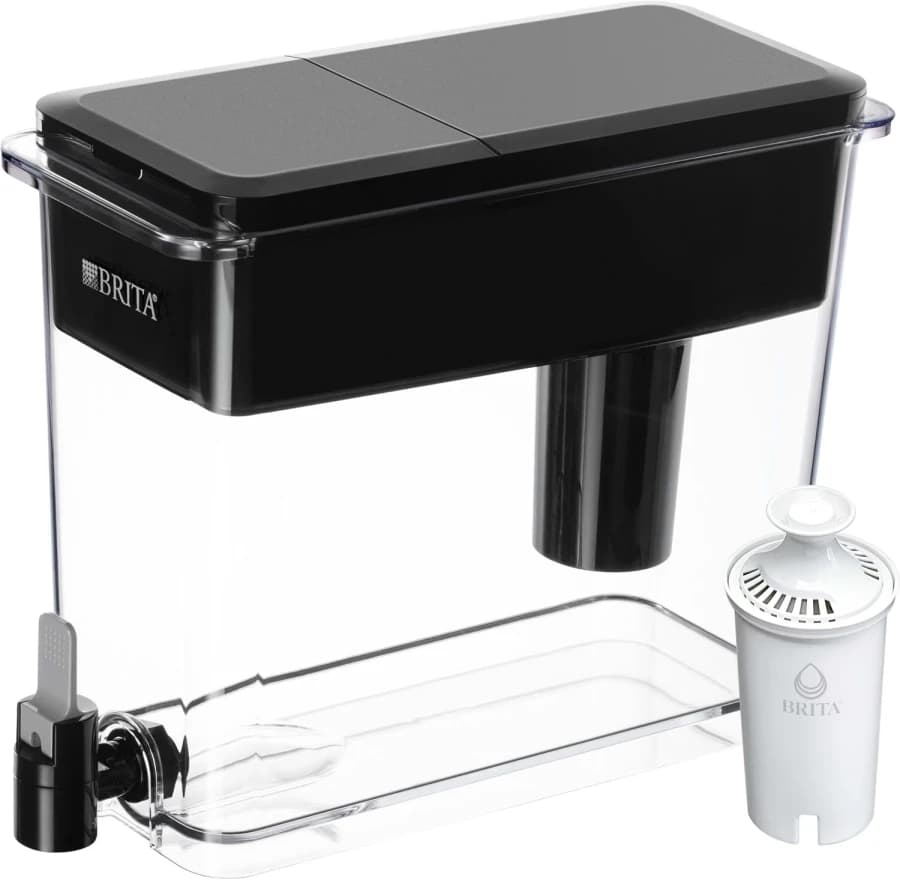
Brita UltraMax 18-Cup
$36
Capacity | Filter | Approx. Filter Life* | Best For | Main Consideration |
27 cups / about 2 gallons | Standard | About 40 gallons / 2 months | Households that need more filtered water | More frequent filter replacement |
27 cups / about 2 gallons | Elite | Up to 120 gallons / 6 months | Users who want longer filter intervals | Higher replacement-filter cost |
27 cups / about 2 gallons | BritaPlus | About 60 gallons, depending on use | Users comparing filter configurations | Verify current compatibility and performance |
18 cups / about 1.13 gallons | Depends on configuration | Depends on filter | Smaller households and tighter spaces | Lower capacity than 27-cup models |
*Filter life depends on the specific cartridge, water conditions, and household usage. Always check the current product and filter documentation before purchasing.
What Is a Brita Water Filter Dispenser?
A Brita water filter dispenser is a larger-capacity filtration system designed to hold filtered water for everyday use. Instead of filtering a small batch at a time like a traditional pitcher, a dispenser provides a larger reservoir that can reduce the number of refills needed throughout the day.
Brita filters commonly use activated carbon and ion-exchange media. Activated carbon can help reduce substances that affect taste and odor, while ion exchange can target certain metals. However, filtration performance varies by cartridge, so you should check the documented claims for the exact filter rather than assuming every Brita filter performs the same way.
The larger capacity can be useful for households that drink several glasses of filtered water each day, fill reusable bottles frequently, or want filtered water available for everyday cooking and drinking.
Why Choose a Dispenser Instead of a Pitcher?
A dispenser is mainly useful when you need more filtered water between refills.
A dispenser may be a better fit if:
Several people use filtered water: A larger reservoir provides more water between refills.
You fill bottles frequently: Having more filtered water ready can make daily use easier.
You want fewer refills: Larger-capacity models reduce refill frequency.
You have enough refrigerator space: Dispensers generally require more room than pitchers.
You prefer a simple setup: These systems do not require plumbing or electricity.
A pitcher may be better if:
You have limited refrigerator space.
One person or a small household uses filtered water.
You prefer something smaller and easier to move.
You do not need a large supply of filtered water at once.
The better choice therefore depends on your daily water consumption and available storage space, not simply on which product has the largest capacity.
What to Look for in a Brita Water Filter Dispenser
Before buying, focus on six practical factors: filter type, filter life, capacity, dimensions, compatibility, and documented filtration claims.
1. Filter Type and Filtration Media
The filter cartridge is more important than the dispenser's exterior design because it determines the filtration characteristics of the system.
Brita filters use filtration media such as activated carbon and ion-exchange material. These technologies can target different substances, so two dispensers with the same reservoir capacity may provide different filtration characteristics if they use different cartridges.
If your main concern is chlorine taste and odor, look at the filter's documented taste-and-odor reduction claims. If you are concerned about a specific contaminant such as lead, check whether the exact cartridge has a certification or published performance claim covering it.
Do not assume that every Brita filter removes every contaminant.
2. Filter Life and Replacement
Filter replacement is an important part of the total cost of ownership.
The product information used for this guide identifies approximately:
Standard-style filters: about 40 gallons or two months under stated usage assumptions.
Elite filter: up to 120 gallons or six months under stated usage assumptions.
BritaPlus configuration: about 60 gallons, depending on use.
Your actual replacement schedule can differ because household water consumption and water conditions vary.
For example, a household that uses a large amount of filtered water can reach a filter's gallon capacity sooner than a household with lighter use.
When comparing dispensers, consider both the filter's rated capacity and the cost and availability of replacement cartridges.
3. Capacity
Capacity determines how much filtered water the dispenser can store.
The UltraMax configurations discussed in this guide include:
18-cup capacity: approximately 1.13 gallons.
27-cup capacity: approximately 2 gallons.
A 27-cup dispenser can reduce the number of refills for a larger household, while an 18-cup model may be easier to fit into a smaller refrigerator.
4. Refrigerator Dimensions
Capacity is only useful if the dispenser fits where you plan to use it.
Before buying, measure:
Refrigerator shelf height
Available width
Available depth
Clearance needed to fill the reservoir
Space needed to remove or replace the filter
A larger dispenser may hold more water but become inconvenient if you have to move it every time you refill it.
5. Filter Compatibility
Do not assume that every Brita cartridge works with every dispenser configuration.
Check:
Your dispenser model
The filter supplied with the product
Compatible replacement cartridges
The manufacturer's current compatibility information
This is especially important when a retailer bundles a dispenser with a third-party or generic replacement filter.
6. Certifications and Contaminant Claims
Certification information can be more useful than a generic statement that a filter "removes impurities."
The product information reviewed for this guide references standards including NSF/ANSI 42 and NSF/ANSI 53. These standards cover specific areas of filtration performance and should not be interpreted as proof that a filter removes every possible contaminant.
If you have a specific water-quality concern, identify the contaminant first and then check the exact cartridge's certification and published reduction claims.
Best Brita Water Filter Dispenser Options
1. Brita UltraMax 27-Cup Dispenser with Standard Filter
The Brita UltraMax 27-Cup Dispenser with Standard Filter is designed for households that want a larger supply of filtered water without frequent refilling.
The configuration discussed in the source product information has a 27-cup capacity, approximately 2 gallons, and uses a Standard Brita filter.
Key Specifications
Feature | Details |
|---|---|
Brand | Brita |
Model | UltraMax 27-Cup Dispenser |
Capacity | 27 cups / approximately 2 gallons |
Filter | Standard Brita filter |
Filtration media | Activated carbon + ion exchange |
Filter life | Approximately 40 gallons / 2 months under stated usage |
Dimensions | Approximately 14" L × 9" W × 17" H |
Who Is It Best For?
This configuration is most relevant to households that prioritize reservoir capacity and want a straightforward filtration setup.
The main advantage is the large water supply. The main tradeoff is the shorter replacement interval compared with the Elite configuration.
Pros
Large 27-cup capacity
Fewer refills than a smaller dispenser
Simple gravity-fed design
Suitable for higher daily water use
Considerations
Requires more refrigerator space
Standard filter requires more frequent replacement than Elite
Filter claims should be checked against the exact current cartridge
2. Brita UltraMax 27-Cup Dispenser with Elite Filter
The Elite configuration combines the 27-cup UltraMax reservoir with Brita's longer-life Elite filter.
The product information used for this guide identifies the Elite filter with a capacity of up to approximately 120 gallons or six months under stated usage conditions.
Brita's published information also identifies specific contaminant-reduction claims for the Elite filter, including a 99% lead reduction claim under its stated testing conditions.
Key Specifications
Feature | Details |
|---|---|
Brand | Brita |
Model | UltraMax 27-Cup Dispenser |
Capacity | 27 cups / approximately 2 gallons |
Filter | Brita Elite |
Filtration media | Activated carbon + ion exchange |
Filter life | Up to approximately 120 gallons / 6 months |
Dimensions | Approximately 14" L × 9" W × 17" H |
Who Is It Best For?
The Elite configuration is relevant for households that want a large dispenser while changing filters less frequently.
The tradeoff is the higher cost of Elite replacement filters compared with standard-style cartridges.
Pros
27-cup capacity
Longer filter life
Specific contaminant-reduction claims documented for the Elite cartridge
Fewer cartridge changes under the stated usage conditions
Considerations
Replacement filters can cost more
Larger footprint requires adequate refrigerator space
Always verify current filter claims and compatibility
3. Brita UltraMax 27-Cup Dispenser with BritaPlus Filter
The BritaPlus configuration provides another 27-cup UltraMax option for shoppers comparing different filter packages.
The source product information identifies approximately 60 gallons of filter life depending on usage.
Because product configurations and filter availability can change, verify the current retailer listing and manufacturer's compatibility information before purchasing.
Key Specifications
Feature | Details |
|---|---|
Capacity | 27 cups / approximately 2 gallons |
Filter | BritaPlus |
Filtration media | Carbon + ion exchange |
Stated filter life | About 60 gallons, depending on use |
Main advantage | Large reservoir with an alternative filter configuration |
Who Is It Best For?
This configuration is mainly relevant to shoppers comparing filter options within the same 27-cup UltraMax format.
The filter itself should be the main comparison point because the reservoir capacity remains similar to the other 27-cup UltraMax configurations.
Pros
Large 27-cup reservoir
Alternative filter configuration
Longer stated filter capacity than the standard-style option
Considerations
Verify current filter availability
Check the exact contaminant claims for the current cartridge
Replacement-filter cost should be included in the buying decision
4. Brita UltraMax 18-Cup Dispenser
The Brita UltraMax 18-Cup Dispenser is a smaller-capacity option for households that do not need the larger 27-cup reservoir.
The source product information identifies an 18-cup capacity, approximately 1.13 gallons, making it a potentially more practical choice where refrigerator space is limited.
Key Specifications
Feature | Details |
|---|---|
Capacity | 18 cups / approximately 1.13 gallons |
Filter configuration | Verify current product listing |
Dimensions in source product information | Approximately 10.47" H × 5.67" W × 14.37" D |
Main advantage | Smaller capacity and potentially easier refrigerator storage |
Who Is It Best For?
An 18-cup dispenser may make more sense for:
Individuals
Couples
Smaller households
Apartments with limited refrigerator space
Users who do not need a two-gallon reservoir
The tradeoff is that you may need to refill it more frequently than a 27-cup model.
18-Cup vs. 27-Cup: Which Size Should You Choose?
The decision is mainly about daily water use and available refrigerator space.
18-Cup | 27-Cup |
|---|---|
Approximately 1.13 gallons | Approximately 2 gallons |
More compact | Larger footprint |
Better for lower daily use | Better for higher daily use |
More frequent refills | Fewer refills |
Easier to fit in tighter spaces | Requires more refrigerator clearance |
If several people use filtered water throughout the day, the additional capacity of a 27-cup model may reduce refill frequency.
If refrigerator space is limited or your household uses less filtered water, the 18-cup option may be more practical.
How Long Does a Brita Water Dispenser Filter Last?
There is no single replacement schedule that applies to every Brita filter.
Based on the product information used in this guide:
Standard-style filters: approximately 40 gallons or two months.
Elite: up to approximately 120 gallons or six months.
BritaPlus: approximately 60 gallons, depending on use.
A high-use household can reach the filter's gallon capacity sooner than the calendar-based interval.
The safest approach is to follow the replacement recommendation for the exact cartridge you are using and consider your actual household consumption.
When Should You Replace a Brita Filter?
Replace the cartridge according to the manufacturer's recommended capacity or replacement interval.
You should also pay attention to changes in:
Water taste
Water flow
Filter age
Total water usage
However, you should not rely only on taste or flow changes to determine whether a filter needs replacement. The cartridge's stated service interval should remain the primary reference.
How to Clean and Care for a Brita Water Filter Dispenser
Regular cleaning helps keep the reservoir, lid, and dispensing area free from accumulated residue.
Before cleaning:
Remove the filter.
Wash removable components according to the manufacturer's care instructions.
Use warm water and mild dish soap where permitted.
Rinse components thoroughly.
Allow parts to dry properly before reassembling.
Keep the dispensing area clean.
Follow the specific preparation instructions supplied with your replacement filter.
Do not clean the filter cartridge with household detergent. Replace the cartridge according to its recommended service interval.
Because cleaning and filter-preparation instructions can vary by product and cartridge, check the current manufacturer's instructions for your specific model.
Common Mistakes to Avoid
1. Choosing the Largest Dispenser Without Measuring Your Refrigerator
A 27-cup dispenser can hold more water, but it also needs more storage space. Measure the shelf before buying.
2. Assuming Every Brita Filter Has the Same Performance
Different cartridges can have different contaminant-reduction claims and replacement intervals.
Always check the exact filter.
3. Ignoring Replacement-Filter Cost
The purchase price is only part of the cost.
A dispenser with an inexpensive initial price can become more expensive over time if its replacement cartridges are costly or need frequent replacement.
4. Choosing Based Only on Capacity
More capacity is not automatically better.
If your household uses relatively little filtered water, a smaller dispenser may be easier to store and maintain.
5. Treating Certification as a Universal Contaminant Guarantee
A certification applies to specific performance criteria. It does not mean that the filter removes every contaminant from tap water.
If you are concerned about a particular contaminant, check the exact cartridge's documented performance.
Brita Dispenser vs. Other Water Filtration Systems
A Brita dispenser is designed for convenient point-of-use filtration of treated tap water. It should not be treated as equivalent to every other type of water-treatment system.
For example:
Brita dispenser: convenient drinking-water filtration
Water pitcher: smaller-capacity point-of-use filtration
Reverse osmosis: different filtration technology and typically a more involved installation
Whole-house filtration: treats water at the household supply rather than only the drinking-water container
The right system depends on the actual water-quality problem you are trying to address.
If your water has a known contamination issue, identify the contaminant and choose a treatment system specifically designed and certified for that concern.
Final Buying Checklist
Before purchasing a Brita water filter dispenser, ask yourself:
How much filtered water does my household use each day?
Will the dispenser fit in my refrigerator?
Which filter is included?
How long does that specific filter last?
What contaminants is it actually certified or documented to reduce?
How much do replacement filters cost?
Are replacement cartridges readily available?
Do I need an 18-cup or 27-cup capacity?
Am I choosing based on actual household needs rather than capacity alone?
A good Brita dispenser is not necessarily the largest or the cheapest option. The better fit depends on the combination of capacity, filter performance, available space, replacement requirements, and your household's actual water use.