What are Berkey water filters and how is their gravity-fed system structured?
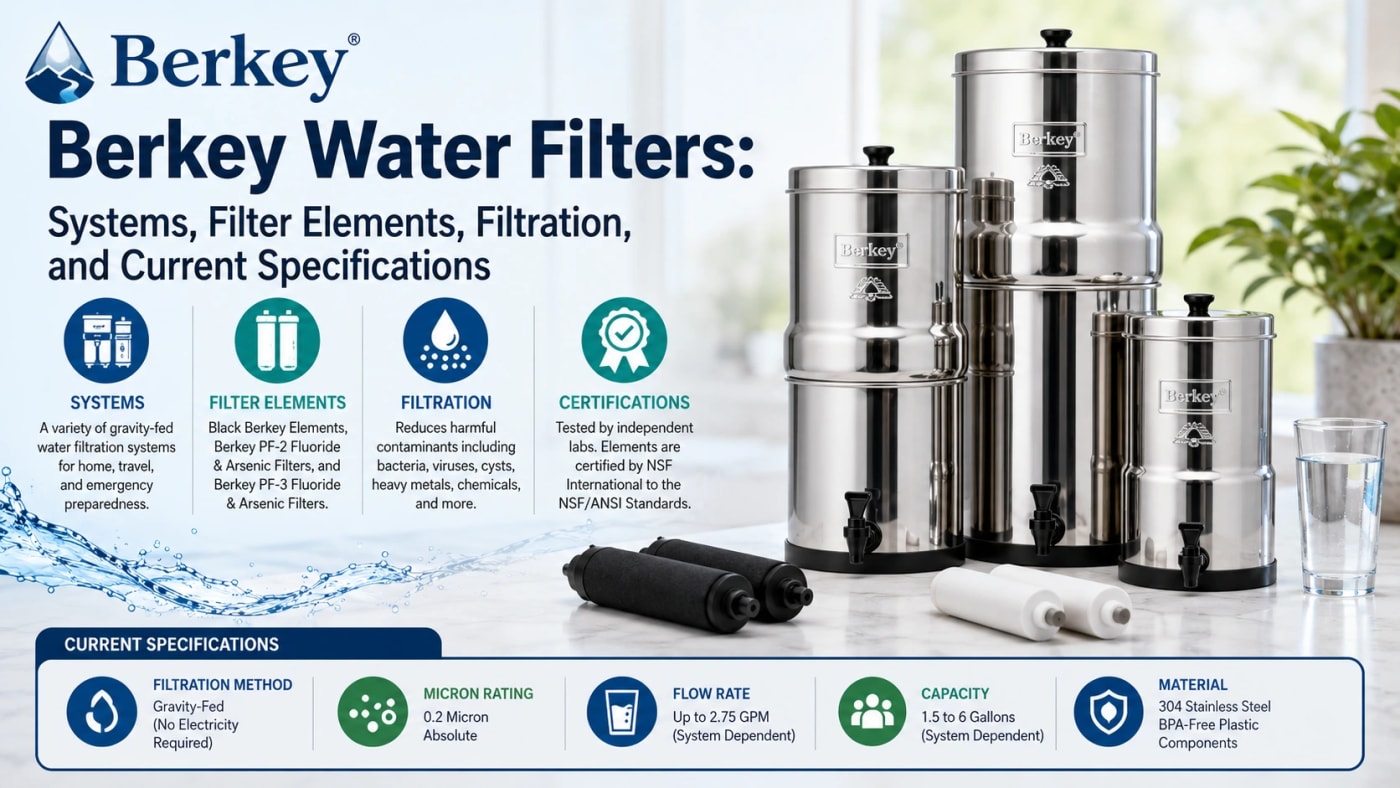
A Berkey water filter is a countertop gravity fed water treatment system. It has no pump, no electrical cord, and no connection to a home water line. The system works using four basic parts.
Main parts of a Berkey system:
Upper chamber: holds untreated tap water poured in by the user
Filter element: sits between the upper and lower chamber and treats the water as it passes through
Lower chamber: holds treated water until it is used
Spigot: a tap fitted to the lower chamber that dispenses the treated water
Water is poured into the upper chamber. Gravity pulls the water down through the filter element. The filtered water drips into the lower chamber and stays there until someone opens the spigot. There is no pressure pump and no waiting on plumbing. Most Berkey systems are built from polished stainless steel, though some models such as the Berkey Light use a food grade plastic body.Because the system relies only on gravity, it can be used anywhere. A kitchen counter, a cabin with no running water, or a vehicle during travel all work the same way.
Which Berkey system sizes and models serve different household needs?
Berkey sells five main countertop sizes: Travel, Big, Royal, Imperial, and Crown. Each size differs in water capacity, height, and how many filter elements it can hold. A larger system with more elements installed can also filter water faster.
The table below shows the current specifications for each core size, based on manufacturer and authorized dealer data.
This table shows the current capacity, household fit, and filter configuration for each Berkey system size.
System | Capacity | Typical household size | Max filter elements | Notes |
Travel Berkey | 1.5 gallons | 1 to 2 people | 2 | Smallest stainless steel model, suited to limited counter space |
Big Berkey | 2.25 gallons | 1 to 4 people | 4 | The best selling model in the lineup |
Royal Berkey | 3.25 gallons | 3 to 6 people | 4 | Taller than the Big Berkey, faster refill cycle for larger families |
Imperial Berkey | 4.5 gallons | 6 to 10 people | 6 | Suited to larger households and higher daily water use |
Crown Berkey | 6 gallons | 10 or more people | 8 | Largest stainless steel model, used in offices, churches, and emergency settings |
Capacity numbers refer to the total water the system holds when the upper and lower chambers are combined. Household size guidance is a general estimate. Actual water need still depends on how much a household drinks, cooks, and uses filtered water for pets or coffee. Always confirm current published specifications with the manufacturer or an authorized dealer before purchase, since these figures can change.
How do Berkey chambers, spigots, stands, and filter mounts work together?
Beyond the two chambers and the filter element, a Berkey system depends on a set of smaller physical parts. These parts hold the system together, seal it against leaks, and let the filter elements sit correctly in place.
Physical components of a Berkey system:
Spigot: the tap on the lower chamber, usually plastic or stainless steel, that controls water flow out of the system
Washers: rubber seals placed on the filter element stems inside the upper chamber to prevent leaks around the mounting holes
Wing nuts: hand tightened nuts that secure each filter element stem inside the upper chamber
Stand or base: an optional accessory that lifts the system to allow a cup or pitcher to fit under the spigot
Filter mounting holes: pre drilled holes in the base of the upper chamber where each filter element is installed
Each filter element has a threaded stem. The stem passes through a mounting hole in the upper chamber floor, a washer seals the connection, and a wing nut tightens from below to hold it in place. Systems with more mounting holes, such as the Imperial and Crown, can run more filter elements at once, which increases flow rate.
Which Berkey products extend beyond the main countertop systems?
Berkey also sells products outside the core stainless steel countertop line. These extend the same gravity filtration idea into other formats.
Berkey product categories beyond the countertop systems:
Berkey Light: a translucent plastic bodied system with a built in LED light option, using the same filter elements as the stainless steel models
Sport Berkey: a portable filtered water bottle for personal, on the go use
Berkey shower filters: fixed shower head filters aimed at reducing chlorine exposure during bathing
Accessories: stands, spigots, priming buttons, and replacement washers sold separately from the main systems
These products share the same brand and, in most cases, compatible filter media. They are positioned as additions to the core countertop system rather than replacements for it.
Which Berkey filter elements are used across its gravity-fed systems?
The filter element is the working part of any Berkey system. Berkey has used more than one filter element over time, and the current lineup looks different than it did a few years ago. Understanding which element is which matters more than understanding the systems themselves.
This table compares the main filter elements used in Berkey systems and their current status.
Element | Role | Compatible systems | Treatment focus | Current status |
Black Berkey | Original primary filter element | Travel, Big, Royal, Imperial, Crown | Broad contaminant reduction including microbial, chemical, and heavy metal categories | Not currently manufactured due to an EPA Stop Sale, Use or Removal Order (SSURO) issued in May 2023 |
Phoenix Gravity New Millennium Edition | Current primary filter element | Travel, Big, Royal, Imperial, Crown, Berkey Light | Chlorine, chloramine, taste, odor reduction, lead free material compliance | In stock, officially endorsed by NMCL as the current replacement for Black Berkey |
PF-2 | Secondary post filter, not a standalone primary filter | Used with Black Berkey or Phoenix elements | Fluoride and arsenic reduction | Available, must be paired with a primary element |
British Berkefeld (Ultra Sterasyl, Ultra Fluoride) | Compatible ceramic filter alternative | Most Berkey and Berkefeld style housings | Bacteria, cysts, chlorine, and select heavy metals depending on model | Available, made by Doulton |
Each element does a different job. Buyers should never assume that one filter name covers everything the brand has claimed over the years. The element installed in a system determines what that system actually treats.
What were Black Berkey elements designed to do within Berkey systems?
Black Berkey elements were the original primary filter used across every Berkey system size since the early 2000s. They were built from a proprietary carbon based media designed to reduce a wide range of contaminants in one pass, including sediment, chlorine, certain heavy metals, and select pharmaceuticals, based on manufacturer and independent lab testing claims published at the time.
These claims came from third party laboratory testing arranged by NMCL, not from a blanket government certification covering every listed contaminant. Historical marketing sometimes summarized this as broad protection, but each specific contaminant reduction figure should be traced back to its own test result rather than treated as one single certified guarantee.
As of 2026, authentic Black Berkey elements are not being manufactured. The EPA issued a Stop Sale, Use or Removal Order against Berkey International, the manufacturer that supplied Black Berkey elements to NMCL, in May 2023. NMCL disputes the EPA's classification of the filters and litigation over the matter is still active. Existing Black Berkey inventory sold out by 2024. Filters currently sold online under the Black Berkey name that are not from an authorized dealer carry a real risk of being counterfeit.
What are Phoenix Gravity New Millennium Edition elements and how do they differ from Black Berkey elements?
Phoenix Gravity New Millennium Edition elements are the current primary filter sold for use in Berkey systems. NMCL developed and endorsed Phoenix as the official replacement for Black Berkey while Black Berkey production remained halted.
Phoenix elements are made with coconut shell activated carbon. They fit all current Berkey system sizes, including Travel, Big, Royal, Imperial, Crown, and Berkey Light. NMCL recommends replacing each element after about 2,750 gallons, or 5,500 gallons per set of two elements, though actual life depends on source water quality.
Certification status needs precise wording here, because manufacturer pages have used different language at different times. Phoenix elements are certified to NSF/ANSI Standard 42, which covers non health related aesthetic contaminants such as chlorine, chloramine, and taste and odor issues. They are also certified to NSF/ANSI/CAN Standard 372, which covers lead free material compliance under the Safe Drinking Water Act. Some manufacturer pages have carried older wording describing the online NSF directory listing as pending, even after the underlying certifications were granted. Buyers should check the current NSF directory listing directly rather than relying only on manufacturer page wording, since that wording has not always been updated consistently across Berkey's own retail sites.
Phoenix elements are not certified under NSF/ANSI Standard 53, which covers health related contaminant reduction such as lead removal from water itself, cyst reduction, or VOC reduction. NSF/ANSI 42 and NSF/ANSI/CAN 372 are aesthetic and material standards, not health effect standards. Do not describe Phoenix as NSF 53 certified unless a current directory listing confirms it.
What do PF-2 fluoride and arsenic reduction elements add to Berkey filtration?
PF-2 elements are a separate add-on filter, not a primary filter. They screw onto the bottom of an installed Black Berkey or Phoenix element and sit in the lower chamber.
PF-2 elements are designed to adsorb fluoride, arsenic V, pre-oxidized arsenic III, and residual heavy metal ions that remain after water passes through the primary element above. Manufacturer and independent testing describe reduction rates above 95 percent for fluoride and above 99 percent for arsenic under normal conditions, though results depend on the level of these contaminants already present in the source water.
How primary filtration and PF-2 filtration relate:
Water is poured into the upper chamber
Water passes through the primary element, either Phoenix or Black Berkey, for broad contaminant reduction
Water then passes through the attached PF-2 element for fluoride and arsenic reduction
Treated water collects in the lower chamber
The number of PF-2 elements installed must match the number of primary elements installed. A system running four primary elements needs four matching PF-2 elements. NMCL recommends replacing PF-2 elements after about 1,000 gallons per set of two, which is a shorter interval than the primary element above it.
How do British Berkefeld ceramic elements fit into Berkey systems?
British Berkefeld elements are a ceramic filter option manufactured by Doulton. They are compatible with Berkey housings and Berkefeld branded systems and offer an alternative filtration approach to the carbon based Black Berkey or Phoenix elements.
These elements use a hard ceramic outer shell combined with an internal layer of activated carbon and heavy metal reduction media. The ceramic shell physically blocks bacteria and cysts through its small pore size, rather than relying on added silver to kill microbes, which was part of the design used in older Black Berkey elements. British Berkefeld elements carry NSF/ANSI 42, NSF/ANSI 53, NSF/ANSI/CAN 372, and NSF/ANSI/CAN 401 certifications depending on the specific model, covering aesthetic reduction, health related contaminant reduction, lead free material compliance, and incidental contaminant reduction.
This table compares the two British Berkefeld ceramic models commonly paired with Berkey systems.
Model | Primary focus | Fluoride reduction |
Ultra Sterasyl | Bacteria, cysts, chlorine, general contaminant reduction | Not included |
Ultra Fluoride | Same base filtration plus dedicated fluoride reduction media | Included |
British Berkefeld elements are one compatible option among several, not the default filter shipped with most current Berkey systems.
How does gravity move water through Berkey filter elements?
Berkey filtration relies entirely on gravity pressure. No pump or electrical component is involved at any stage.
Steps water takes through a Berkey system:
Water is poured into the upper chamber by hand
The weight of the water column above the filter element creates gravity pressure
This pressure pushes water slowly through the dense, microporous filter media
Contaminants are trapped through a combination of mechanical filtration, adsorption, and ion exchange, depending on the element type
Treated water exits the base of the element and drips into the lower chamber
Water is drawn out through the spigot when needed
Mechanical filtration blocks particles that are physically too large to pass through the tiny pores in the filter media. Adsorption pulls chemical contaminants such as chlorine onto the surface of activated carbon inside the media. Ion exchange, used mainly in PF-2 elements, swaps out unwanted ions such as fluoride for other ions held in the filter media. Together these three mechanisms account for how a gravity system treats water without any moving mechanical parts.
Which contaminant categories do Berkey filter elements target?
Berkey filter elements are designed to treat several distinct categories of contaminants. Each category is handled by a specific element or element combination, and no single Berkey element removes every contaminant class at once.
This table shows the main contaminant categories, examples within each, and which Berkey element targets them.
Contaminant class | Examples | Relevant element | Evidence or status |
Microbial | Bacteria, cysts, protozoa | Black Berkey (historical), British Berkefeld ceramic | Independent lab testing, ceramic pore size blocking |
Chemicals and organics | Chlorine, chloramine, VOCs, pesticides | Phoenix, Black Berkey | NSF/ANSI 42 certified for aesthetic effects |
Heavy metals | Lead, mercury, cadmium, copper | Phoenix, Black Berkey, British Berkefeld | NSF/ANSI/CAN 372 covers lead free material compliance, not the same as contaminant removal certification |
Particulate matter | Sediment, rust, silt | All Berkey filter elements | Mechanical filtration through microporous media |
Emerging contaminants | PFAS, pharmaceuticals | Phoenix (third party tested), Black Berkey (historical claims) | Independent lab testing, not covered under a specific NSF standard for PFAS |
The EPA has stated that filter certifications are specific to individual contaminants, not a general seal of approval covering everything a manufacturer might claim. A certification for chlorine reduction does not imply certification for lead removal, and the reverse is also true. Treat each contaminant claim on its own, tied to its own testing or certification evidence.
How are chlorine, chloramine, taste, odor, and organic compounds addressed by Berkey elements?
This group of contaminants falls under aesthetic and taste related treatment rather than health related contaminant removal. Phoenix Gravity New Millennium Edition elements are currently certified to NSF/ANSI Standard 42 for this category.Activated carbon media inside the filter element adsorbs chlorine and chloramine molecules as water passes through, which reduces both taste and odor issues in the treated water. This same carbon media also plays a role in reducing certain volatile organic compounds and other organic chemicals present in tap water, based on independent lab testing separate from the NSF 42 certification itself.
This category does not include lead, fluoride, or microbial contaminants. Those are handled through separate certifications and separate parts of the filtration process described elsewhere in this guide.
How are lead and other heavy metals handled by Berkey filtration?
Heavy metal reduction covers lead, mercury, cadmium, chromium, copper, and aluminum. Handling these contaminants correctly in a Berkey system depends on knowing the difference between two separate NSF standards that often get confused.NSF/ANSI/CAN 372 certifies that a filter element's own materials are lead free, consistent with Safe Drinking Water Act plumbing requirements. This certification is about what the filter is made of, not about how much lead the filter removes from the water passing through it.
NSF/ANSI 53 is the standard that certifies actual contaminant reduction performance, including lead removal from water. Phoenix elements currently hold NSF/ANSI 42 and NSF/ANSI/CAN 372 certification. They are not certified under NSF/ANSI 53. British Berkefeld ceramic elements do carry NSF/ANSI 53 certification for certain models, which supports specific health related contaminant reduction claims, including some heavy metals.
Buyers concerned about lead removal from their specific water source should check the exact NSF/ANSI 53 listing for the specific element they plan to use, rather than assuming any Berkey branded product removes lead simply because it carries an NSF certification of some kind.
How are fluoride and arsenic treated within the Berkey filter configuration?
Fluoride and arsenic reduction is handled only by the PF-2 element, not by the primary Phoenix or Black Berkey element on its own. This is a common point of confusion, since PF-2 is sold as an add on rather than a standalone product.Water first passes through the primary filter element for general contaminant reduction. It then passes through the attached PF-2 element, where fluoride and arsenic are removed through adsorption and ion exchange. Manufacturer testing reports fluoride reduction above 95 percent and arsenic reduction above 99 percent under normal source water conditions, with actual performance varying based on the starting concentration of these contaminants.
A Berkey system without PF-2 elements installed will not meaningfully reduce fluoride or arsenic, regardless of which primary filter element is used above it. This distinction should not be blurred in marketing or advice content.
How does Berkey address PFAS, pharmaceuticals, pesticides, and VOCs?
PFAS is a large family of thousands of individual chemical compounds, not one single substance. Independent third party lab testing on Phoenix elements has reported reduction of specific PFAS compounds, including PFOA and PFOS, along with select pharmaceuticals, pesticides, and VOCs commonly found in municipal water testing reports.
These results come from independent lab testing arranged by the manufacturer, not from a dedicated NSF standard covering the full PFAS chemical family. Berkey's own published guidance cautions against treating PFAS reduction as one blanket claim, since performance can vary significantly between individual PFAS compounds.
Use precise language when describing this category. Say that specific PFAS compounds were tested and reduced according to available lab data, rather than stating that Berkey removes all PFAS. The same caution applies to pharmaceuticals and pesticides, where testing typically covers a defined list of specific compounds rather than every possible chemical in those broader categories.
Which water contaminants and properties fall outside Berkey's normal treatment role?
Berkey filtration is not designed to address every water quality issue. Several contaminant types and water properties fall outside its normal function.
Water issues Berkey systems do not address:
Nitrates: not a target contaminant for standard Berkey filter elements
Dissolved salts: Berkey does not desalinate water
Extreme total dissolved solids (TDS): Berkey filtration does not lower TDS, since it is designed to leave natural minerals in place
Water hardness: Berkey is not a water softener and does not remove calcium or magnesium responsible for hardness
Berkey's own published guidance draws a clear line between its gravity filtration approach and both water softening and reverse osmosis systems, which are built for different jobs. A household dealing with hard water, high salinity, or high nitrate levels needs a different treatment technology matched to that specific issue, not a Berkey system alone.
How do Berkey system capacity, flow rate, and filter life relate to daily use?
Several factors work together to determine how a Berkey system performs day to day: chamber capacity, the number of filter elements installed, gravity pressure from the water column, and the condition of the source water.
This table shows chamber capacity across the core Berkey system sizes.
System | Total capacity |
Travel Berkey | 1.5 gallons |
Big Berkey | 2.25 gallons |
Royal Berkey | 3.25 gallons |
Imperial Berkey | 4.5 gallons |
Crown Berkey | 6 gallons |
Flow rate depends on how much water sits in the upper chamber and how many filter elements are installed. A fuller upper chamber creates more gravity pressure, which speeds up flow. As the water level drops, flow rate naturally slows. Adding PF-2 fluoride elements to a system also reduces overall flow rate, typically by an estimated 15 to 20 percent, since water must pass through an additional layer of filtration media.
Source water condition matters too. Water with high sediment or high levels of competing contaminants will shorten the practical life of a filter element compared to the same element used on cleaner source water.
How does the number of filter elements affect Berkey flow and throughput?
Each Berkey system has a fixed number of mounting holes in the upper chamber floor, which sets the maximum number of filter elements it can run at once. Running more elements at the same time increases total flow rate because water has more surface area to pass through simultaneously.
This table shows how filter element count affects flow rate on the Royal Berkey as an example.
Elements installed | Approximate flow rate |
2 elements | Up to 4 gallons per hour |
4 elements | Up to 8 gallons per hour |
This relationship holds across other system sizes as well, with larger systems supporting more total elements and correspondingly higher maximum flow rates. Actual flow in daily use will still vary with water level, element condition, and source water quality, so these figures represent an upper bound rather than a guaranteed rate.
How long do current Berkey filter elements last before replacement?
Filter element lifespan is measured in gallons of water treated, not in a fixed number of months, though manufacturers often provide a rough time estimate for average households.
This table compares the current recommended replacement intervals for each filter element type.
Element | Recommended replacement |
Phoenix Gravity New Millennium Edition | About 2,750 gallons per element, or 5,500 gallons per set of two |
Black Berkey (historical figures, not currently manufactured) | About 3,000 gallons per element, or 6,000 gallons per set of two |
PF-2 | About 1,000 gallons per set of two |
British Berkefeld ceramic | Varies by model, based on published NSF tested lifespans rather than a single universal figure |
These figures should never be combined across different element types, since each element uses different media with a different rated capacity. Actual replacement timing depends heavily on source water quality. Water with higher sediment or contaminant loads will shorten the practical life of any element below its rated capacity.
How are Berkey systems primed, cleaned, and maintained?
Berkey systems need a short setup process before first use, along with ongoing cleaning to keep flow rate consistent over time.
Steps for priming and maintaining a Berkey system:
Wash the upper and lower chambers with warm water before first use
Prime each new filter element using the included priming button, running water through it for about 60 seconds to remove loose media and trapped air
Install the primed elements into the upper chamber using the washers and wing nuts to secure them
Run several batches of water through the system and discard the first few filtered batches, since new carbon media can release fine black particles initially
Monitor flow rate over time, since a steady drop that cleaning does not fix usually signals the element is near the end of its rated life
Wipe down the outer surface of the filter elements periodically with a clean scrubbing pad to remove buildup on the outer surface, following the specific cleaning method listed for that element type
Cleaning steps differ slightly between carbon based elements like Phoenix and ceramic elements like British Berkefeld, since ceramic elements can typically be scrubbed more aggressively without damaging the media. Always follow the specific instructions provided for the exact element installed.
What does Berkey's current testing and certification status mean for buyers?
Three separate things get discussed under the single word certification, and confusing them leads to inaccurate claims: independent lab testing, formal NSF certification, and EPA regulatory status. These are not interchangeable.
Independent lab testing means a private laboratory tested a filter element against specific contaminants and reported results. This can happen without any formal certification body being involved. Formal NSF certification means an accredited certification body such as NSF International has verified a product against a specific published standard, such as NSF/ANSI 42 or NSF/ANSI 53, and lists that product in its public directory. EPA regulatory status is a separate, unrelated government process concerned with how a product is classified and whether it can legally be sold, not with how well it filters water.
NSF states that consumers should verify certification claims directly in its official public directory rather than relying only on manufacturer marketing language, since certification wording on retail pages is not always kept current.
What does the current NSF listing show for Phoenix-equipped Berkey systems?
As of August 24, 2026, the current NSF directory listing shows Big Berkey, Royal Berkey, and Travel Berkey systems equipped with Phoenix PGF9-2 elements certified under NSF/ANSI 42 for chlorine, taste, and odor reduction. A separate listing under NSF/ANSI/CAN 372 confirms lead free material compliance for these same systems.
This is the specific, current evidence that should be cited when describing Phoenix certification status. It does not extend to NSF/ANSI 53 health effect claims, and it should not be generalized into a blanket statement that all Berkey systems or all Berkey elements are NSF certified. Certification is tied to the specific element and specific system combination listed in the directory, not to the brand as a whole.
What does the EPA regulatory history mean for Black Berkey elements?
The regulatory history behind the current Black Berkey shortage follows a clear timeline based on EPA and court filings.
Timeline of the EPA and Berkey regulatory matter:
Late 2022 to early 2023: EPA began issuing Stop Sale, Use or Removal Orders (SSUROs) across parts of Berkey's US supply chain, citing FIFRA, the federal law governing pesticide regulation
May 8 to 9, 2023: EPA issued an SSURO to Berkey International, the manufacturer supplying Black Berkey elements to NMCL, classifying the silver used in the filter media as an unregistered pesticide device
August 2023: NMCL and the James B. Shepherd Trust filed a lawsuit against the EPA in North Texas District Court, seeking to lift the SSURO
November 2023: The North Texas case was dismissed on the grounds that NMCL lacked legal standing to bring the claim
December 2024: The Supreme Court declined to hear an appeal of that case, closing it
March 2024: A separate case, Berkey International v. EPA, was filed in Puerto Rico
October 2025: Oral arguments in the Puerto Rico case were heard before the First Circuit Court of Appeals
As of August 24, 2026: The Puerto Rico case remains active, and the SSURO against Berkey International remains in effect
The core legal dispute is whether the silver used in Black Berkey elements as an antimicrobial agent makes the filter a regulated pesticide device under FIFRA. NMCL disputes this classification. The EPA maintains its position. No authentic Black Berkey elements have been manufactured since May 2023 as a direct result of this order, and existing inventory sold out by 2024.
How should buyers distinguish certification, testing, EPA status, and manufacturer claims?
These four concepts get mixed together often in Berkey marketing and in general water filter discussion, but each answers a different question.
This table separates the four concepts that commonly get confused when evaluating a water filter claim.
Concept | What it actually confirms | Who confirms it |
Independent testing | A specific contaminant was reduced by a specific amount in a specific test | A private accredited laboratory |
Certification | A product meets a defined published standard for a specific contaminant category | An accredited certification body such as NSF International |
EPA regulatory status | Whether a product can be legally sold and how it is classified under federal law | The Environmental Protection Agency |
Manufacturer claims | What the company states about its own product's performance | The manufacturer itself, not an independent party |
None of these four automatically implies the others. A product can be independently tested without being formally certified. A product can be certified for one narrow standard while a manufacturer describes it in much broader marketing language. A product can face an active regulatory dispute while still carrying valid certifications for other, unrelated standards. Keeping these separate is the clearest way to evaluate any specific Berkey filtration claim.
How do Berkey systems fit different water sources and use cases?
Berkey systems get used across several distinct water sources and settings, and the right fit depends on matching the system and filter element to the actual water being treated. The table below summarizes typical use cases.
This table shows common Berkey use cases and the relevant considerations for each.
Use case | Main consideration |
Municipal water | Focus on chlorine, chloramine, taste, and odor reduction |
Well water | Test source water first, since well water quality varies widely and may need a different treatment approach |
Off-grid living | No electricity or plumbing required, which fits remote settings |
Emergency preparedness | Portable and functional during power outages |
RV and travel | Compact sizes such as Travel Berkey suit limited space |
Camping | Manual gravity operation works without any power source |
The EPA recommends selecting water treatment technology based on which specific contaminants are present in the source water and which certification actually covers those contaminants, rather than selecting a product based on brand reputation alone. Testing the source water before choosing a filter element combination is the most reliable starting point in every one of these use cases.
How does Berkey fit municipal drinking-water treatment?
City tap water in the United States is already treated at a municipal level, but it typically still contains chlorine or chloramine added as a disinfectant, along with trace organic compounds and occasional taste or odor issues. This is the water condition Phoenix elements are specifically certified to address under NSF/ANSI 42.
For a household on municipal water without significant well water concerns such as sediment or untreated pathogens, a Phoenix equipped Berkey system addresses the aesthetic contaminant profile that standard NSF/ANSI 42 certification covers. Households wanting fluoride reduction on municipal water, since many municipal systems add fluoride, need a matching PF-2 element installed alongside the primary filter.
How does Berkey fit well-water and non-municipal water treatment?
Well water and other non municipal sources vary far more than treated city water. Sediment levels, mineral content, and the presence of specific contaminants such as arsenic, nitrates, or bacteria depend entirely on the local well and surrounding geology.
Testing the specific well water source is the necessary first step before choosing any filtration setup, including a Berkey system. A lab test result showing which contaminants are actually present, and at what concentration, should guide the choice of filter element combination. A Berkey system paired with the right elements can address several common well water issues, including sediment, certain heavy metals, and select organic contaminants. It should not be assumed to make an unknown, untested well water source universally safe, since some well water contaminants fall outside what any Berkey filter element is designed to treat.
Why are Berkey systems used for off-grid and emergency water treatment?
Berkey systems are used in off-grid and emergency settings because they need no electricity and no plumbing connection to function. This single design feature is the main reason the brand shows up repeatedly in emergency preparedness and off-grid living discussions.
During a power outage, a standard electric water filtration system stops working entirely. A Berkey system continues to function exactly as it would under normal conditions, since gravity alone drives the filtration process. This makes it suitable for power outages, remote cabins without utility connections, recreational vehicles, and general emergency preparedness stockpiling.
Larger systems such as the Imperial and Crown Berkey are commonly positioned for these exact scenarios, since their higher capacity supports more people between refills, which matters when normal water supply infrastructure is disrupted or unavailable.