
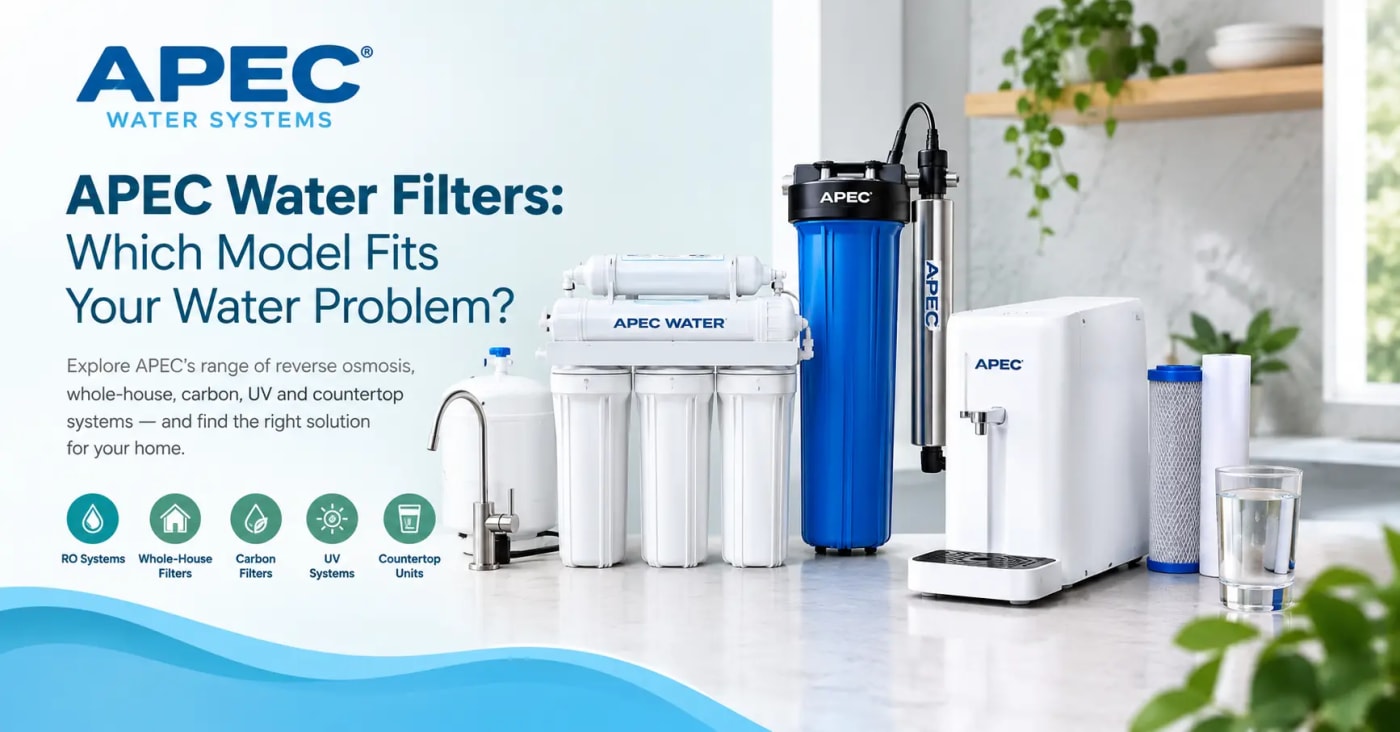
APEC water filters cover several residential treatment needs, from reverse osmosis drinking-water systems to whole-house filtration and countertop units. If you are researching APEC RO system reviews, this guide helps you understand the product range, choose the right treatment location, and move to the dedicated review for the APEC system that fits your water problem.
What Is APEC Water Systems?
APEC Water Systems is a water-treatment brand offering residential reverse osmosis, whole-house filtration, carbon filtration, UV treatment, countertop systems, and related replacement filters. Its products are designed for different treatment locations, so the right system depends on whether you need water treated at one faucet or throughout the home.
What Types of Water Filters Does APEC Make?
Reverse Osmosis Systems
APEC reverse osmosis systems are designed primarily for point-of-use drinking water treatment. They use an RO membrane along with prefilters and post-treatment to address dissolved contaminants, while different configurations add features such as remineralization, UV treatment, higher output, or tankless operation.
Whole-House Filters
Whole-house APEC filters treat water at the point where it enters the home, allowing multiple fixtures to receive treated water. They are more appropriate when the concern involves household-wide water quality, such as chlorine, sediment, iron, or other source-specific problems.
Carbon Filters
Carbon filtration uses adsorption to reduce chlorine, taste, odor, and selected organic compounds. It can make sense when the main issue is treated tap water that tastes or smells unpleasant and a full reverse osmosis system is unnecessary.
UV Systems
UV treatment uses ultraviolet energy as a microbial treatment step rather than as a replacement for chemical filtration. APEC combines UV with selected filtration configurations when the water source or treatment objective calls for additional microbial protection.
Alkaline / Remineralization Systems
Alkaline APEC systems add a remineralization stage after reverse osmosis. The additional stage can restore minerals such as calcium and change the taste and mineral profile of the treated water.
Which APEC Model Fits Your Situation?
The easiest way to choose among APEC systems is to start with treatment location, water source, required output, and any feature that matters to your installation. The table below summarizes the models specified in this guide. Current starting prices and rated outputs can change, so the dedicated product or review page should be checked before publishing or updating this table.
Model | Type | Best For | Rated Output |
ROES-50 | 5-stage tank RO | Standard under-sink drinking-water treatment | 50 GPD |
ROES-PH75 | 6-stage alkaline tank RO | RO with remineralization | 75 GPD |
ROES-PHUV75 | 7-stage alkaline RO with UV | RO with remineralization and UV | 75 GPD |
RO-90 | 5-stage tank RO | Higher-output conventional RO | 90 GPD |
RO-PH90 | 6-stage alkaline tank RO | Higher-output RO with remineralization | 90 GPD |
RO-PERM | Permeate-pumped RO | Lower-pressure installations | 90 GPD rated membrane |
ROTL-AIO | Tankless RO | Compact tankless installation | 600 GPD class |
ROTL-A1000 | 4-stage tankless RO | High-output tankless treatment | 1,000 GPD |
ROCT-PLUS | Countertop RO | Renters or kitchens without a faucet connection | 75 GPD |
Use the table as a routing tool rather than a final verdict. Match your treatment location and water source to the appropriate row, then open the dedicated review for the model's detailed specifications, certification information, maintenance requirements, and performance discussion.
What Certifications Apply to APEC Water Filters?
For an APEC RO water filter review specifications certifications check, start with the exact model rather than assuming a certification applies to the entire brand. NSF/ANSI 58 covers point-of-use reverse osmosis systems and addresses areas including TDS reduction, efficiency, recovery, structural integrity, material safety, and specific contaminant-reduction claims.
WQA Gold Seal certification is also product-specific. WQA describes Gold Seal as a third-party certification program for water-treatment products, so certification should be checked against the exact model and the contaminants covered by the certification.
How Much Do APEC Filters Cost to Maintain?
APEC maintenance costs vary by model because replacement filters, membranes, and replacement intervals differ across the product range. Prefilters are generally replaced roughly every 6 to 12 months, while RO membranes and post-carbon filters can last several years depending on the model, water quality, and usage.
Current APEC replacement sets range from basic prefilter sets to complete multi-stage kits, so there is no reliable single APEC RO annual maintenance cost for the entire brand. Check the specific model page before estimating your yearly ownership cost, especially if you are comparing APEC RO annual filter cost between two systems.
How Much Water Do APEC Reverse Osmosis Systems Waste?
Reverse osmosis produces a reject-water stream as the membrane separates treated water from concentrated contaminants. The useful way to compare systems is the pure-to-drain ratio, because a lower amount of reject water per gallon of treated water indicates greater water efficiency.
EPA's WaterSense benchmark allows a maximum of 2.3 gallons of reject water per gallon of treated water for labeled point-of-use RO systems. APEC tank-based and tankless systems can have different efficiency profiles, so exact wastewater performance should be checked on the individual model page rather than generalized across the brand.
How Does APEC Compare With Other Water Filter Brands?
APEC and iSpring overlap heavily in residential reverse osmosis and drinking-water systems, so a meaningful comparison should examine filtration configuration, certification, rated output, maintenance, water efficiency, and installation requirements. See the dedicated APEC vs iSpring comparison page for the detailed model-level analysis.
APEC and Waterdrop overlap in residential RO, particularly tankless systems and compact under-sink installations. The dedicated APEC vs Waterdrop comparison should be used when the decision involves tank design, rated output, efficiency, filter replacement, and installation.
APEC and SpringWell cover some different areas of residential treatment, particularly when whole-house filtration is involved. Use the dedicated comparison page when you need to compare treatment approach, installation location, and system configuration rather than simply comparing brand names.
APEC and Aquasana also overlap across residential water treatment, including whole-house filtration and drinking-water applications. The dedicated comparison should be used for the detailed product-to-product differences.