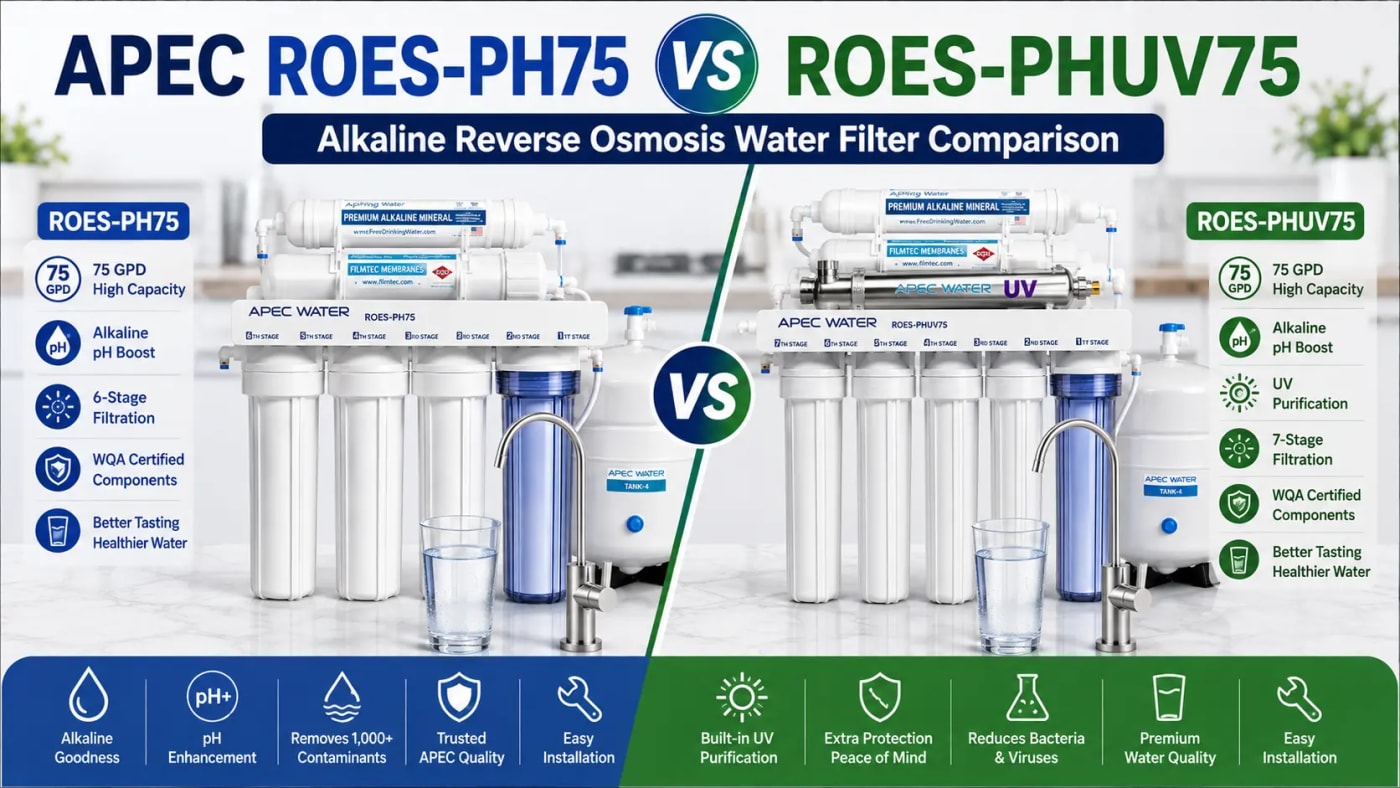
Which filtration stages are common to both APEC 75 GPD alkaline RO systems?
Both systems start with the same first four stages. Water enters through a sediment filter, then passes through two carbon block filters, then reaches the TFC RO membrane.
Shared Filtration Stages 1 Through 4:
Polypropylene sediment filter removes dust, particles and rust
Carbon block filter removes chlorine, taste, odor and some VOCs
Carbon block filter removes remaining chlorine and chemical compounds
TFC RO membrane separates dissolved contaminants and reduces TDS
The sediment filter protects the membrane from physical particles that could damage it over time. The two carbon block filters protect the membrane from chlorine, which can break down the membrane material if it reaches it directly, and they also remove taste and odor issues. The TFC membrane does the core work of removing dissolved contaminants from the water. This four-stage sequence is identical on both models, since both use the same base RO platform.
How do the 75 GPD ratings and storage tanks compare between these APEC RO systems?
Both models carry the same 75 GPD production rating, tested under APEC's standard conditions of 60 PSI feed pressure and 77°F water temperature. Both models also include the same 4-gallon pressurized storage tank.
A rated production number reflects lab test conditions, not a guarantee for every home. Actual output at your faucet depends on your home's real feed water pressure and temperature. Lower pressure or colder water will slow production below the rated 75 GPD on either system, since both use the identical membrane platform and respond to pressure and temperature the same way.
How does pHPlus remineralization work in both APEC RO systems?
Both the ROES-PH75 and the ROES-PHUV75 include APEC's pHPlus stage. This stage sits at the end of the filtration sequence and adds high-purity calcium carbonate back into the water after the RO membrane removes it.
This stage raises the water's pH out of the mildly acidic range typical of raw RO water and into alkaline territory. It also improves taste, since plain RO water can taste flat without added minerals. Both systems produce alkaline water through this identical pHPlus stage, so remineralization is not something that separates these two products. Whichever model you choose, this feature works the same way.
What does the UV sterilization stage add to the APEC ROES-PHUV75?
This is the main difference between the two systems. The ROES-PHUV75 adds a UV stage as its fifth stage, positioned after the storage tank and before the post-carbon and pHPlus stages. Water sits in the pressurized tank after leaving the RO membrane, then passes through the UV stage when the faucet is opened, then continues through the post-carbon filter and the pHPlus filter before reaching the faucet.
UV treatment works differently from every other stage in the system. The earlier stages use physical filtration and chemical adsorption to remove particles and dissolved substances. The UV stage uses ultraviolet light to disable the DNA of microorganisms passing through it, stopping them from reproducing. It does not remove or filter anything physically. It disinfects.
This table shows the treatment flow through the ROES-PHUV75, in order.
Order | Stage | Function |
1 | Sediment filter | Removes particles |
2 | Carbon block filter | Removes chlorine and taste issues |
3 | Carbon block filter | Removes remaining chemicals |
4 | TFC RO membrane | Removes dissolved contaminants |
5 | UV sterilizer | Disinfects water leaving the tank |
6 | Post-carbon filter | Polishes final taste |
7 | pHPlus filter | Adds calcium carbonate and raises pH |
Which microorganisms does the PHUV75 UV stage target in drinking water?
APEC states the UV stage is designed to target bacteria, viruses and cysts. The manufacturer claims up to 99.99% reduction of these microorganisms through the UV stage. This is a manufacturer claim based on APEC's own product documentation, not a figure confirmed through independent laboratory testing of the ROES-PHUV75 specifically.
It is important to understand what UV disinfection actually does. It inactivates microorganisms so they cannot reproduce or cause infection. It does not physically remove them from the water the way a filter does. The organisms are still present in the water after UV treatment, but they are no longer able to multiply or cause illness under normal conditions.
Why does the UV stage matter differently for non-chlorinated and microbiologically questionable water?
The value of a UV stage depends heavily on where your water comes from. Municipal water systems in most areas already receive chlorine treatment, which controls bacteria and other microorganisms before the water ever reaches your home. For this type of water source, the added UV stage provides an extra layer of protection rather than addressing a known gap.
Private wells and other non-chlorinated water sources are a different situation. These sources do not go through centralized treatment, so any microbial contamination present in the source water reaches your tap directly unless something at the point of use addresses it. The EPA recommends testing a private well annually for total coliform bacteria, nitrates, total dissolved solids and pH, and testing for additional contaminants if there is reason to suspect them.
This does not mean every well owner automatically needs the UV model. The right decision depends on what your specific water test results show. A well testing clean for total coliform bacteria has a different risk profile than one with a known history of bacterial contamination. Source water testing should guide this decision rather than a blanket assumption about well water in general.
How do contaminant-reduction functions compare between the PH75 and PHUV75?
The two systems handle contaminants through different mechanisms, and this distinction matters more than simply counting how many contaminants each product page lists.
This table shows how each treatment mechanism functions across both systems.
Treatment Mechanism | Present On | Function |
RO membrane and carbon stages | Both PH75 and PHUV75 | Removes dissolved solids, metals, salts and chemical contaminants |
UV sterilizer | PHUV75 only | Disinfects bacteria, viruses and cysts |
The RO membrane and carbon stages, shared by both systems, handle the chemical and physical side of water treatment. The UV stage, found only on the PHUV75, handles the microbial side. These two treatment types do not overlap or replace each other. A system with UV does not filter chemicals any better than one without it, since the UV stage does not touch dissolved solids or chemical contaminants at all.
Which dissolved contaminants are handled by the shared RO membrane and carbon stages?
The membrane and carbon stages, common to both systems, are built to reduce a wide range of dissolved substances. APEC's product documentation lists total dissolved solids, lead, arsenic, fluoride, nitrate, chlorine, chloramines and volatile organic compounds among the substances these stages address.
It is worth separating manufacturer claims from independently confirmed results. Independent lab testing of the base ROES-PH75 by Water Filter Guru confirmed strong reduction of total dissolved solids, fluoride, uranium and several disinfection byproducts, along with a formal WQA certification specifically for TDS reduction. The wider list of contaminants on APEC's product page reflects the system's intended design targets, not each contaminant carrying its own separate certification record.
What contaminants does the PHUV75 UV stage not address?
UV treatment has clear limits. It is not a substitute for reverse osmosis when it comes to dissolved solids, salts, heavy metals, fluoride, nitrate or other chemical contaminants. UV light disinfects microorganisms. It does nothing to reduce the chemical composition of the water.
The EPA notes that UV treatment effectiveness depends on factors including water quality and the UV dose delivered, meaning cloudy or heavily contaminated water can reduce how well UV disinfection performs. On the ROES-PHUV75, the RO membrane and carbon stages still carry the full responsibility for chemical and dissolved contaminant reduction. The UV stage only adds a microbial disinfection layer on top of that existing filtration work.
How do installation requirements differ between the PH75 and PHUV75?
Both systems share the same basic installation steps, since both use the same core plumbing layout. The difference comes down to one added electrical requirement on the PHUV75.
This table compares installation requirements for both systems.
Requirement | APEC ROES-PH75 | APEC ROES-PHUV75 |
Cold water connection | Required | Required |
Dedicated faucet | Required | Required |
Drain connection | Required | Required |
Tubing and fittings | Quick connect, color-coded | Quick connect, color-coded |
Storage tank placement | Required | Required |
Electrical power | Not required | Required, 110V UV transformer |
Under-sink outlet access | Standard outlet not needed | Standard electrical outlet needed near cabinet |
The ROES-PHUV75 needs an available electrical outlet near the installation site to power its 110V UV transformer. This is the one installation requirement that does not apply to the standard ROES-PH75, since that model has no electrical component at all.
How much under-sink space does each APEC RO system require?
The ROES-PH75 measures 15.5 by 5.25 by 17.5 inches. The ROES-PHUV75 measures 15.5 by 5.25 by 18.5 inches, one inch taller to accommodate the added UV housing. Both models use the same separate 4-gallon tank, which takes up its own space in the cabinet regardless of which system you choose.
The extra inch on the PHUV75 is a small difference on paper, but cabinet layout matters as much as the raw dimensions. Check your available vertical clearance, and confirm that your outlet, drain access and plumbing connections will not conflict with a slightly taller unit before choosing the UV model.
How does filter and UV maintenance differ between the two APEC RO systems?
Both systems share the same filter replacement schedule for their common stages. The PHUV75 adds one additional maintenance task tied to its UV component.
This table shows the maintenance schedule for both systems.
Component | APEC ROES-PH75 | APEC ROES-PHUV75 |
Stages 1 to 3 (pre-filters) | Every 6 to 12 months | Every 6 to 12 months |
RO membrane | Every 2 to 4 years | Every 2 to 4 years |
Post-carbon filter | Every 2 to 4 years | Every 2 to 4 years |
pHPlus filter | Every 6 to 12 months | Every 6 to 12 months |
UV bulb | Not applicable | Every 12 months |
When should the RO membrane, carbon filters and pHPlus filter be replaced on each model?
APEC recommends replacing the first three pre-filters and the pHPlus filter every 6 to 12 months. The RO membrane and post-carbon filter last longer, with a recommended interval of 2 to 4 years. These intervals apply the same way to both the ROES-PH75 and the ROES-PHUV75, since both use identical filter components for these shared stages. Actual filter life will vary depending on your local water quality and how much water your household uses daily.
When does the PHUV75 UV bulb need replacement and why does UV maintenance matter?
APEC's manual for the ROES-PHUV75 states the UV bulb should be replaced after one year of use. This is a separate schedule from the filter replacement intervals listed above, and it applies only to the UV-equipped model.UV bulb strength declines gradually over time, even while the bulb continues to light up and appears to work normally. A bulb operating past its rated life may still glow but no longer deliver enough UV dose to reliably disinfect the water passing through it. This is why the one-year replacement recommendation exists, regardless of whether the bulb looks like it still works.
Before performing any UV maintenance, unplug the transformer from its power source first. The UV stage runs on 110V electricity, and working near the housing while it is powered creates an unnecessary safety risk.
How do purchase price and ongoing ownership costs compare between the PH75 and PHUV75?
At the time of this research, APEC listed the ROES-PH75 at $268.99 and the ROES-PHUV75 at $366.99 through its direct store. Prices change over time and vary by retailer, so treat these figures as a snapshot rather than a fixed number, and check current pricing directly with APEC or an authorized retailer before purchasing.
Purchase price is only part of total ownership cost. Ongoing costs include replacement filters, and for the PHUV75, the added UV bulb and its electricity use. The base ROES-PH75 has an estimated annual maintenance cost near $133, based on independent cost analysis of its shared filter set. The ROES-PHUV75 carries this same filter cost, plus the additional yearly UV bulb replacement and a small amount of electricity to run the transformer continuously.
How does the UV component change the long-term maintenance cost of the PHUV75?
The added cost from the UV component comes from three sources: the replacement bulb itself, the transformer if it ever needs replacement, and the electricity used to power the transformer continuously. APEC sells dedicated UV replacement bulbs and transformer parts for this model family. None of these additional costs apply to the base ROES-PH75, since it has no UV or electrical components at all.
How do water pressure and wastewater affect the real-world performance of these 75 GPD RO systems?
Both systems share the same 75 GPD rating, tested at 60 PSI and 77°F. Real-world output depends on your actual home conditions, which rarely match lab test conditions exactly.
Independent testing of the base ROES-PH75 by Water Filter Guru recorded a measured output of 42.74 GPD under their test conditions of 48 PSI feed pressure and 60.4°F water temperature, well below the 75 GPD rating. Their wastewater measurements also varied depending on draw size, with a smaller draw producing a less efficient ratio than a larger one.
This table shows the manufacturer rating alongside the independent test conditions for the ROES-PH75.
Metric | APEC Rated Condition | Independent Test Condition |
Feed pressure | 60 PSI | 48 PSI |
Feed temperature | 77°F | 60.4°F |
Measured production | 75 GPD | 42.74 GPD |
These results apply specifically to the tested ROES-PH75 unit and its test conditions. The ROES-PHUV75 was not part of this specific independent study, so its real-world output under different pressure and temperature conditions has not been separately measured. Given that both systems share the identical RO membrane and tank, similar pressure and temperature effects would reasonably apply to the UV model as well, though this has not been confirmed through the same testing process.
Which water source and treatment concern fit the PH75 or PHUV75 better?
Bringing the comparison together means matching each system's capabilities to your actual water source and treatment goals, rather than picking based on stage count alone.
Buyer Scenarios for Each System:
A household on treated municipal water with no known microbial concerns fits the standard ROES-PH75
A household wanting RO filtration and alkaline water without added electrical components fits the ROES-PH75
A household on a private well with unconfirmed water quality benefits from testing first, then considering the ROES-PHUV75 if microbial risk is confirmed
A household on a non-chlorinated source, such as a spring or cistern, benefits from the added UV barrier in the ROES-PHUV75
A household with a confirmed history of bacterial contamination in their water source benefits from the ROES-PHUV75's UV disinfection layer
A household prioritizing simpler maintenance with no electrical component fits the ROES-PH75
When is the PH75 sufficient for treated municipal drinking water?
Municipal water systems generally receive chlorine disinfection before distribution, which addresses microbial risk at the source. For a household on treated municipal water with no specific concerns about microbial contamination, the base ROES-PH75 provides the same RO filtration and alkaline treatment as the PHUV75, without the added electrical requirement or UV maintenance task. Checking your local water quality report is still worthwhile, since treatment quality and any documented issues vary by utility and region.
When does the PHUV75 provide a meaningful extra treatment layer?
The PHUV75 becomes most useful when there is a real, identified microbial risk in the source water. This includes private wells with elevated total coliform results, non-chlorinated water sources, or situations where local health authorities have flagged known contamination concerns in the area. Testing your water before buying is the right first step for any private well, since it tells you whether this added layer of protection addresses an actual, confirmed risk in your specific water supply.
What should you verify about your drinking water before choosing between these APEC RO systems?
The right choice between these two systems depends on your actual source water profile, not simply on which model has more stages. Before deciding, verify a few key points about your water.
Water Details to Verify Before Choosing:
Get a water test that covers total coliform bacteria, nitrate, total dissolved solids and pH at minimum
Check whether your water source is treated municipal water or an untreated private source
Review any known local water quality concerns from your utility or health department
Confirm your home's feed water pressure to understand realistic production output
Note any chlorine or chloramine treatment already present in your water
Check for heavy metals or other chemical contaminants specific to your area
How should you test private well water before buying a reverse osmosis filter?
Use a state-certified drinking water laboratory for accurate results. At minimum, test for total coliform bacteria, nitrate, total dissolved solids and pH. Add tests for other specific contaminants based on your location and any known local risks. A dedicated private well water testing guide covers the full testing process in more detail.
What does a reverse osmosis water filter remove from drinking water?
Reverse osmosis reduces total dissolved solids and a wide range of dissolved chemicals and metals by pushing water through a semi-permeable membrane. A dedicated guide covers exactly what reverse osmosis removes, contaminant by contaminant.
How does UV water purification work in a drinking water filter?
UV water purification uses ultraviolet light to inactivate the DNA of bacteria, viruses and other microorganisms, stopping them from reproducing. A dedicated UV water purification guide covers wavelength, dose, turbidity effects and maintenance requirements in full detail.
How often should reverse osmosis filters be replaced?
Pre-filters typically need replacement every 6 to 12 months. The membrane and post-carbon filter last longer, generally 2 to 4 years. The remineralization filter follows the same 6 to 12 month schedule as the pre-filters. A dedicated reverse osmosis filter replacement guide covers the complete schedule and how to judge early signs of filter wear.
Which APEC reverse osmosis water filter is best for your home?
The right APEC model depends on your water source, desired output, remineralization preference, need for UV disinfection, available installation space and budget. A broader APEC model comparison guide covers the full lineup beyond just these two systems.
How does alkaline remineralization change reverse osmosis water?
Alkaline remineralization adds calcium carbonate back into RO water after the membrane removes it, raising pH out of acidic territory and improving taste. A dedicated alkaline reverse osmosis water filter guide covers the media types and process in more detail.