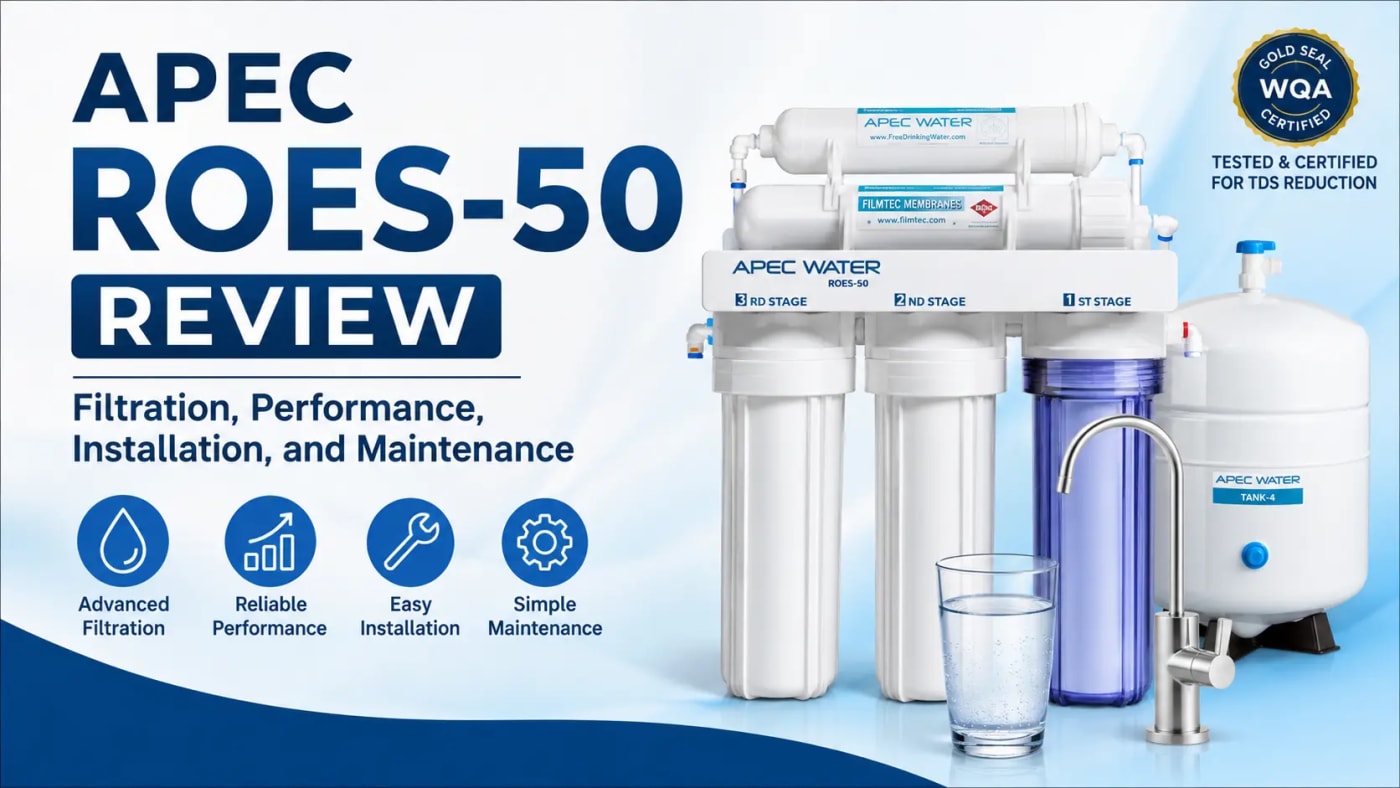
Quick Verdict | APEC ROES-50 Essence Series (2026) |
|---|
Overall Rating | #1 of 13 RO systems (TechGearLab, December 2025) — Score: 89/100 |
Best For | Buyers who want maximum contaminant removal at the lowest total cost — no smart features needed |
Not Right For | Limited under-sink space; users who want better water taste (remineralization); homes with water pressure below 40 PSI without a pump |
Upfront Price | ~$230 |
Annual Cost | ~$75–80/year (standard 10-inch filters — buy from any store) |
Output | 50 GPD at 60 PSI; about 30 GPD at 50 PSI |
Electricity? | No — runs entirely on household water pressure |
Certification | WQA Gold Seal to NSF/ANSI 58 (covers TDS reduction) |
Wastewater | Approximately 3:1 at standard pressure (4–5:1 at lower pressure) |
Cost Summary
Stage | Filter Type | Replace Every |
|---|
1 | 5-micron sediment filter | 6–12 months |
2 | 5-micron carbon block | 6–12 months |
3 | 5-micron carbon block | 6–12 months |
4 | TFC RO membrane (Dow Filmtec) | 2–3 years |
5 | Coconut shell carbon post-filter | 2–3 years |
Total | Annual cost approximately $75–80 | Standard 10-inch filters — buy from any store |
What Exactly Does the APEC ROES-50 Do to Your Water?
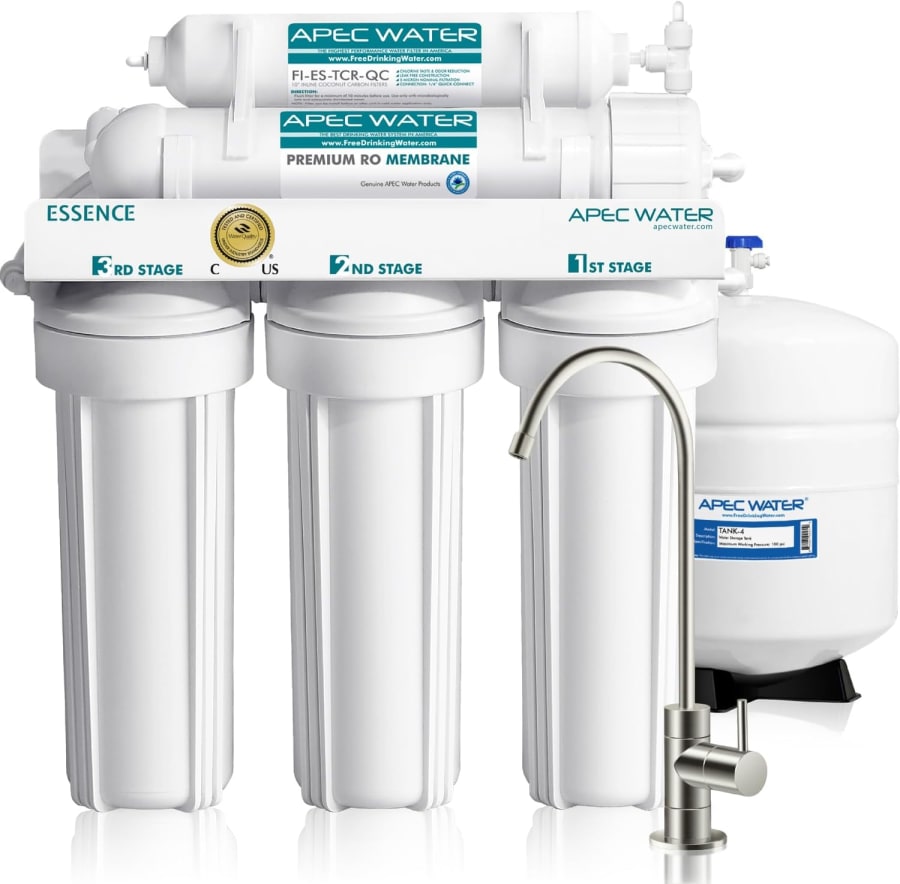
The APEC ROES-50 uses a five-stage process to turn tap water into high-purity drinking water. Each stage has a specific job, from catching physical dirt to stripping out invisible chemicals and heavy metals.
Stage 1: Sediment Filter
This is the first line of defense. It acts like a fine screen to catch physical particles like sand, dirt, and rust flakes. While it doesn't remove chemicals, it is essential because it prevents the more expensive filters and the membrane from getting clogged with "gunk." Replace every 6–12 months.
Stage 2: Carbon Block Filter
This is your first chemical filter. It is designed to soak up chlorine, chloramines, and unpleasant odors. Removing chlorine here is critical because it can permanently eat away at the delicate material of the RO membrane in Stage 4.
Stage 3: Carbon Block Filter (Second Pass)
This is a "double-check" stage that uses a second carbon block. It catches any remaining chlorine or organic chemicals that managed to slip through the first pass. This two-step process is why APEC is so effective at removing 100% of chlorine in independent tests. Replace Stages 2 and 3 every 6–12 months.
Stage 4: Dow Filmtec RO Membrane
This is the "brain" of the system. The Dow Filmtec membrane has microscopic pores so small that only water molecules can fit through. Lead, arsenic, fluoride, PFAS, and bacteria are too Large items that are flushed away down the drain. This specific brand is famous for having one of the highest "rejection rates" (purity scores) in the industry. Replace every 2–3 years.
Stage 5: Coconut Shell Carbon Post-Filter
This is the final "polishing" step. Since the water sits in a storage tank before you drink it, it passes through this coconut-shell carbon filter right before it hits your glass. It removes any stale taste or smell the water might have picked up from the tank, ensuring a crisp, neutral flavor. Replace every 2–3 years.
How Well Does the ROES-50 Actually Remove Contaminants?
When it comes to raw performance, the APEC ROES-50 remains a powerhouse. In December 2025, independent testing by TechGearLab ranked the ROES-50 as the #1 overall water filter, earning an 89/100 score. Most impressively, it secured a perfect 10/10 for critical contaminant removal.
The Lab Results
All the main harmful contaminants tested, like lead, arsenic, uranium, and PFNA/PFBA (types of PFAS), were brought down to levels that couldn't be detected in controlled lab tests. Previous independent data support this: the system removes 100% of chlorine, copper sulfate, and copper while stripping 94.7% of fluoride. In one extreme test, TDS was 3,000 mg/L, and it was crushed to a nearly distilled 0.53 mg/L.
The Certification
You have to know what official stamps mean. APEC holds a WQA Gold Seal for the ROES-50 standard. But this certification is for NSF/ANSI 58, which mainly verifies TDS reduction and structural integrity. It does not mean that the WQA has certified that every contaminant, like lead or PFAS, was removed. Instead, those 99% reduction claims are supported by APEC internal and independent lab testing.
This difference in quality does not affect the water for the average homeowner. The RO membrane's physical process blocks these pollutants consistently. Its only real limitation is biological: the ROES-50 has no UV sterilizer function. While most bacteria are blocked by pore size, it isn't certified to kill live viruses. For private wells with known bacterial problems, add a UV pre-filter.
What Are the Real Costs of Owning the ROES-50 Long-Term?
The biggest mistake people make when buying a water filter is only looking at the price on the box. The APEC ROES-50 is arguably the most budget-friendly system to own over a decade because it uses "universal" parts rather than expensive, brand-name-only cartridges.
Maintenance Schedule
To keep your water pure, you have to swap filters on a schedule. Here is the realistic breakdown of what you'll spend:
These are the workhorses. You should swap these every 6 to 12 months. If your water is particularly "hard" or full of sediment, lean toward 6 months. A set of all three costs about $30–$45.
This is the heart of the system. It only needs replacing every 2 to 3 years and costs roughly $40–$50.
This final "polishing" filter also lasts 2 to 3 years and costs about $15.
Stage | Filter Type | Replace Every | Approx. Cost |
|---|
1–3 | Sediment & Carbon Blocks | 6–12 months | $30–$45 |
4 | Dow Filmtec RO Membrane | 2–3 years | $40–$50 |
5 | Coconut Shell Carbon | 2–3 years | $12–$15 |
10-Year Bottom Line
When you add it all up, your annual maintenance averages out to $75–$80 per year. Over a full decade, you’ll spend roughly $1,000 total (including the system itself). Compare that to buying just one $1.50 bottle of water a day, which would vanish $5,400 from your bank account over the same period.
The secret weapon of the ROES-50 is the 10-inch industry-standard housing. These are not 'proprietary' twist-and-lock filters that you have to buy from APEC. You can find compatible filters at most hardware stores or online retailers, keeping prices low and avoiding being stuck with an "obsolete" system when a company goes out of business.
How Easy Is the ROES-50 to Install and Maintain?
The APEC ROES-50 is for you if you can operate a power drill and follow a color-coded map. For a first-timer, plan on 1.5 to 2.5 hours. Maintenance involves a little more elbow grease than modern, click-in methods.
APEC uses John Guest (JG) push-fit fittings and color-coded tubing (red for supply, blue for the faucet, and yellow for the tank). You simply push the tube into the fitting until it locks. To get it up and running, you will need:
A Power Drill: To create a hole in your sink or countertop for the RO faucet and a small hole in your drainpipe for the wastewater line.
Wrenches: A crescent wrench for the feed water valve and the drain saddle.
Teflon Tape: Included in the box, used to ensure threaded connections don't drip.
Unlike modern systems, where you twist a pod and walk away, the ROES-50 uses vertical filter housings. To change stages 1–3, you must use the included large plastic wrench to unscrew the heavy, water-filled canisters.
The Struggle: These housings can become incredibly stiff over time.
The Pro Tip: The most common mistake is forgetting to lubricate the O-rings. Always apply a thin layer of food-safe silicone grease to the black rubber rings before screwing the housings back on. This prevents leaks and makes the next filter change much easier.
The Mess: Expect a moderate amount of water to spill under the cabinet; keep a bucket and towels handy.
Your first install may produce milky or cloudy water. Don't panic; this is trapped air pushing out of the new membrane. It's harmless and usually clears up in 24 to 48 hours. You should also flush the whole 4-gallon tank once before drinking to wash away loose carbon dust from new filters.
What Are the Biggest Weaknesses of the APEC ROES-50?
No review is useful without a clear look at the downsides. While the ROES-50 is a top-tier performer for purification, it has five documented weaknesses that might make it the wrong choice for your kitchen.
1. The "Flat" Water Taste
Because this system strips contaminants so well, healthy minerals are also stripped, like calcium and magnesium. This makes the water taste flat or empty to many people, like bottled spring water. Base ROES-50 contains no remineralization stage. For a crisp mineral taste, you'll need to buy an alkaline stage APEC ROESPH75 or a $25 separate mineral filter inline.
2. It Is a Space Hog
The ROES-50 is bulky. You aren't just installing five filter canisters; you are also installing a 4-gallon pressurized tank. The combined footprint typically swallows 60–70% of a standard under-sink cabinet. If you share that space with a garbage disposal or pull-out trash bin, it might not fit. Measure your cabinet (16" x 17.5" for the unit and 11" x 15" for the tank) before you buy.
3. High Water Waste
Like most traditional RO systems, the efficiency isn't outstanding. For every 1 gallon of clean water produced, the ROES-50 sends about 3 gallons to the drain. If your home has low water pressure, that waste can jump to a 5:1 ratio. This risk is a real concern for eco-conscious buyers or those on private wells with limited yield.
4. Risk of Housing Cracks
A common but under-discussed complaint on Trustpilot and Home Depot involves the plastic filter housings. Over 2–3 years, some users report the plastic cracking near the connection points, leading to slow, silent leaks. It is vital to inspect your housing every 6 months to catch moisture before it ruins your cabinetry.
5. Zero "Smart" Monitoring
There is no TDS display, no filter life light on the faucet, and no app. You are flying blind unless you buy a separate $15 handheld TDS meter and manually mark your calendar for filter changes. For $200, such functionality is expected, but it feels primitive compared to modern "smart" systems like Waterdrop.
Is the APEC ROES-50 the Right System for Your Home?
The APEC ROES-50 is a top-tier choice if you prioritize lab-proven contaminant removal and the lowest possible long-term maintenance expenses. However, it isn't a "one-size-fits-all" solution. Here is how to tell if it fits your specific household needs.
The Quick Verdict
Buy if: You want a "workhorse" system with a 25-year track record, you have plenty of cabinet space, and you want to spend less than $80 a year on filters.
Do not buy if: You have a tiny kitchen, you want a "smart" faucet with digital readouts, or you want a 3-second filter change that doesn't require a wrench.
Does It Fit Your Situation?
The ROES-50 performs best at 60 PSI. If your home is below 40 PSI, the system will waste more water and fill the tank very slowly. If you are on low pressure, skip this version and get the APEC RO-PERM, which has a built-in pump to solve this exact issue.
For a family of 4, the 50 GPD (gallons per day) capacity is plenty for drinking and light cooking. However, if you have 5+ people or you frequently fill large pots for pasta and homebrewing, the tank might run dry. In that case, look at the APEC RO-90 for faster refilling.
This system is well-water compatible, but only if your water is already pre-treated for high hardness or iron. If your well has bacteria issues, you must add a UV sterilization stage; the ROES-50 alone isn't enough to guarantee "biologically safe" water.
This is not ideal for renters. It requires drilling a hole in the sink and tapping into the plumbing. If you can't make permanent changes, the APEC RO-CTOP (countertop version) is a much better, non-permanent alternative.
How Does the ROES-50 Compare to Other APEC Models and Similar Systems?
If the ROES-50 doesn't perfectly fit your needs, there are three common upgrade paths that address specific issues like taste, capacity, or price.
ROES-50 vs. ROES-PH75
The ROES-PH75 is essentially the ROES-50 with an added sixth stage: an alkaline remineralization filter. This fixes the "flat" water taste by adding food-grade calcium back into the water and increases production to 75 GPD. At roughly $270, it is the best choice if you prefer the crisp taste of mineral water.
ROES-50 vs. RO-90 (Ultimate Series)
The RO-90 is the high-output sibling, producing 90 GPD, double that of the ROES-50. It uses higher-capacity "Ultimate" filters that last twice as long and is the correct choice for families of five or more who cook heavily with RO water. It typically retails for about $265–$300.
ROES-50 vs. iSpring RCC7AK
The iSpring RCC7AK is the ROES-50's closest rival, offering 6 stages and 75 GPD for about $235. While the iSpring solves the flat taste problem for a lower upfront price, APEC typically wins on purity, delivering a slightly lower TDS (Total Dissolved Solids) count thanks to its US-manufactured primary filters.
Why Is the Water Flow Slow After I Changed the Filters?
The most common cause of APEC ROES-50 slow flow after maintenance is an O-ring that isn't seated correctly. If the rubber ring is pinched or out of its groove, it restricts the water path and drops the pressure at your faucet. Another culprit is low Apec roes-50 tank pressure; when the tank is completely empty, the air valve on the side should read between 7 and 8 PSI. If it’s lower, use a bicycle pump to add air until it hits that mark.
What Happens If You Don't Change the Filters on Time?
If you neglect your APEC ROES-50 filter's overdue schedule, chlorine will eventually bypass the exhausted carbon blocks and reach the RO membrane. Chlorine causes permanent APEC ROES-50 membrane damage, forcing you to spend $35–50 on a new one prematurely. Beyond equipment damage, old filters lead to foul tastes, reduced flow, and potential bacterial growth. Use a $15 TDS meter to check your water; if your usual reading of 10 PPM suddenly jumps to 50 PPM, your membrane is no longer protecting you.
Can You Install the ROES-50 Somewhere Other Than Under the Kitchen Sink?
Yes, you can install it in a garage, basement, or utility room if the area never freezes. Only need a cold water feed with a drain connection, then run a longer tube to your RO faucet at the sink. Keep it under 20 feet, as longer runs will impede the flow of water. Most importantly, do not let the APEC ROES-50 basement install get below 32°F, as ice will rupture the membrane and internal tank bladder.
Can You Connect the ROES-50 to a Refrigerator Ice Maker?
The APEC ROES-50 ice maker kit (about $20) makes it easy to split the purified water line between your sink faucet and your fridge. This is a popular APEC ROES-50 refrigerator connection, but remember that both outlets will draw from the same 4-gallon tank. If your family uses a lot of ice and drinking water simultaneously, the tank may drain faster than it can refill. If you have a high-demand household, the APEC RO-90 is a better fit, as it produces nearly double the water daily to keep both lines flowing.
Is the ROES-50 Still One of the Best RO Systems You Can Buy in 2026?
Absolutely. According to the December 2025 Techgearlab RO Ranking, the ROES-50 ranked 1 out of 13 systems, ahead of tankless models that cost triple the price. No "smart" bells or whistles here, but double-pass carbon filtration and a Dow Filmtec membrane provide industry-best contaminant removal. For anyone who values water purity more than digital displays or high-speed filter swaps, it remains the APEC ROES-50 2026 best value. If you want a smaller footprint without a high annual cost, the only real rival is the Waterdrop G3P600.