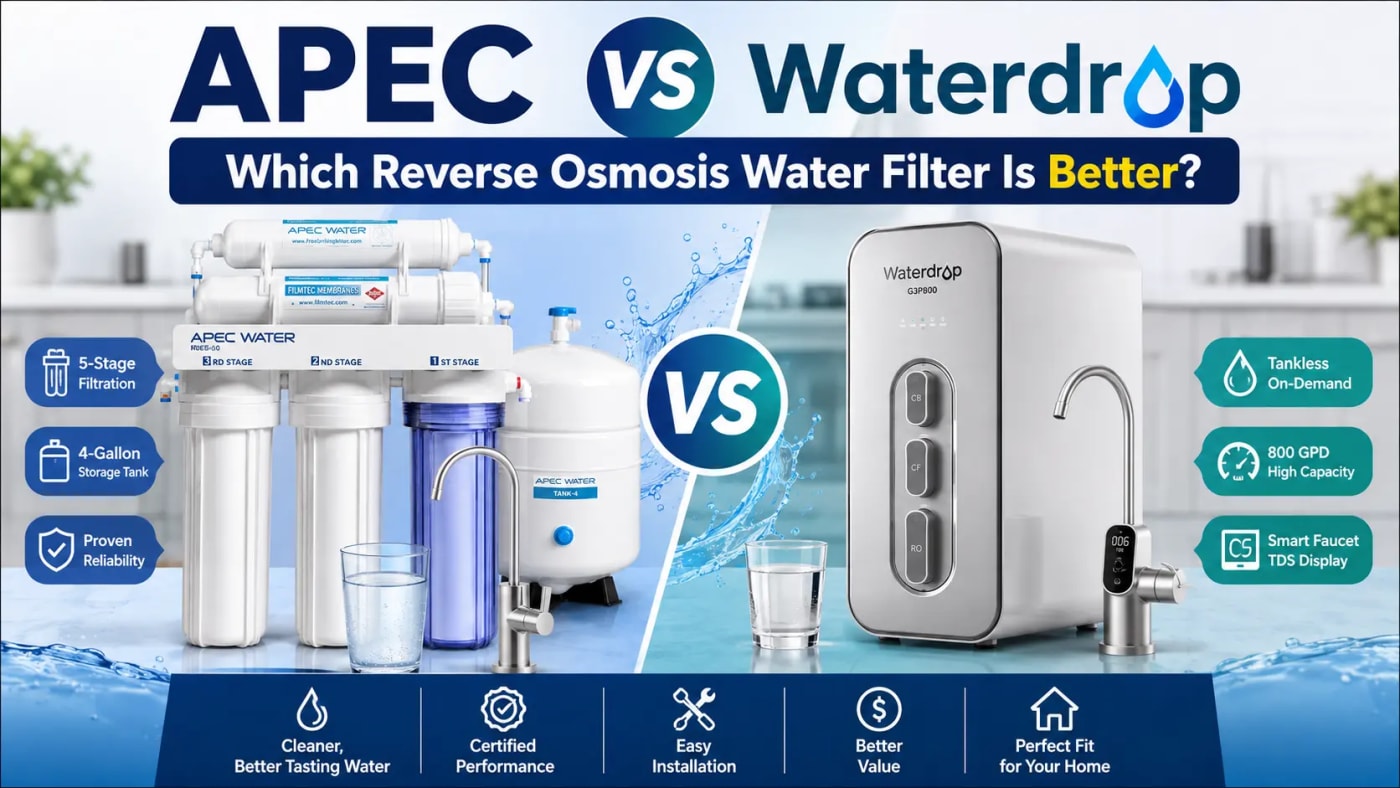
Choosing between APEC and Waterdrop is not simply about picking a bigger brand name. Both companies build reverse osmosis systems, but their approach to design is different. APEC is known for traditional tank based systems. Waterdrop has built its reputation on tankless, on demand systems.
The real answer to "which one is better" depends on several factors. These include system design, filtration performance, certifications, daily water output, under sink space, wastewater efficiency, installation needs, maintenance routine, total ownership cost, and smart features. It also depends on what your household actually needs from a water filter.
Throughout this guide, the APEC ROES-50 and the Waterdrop G3P800 are used as representative examples. They do not represent every product each brand sells. Both companies offer several other models with different capacities and features. This article breaks down each decision factor so you can match a system to your actual needs instead of picking based on brand reputation alone.
How Do APEC and Waterdrop Differ in Their Reverse Osmosis System Design?
The biggest difference between APEC and Waterdrop lies in the basic architecture of their systems. APEC has built its reputation on traditional tank based reverse osmosis systems. Waterdrop has focused on tankless, on demand systems.
A tank based system, like the APEC ROES-50, filters water and stores it in a pressurized tank under your sink. When you open the faucet, water flows out from this stored supply. APEC officially lists the ROES-50 with a 4 gallon pressurized tank. This design uses water pressure to move water through the filters and does not need electricity to operate.
A tankless system, like the Waterdrop G3P800, works differently. It filters water at the exact moment you need it, without storing a reserve. Waterdrop lists the G3P800 as a tankless system that requires electricity to run its internal pump. This design removes the tank but adds a dependency on a power outlet.
The table below shows the core design differences between the APEC ROES-50 and the Waterdrop G3P800.
Feature | APEC ROES-50 | Waterdrop G3P800 |
System type | Tank based | Tankless |
Storage tank | 4 gallon pressurized tank | None |
Power source | Water pressure only | Electricity required |
Filtration stages | 5 stages | 10 stages |
How Does a Tank-Based APEC System Compare With a Tankless Waterdrop System for Daily Water Availability?
A tank system stores a reserve of filtered water ahead of time. This means water is ready to use even before you turn on the faucet. A tankless system produces water on demand, without holding a built in reserve.
This difference matters most during moments of heavy use. If several people in your home need filtered water at the same time, a tank can run low and needs time to refill. A tankless system keeps producing water continuously, as long as it has power and enough water pressure feeding into it.
What this means for you:
If your household uses filtered water in small amounts throughout the day, a tank system usually keeps up without issue.
If you often need large volumes quickly, such as filling a big pot or several bottles at once, a tankless system avoids the wait for a tank to refill.
If your area experiences frequent power outages, a tank system continues working because it does not depend on electricity.
If counter space and instant flow matter more to you than backup during outages, a tankless system offers that convenience.
Neither design is universally better. The right choice depends on your household's daily water habits and how you plan to use the system.
How Much Under-Sink Space Do APEC and Waterdrop RO Systems Require?
Physical footprint is one of the most practical differences between these two designs. A tank based system needs room for a separate storage tank in addition to the filter housings. A tankless system combines everything into one compact unit, which generally needs less cabinet space.
APEC officially provides dimensions for the ROES-50 system and its separate tank. The tank alone measures roughly 11 by 11 by 15 inches. This tank sits next to the filter housings, so your cabinet needs to fit both pieces.
Waterdrop provides dimensions for the G3P800 as a single compact unit, measuring approximately 18.11 by 5.67 by 17.72 inches. Because there is no separate tank, the whole system takes up one footprint rather than two.
The table below shows the space each exact model needs under your sink.
Component | APEC ROES-50 | Waterdrop G3P800 |
Filter unit | Separate housings, standard footprint | Single 18.11 x 5.67 x 17.72 inch unit |
Storage tank | Separate, approximately 11 x 11 x 15 inches | Not applicable, tankless |
Total cabinet items | Two components | One component |
If your under sink cabinet is small or already crowded with cleaning supplies and trash bins, a tankless design generally fits with less rearranging. If you have a larger cabinet, the extra tank space required by a traditional system may not be a problem at all.
How Do APEC and Waterdrop Compare for Filtration Performance and Contaminant Reduction?
Both APEC and Waterdrop sell reverse osmosis products, but actual contaminant reduction depends on the exact model and its certified performance data. A higher number of filtration stages or a higher GPD rating does not automatically mean better filtration. What matters is the certified reduction claim for each specific contaminant.
The APEC ROES-50 official page states the system removes up to 99% of contaminants through its RO membrane stage. This includes chlorine, fluoride, arsenic, lead, and chromium, along with general total dissolved solids reduction. The system uses 5 filtration stages, including sediment filtration, two carbon filtration stages, the RO membrane, and a final carbon polishing stage.
The Waterdrop G3P800 uses 10 filtration stages and officially lists certified standards that support reduction claims for a broader range of substances, including PFAS compounds such as PFOA and PFOS, chlorine, lead, and dissolved solids. Waterdrop states the system can reduce up to 99% of PFOA and PFOS using its 0.0001 micron RO membrane.
The table below shows how filtration performance compares between the two models.
Attribute | APEC ROES-50 | Waterdrop G3P800 | What this means |
Filtration stages | 5 stages | 10 stages | More stages can target more specific contaminants, but effectiveness depends on certified claims, not stage count alone |
Contaminant reduction claim | Up to 99% of 1,000+ contaminants including chlorine, fluoride, lead, arsenic, chromium | Up to 99% PFOA and PFOS reduction, plus TDS, chlorine, lead, and other contaminants | Both claim high reduction rates, but each is tied to specific tested substances |
Maximum TDS handled | Up to 2,000 ppm | Not separately capped in official listings | Check your water's TDS level before choosing either system |
Membrane rating | Standard TFC RO membrane | 0.0001 micron RO membrane | A smaller pore size can capture finer particles, including some PFAS compounds |
Do not assume that a system with more stages or a bigger membrane number automatically filters better than one with fewer stages. Always check the exact certified reduction percentage for the specific contaminant you care about, using each manufacturer's official documentation.
What Do the WQA and NSF/ANSI Certifications of APEC and Waterdrop Systems Actually Verify?
Certifications tell you what a system has been independently tested to do. They are not a marketing score, and having more certification numbers does not automatically mean a system is safer.
The APEC ROES-50 holds WQA Gold Seal certification, along with NSF/ANSI 58 and NSF/ANSI 372 certification. WQA Gold Seal confirms the product was tested by the Water Quality Association against its stated performance claims. NSF/ANSI 58 is the standard specific to reverse osmosis systems and covers contaminant reduction claims tied to the RO membrane. NSF/ANSI 372 addresses low lead content in the materials used to build the system. This certification is about the materials themselves, not a direct lead reduction claim from the water.
The Waterdrop G3P800 is certified by IAPMO R&T to NSF/ANSI 42, 53, 58, and 372. NSF/ANSI 42 covers aesthetic effects such as chlorine, taste, and odor reduction. NSF/ANSI 53 covers health related contaminant reduction claims, which can include substances like lead and certain organic compounds depending on the specific test. NSF/ANSI 58 again covers RO specific performance. NSF/ANSI 372 covers the same low lead material standard mentioned above.
The table below shows what each certification actually addresses.
Standard | What it addresses | Why it matters here |
WQA Gold Seal | Independent testing against the manufacturer's stated performance claims | Confirms the tested claims match what is advertised |
NSF/ANSI 42 | Aesthetic effects like chlorine, taste, and odor | Improves how the water tastes and smells |
NSF/ANSI 53 | Health related contaminant reduction | Confirms tested reduction of specific health related substances, not a blanket guarantee for every contaminant |
NSF/ANSI 58 | Reverse osmosis system performance | Confirms the RO membrane itself meets reduction standards for tested substances |
NSF/ANSI 372 | Low lead content in materials | Confirms the system parts do not add lead, this is a materials standard, not a water testing claim |
Before choosing based on certifications alone, check which exact contaminants each certification covers for the exact model you are considering. A certification number by itself does not tell you everything the system removes.
How Do APEC and Waterdrop Compare in Water Production Capacity and Flow?
Gallons per day, often shortened to GPD, is a rating of how much water a system can produce under specific test conditions. It is not a measure of water purity. A system with a higher GPD rating does not filter water any more thoroughly than one with a lower rating.
APEC lists the ROES-50 at 50 GPD, tested under specified operating conditions including adequate feed water pressure. Waterdrop lists the G3P800 at 800 GPD, also tested under specific conditions, typically around 77 degrees Fahrenheit water temperature and 60 psi of pressure. Real world output for both systems can be lower if your home has colder water or lower incoming pressure.
The table below shows the rated output and test conditions for each system.
System | Rated output | Test conditions | Real world note |
APEC ROES-50 | 50 GPD | Feed water pressure 40 to 85 psi | Tank stores water ahead of demand, so instant flow does not rely only on this rating |
Waterdrop G3P800 | 800 GPD | Approximately 77°F water temperature, 60 psi pressure | Output drops with colder water or lower pressure, commonly reported in the 500 to 600 GPD range under less ideal home conditions |
Which households benefit from higher output:
Small households with light daily use often do not notice a practical difference between 50 GPD and 800 GPD because a tank stores enough water in advance.
Households that fill large pots, jugs, or multiple bottles at once benefit more from a high GPD tankless system, since water keeps flowing without a wait.
Homes with older plumbing or low water pressure should check real output numbers rather than relying only on the advertised maximum rating.
Does a Higher GDP Rating Make Waterdrop a Better Choice for Large Households?
A higher GDP number sounds like an obvious advantage, but actual household need depends on usage patterns, not simply family size. Two households of the same size can have very different water demands.
When each type makes sense:
Occasional drinking and cooking demand: a traditional lower capacity system like the ROES-50 is often sufficient, since the tank keeps a ready supply on hand between uses.
Frequent high volume demand, such as filling large containers, running a coffee shop level of activity, or having many people draw water at once: a higher output system like the G3P800 offers more convenience because it does not run dry.
Mixed or unpredictable demand: consider your peak usage moments, not just your average daily use, when deciding how much output you actually need.
Which Brand Produces Less RO Wastewater, APEC or Waterdrop?
Reverse osmosis systems produce some wastewater as part of the filtration process. This water carries away the contaminants the membrane filters out. The ratio between pure filtered water and wastewater varies by exact model, so you should never assume one ratio applies to every APEC or every Waterdrop system.
Waterdrop officially lists the G3P800 with a 3 to 1 pure to drain ratio. This means the system produces 3 gallons of filtered water for every 1 gallon sent down the drain as wastewater. This ratio is considered efficient compared to many older reverse osmosis designs.
Traditional tank based systems, including many APEC models, can vary more widely in wastewater ratio depending on the exact model, membrane type, and water pressure. Always check the specific ratio for your chosen model rather than assuming a fixed number for the whole brand.
The table below shows the pure to drain ratio for each model.
Model | Stated ratio | What this means |
Waterdrop G3P800 | 3:1 pure to drain | For every 3 gallons of clean water produced, 1 gallon goes to drain as wastewater |
APEC ROES-50 | Varies by exact operating conditions and should be checked against current official specifications | Traditional systems can range more widely, so confirm the exact figure before comparing |
Avoid making annual dollar savings claims based on wastewater ratios alone. Local water rates and actual household consumption vary too much to calculate a universal saving figure without checking your own water bill and usage.
What Does the Pure-to-Drain Ratio Mean When Comparing APEC and Waterdrop?
The pure to drain ratio is a simple way to describe filtration efficiency. It compares the amount of usable filtered water produced against the amount of water sent to the drain during the same filtration process.
For example, a 1 to 1 ratio means the system sends away the same amount of water it produces for drinking. A 3 to 1 ratio, like the one Waterdrop lists for the G3P800, means three times more filtered water is produced compared to what goes to waste.
When comparing two systems, always check the ratio for the exact model. Do not assume every tankless system is equally efficient, and do not assume every tank based system wastes more water. Efficiency depends on the specific membrane and system design used in that model.
How Do APEC and Waterdrop Compare for Installation Requirements?
Installation involves several practical requirements. These include a water supply connection, a drain connection, a dedicated faucet, enough under sink space, adequate feed water pressure, and in some cases an electrical outlet. These exact requirements vary by model, so check the official specifications for the system you are considering.
APEC officially lists the ROES-50 feed water pressure requirement as 40 to 85 psi. This range needs to be met for the system to function properly and fill its tank at a reasonable rate. The system does not require electricity, since it relies entirely on incoming water pressure.
Waterdrop lists electricity as a requirement for the G3P800, since its internal pump and smart faucet display need a power source. This means your installation location needs an available outlet within reach of the unit.
The table below shows the installation requirements for each system.
Requirement | APEC ROES-50 | Waterdrop G3P800 |
Feed water pressure | 40 to 85 psi | Rated performance tested at 60 psi |
Electricity needed | No | Yes |
Drain connection | Required | Required |
Dedicated faucet | Included | Included, with smart LED display |
Typical installation time | Comparable to other tank based DIY kits | Approximately 30 minutes with included kit, according to Waterdrop |
This section covers requirements only. Detailed step by step installation instructions are outside the scope of this comparison and are best followed directly from each manufacturer's official installation manual.
Do Waterdrop Tankless RO Systems Need Electricity While Traditional APEC Systems Do Not?
Yes, for these specific representative models. The Waterdrop G3P800 officially requires electricity to power its internal pump and smart faucet features. Without an outlet nearby, the system cannot function as designed.
Traditional systems such as the APEC ROES-50 operate through water pressure alone, combined with the storage tank design. There is no dependency on electricity for the core filtration process.
This distinction matters in two practical situations. First, if your under sink area does not have an accessible outlet, a tank based system avoids the need for additional electrical work. Second, during a power outage, a tank based system continues to provide stored filtered water, while a tankless electric system stops producing new filtered water until power returns.
Which Brand Is Easier to Maintain and Replace Filters For?
Maintenance involves how often filters need replacing, how many components the system has, how easy those components are to access, and whether the filters are proprietary to one brand or compatible with other options.
Waterdrop officially lists specific replacement intervals for the G3P800. The CF filter needs replacement every 6 months. The CB filter needs replacement every 12 months. The RO filter needs replacement every 24 months. This staggered schedule means you replace different components at different times rather than swapping everything at once.
APEC recommends replacing most filters in the ROES-50 system every 6 to 12 months, depending on water quality and usage. The RO membrane itself typically lasts longer, often cited around 2 to 3 years, and should be replaced on that schedule even if performance still seems adequate.
The table below shows the filter replacement schedule for each system.
Component | APEC ROES-50 | Waterdrop G3P800 |
Sediment and carbon filters | Every 6 to 12 months | CF filter every 6 months |
Secondary filter stage | Included in standard 6 to 12 month set | CB filter every 12 months |
RO membrane | Approximately every 2 to 3 years | RO filter every 24 months |
Number of filter stages to track | 5 stages | 10 stages |
Do not assume every APEC filter set uses fully universal parts, and do not assume every Waterdrop filter is exclusive to that brand. Always check compatibility against the exact model number before ordering replacement filters, since using incompatible filters can affect performance and may void a warranty.
How Much Do APEC and Waterdrop Replacement Filters Cost Over Time?
Replacement filter prices change over time, so any specific dollar figure should be checked against current official pricing immediately before you rely on it. Instead of publishing a fixed cost that may go out of date, use this simple formula to calculate your own ownership estimate.
Formula for calculating ownership cost:
Start with the current product price from an official or verified current retailer.
Add the official replacement filter price for each component the system uses.
Multiply each filter's price by how many times you will replace it within your chosen time period, based on the official replacement interval.
Add these totals together to get your estimated cost for that period.
As one general reference point checked at the time of writing, an APEC ROES-50 replacement filter set was listed around 25 to 55 dollars depending on the retailer and set size, while Waterdrop replacement filters for the G3P800 are sold on a subscription basis with the interval noted above. These figures change often, so confirm current pricing directly from each manufacturer's official store before making a purchase decision.
How Do APEC and Waterdrop Compare in Upfront Price and Long-Term Ownership Cost?
A complete cost comparison separates the initial purchase price from ongoing costs. Ongoing costs include recurring filter replacements, electricity where relevant, potential installation costs, and any additional parts needed over time.
What to include in a full cost picture:
Initial purchase price of the complete system, checked from an official or verified current retailer.
Scheduled filter replacement costs, based on each component's official replacement interval.
Electricity cost, relevant only for systems like the Waterdrop G3P800 that require a power source.
Installation costs, if you plan to hire a plumber instead of doing a DIY setup.
Any optional add ons, such as extra filter sets or accessories.
Generally, tank based systems like the APEC ROES-50 have a lower upfront price and lower ongoing filter costs, since they use fewer filtration stages. Tankless systems like the Waterdrop G3P800 typically cost more upfront and can involve more components to replace over time, but they offer higher daily output and additional features such as UV sterilization and smart monitoring.
The cheaper option is not automatically the better value for every buyer. If your household values compact space, higher output, and smart monitoring, the added cost of a system like the G3P800 may be worth it. If your priority is a lower cost, simpler system with fewer parts to track, a traditional tank based option like the ROES-50 may offer better value for your specific needs.
Are Waterdrop's Smart Features Worth More Than APEC's Simpler System Design?
Technology and convenience features are one of the clearest differences between these two approaches. Waterdrop has built several smart features into the G3P800, including a smart faucet, real time TDS display, filter life monitoring, and automatic flushing.
The smart faucet displays live TDS readings directly at the point of use. This lets you see a general indicator of dissolved solids in your water without needing a separate handheld meter. The system also tracks filter life and provides a reminder when a specific filter needs replacement, which helps prevent forgetting a maintenance schedule.
The table below shows what each smart feature does and how it helps you.
Feature | What it does | Benefit to you |
Smart LED faucet | Displays real time TDS reading | Gives an ongoing indicator of dissolved solids without a separate meter |
Filter life monitoring | Tracks each filter's remaining lifespan | Reduces the chance of forgetting a replacement schedule |
Automatic flushing | Cleans the RO membrane on a set schedule | Helps prevent buildup and supports stable filtration performance over time |
A TDS reading is a helpful general indicator, but it is not a complete water safety test. A low TDS number does not confirm the absence of specific contaminants like PFAS or bacteria, and a high TDS number does not automatically mean the water is unsafe. Use TDS readings as one data point, not a full water quality report.
APEC's ROES-50 uses a simpler design without these smart monitoring features. This can appeal to buyers who prefer fewer electronic parts and a more straightforward system to operate and maintain.
Do Features Like UV Sterilization and Remineralization Change Which Brand You Should Choose?
UV sterilization and remineralization are optional treatment features. Whether you need either one depends on your specific water source and the exact product configuration you choose, not on brand alone.
UV sterilization:
UV sterilization matters most if your water source may carry bacteria or viruses that pass through the RO membrane's own filtration stage or exist afterward in stored or stagnant water. Waterdrop's official information for the G3P800 includes a UV component in relevant configurations, using an LED based system rather than older mercury based UV lamps. Not every household needs this feature, particularly those on treated municipal water with no known microbiological concerns.
Remineralization:
Remineralization adds back minerals that the RO process removes during filtration. This is primarily a taste preference feature rather than a required health measure for most users. Some buyers prefer the taste of remineralized water, while others find standard RO output perfectly acceptable. Check whether your chosen model includes this as a built in stage or as a separate optional filter.
Neither feature makes one brand automatically the right choice for everyone. Base your decision on your actual water source and personal taste preference, not on the idea that more features always means a better system.
Which Water Quality Factors Should You Check Before Choosing Between APEC and Waterdrop?
The better system for you depends on more than brand reputation. It depends on what is actually in your tap water, your household's daily demand, your available sink space, your incoming water pressure, and your installation conditions.
Checklist before choosing a system:
Get a current water quality report from your local water utility, or test your water directly if you use a private well.
Check your TDS level and note any specific contaminants of concern, such as lead, PFAS, or chlorine byproducts.
Measure your available under sink space, including room for a tank if you are considering a tank based system.
Check your home's water pressure to confirm it falls within the operating range of the system you are considering.
Confirm whether an electrical outlet is available near the installation location if you are considering a tankless system.
Estimate your household's typical and peak daily water demand.
Use a current water quality report or appropriate testing before selecting a system aimed at a specific contaminant. This section is meant to guide your next research step, not to repeat the full brand comparison covered earlier in this article.
Do You Need a Reverse Osmosis Water Filter Based on Your Tap Water Quality?
Whether you need a reverse osmosis system depends on what is actually present in your tap water and what you personally want to reduce. Municipal water in many areas already meets basic safety standards, but some contaminants, taste issues, or personal health concerns may still lead a household to choose additional filtration.
TDS alone is not a complete safety measurement. It tells you the general level of dissolved solids in your water, but it does not identify which specific contaminants are present. For a full picture, check your official water quality report and consider testing for specific substances you are concerned about.
For a deeper explanation of testing options and how to match a filter to your specific water quality, see our guide on [Water Quality Testing and Choosing the Right Water Filter].
What Is the Difference Between Tankless and Tank Reverse Osmosis Systems?
A tank based system stores filtered water in advance, using a larger footprint under your sink. A tankless system produces water on demand, using a more compact design that may depend on electricity.
This is the core distinction covered earlier in this comparison between the APEC ROES-50 and the Waterdrop G3P800. For the full breakdown of design differences, daily availability, and space requirements, see our dedicated guide on [Tankless vs Tank Reverse Osmosis Systems].
What Does NSF/ANSI 58 Certification Mean for a Reverse Osmosis System?
NSF/ANSI 58 is the certification standard specific to reverse osmosis systems. It must be interpreted according to the exact standard and the specific performance claims tied to it, rather than treated as a general safety label.
Before buying any RO system, check the exact certification scope listed for that specific model. For a full explanation of what this certification covers and how to read it correctly, see our dedicated guide on [NSF/ANSI 58 Certification for Reverse Osmosis Systems].
How Often Should Reverse Osmosis Filters Be Replaced?
Replacement schedules vary by filter type, your local water quality, and the manufacturer's specific instructions. There is no single universal schedule that applies to every system or every filter stage.
For a complete breakdown of typical replacement intervals and how to build a maintenance schedule for your specific system, see our guide on [Reverse Osmosis Filter Replacement Schedule].
Does Reverse Osmosis Remove PFAS, Lead, Fluoride, and Other Contaminants?
Contaminant reduction depends on the exact system, its membrane specifications, its certifications, and the documented claim for that specific contaminant. Not all reverse osmosis systems remove every contaminant at the same rate, so check the certified data for the exact model you are considering.
For a full breakdown of which contaminants reverse osmosis systems typically address and how to verify specific claims, see our guide on [What Reverse Osmosis Filters Remove From Water].
Which Waterdrop Reverse Osmosis System Is Best for Different Household Needs?
Waterdrop offers several models beyond the G3P800, with differences in GPD output, physical footprint, certifications, wastewater ratio, UV inclusion, remineralization options, and price. The right model for your household depends on your specific priorities among these factors.
For a full comparison of Waterdrop's model lineup and which one fits different household needs, see our dedicated guide on [Best Waterdrop Reverse Osmosis Systems].
Which APEC Reverse Osmosis System Is Best for Different Household Needs?
APEC also offers multiple models beyond the ROES-50, with differences in tank capacity, GPD rating, number of filtration stages, remineralization options, and some tankless configurations. The right choice depends on matching these features to your household's specific water quality and usage needs.
For a full comparison of APEC's model lineup and which one fits different household needs, see our dedicated guide on [Best APEC Reverse Osmosis Systems].
Our Verdict
Neither the APEC ROES-50 nor the Waterdrop G3P800 is a universal winner they're built for different priorities, and the "better" choice comes down to how your household actually uses water.
Choose the APEC ROES-50 if:
You want a lower upfront cost and simpler long-term ownership
You'd rather avoid depending on electricity, including during power outages
Your household has light-to-moderate daily water use that a 4-gallon tank can comfortably keep up with
You prefer a straightforward system without smart displays or extra components to manage
Choose the Waterdrop G3P800 if:
Your household needs large volumes of filtered water quickly, without waiting for a tank to refill
You want broader certified contaminant coverage, including PFAS reduction
Under-sink space is tight and you'd rather have one compact unit instead of a filter housing plus a separate tank
You value real-time monitoring TDS readout, filter-life tracking, and automatic flushing and don't mind paying more upfront for it
Bottom line: The APEC ROES-50 is the practical, budget-friendly pick for smaller households that want reliable filtration without extra bells and whistles. The Waterdrop G3P800 is the better fit for larger households, high-volume use, or anyone who wants the latest filtration technology and smart features provided they have an outlet available and are comfortable with the higher price tag. Whichever you lean toward, check your own water pressure, TDS level, and any specific contaminants of concern before finalizing your decision, since both systems' real-world performance depends on your home's actual conditions.