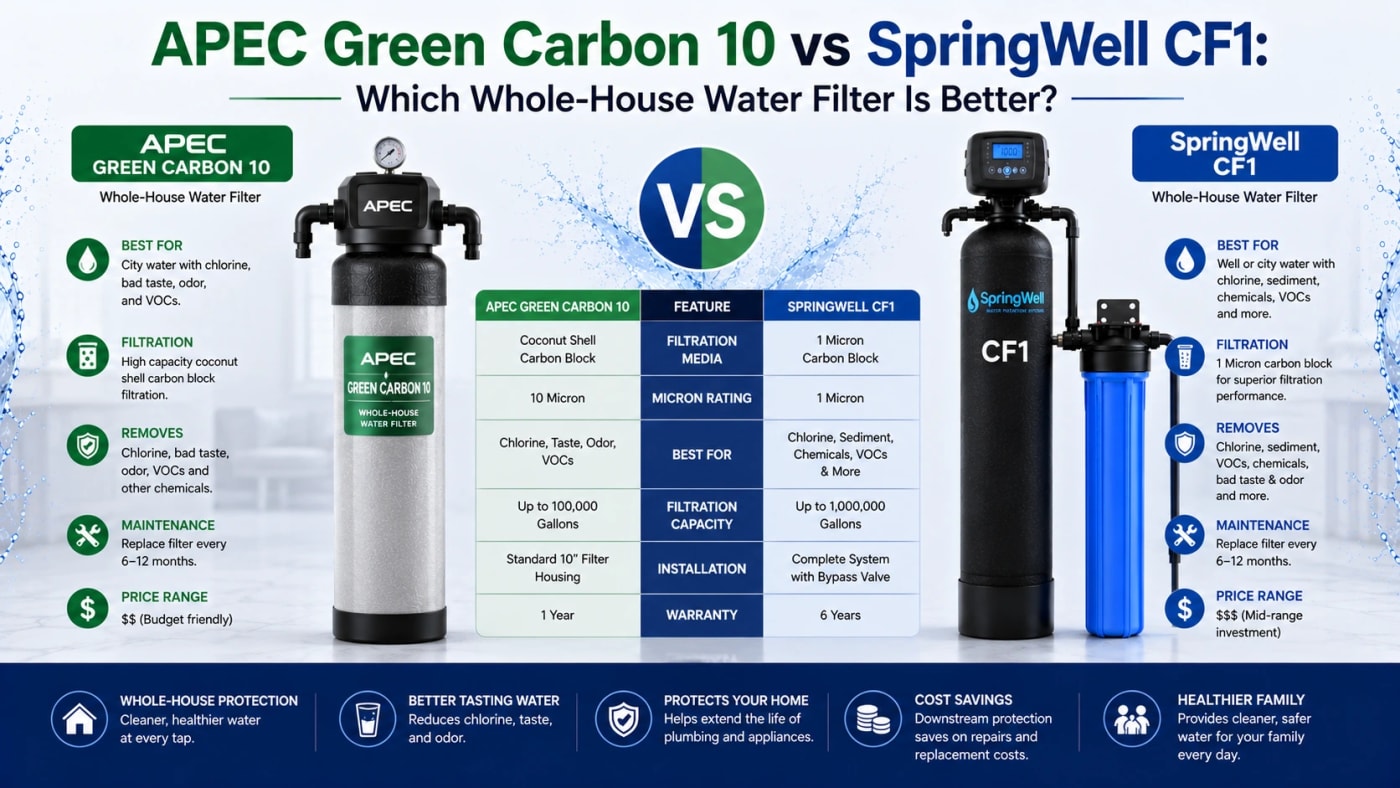
Both the APEC Green Carbon 10 and the SpringWell CF1 are whole house point of entry filters built around catalytic carbon, and both target municipal city water. This guide compares both systems point by point, covering physical specifications, filtration media and treatment design, contaminant targeting, real world flow performance, installation and maintenance requirements, long term ownership cost, warranty and buyer protection, and the water problems neither system solves on its own. Along the way, the guide translates each attribute into practical decision scenarios, so a buyer can see exactly where the two systems match and where they separate, without relying on either brand's marketing alone.
This table shows a primary side by side comparison of both systems, based on current official manufacturer data:
How do the APEC Green Carbon 10 and SpringWell CF1 specifications differ for whole house use?
The APEC Green Carbon 10 and SpringWell CF1 specifications differ mainly in flow rating and tank size, while both are built for the same 1 to 3 bathroom category.
Physical and system specifications for each unit:
APEC Green Carbon 10: Rated service flow of 8 to 10 GPM, tank body measuring 9 inches wide by 48 inches tall, or 53 inches with the tank top installed. System weight is around 60 pounds. Minimum working pressure is 25 PSI, and operating temperature runs from 36 to 120 degrees Fahrenheit. The connection uses a 1 inch FPT bypass adapter. APEC states the system is not recommended for outdoor installation.
SpringWell CF1: Rated service flow of 9 GPM, tank body measuring 9 inches wide by 48 inches tall, or 52 inches with the head installed. Operating pressure runs from 25 to 80 PSI, and operating temperature runs from 36 to 120 degrees Fahrenheit. The connection uses a 1 inch fitting. SpringWell states the system can be installed outdoors as long as temperatures stay above freezing.
Both systems land in a very similar footprint and flow range, so the main practical difference for most 1 to 3 bathroom homes comes down to indoor versus outdoor placement and the small gap between an 8 to 10 GPM range and a fixed 9 GPM rating.
What filtration media and treatment design does each system use?
The filtration media and treatment design used by each system share the same core idea, catalytic carbon, but they are built differently inside the tank.
Media and design comparison:
APEC Green Carbon 10: Uses catalytic granular activated carbon made from coconut shell material, contained in a single tank with an upflow service direction. Water enters, passes upward through the carbon bed, and exits toward the house. A separate sediment filter is bundled with the system to protect the main tank from sand, silt, and rust.
SpringWell CF1: Uses catalytic carbon combined with KDF media in a single upflow tank, along with a separate sediment pre filter that is replaced on its own schedule.
Shared design goal: Both systems rely on an upflow tank to give water more contact time with the media bed, which is intended to support even treatment across the full media volume rather than water finding one narrow path through the tank.
Neither design is universally better on its own. The addition of KDF media in the SpringWell CF1 gives it an extra layer aimed at certain metals and contaminants beyond what carbon alone addresses, while APEC's single carbon bed keeps the design simple and focused on adsorption.
Which contaminants does APEC Green Carbon 10 versus SpringWell CF1 target or reduce?
APEC Green Carbon 10 versus SpringWell CF1 target a similar contaminant list, but the two companies phrase and qualify these claims differently.
This table shows contaminant claims for each system alongside the type of evidence behind each claim:
Contaminant | APEC Green Carbon 10 claim | SpringWell CF1 claim | Evidence type and qualification |
Chlorine | Guaranteed removal, per product listing | Reduced, with a manufacturer performance guarantee | Manufacturer statement for both, treat as a starting point rather than a certified lab figure for either brand unless a specific NSF number is provided |
Chloramine | Guaranteed removal, marketed with almost double the removal capacity of standard carbon | Reduced through catalytic carbon, per manufacturer statement | Manufacturer claim for both, chloramine is harder to remove than chlorine so contact time and carbon type matter |
Taste, odor, and color | Guaranteed removal, per product listing | Addressed as a result of chlorine and chemical reduction | Manufacturer claim for both |
VOCs and THMs | Listed as removed on the product page | Listed as reduced on the product page | Manufacturer claim for both |
PFAS, PFOA, PFOS | Not specifically marketed as a targeted contaminant on the current APEC listing | Specifically marketed, with reduction supported by third party testing referenced in SpringWell technical documents | SpringWell publishes a specific PFAS claim, APEC does not feature this claim on its current product page |
Media certification | APEC states its Green Carbon media is NSF certified, without listing every specific standard number on the retail page | SpringWell references independent testing for select claims, without a single blanket NSF certification for the whole CF1 system | Buyers who need a specific certification number for a specific contaminant should request the current test data sheet directly from either company |
A manufacturer claim on a product page is a starting point, not a certified lab result. Readers who need a guaranteed reduction percentage for one specific contaminant should ask each company for its current documentation before buying, since certification details are updated over time.
How does the 10 GPM APEC rating compare with the SpringWell CF1 9 GPM service flow in a real home?
The 10 GPM APEC rating compares closely with the SpringWell CF1 9 GPM service flow, since both numbers sit in the same practical range for a 1 to 3 bathroom home. GPM stands for gallons per minute, and it measures how much water a system can supply before pressure at the fixtures begins to drop. Bathroom count alone does not decide sizing, since the real question is how many fixtures run at the same time.
A simple peak demand example, using APEC's own fixture flow guidance:
Shower running: Uses around 3 GPM.
Laundry machine running at the same time: Uses around 3 GPM.
Dishwasher running at the same time: Uses around 3 GPM.
Total estimated peak demand: 3 plus 3 plus 3 equals 9 GPM.
Against this example, the APEC unit at up to 10 GPM has a small amount of extra headroom, while the SpringWell CF1 at 9 GPM sits right at the estimated peak. This is a manufacturer style example rather than a fixed number for every household, since actual fixture flow varies by model and by home. Households that regularly run three or more fixtures at once should measure their own peak demand rather than relying on bathroom count alone.
How do installation and maintenance requirements differ between APEC Green Carbon 10 and SpringWell CF1?
Installation and maintenance requirements differ mainly in flushing steps at start up and in how often each brand recommends replacing the main media bed.
Installation steps common to both systems, based on manufacturer instructions:
Choose an indoor location on the main line: APEC specifically states its system should not be installed outdoors. SpringWell allows outdoor installation above freezing temperature.
Shut off the main water supply: Both manuals require this before connecting the bypass valve.
Connect the bypass valve and inlet and outlet fittings: Both systems use a simple in and out connection with a 1 inch adapter.
Flush the carbon media before first use: APEC's manual specifically requires a media flush step using a flush kit before the system is placed into normal service, to clear carbon fines from the tank.
Turn water back on slowly and check every joint for leaks: This step applies to both systems.
Confirm normal flow at the furthest fixture in the house: This step verifies the installation before daily use begins.
Both manufacturers state that a homeowner with basic plumbing skills can complete installation, though APEC product listings note that plumbing experience is recommended, and both companies confirm that professional installation remains optional rather than mandatory for warranty purposes.
Maintenance comparison for each system:
APEC Green Carbon 10: The bundled sediment filter needs periodic inspection and replacement based on household water use and visible pressure drop. The main catalytic carbon media is rated for 5 to 8 years before replacement.
SpringWell CF1: The 5 micron sediment pre filter is commonly replaced every 6 to 9 months. The main carbon and KDF media is rated for 10 years or 1,000,000 gallons, whichever comes first.
SpringWell's stated media interval runs longer than APEC's stated interval, which matters for households planning long term costs, though both companies describe their main tank as largely maintenance free between sediment filter changes.
Which system has the lower long-term ownership burden?
The system with the lower long term ownership burden depends on how the media replacement interval and current pricing line up over time.
Cost of ownership factors for reference, since prices and stock status change often:
APEC Green Carbon 10: Listed around 850 dollars for the base unit at the time of writing, though this specific listing showed a sold out status, so current price and availability should be confirmed directly on APEC's site before ordering. Main media replacement is needed sooner, at the 5 to 8 year mark, compared with SpringWell.
SpringWell CF1: Listed around 1,000 to 1,100 dollars depending on current promotions. Main media replacement is needed later, at the 10 year or 1,000,000 gallon mark, which can offset some of the higher upfront price over a long ownership period.
Shared low cost factor: Neither system needs electricity, a drain line, or a backwashing cycle, so neither adds an ongoing utility cost the way an electric or salt based system would.
Exact totals depend on the price each buyer pays and how long the main media actually lasts in their specific water condition, so this section should be read as a framework rather than a fixed final number.
How do APEC and SpringWell differ in warranty and buyer protection?
APEC and SpringWell differ in warranty length and in how the return period is structured, even though both offer a multi year commitment on the core hardware.
Warranty and return terms for each brand:
APEC Green Carbon 10: A 10 year limited warranty covers the tank, valve, bypass, and fittings against defects in material and workmanship. Returns are accepted within 30 days from the date of invoice, following APEC's stated return policy conditions.
SpringWell CF1: A lifetime warranty covers the tank, valve, and fittings against defects, alongside a separate guarantee of performance stating that the carbon will reduce chlorine and chloramine below minimum detection levels for 6 years or 1,000,000 gallons. Returns are accepted within 6 months of the original purchase date, with a restocking fee applied to approved non defective returns.
SpringWell's lifetime warranty term is longer on paper than APEC's 10 year term, and its 6 month return window is longer than APEC's 30 day window. Buyers should still read each company's current warranty document directly, since exclusions for improper installation or water conditions outside the stated range apply to both brands.
What water-treatment problems can neither APEC Green Carbon 10 nor SpringWell CF1 solve by themselves?
Neither the APEC Green Carbon 10 nor the SpringWell CF1 solves every water problem by themselves, since both are carbon based filters rather than softeners or reverse osmosis systems.
Water problems outside the scope of either system:
Hard water and scale: Both systems reduce chemical contaminants, not hardness minerals such as calcium and magnesium. A separate softener or salt free conditioner is needed for scale control.
High total dissolved solids or fluoride: Carbon filtration does not meaningfully lower TDS or remove fluoride. A reverse osmosis system at the drinking water tap covers this need.
Microbiological contamination: SpringWell explicitly states its CF1 system is not designed to make water microbiologically safe, and offers a UV system as a separate add on for this purpose. APEC's carbon based design carries the same limitation, since carbon adsorption does not disinfect bacteria or viruses.
Homeowners with any of these specific problems should treat a carbon filter as one part of a larger water treatment plan, adding a softener, RO unit, or UV system as a separate layer rather than expecting one single filter to solve every issue.
Which system is better for city-water homes based on household needs and treatment priorities?
The system that is better for city water homes depends on the specific priority a household is weighing, since both systems perform a similar core job with different trade offs.
Decision scenarios based on the attributes compared above:
A household that wants the lowest upfront price: The APEC Green Carbon 10 fits well, based on its current listed price being lower than SpringWell's.
A household that wants the longest media life before replacement: The SpringWell CF1 fits well, given its 10 year or 1,000,000 gallon media rating compared with APEC's 5 to 8 year rating.
A household specifically concerned about PFAS: The SpringWell CF1 fits well, since it carries a specific PFAS reduction claim supported by referenced third party testing.
A household that wants the longest warranty term: The SpringWell CF1 fits well, due to its lifetime warranty compared with APEC's 10 year term.
A household planning an outdoor installation location: The SpringWell CF1 fits well, since APEC specifically states its system should stay indoors.
A household that wants a bundled free sediment filter included in the box: The APEC Green Carbon 10 fits well, since it ships with a 10 inch sediment filter at no extra cost.
How should the APEC Green Carbon 10 and SpringWell CF1 comparison guide the next water-filtration decision?
The APEC Green Carbon 10 and SpringWell CF1 comparison should guide the next water filtration decision by pointing a buyer toward their own water source, their specific target contaminants, their household's peak flow demand, and whether whole house treatment is being paired with a separate point of use system for drinking water. A side by side comparison like this one gives the starting facts, but the final decision should be matched against your own water test results and daily household demand rather than either brand's marketing alone.
What should you know before buying a whole-house water filter for your home?
You should know your water source, your specific contaminant profile, your peak flow demand, your installation location, and your maintenance preference before buying a whole house water filter for your home. See the full whole house water filter buying guide and hub for a complete checklist.
How does reverse osmosis compare with whole-house carbon filtration for drinking water?
Reverse osmosis compares with whole house carbon filtration through a different treatment scope. Whole house carbon filtration treats all water entering the home at one point. Reverse osmosis is commonly installed at a single drinking water tap and removes a wider range of dissolved contaminants through a membrane. See the full reverse osmosis versus carbon filtration guide for a complete comparison.
Does a whole-house carbon filter replace a water softener for hard water?
A whole house carbon filter does not replace a water softener for hard water, since carbon filtration and softening address different water characteristics entirely. Carbon reduces chemical contaminants. Softening reduces hardness minerals. See the full water softener versus water filter guide for a deeper look at hard water treatment.
How should you choose a whole-house water filter for city water?
You should choose a whole house water filter for city water by starting with a water test or report, identifying your specific contaminants, estimating your peak flow demand, selecting the right filtration technology, and planning any complementary treatment you may need. See the full best whole house water filters for city water hub for a complete step by step process.
How does the SpringWell CF1 compare with other whole-house water filters?
The SpringWell CF1 compares with other whole house water filters through differences in certification, flow rating, media type, and maintenance schedule, since additional competitors exist beyond APEC. See the full SpringWell CF1 comparisons and review hub for a broader look at how it stacks up against other brands.
How does the APEC Green Carbon 10 compare with other APEC water filtration systems?
The APEC Green Carbon 10 compares with other APEC water filtration systems as one entry in a wider APEC lineup that also includes larger whole house units, water softeners, salt free conditioners, and reverse osmosis systems for drinking water. See the full APEC water filter and Green Carbon hub for a complete breakdown of APEC's product range.