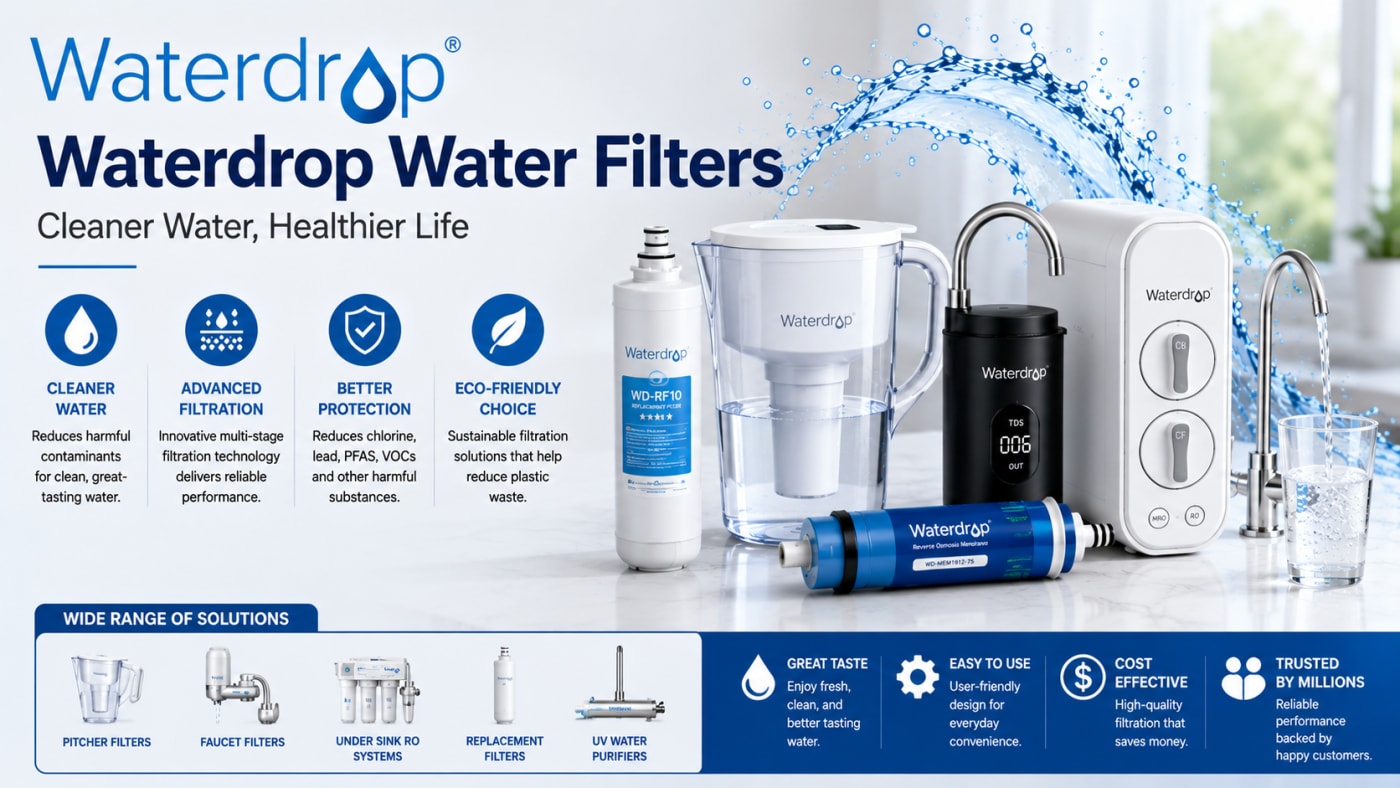
Waterdrop makes several types of water filters, including reverse osmosis systems, under sink filters, countertop filters, whole house filters, and bottleless water coolers, and each type uses a different filtration technology. Waterdrop is not one single product. Filtration method, installation format, certification status, and ownership requirements all differ between product lines. This guide explains the main product categories, the filtration technologies behind them, and how to match a category to your household needs.
What Types of Water Filters Does Waterdrop Offer?
Waterdrop products fall into several clear categories. Each one represents a different physical format and serves a different kind of household or space.
Waterdrop product categories:
Under sink filters: Install inside the cabinet below the kitchen sink and connect to the cold water line
Countertop filters: Sit on the kitchen counter and need no permanent plumbing connection
Reverse osmosis systems: Use a multi stage membrane process, available in under sink and countertop formats
Whole house filters: Connect to the main water line and treat water for the entire home
Bottleless water coolers: Combine filtration with a dispenser to replace bottled water coolers
Faucet and pitcher filters: Compact filtration products for light, everyday use
Refrigerator filters: Replace the water filter inside compatible refrigerators
A renter with no access to plumbing tools may choose a countertop filter. A homeowner who wants to treat all water entering the house may choose a whole house filter. The right category depends on installation space, water source, and filtration goals.
Which Filtration Technologies Does Waterdrop Use?
Waterdrop products use several filtration technologies, and each one works through a different mechanism and targets different substances.
The table below shows the main filtration technologies Waterdrop uses and what each one does.
Technology | How It Works | What It Targets |
Reverse osmosis | Pushes water through a semi permeable membrane under pressure | Dissolved solids, heavy metals, and contaminants smaller than water molecules |
Ultrafiltration | Uses a membrane with larger pores than reverse osmosis | Sediment, bacteria, and larger particles, while keeping minerals |
Activated carbon | Uses porous carbon material to trap particles | Chlorine, taste and odor compounds |
Sediment filtration | Uses a physical mesh or fiber layer | Dirt, rust, and sand particles |
Remineralization | Adds a mineral stage after RO filtration | Restores minerals removed during the RO process |
Alkaline treatment | Adds an alkaline stage after filtration | Raises the pH level of filtered water |
UV treatment | Uses ultraviolet light | Bacteria and microorganisms |
Reverse osmosis removes a much wider range of dissolved substances than the other technologies. Carbon, sediment, and ultrafiltration mainly target specific groups of contaminants and do not reduce dissolved solids the way reverse osmosis does.
Which Waterdrop Filters Fit Under Sink Installation?
Under sink filters include tankless reverse osmosis systems, direct connect filtration systems, and systems with a dedicated faucet. These filters connect to the cold water supply line inside the kitchen cabinet.
Under sink installation approaches:
Tankless RO systems: Skip the storage tank and produce filtered water on demand, saving cabinet space
Direct connect filtration systems: Attach straight to the water line, without a separate faucet in some models
Dedicated faucet systems: Come with a separate faucet installed on the sink or counter for filtered water only
Before choosing an under sink filter, check the available cabinet space, the plumbing connection type, and whether a separate faucet hole is needed.
Which Waterdrop Filters Fit Countertop Use?
Countertop filters sit directly on the kitchen counter and need no drilling or permanent plumbing change. Countertop RO systems use the same multi stage process as under sink RO systems, in a compact, movable unit. Countertop filtration systems use carbon or ultrafiltration without the RO membrane stage. This format suits renters, since rental agreements often restrict drilling or new plumbing lines, and it can be moved between homes.
How Do RO Systems Differ from Non RO Filters?
RO systems differ from non RO filters mainly in treatment method and the range of contaminants they reduce. Non RO systems, such as carbon or ultrafiltration filters, remove chlorine taste, sediment, and some larger particles, but generally do not reduce dissolved solids. RO systems add a membrane stage that removes a wider range of dissolved substances. RO systems are usually more complex and produce some wastewater during filtration, measured through the pure to drain ratio. Non RO systems are simpler and need less maintenance, but filter a narrower set of contaminants.
Which Contaminants Can Waterdrop Filters Reduce?
Reduction claims are specific to each product and technology, not a single brand wide guarantee.
The table below shows common contaminant groups, the technology responsible, and the evidence needed to confirm a claim.
Contaminant Group | Relevant Technology | Evidence Needed |
Chlorine taste and odor | Activated carbon | Product data sheet or NSF/ANSI 42 certification |
Lead | Reverse osmosis or certified carbon block | NSF/ANSI 53 certification for the specific model |
PFAS | Reverse osmosis or specialized carbon media | NSF/ANSI 53 or 58 certification for the specific model |
Fluoride | Reverse osmosis | NSF/ANSI 58 certification for the specific model |
Nitrate | Reverse osmosis | NSF/ANSI 58 certification for the specific model |
Arsenic | Reverse osmosis | NSF/ANSI 58 certification for the specific model |
Total dissolved solids | Reverse osmosis | Manufacturer TDS rejection rate data |
Not every Waterdrop filter reduces every contaminant on this list. A household concerned about a specific contaminant should check the certified performance data of the exact model, not the brand as a whole.
What Do Waterdrop's NSF Certifications Cover?
Certifications verify filtration claims by testing a specific product against a defined standard for a specific contaminant.
What each NSF/ANSI standard covers:
NSF/ANSI 42: Aesthetic effects, such as chlorine taste and odor reduction
NSF/ANSI 53: Health effects, such as lead and other specific contaminant reduction
NSF/ANSI 58: Reverse osmosis systems and reduction of dissolved contaminants such as fluoride, nitrate, and arsenic
NSF/ANSI 372: Lead free material compliance for system parts, not contaminant removal performance
NSF/ANSI 401: Reduction of emerging contaminants, including some pharmaceuticals and chemicals
NSF/ANSI 372 certification means the product parts meet lead free material requirements. It does not mean the filter removes lead from water. A filter can carry 372 certification and still lack 53 certification for lead reduction.
What Performance Attributes Should You Compare Between Models?
These attributes describe how a system performs day to day, separate from contaminant reduction claims.
Attributes worth comparing:
GPD, gallons per day: Total filtered water output capacity in one day
GPM, gallons per minute: Speed of water flow at the faucet
Filter capacity: Total volume a filter cartridge can process before replacement
Filter life: Expected time before a cartridge needs replacement, based on usage
Pure to drain ratio: Ratio of filtered water produced to wastewater discharged during RO filtration
TDS rejection rate: Percentage of total dissolved solids removed
Tankless design: Whether the system stores filtered water in a tank or produces it on demand
Dispensing options: Choices such as hot, cold, or room temperature output
A household with high daily water use needs a higher GPD rating. A household concerned about water waste should compare the pure to drain ratio between RO models.
How Does Waterdrop Handle Filter Replacement and Maintenance?
Filter replacement depends on the cartridge type, rated capacity, and household water usage. Waterdrop uses both integrated composite filters and independently replaceable stages, depending on the product line.
Maintenance factors to know:
Replacement cartridges: Each model uses specific cartridges rated for a certain volume of water
Filter life expectations: Based on rated capacity and actual usage, not a fixed calendar date
Maintenance indicators: Some models include lights or displays that signal replacement time
Cartridge compatibility: Cartridges are specific to each product line and are not always interchangeable
Integrated versus independent filters: Some systems combine stages into one cartridge, others use separate replaceable stages
Composite filters are simpler to replace but may cost more per replacement, since a household replaces multiple stages at once. Independent stages allow a household to replace only the depleted stage, which can lower cost over time.
How Do You Choose the Right Waterdrop Filter?
Choosing the right filter follows a clear sequence that narrows the choice step by step.
Steps to choose a Waterdrop water filter:
Identify your water source, since municipal and well water carry different concerns
Identify your target contaminants by testing your water or checking a local water quality report
Determine your installation location, whether under sink, countertop, or whole house
Choose the filtration technology that matches your target contaminants
Evaluate capacity and flow needs against household water usage
Verify the exact model certification for the contaminant claims that matter to you
Consider maintenance and ownership costs before final purchase
Quick Answers to Common Waterdrop Questions
Which Waterdrop filter removes lead from drinking water? Lead reduction is model specific, not brand wide. Verify the exact model's NSF/ANSI 53 certification rather than assuming any Waterdrop product removes lead based on the brand name alone.
Which Waterdrop filters reduce PFAS? PFAS reduction is not a universal claim across the product line. Different models use different filtration stages that affect PFAS reduction capability, so check the specific model's certified performance data.
How often should Waterdrop filters be replaced? Replacement frequency depends on the specific cartridge, its rated capacity, time since installation, and household water usage. There is no single interval that applies across all products.
How much do Waterdrop replacement filters cost? Cost varies by model and cartridge architecture. Systems using integrated composite cartridges may have a different cost structure than systems using independently replaceable stages.
Is Waterdrop a good water filter brand? Waterdrop offers a wide product range, compact and tankless design options, certification on specific products, and defined maintenance systems. A good evaluation depends on the exact model under consideration, not the brand as a whole.