How Do the Best Apartment Water Filters Compare?
Apartment renters have five strong water filter options, each suited to different needs, spaces, and budgets.
AquaTru Classic uses a four-stage reverse osmosis system that plugs in without needing any plumbing, making it a countertop unit you can easily move (as long as there's an outlet nearby). It removes the broadest range of contaminants — lead, fluoride, PFAS, VOCs, nitrates, and chlorine — and holds several certifications (NSF/ANSI 42, 53, 58, 401, and P473). Its 0.75-gallon tank lasts 600 to 1200 gallons, or roughly 6 to 24 months, before needing a new filter. It costs about $449 upfront, with ongoing filter costs of $95 to $100 per year. This makes it the best choice for renters who want the most thorough contaminant removal available.
Aquasana Clean Water Machine relies on powered carbon filtration (Claryum technology) and, like the AquaTru, plugs in with no plumbing required, sitting on the countertop and staying portable. It targets lead, mercury, chlorine, microplastics, and PFOA/PFOS, and carries NSF/ANSI 42, 53 (including P473), and 401 certifications. Rather than storing water in a tank, it filters on demand. A filter lasts about 300 gallons, or roughly 4 to 6 months. It costs about $130 to $160 upfront, with moderate ongoing filter costs. This unit suits renters who want fast filtration while still keeping beneficial minerals in their water.
PUR Plus PFM400H is a carbon block filter that screws directly onto the faucet, requiring no tools to install. It takes up no counter space at all, making it highly portable. It filters out lead, mercury, chlorine, and some pesticides, and is certified by NSF and WQA for 70 contaminants. Like the Aquasana, it filters on demand rather than storing water. Each filter lasts about 100 gallons, or roughly 3 months. It's the cheapest of the plumbed or powered options at $35 to $50 upfront, though replacement filters need to be bought low-cost but frequently. This is the ideal pick for renters with very little counter space.
Brita Denali with Elite Filter is a simple carbon pitcher that needs no installation at all — it just sits in the fridge. It's highly portable and removes lead, chlorine, asbestos, cadmium, and microplastics, backed by NSF/ANSI and WQA certification. Its 6-cup (about 48-ounce) pitcher holds a filter that lasts about 120 gallons, or roughly 6 months. At just $25 to $35 upfront with low ongoing costs, it's the most affordable and simplest option, best for renters who want the lowest-cost, no-fuss solution.
ZeroWater 10-Cup Ready-Pour is a five-stage ion exchange pitcher, also requiring no installation and stored in the fridge, and just as portable as the Brita. It stands out for removing lead, chromium, mercury, PFOA/PFOS, and total dissolved solids (TDS), and is IAPMO certified to NSF/ANSI 42 and 53. Its 10-cup (80-ounce) pitcher costs about $35 to $45 upfront, but filter life is shorter — often only 15 to 40 gallons — especially in water with high dissolved solids, which pushes ongoing costs to moderate or high. This makes it the best fit for renters specifically concerned about high TDS in their water.
In short: AquaTru offers the most complete filtration, Aquasana balances speed with mineral retention, PUR is best for tight spaces, Brita is the cheapest and simplest, and ZeroWater is the specialist choice for hard or high-TDS water.
AquaTru Classic
Product Overview:
Category: Countertop reverse osmosis water purifier
Best for: Renters who want deep contaminant removal without plumbing changes
Filtration technology: Four stage reverse osmosis, including a pre filter, an RO membrane, a carbon filter, and a post filter
Installation: No installation. It plugs into a standard wall outlet
Certification: Certified to NSF/ANSI 42, 53, 58, and 401, by IAPMO R&T, and separately certified to NSF/ANSI P473 for PFOA and PFOS reduction
Primary limitation: It takes up real counter space and needs electricity to run
The AquaTru Classic is a countertop reverse osmosis system built for people who cannot install a permanent RO system under the sink. You fill the rear tank with tap water, press a button, and the machine pushes water through four filtration stages into a front pitcher. The brand lists 84 contaminants removed across its certifications, including PFAS, lead, arsenic, and chloramines. It uses an electric pump instead of relying only on water pressure, which gives it a waste ratio of about 0.6 to 1. This waste ratio is lower than many gravity fed RO systems, so less water goes down the drain for every gallon produced.
The unit weighs about 17 pounds and holds 0.75 gallons of clean water in its front tank, enough for one or two servings at a time. A full batch takes around 10 to 15 minutes to process, so it works best when you run it ahead of time rather than waiting on it. The countertop footprint is close to that of a small kitchen appliance, so it needs a dedicated spot on the counter. The sediment pre-filter lasts about 6 months, the carbon filter lasts 6 to 12 months depending on chlorine levels in your tap water, and the RO membrane lasts about 2 years. Combined annual filter cost runs around $95 to $100.
The main tradeoff with any RO system is water loss during filtration and the need for an electrical outlet. For renters, this is a fair trade. You get certified, lab verified contaminant removal without calling a plumber or drilling a hole in a rented kitchen.
Pros and Cons:
Pros: Removes the widest range of contaminants of the five filters, no plumbing needed, certified to five separate NSF/ANSI standards, low water waste for an RO system
Cons: Highest upfront price of the group, takes real counter space, needs an electrical outlet, batch process is not instant
Aquasana Clean Water Machine
Product Overview:
Category: Powered countertop carbon water filter
Best for: Renters who want fast filtration that keeps natural minerals in the water
Filtration technology: Powered Claryum filtration using activated carbon, ion exchange, and sub micron filtration
Installation: No installation. It plugs into a standard wall outlet
Certification: WQA tested and certified to NSF/ANSI Standards 42, 53 (includes P473), and 401
Primary limitation: It does not remove dissolved solids the way a reverse osmosis system does
The Aquasana Clean Water Machine sits in a different category from the AquaTru Classic. Instead of reverse osmosis, it uses powered carbon filtration to push water through four filtration methods at once. It is certified by the Water Quality Association to reduce 78 contaminants under NSF Standards 42, 53, and 401, which covers chlorine, lead, cysts, several pharmaceuticals, microplastics, and a long list of volatile organic compounds. Third party testing shows it reduces over 99% of microplastics, lead, and cysts, 97% of chlorine, 96% of mercury, and 95% of PFOA, PFOS, and VOCs.
Speed is where this filter stands apart from the rest of the group. It delivers an 8 ounce glass of filtered water in about 8 seconds, which is much faster than any pitcher and faster than waiting on an RO batch. Unlike reverse osmosis, Claryum filtration retains beneficial minerals such as calcium, potassium, and magnesium, so the water tastes less flat than RO water to some people. One filter provides up to 300 gallons of filtered water, which is far longer than a standard pitcher filter but shorter than the AquaTru RO membrane.
This filter is a strong middle ground. It does not reach the same contaminant count as reverse osmosis, and it does not remove dissolved solids like fluoride the way RO does. But it gives fast, broad, certified filtration without wasted rinse water and without giving up the natural taste of minerals in your tap water.
Pros and Cons:
Pros: Very fast dispensing, keeps healthy minerals, no wasted water, certified for a wide range of contaminants, compact footprint
Cons: Does not reduce fluoride effectively, needs an electrical outlet, filter cost is higher than a basic pitcher
PUR Plus Faucet Filtration System PFM400H
Product Overview:
Category: Faucet mounted carbon filter
Best for: Renters with very little kitchen counter space
Filtration technology: Three stage carbon block filtration over a mineral core
Installation: Screws onto a standard faucet, no tools needed
Certification: NSF and WQA certified to reduce 70 contaminants, including lead and mercury
Primary limitation: It only fits standard faucets with a visible external aerator
The PUR Plus PFM400H attaches directly to your kitchen faucet, so it uses no counter space and needs no separate water line. It is certified by WQA and NSF to reduce 70 chemical and physical substances, including lead, and is also certified to reduce microplastics. Independent test data lists a 99% reduction in lead and a 96% reduction in chlorine. An on and off lever lets you switch between filtered and unfiltered water at the tap, and a built in light tells you when the filter needs changing.
Installation takes only a few minutes with no tools required. This is the fastest setup of any filter in this guide. The tradeoff is faucet compatibility. The system fits most faucets with visible external aerators, but it does not fit pull-out, pull-down, or handheld faucet heads, or faucets with internal aerators. Renters need to check their faucet type before buying, since many modern kitchen faucets in newer apartments use pull-down sprayer heads that will not accept this filter. Each filter lasts up to 100 gallons or about 3 months of typical use, which is shorter than a pitcher filter and means more frequent replacement over a year.
For renters who want filtered water directly from the tap without giving up any counter space, this is one of the most practical options available. The main homework before buying is confirming your faucet will actually accept it.
Pros and Cons:
Pros: No counter space needed, tool free installation, certified for 70 contaminants, filter change light included
Cons: Not compatible with pull-down or pull-out faucets, filter life is shorter than a pitcher, flow rate through the tap slows slightly when filtering
Brita Denali Water Pitcher with Elite Filter
Product Overview:
Category: Carbon pitcher filter
Best for: Renters who want the simplest and lowest cost option
Filtration technology: Carbon based Advanced Carbon Core filtration
Installation: No installation. Fill it and store it in the fridge
Certification: NSF/ANSI certified, reduces 99% of lead and reduces chlorine, asbestos, cadmium, and microplastics
Primary limitation: It does not reach the contaminant breadth of an RO or powered carbon system
The Brita Denali with Elite Filter is the simplest product in this guide. There is nothing to install. You fill the pitcher through a flip top lid, place it in the fridge, and pour filtered water when you need it. The Elite filter uses Advanced Carbon Core Technology and is certified by WQA to NSF/ANSI standards for lead, microplastics, chlorine, pharmaceuticals, and pesticides. It is important to buy the Elite filter and not the Standard filter, since the Standard version reduces far fewer contaminants and does not carry the same lead reduction claim.
The filter lasts 120 gallons or about 6 months for most households, three times longer than Brita's older Standard filters. A built in SmartLight indicator tracks usage and lets you know exactly when to replace the filter, rather than guessing based on taste. Beyond lead, the Elite filter is also certified to reduce mercury and benzene, making it more capable than most people expect from a simple pitcher.
The main limitation is scope. This pitcher does not reduce fluoride, does not touch total dissolved solids the way ZeroWater does, and does not match the contaminant count of an RO or powered carbon system. For renters who mainly want better tasting water and real lead protection at a low price, it remains one of the easiest choices to live with.
Pros and Cons:
Pros: Lowest cost of the group, no installation, fits in the fridge door, certified 99% lead reduction, simple filter change indicator
Cons: Small capacity compared to countertop units, does not reduce fluoride or total dissolved solids, needs manual refilling
ZeroWater 10-Cup Ready-Pour
Product Overview:
Category: Five stage ion exchange pitcher
Best for: Renters concerned about high total dissolved solids in their tap water
Filtration technology: Five stage filtration combining particle filtration, activated carbon, and ion exchange resin
Installation: No installation. Fill it and store it in the fridge
Certification: IAPMO certified to reduce PFOA/PFOS, lead, chromium, and mercury
Primary limitation: Filter life drops fast in water with high dissolved solids
The ZeroWater 10-Cup Ready-Pour takes a different approach from a standard carbon pitcher. It uses five stages of filtration, including ion exchange resin, designed to reduce total dissolved solids by up to 99.9%. Every pitcher includes a TDS meter, so you can test your water before and after filtering and see the number drop toward zero.
The pitcher is certified by IAPMO against NSF/ANSI standards 42 and 53 for the reduction of chlorine, taste and odor, lead, mercury, PFOA and PFOS, and hexavalent chromium. Reported reduction rates are strong across the board, with lead reduction reaching close to 99.7% and chromium reduction near 99.6% under lab conditions. The pitcher holds 80 ounces, or 10 cups, with a comfort grip handle and a quick fill spigot that lets you pour while the reservoir is still filtering.
It is important to understand what the TDS meter actually measures. A reading of zero TDS means dissolved solids have dropped close to zero. It does not mean every possible contaminant is gone, since TDS is a general measurement and not a direct test for any single substance. Renters should treat the TDS number as one signal among several, not as full proof of water purity. Filter life also varies a great deal depending on your water. In water with high starting TDS, the filter can wear out in as little as 15 to 20 gallons, well short of what a Brita Elite filter delivers, so ongoing costs can climb quickly for renters in hard water areas.
Pros and Cons:
Pros: Strong reduction of lead, chromium, mercury, and PFOA/PFOS, includes a TDS meter, no installation needed, large 10 cup capacity
Cons: Filter life shortens quickly in high TDS water, ongoing filter cost can be higher than other pitchers, water can taste flat to some people
Which Filter Type Works Best for a Rental Apartment?
Filter Formats for Renters:
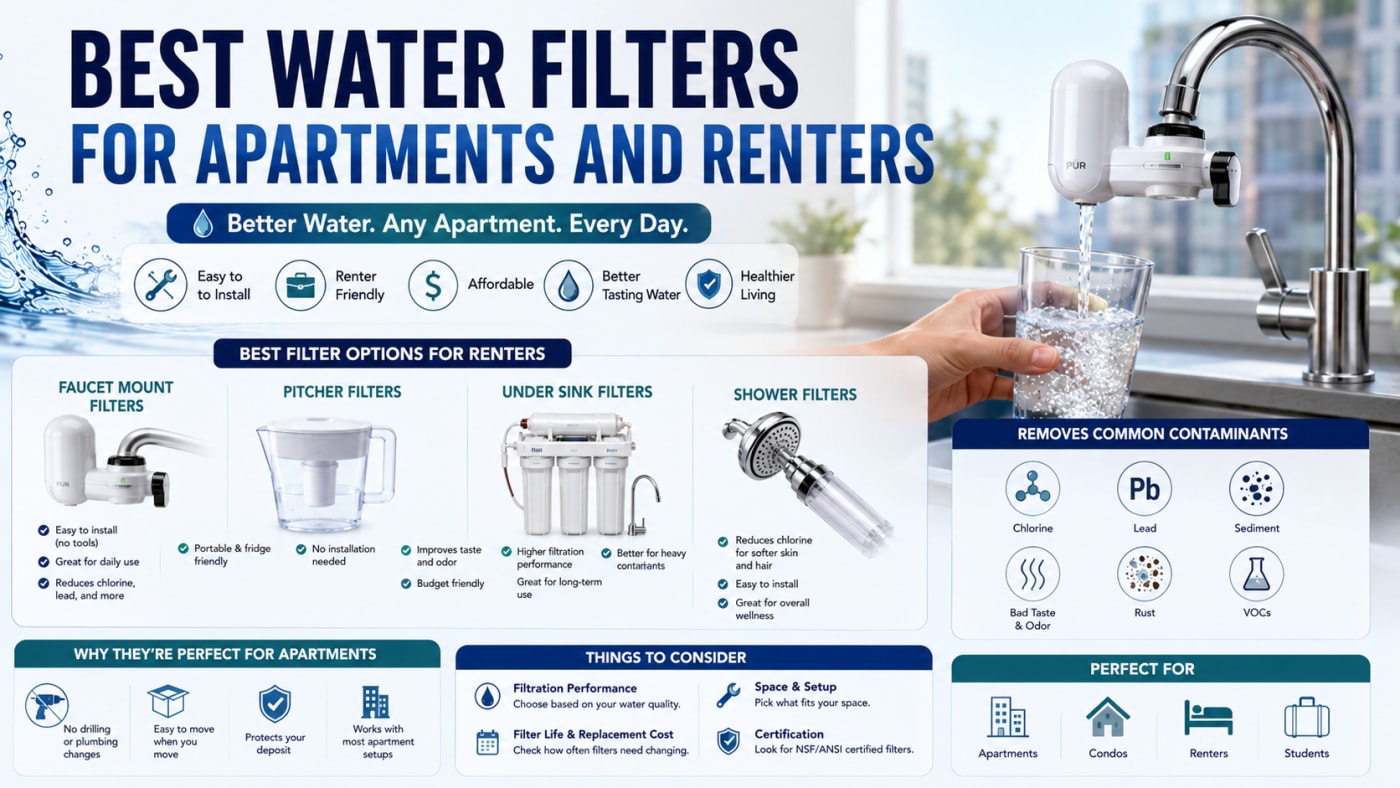
Pitcher filters need no installation and store in the fridge. They offer the lowest cost and the most portability, but they filter smaller amounts at a time and remove a narrower range of contaminants than powered systems.
Faucet mount filters attach directly to the tap with no tools and use no counter space. They deliver filtered water on demand, but they only fit certain faucet types and need frequent filter changes.
Countertop powered carbon filters dispense water quickly and keep natural minerals in place. They need an outlet and some counter space, and they reduce a wider range of contaminants than a basic pitcher.
Countertop reverse osmosis filters remove the widest range of contaminants, including dissolved solids and PFAS. They need the most counter space and the highest upfront cost, and they process water in batches rather than instantly.
The right format depends on how much space you have, how many people share your water, and how many contaminants concern you. A single renter with a small kitchen often does better with a pitcher or a faucet mount filter. A household worried about PFAS or a wide list of contaminants gets more value from a countertop powered or RO system, as long as there is room and an outlet for it.
What Contaminants Should an Apartment Water Filter Remove?
Contaminants to Check For, Grouped by Type:
Aesthetic contaminants: Chlorine taste and odor, chloramine taste, and general cloudiness. These affect how water tastes and smells but do not usually pose a direct health risk at normal tap water levels.
Heavy metals: Lead, mercury, chromium, and arsenic. Lead is a particular concern in older buildings with aging pipes or fixtures, and it needs a filter with a specific certified lead reduction claim, not a general "removes metals" statement.
Emerging contaminants: PFAS compounds such as PFOA and PFOS, along with certain pharmaceuticals. These require a specific certification, since not every carbon filter is tested for them.
Microorganisms: Cysts such as Cryptosporidium and Giardia. These matter most for renters on well water or in areas with known water treatment issues.
Dissolved solids: Fluoride, nitrates, and general total dissolved solids. Only reverse osmosis and some ion exchange systems reduce these effectively.
The safest approach is to check the exact contaminant list and certification for the specific model you plan to buy, rather than trusting a general marketing phrase on the box.
Which NSF Standards Matter for Apartment Water Filters?
The table below shows what each common NSF/ANSI standard actually covers, so you can match a certification to the problem you want solved.
NSF/ANSI Standard | What It Covers | What It Means for Your Purchase |
NSF/ANSI 42 | Non-health related contaminants such as chlorine, taste, odor, chloramine, and particulates | Confirms better taste and clearer water. Does not confirm health related contaminants are removed |
NSF/ANSI 53 | Health related contaminants such as lead, mercury, arsenic, certain pesticides, and cysts like Giardia and Cryptosporidium | This is the standard to look for if you have health concerns about your tap water |
NSF/ANSI 58 | Complete reverse osmosis systems, covering total dissolved solids and, depending on the listing, arsenic, fluoride, nitrate, lead, chromium, and PFAS | Needed if you want dissolved solids and fluoride reduced, not just carbon filtration |
NSF/ANSI 401 | Emerging compounds such as certain pharmaceuticals and industrial chemicals | Useful add on if you want protection beyond the basics covered by 42 and 53 |
A certification is only valid for the exact contaminants named in that specific listing, and being tested is not the same as being certified. It is worth checking the exact model on the certifier's public database rather than trusting the words on the packaging alone.
How Should Renters Choose a Filter Based on Their Water?
Decision Steps for Choosing a Filter:
Get your municipal Consumer Confidence Report from your water provider. This report lists what is actually in your tap water each year.
If your building uses well water or private water, arrange a water test instead of relying on a municipal report.
If the main issue is taste or smell from chlorine, choose a basic carbon pitcher or faucet filter certified to NSF/ANSI 42.
If lead is a concern, especially in an older building, choose a filter with a specific certified lead reduction claim under NSF/ANSI 53, such as the Brita Elite filter or the PUR Plus faucet filter.
If you want the broadest protection, including PFAS and dissolved solids, choose the AquaTru Classic or another certified reverse osmosis system.
If your water shows high total dissolved solids, choose the ZeroWater pitcher or a reverse osmosis system rather than a basic carbon filter.
If your kitchen has very little space, choose the PUR faucet filter or a pitcher over a countertop system.
Matching the filter to your actual water report gives a far more reliable result than choosing based on taste or smell alone.
What Should Renters Check Before Buying a Water Filter?
Pre-Purchase Checklist for Renters:
Faucet type and thread size, especially for faucet mount filters, since pull-down and pull-out faucets are often incompatible
Available counter space and dimensions, measured before buying a countertop unit
Access to a nearby electrical outlet for powered countertop filters
Refrigerator door or shelf space for pitcher filters
Availability and price of replacement filters in your area or online
Any restrictions in your lease about drilling, plumbing changes, or fixed appliances
How portable the unit needs to be if you plan to move again soon
Checking these details before buying avoids returns and wasted money on a filter that does not fit your actual kitchen.
How Much Does an Apartment Water Filter Cost to Own?
What Affects Total Ownership Cost:
Upfront price: Pitchers and faucet filters cost the least to buy. Countertop RO and powered systems cost the most upfront.
Replacement filters: Faucet filters need replacement every 3 months, pitcher filters every 2 to 6 months depending on the model, and RO membranes every 1 to 2 years.
Electricity: Powered countertop systems add a small amount to your electric bill, while pitchers and faucet filters use none.
Wasted water: Reverse osmosis systems send some water to the drain during filtration, which adds a small amount to your water bill.
Looking at total cost over a year gives a clearer picture than looking at the price tag alone. A cheap pitcher with frequent filter changes can cost about the same per year as a more expensive system with a longer lasting filter.
How Often Should Apartment Water Filters Be Replaced?
Filter replacement depends on the manufacturer's rated capacity, how much water you use, and how hard or contaminated your water is. Running more water through a filter than its rated capacity lowers its ability to reduce contaminants, even if the water still looks and tastes normal. Brita recommends replacing the Elite filter every 120 gallons, or about every 6 months for the average household, and replacing it sooner if the water is hard. PUR rates its faucet filter for 100 gallons or about 3 months. AquaTru rates its pre filter for 6 months, its carbon filter for 6 to 12 months, and its RO membrane for about 2 years. Following the manufacturer's replacement schedule, rather than waiting until the water tastes different, keeps a filter working as intended.
What Is the Best Water Filter for an Apartment With Lead Concerns?
The right choice is a filter with a specific, named certification for lead reduction, not a filter that only claims to "remove metals" in general terms. Look for NSF/ANSI 53 certification with lead listed by name on the performance data sheet. For a full breakdown of the top options, see our guide to the Best Water Filters for Lead Removal.
What Is the Best Water Filter for PFAS Removal?
The right choice depends on the exact model and its specific PFAS certification, since not every filter marketed for PFAS carries a matching NSF/ANSI 401, 53, or 58 listing. Check the performance data sheet for the exact compounds covered before buying. For a full ranking of options, see our guide to the Best Water Filters for PFAS Removal.
Do Water Filters Remove Fluoride From Drinking Water?
Not every filter removes fluoride, since the technology used makes the difference. Most standard carbon pitchers and faucet filters do not reduce fluoride in any meaningful way. Reverse osmosis is one of the few common technologies that reduces it effectively. For a full comparison, see our guide to the Best Water Filters for Fluoride Removal.
What Is the Difference Between NSF 42, 53, and 58?
NSF/ANSI 42 covers taste and odor, NSF/ANSI 53 covers health related contaminants like lead and cysts, and NSF/ANSI 58 covers full reverse osmosis systems including dissolved solids. For the full explanation with examples, see our guide to NSF 42 vs NSF 53 vs NSF 58 Water Filter Certifications.
Can Renters Install an Under-Sink Water Filter?
Installation can require access to the plumbing under the sink, a dedicated faucet, or a drain connection, and it often needs landlord approval depending on the system and the lease. For a complete setup guide, see our article on the Best Under-Sink Water Filters.
What Is the Difference Between Reverse Osmosis and Carbon Filtration?
Reverse osmosis reduces a broad range of dissolved contaminants, including salts, fluoride, and heavy metals, by forcing water through a fine membrane. Carbon filtration focuses on a different set of contaminants, mainly chlorine, certain organic chemicals, and taste and odor issues, using activated carbon instead of a membrane. For a full side by side comparison, see our guide to Reverse Osmosis vs Carbon Water Filters.