Water filter brands each carry their own identity, built around a specific filtration type, a specific water source, and a specific place in a household's daily routine. Some brands live on the kitchen counter as a simple pitcher. Others sit quietly under the sink, and some work from a single point to treat every drop entering the home. This guide compares the leading residential water filter brands side by side, across filtration technology, certifications, real performance evidence, ownership cost, and overall buyer fit. There is no single best brand for every home, only the right brand for a specific water source and a specific need. The right choice depends on what comes out of the tap, which contaminants matter most, the installation setup available, and how much ongoing maintenance a household is willing to take on. The sections ahead move from broad brand categories down to individual brand overviews, turning a crowded market into a clear and confident decision.
Which water filter brands serve the major residential filtration categories?
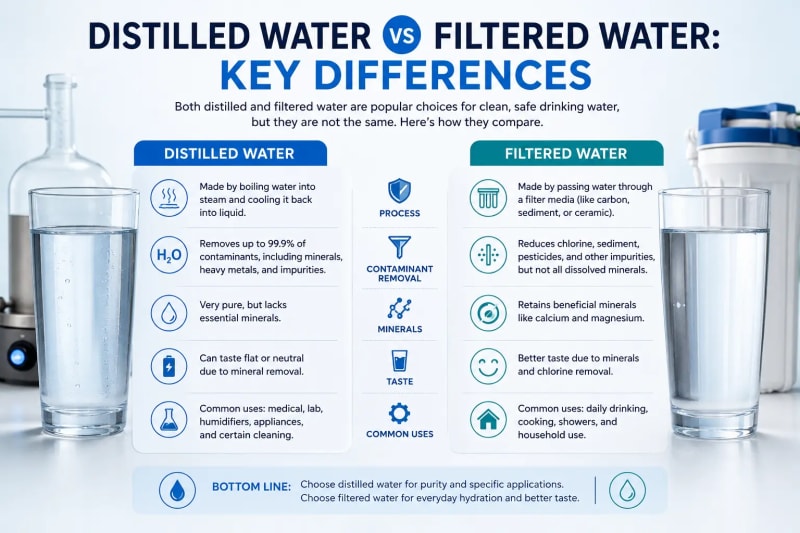
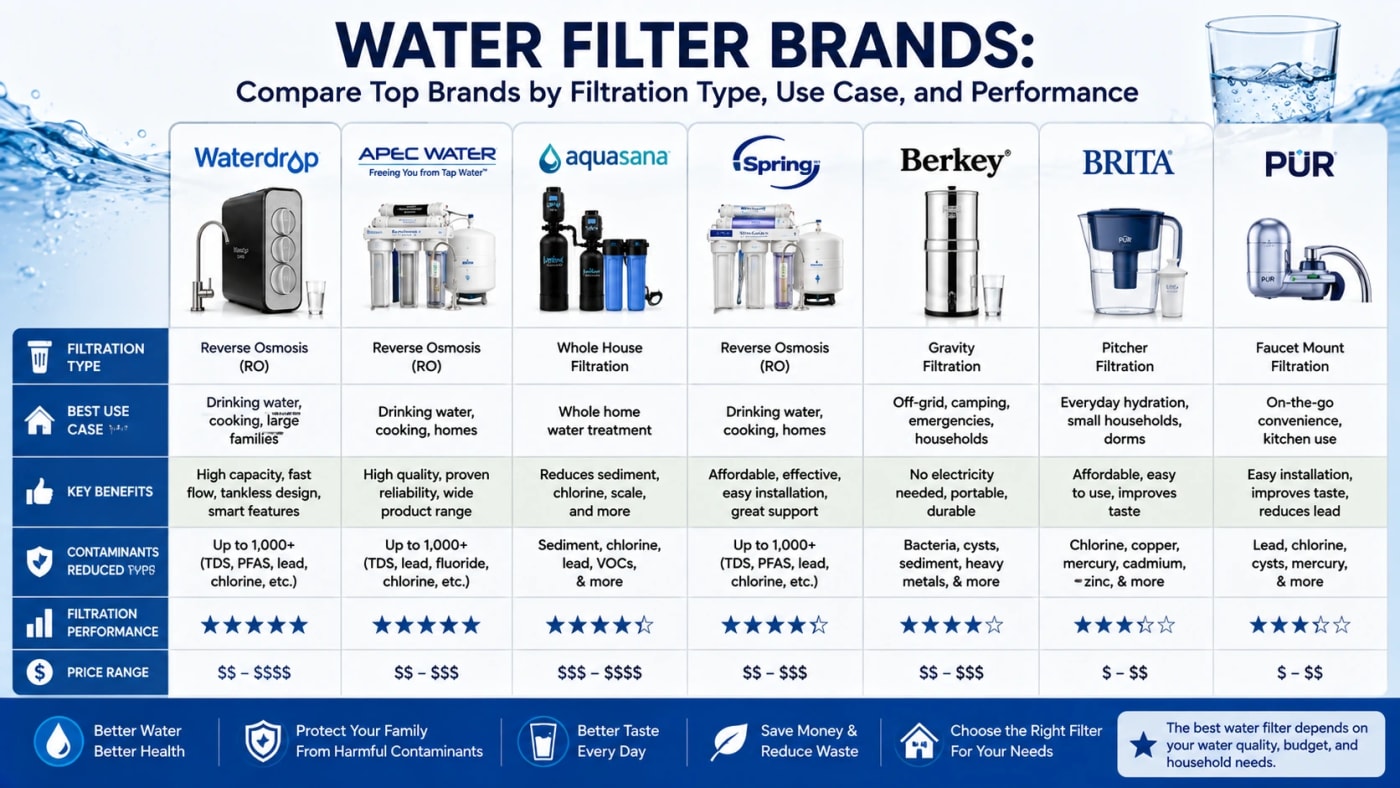
Water filter brands serve the major residential filtration categories by specializing in one or two system types rather than spreading across all of them equally. The market splits into pitcher and faucet filters, countertop and gravity systems, under sink and reverse osmosis systems, and whole house point of entry systems. Each category solves a different problem, from quick convenience filtration to full home treatment.
This table shows how leading brands map to the major filtration categories.
Filtration Category | Representative Brands | Typical Application |
Pitcher and faucet | Brita, PUR, ZeroWater | Everyday drinking water convenience |
Countertop and gravity | Berkey, LifeStraw Home, Aquasana Countertop | No plumbing installation, portable use |
Under sink and reverse osmosis | APEC, Waterdrop, iSpring, AquaTru | Dedicated drinking water at the kitchen tap |
Whole house and point of entry | Aquasana, SpringWell, Culligan, Pentair, Pelican | Treating water at every faucet in the home |
Which brands specialize in pitcher and faucet water filtration?
Brands that specialize in pitcher and faucet water filtration focus on portable, low cost, and low maintenance products that fit directly into daily use. Brita is the most recognized name in this category. Its standard pitcher filter carries NSF/ANSI 42 certification for chlorine taste and odor reduction, and its Elite filter adds NSF/ANSI 53 certification for lead reduction with a longer 120 gallon lifespan. PUR competes closely with Brita and holds NSF/ANSI 42 and 53 certification across its main pitcher and faucet filters, with its Plus filter adding NSF/ANSI 401 and 473 certification for PFAS reduction. ZeroWater takes a different approach with a five stage ion exchange cartridge that drives total dissolved solids toward zero, and it carries NSF certification for lead and chromium reduction.
Attributes that define this category:
Portability: No installation, works straight out of the box.
Convenience: Fits in a refrigerator or on a countertop.
Cartridge replacement: Filters last between 20 and 120 gallons depending on the model.
Everyday use: Built for daily drinking water, not whole home treatment.
Which brands specialize in countertop and gravity water filtration?
Brands that specialize in countertop and gravity water filtration serve households that want filtration without any plumbing connection. Berkey is the best known gravity fed brand, using stainless steel chambers and proprietary Black Berkey elements that do not currently carry NSF/ANSI certification in the United States, a point that independent reviewers and regulators have raised. LifeStraw offers a gravity fed pitcher and dispenser line under its Home series, carrying NSF/ANSI 42, 53, and 401 certification for chlorine, lead, mercury, and PFAS reduction. Aquasana also sells a countertop system, the Clean Water Machine, which is WQA certified to NSF/ANSI 42, 53, and 401 and requires no installation. These systems generally filter slower than pressurized under sink units, since gravity alone pushes the water through the media.
Attributes that define this category:
No plumbing required: Works on any countertop or table.
Portability: Useful for off grid, travel, or rental housing.
Capacity: Tanks typically hold 1.5 to 3 gallons per fill.
Buyer scenario: Fits renters, emergency preparedness, and households avoiding installation.
Which brands specialize in under sink and reverse osmosis filtration?
Brands that specialize in under sink and reverse osmosis filtration build systems around a semipermeable membrane that removes dissolved solids at a microscopic level. APEC Water Systems has built its reputation on WQA Gold Seal certified reverse osmosis systems, with output ranging from 50 GPD in its Essence series up to 90 GPD in its Ultimate series. Waterdrop offers a wide tankless RO lineup, including the G3 series and X series, with output capacity reaching into the hundreds of gallons per day and certifications spanning NSF/ANSI 42, 53, 58, and 372 depending on the exact model. iSpring also competes in this space with multi stage RO systems and alkaline remineralization options. AquaTru focuses on countertop RO units that need no permanent installation while still using a four stage reverse osmosis process.
Attributes that define this category:
RO architecture: Uses a semipermeable membrane rated near 0.0001 micron.
Tank or tankless configuration: Tank models store filtered water, tankless models produce it on demand.
Installation: Requires a drain connection and often a dedicated faucet.
Wastewater ratio: Ranges from 1:1 to 3:1 depending on the model and technology.
Which brands specialize in whole house and point of entry water filtration?
Brands that specialize in whole house and point of entry water filtration treat water before it reaches any tap in the home, rather than filtering at a single point of use. Aquasana's Rhino series and SpringWells CF series both use activated carbon and KDF media to reduce chlorine, chloramine, and sediment across the entire house, with capacities rated up to 1,000,000 gallons or about ten years of use. SpringWell also builds well specific systems that target iron, manganese, and hydrogen sulfide, since these contaminants are common in private well water but rare in treated municipal supplies. Culligan operates through a dealer network offering both whole house filtration and water softening. Pentair and Pelican Water also compete in this category with salt free conditioning and whole house carbon filtration systems.
Attributes that define this category:
House wide treatment: Every faucet and appliance receives filtered water.
Flow requirements: Rated in gallons per minute to match household bathroom count.
Water source: Municipal city water and private well water need different system configurations.
Installation: Requires professional or advanced DIY installation at the main water line.
Which water filter brands are positioned for different water sources and household needs?
Water filter brands are positioned for different water sources and household needs based on what is actually present in the water supply, not based on brand reputation alone. A household on treated municipal water faces different contaminants than a household relying on a private well. Matching the water condition to the correct filtration requirement comes before choosing any specific brand.
Which brands are suited to municipal and city water treatment?
Brands suited to municipal and city water treatment focus mainly on chlorine, chloramine, taste, odor, and increasingly PFAS reduction, since these are the contaminants most associated with treated public water systems. SpringWell's whole house CF system and Aquasana's Rhino system both target chlorine and chloramine at the point of entry. Brita, PUR, and ZeroWater serve the same water type at the point of use through pitchers and faucet filters. Certification should always be checked at the specific product and model level, since a brand offering PFAS reduction on one system does not mean every product in its lineup carries the same certification.
Which brands are suited to well water filtration?
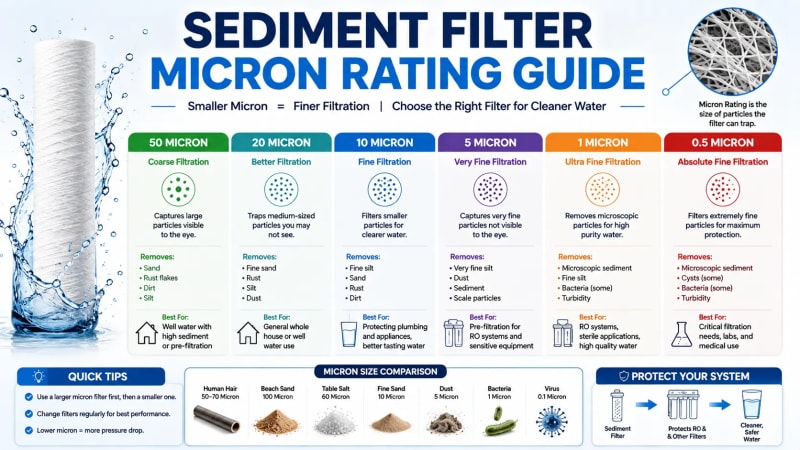
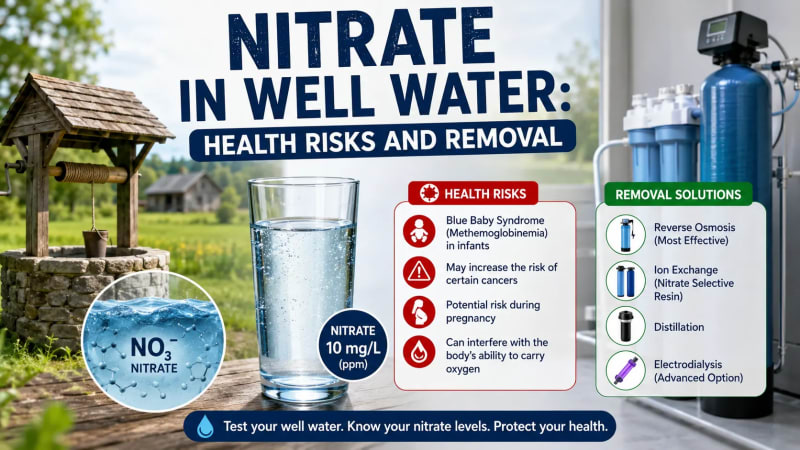
Brands suited to well water filtration address contaminants that rarely appear in city water, such as iron, manganese, sulfur, and sediment. SpringWell offers dedicated well water systems, including an all in one unit that reduces hydrogen sulfide, iron, and manganese through an oxidation and filtration process. APEC and Waterdrop RO systems can also treat well water, but Waterdrop specifically states that well water requires additional pre filtration before entering its RO units. The correct filtration setup for well water always depends on a water test, since well conditions vary widely even between neighboring properties.
Which brands offer solutions for hard water and whole home treatment?
Brands offering solutions for hard water and whole home treatment separate filtration from softening, since these solve different problems. A water filter removes contaminants, while a water softener or conditioner reduces the calcium and magnesium minerals that cause scale buildup. Not every water filter brand addresses hardness at all. SpringWell and Aquasana both sell combination systems that pair a whole house carbon filter with a separate salt based softener or salt free conditioner, letting a household treat contaminants and hardness together rather than buying two unrelated products.
Which water filter brands have the strongest evidence for contaminant reduction?
Water filter brands with the strongest evidence for contaminant reduction are the ones that back specific product claims with independent testing, not general brand level statements. Contaminant reduction should always be evaluated at the specific product and model level, since certification never applies to an entire brand. Manufacturer performance data, when paired with independent testing from NSF, WQA, or IAPMO, gives the clearest picture of what a filter actually does. Checking a certification database directly is more reliable than trusting marketing language alone, a point that independent water filter testing organizations consistently emphasize when comparing brand claims against verified results.
Which certifications should be checked when evaluating a water filter brand?
Certifications that should be checked when evaluating a water filter brand include NSF/ANSI 42, 53, 58, 372, and 401, along with the certifying body behind each claim. NSF/ANSI 42 covers chlorine, taste, and odor reduction. NSF/ANSI 53 covers health related contaminants such as lead, mercury, and certain cysts. NSF/ANSI 58 applies specifically to reverse osmosis systems for total dissolved solids reduction. NSF/ANSI 372 confirms lead free material construction. NSF/ANSI 401 covers a broader list of emerging contaminants including some pharmaceuticals and PFAS related substances. A certification does not mean a filter removes everything. It means the filter has been independently tested against the specific contaminants and testing conditions listed on that certification.
How should water filter brands be compared for long term ownership?
Water filter brands should be compared for long term ownership by separating the upfront purchase price from ongoing filter costs, maintenance needs, and support quality. These ownership factors often matter more over several years than the initial price tag, since replacement filters and service add up over time.
How do filter replacement and maintenance requirements differ between water filter brands?
Filter replacement and maintenance requirements differ between water filter brands mainly in cartridge lifespan and replacement frequency. Pitcher filters from Brita and PUR typically last between 40 and 120 gallons, or roughly two to six months of normal use. Under sink RO systems from APEC and Waterdrop use a mix of shorter lived pre filters, changed every six months, and longer lived RO membranes, changed every one to two years. Whole house systems from SpringWell and Aquasana use larger filter beds rated for up to 1,000,000 gallons or about a decade, which lowers how often a household needs to perform maintenance. Replacement filter availability also varies, since proprietary cartridge designs can limit a household to buying only from the original brand.
How do water filter brands differ in warranty, support, and replacement part availability?
Water filter brands differ in warranty, support, and replacement part availability based on how each company structures its post purchase service. SpringWell offers a return window of six months on most systems along with ongoing customer support for installation questions. Aquasana provides a shorter guarantee period along with an auto ship replacement filter program. APEC backs its reverse osmosis systems with lifetime customer and technical support alongside a standard limited warranty. Brita and PUR rely on retail availability through major stores, making replacement cartridges easy to find without contacting the manufacturer directly. Berkey's replacement element availability has faced disruptions in the United States due to ongoing regulatory questions, which is worth checking before buying into any gravity fed brand with limited or inconsistent certification history.
Which water filter brands fit different buyer priorities?
Water filter brands that fit different buyer priorities depend on the household situation more than any single performance number. Translating verified capabilities into buyer profiles makes the decision practical instead of theoretical.
This table shows which brand category fits common buyer priorities.
Buyer Priority | Best Fitting Category | Example Brands |
Renter with no installation allowed | Pitcher, faucet, or countertop | Brita, PUR, ZeroWater, LifeStraw Home |
Homeowner wanting whole home treatment | Whole house point of entry | SpringWell, Aquasana, Culligan |
Drinking water only, budget focused | Pitcher or basic under sink | Brita, PUR, APEC Essence series |
High contaminant concern, PFAS or lead | Certified RO or NSF 401 rated filters | Aquasana Claryum, PUR Plus, Waterdrop RO |
Well water household | Well specific whole house or RO with pre filtration | SpringWell well systems, Waterdrop RO |
DIY installer | Under sink RO with simple fittings | APEC, Waterdrop |
Low maintenance priority | Whole house systems with long filter life | SpringWell, Aquasana Rhino |
How can you narrow a water filter brand shortlist before comparing individual products?
You can narrow a water filter brand shortlist before comparing individual products by following a clear selection sequence instead of browsing brands at random. Start by identifying the water source, whether it comes from a municipal supply or a private well. Next, identify the specific contaminants of concern, ideally confirmed through a water test. Then choose the filtration category that matches the use case, such as drinking water only or whole home treatment. From there, shortlist two or three brands that specialize in that category. Verify certification and performance data for the exact model under consideration, not just the brand name. Finally, compare specific models side by side and check ownership requirements such as filter cost and installation needs before making a final decision.
What should you know about SpringWell water filters before choosing a system?
What you should know about SpringWell water filters before choosing a system starts with its focus on whole house and well water treatment. SpringWell offers whole house carbon filters for city water, dedicated well water systems for iron, manganese, and sulfur, salt free water conditioners, and under sink reverse osmosis systems. The brand fits households wanting a single filtration solution for the entire home rather than a countertop or pitcher setup. For full system specifications, current pricing, and model comparisons, visit the dedicated SpringWell Water Filters page.
What should you know about Aquasana water filters before choosing a system?
What you should know about Aquasana water filters before choosing a system starts with its wide product range across under sink, countertop, whole house, and shower categories. Aquasana's Claryum technology is WQA and IAPMO certified across several of its under sink and countertop models, while its Rhino whole house line carries a narrower certification scope. This makes Aquasana a fit for households that want one brand covering multiple filtration needs across the home. For full certification details, product comparisons, and contaminant data, visit the dedicated Aquasana Water Filters page.
What should you know about APEC Water Systems before choosing an RO system?
What you should know about APEC Water Systems before choosing an RO system starts with its position as a long established specialist in residential reverse osmosis. APEC systems carry WQA Gold Seal certification across its Essence and Ultimate series, with output capacity ranging from 50 to 90 GPD in its standard tank based lineup. The brand fits households prioritizing DIY friendly installation and a strong certification record in the RO category specifically. For detailed specifications and model options, visit the dedicated APEC Water Systems page.
What should you know about Waterdrop water filters before choosing a system?
What you should know about Waterdrop water filters before choosing a system starts with its broad tankless reverse osmosis lineup, including the G3 and X series. Waterdrop systems range from 400 GPD up to 1600 GDP depending on the model, with certification scope varying between NSF/ANSI 42, 53, 58, and 372 based on the specific system. The brand fits households wanting a compact tankless design with smart faucet monitoring built in. For individual product reviews and specification comparisons, visit the dedicated Waterdrop Water Filters page.
What should you know about Brita water filters before choosing a pitcher or faucet filter?
What you should know about Brita water filters before choosing a pitcher or faucet filter starts with its position as the most widely recognized pitcher brand in the United States. Brita's standard filter carries NSF/ANSI 42 certification, while its Elite filter adds NSF/ANSI 53 certification for lead reduction with a longer 120 gallon lifespan. The brand fits households wanting affordable, low maintenance filtration for everyday drinking water. For detailed cartridge comparisons and contaminant data, visit the dedicated Brita Water Filters page.
What should you know about PUR water filters before choosing a pitcher or faucet filter?
What you should know about PUR water filters before choosing a pitcher or faucet filter starts with its certification scope, which extends beyond Brita's standard filter in several models. PUR's Plus filter carries NSF/ANSI 42, 53, 401, and 473 certification, making it one of the few pitcher filters certified for PFAS reduction. The brand fits households wanting broader certified contaminant coverage without stepping up to a full RO system. For full model comparisons, visit the dedicated PUR Water Filters page.
What should you know about Berkey water filters before choosing a gravity system?
What you should know about Berkey water filters before choosing a gravity system starts with its position as a long standing gravity fed brand built around proprietary Black Berkey elements. Berkey's elements have not held NSF/ANSI certification in the United States, and the brand has faced regulatory questions from the EPA regarding its contaminant removal claims. Certified gravity fed alternatives exist in the same category for buyers who prioritize independently verified performance. For a closer look at Berkey's current standing and alternatives, visit the dedicated Berkey Water Filters page.
What should you know about LifeStraw water filters before choosing a portable system?
What you should know about LifeStraw water filters before choosing a portable system starts with its origin in personal and outdoor water purification. LifeStraw's personal filter and Home dispenser line carry NSF/ANSI 42, 53, and 401 certification, covering chlorine, lead, mercury, and PFAS reduction depending on the exact product. The brand fits travelers, emergency preparedness buyers, and households wanting a countertop option without installation. For detailed product specifications, visit the dedicated LifeStraw Water Filters page.