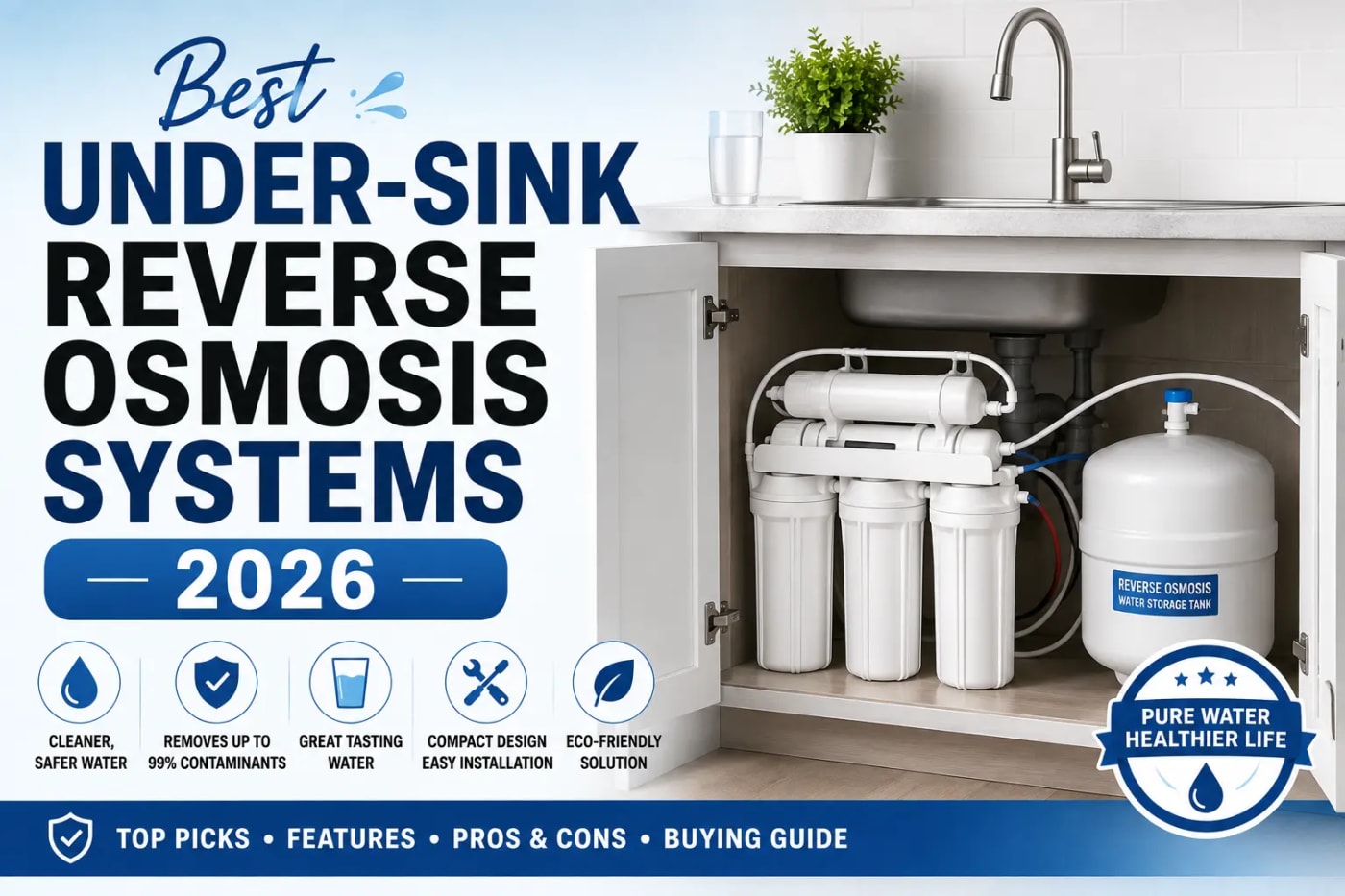
Clean drinking water at home does not need to mean bottled water. An under-sink reverse osmosis system connects to your cold water line and pushes tap water through a membrane that strips out dissolved solids, heavy metals, and many other contaminants. The result is water that tastes lighter and cleaner straight from its own faucet.
This guide compares five of the strongest under-sink RO systems available right now. Each one is reviewed on filtration power, certification, daily production, water efficiency, installation, and long term cost. You will find a full comparison table, five in-depth reviews, and a decision framework that helps you match a system to your household, your cabinet space, and your budget. This article does not cover countertop pitchers or whole-house filtration. It focuses only on point-of-use systems that sit under your kitchen sink.
Top 3 Picks
Quick picks for readers in a hurry:
Cloud RO - Best for smart monitoring and remineralization. A tank-based system with a measured pure-to-waste ratio near 1:1, built-in alkaline remineralization, and an app that tracks filter life and water quality in real time. NSF/ANSI 58 certified, rated for 80 GPD production.
Waterdrop G3P800 - Best for large households and cabinet space. A tankless system rated at 800 GPD with a 3:1 pure-to-drain ratio, a smart faucet that displays TDS readings, and NSF/ANSI 42, 53, 58, and 372 certification.
APEC ROES-50 - Best budget pick. A conventional 5-stage, 50 GPD tank system with WQA Gold Seal certification. Lower upfront cost, simple parts, and a long track record of reliable service.
How do the leading under-sink RO systems compare?
Each of these five systems takes a different approach to filtration architecture, efficiency, and added features. Some use a pressurized storage tank, others are tankless. Some add minerals back into the water, others leave it as pure RO output. The table below lines up the core specifications side by side so you can see the tradeoffs at a glance.
The table below compares the five systems on the specifications that matter most for a buying decision:
Product | Type | GPD | Stages | Certification | Pure-to-Drain Ratio | Remineralization | Tank | Best For |
Cloud RO | Tank-based | 80 | Multi-stage + alkaline post filter | NSF/ANSI 58 | About 1:1 | Yes, alkaline | 2.8 gallon | Smart monitoring, taste |
Waterdrop G3P800 | Tankless | 800 | 10-stage | NSF/ANSI 42, 53, 58, 372 | 3:1 | No (standard model) | None | Large families, fast flow |
APEC ROES-50 | Tank-based | 50 | 5-stage | WQA Gold Seal, NSF/ANSI 58 | Standard tank ratio | No | 3.2–4 gallon | Budget buyers |
iSpring RCC7AK | Tank-based | 75 | 6-stage | NSF/ANSI 58 | Standard tank ratio | Yes, alkaline | Included tank | Alkaline taste on a budget |
Home Master TMAFC-ERP | Tank-based with permeate pump | 75 | 7-stage | NSF certified components | 1:1 | Yes, Full Contact double pass | Included tank | Efficiency plus taste |
A quick note on how to read this table. GPD, or gallons per day, is a rated production number under ideal test conditions, not a live flow rate at your faucet. Pure-to-drain ratio tells you how many gallons of wastewater a system produces for each gallon of purified water. A 1:1 ratio wastes far less water than an older-style 3:1 or 4:1 tank system. Keep both numbers in mind as you read the individual reviews below.
How should you choose an under-sink RO system?
Once you understand what each system offers, the next step is matching a system to your actual situation rather than chasing the highest spec number on the page. Work through the decision points below in order.
Decision framework for choosing an under-sink RO system:
Water problem: Identify what you actually need removed. A water quality test or your municipal water report tells you whether you are dealing with high TDS, specific heavy metals, chlorine taste, or something else.
Certification requirement: Decide whether you need a specific certified contaminant claim, such as lead or PFAS reduction, or whether general TDS reduction under NSF/ANSI 58 is enough for your situation.
Household demand: Match GPD rating and tank size to how many people use the kitchen at once and how much water your household drinks and cooks with daily.
Cabinet constraints: Measure your under-sink cabinet before you buy. A tankless system frees up significant space, while a tank system needs enough clearance for a pressurized tank plus the filtration housing.
Efficiency priorities: If minimizing water waste matters to you, look for a permeate pump or a low-ratio tankless design rather than a standard tank system.
Maintenance budget: Factor in the ongoing cost of filters and membranes, not just the purchase price, before you commit to a system.
Which certification claims should you verify before buying?
Certification language on RO product pages can be confusing, so it helps to know what each label actually means. NSF/ANSI 58 is the primary standard for point-of-use reverse osmosis systems. It covers materials safety, structural integrity, system performance including flow control and storage capacity, TDS reduction, and verification of any additional chemical or contaminant reduction claims a manufacturer makes.
There is an important distinction between three types of certification claims. Whole-system certification, such as a WQA Gold Seal, means the assembled unit as sold was tested end to end. Component certification means individual parts, such as a membrane or a faucet, were tested against a standard, which does not automatically mean the finished assembled system carries its own certification number. Manufacturer testing, often done through a third-party lab like SGS, provides useful data but is not the same as formal NSF or WQA certification. Before you buy, check whether the specific contaminant claim you care about, such as PFAS or lead, is covered by the certification itself or only mentioned in marketing copy.
How much RO capacity does your household actually need?
GPD is a rated production capacity measured under specific laboratory conditions, not a literal number of gallons that will flow from your faucet on demand. A system rated at 50 GPD is not necessarily too slow for a family of four, because tank-based systems store already-purified water ahead of time, ready to draw from at full faucet pressure. Tankless systems rated at higher GPD numbers, such as 800 GPD, are built for situations with heavy simultaneous demand, multiple appliances connected at once, or households that want the fastest possible fill time without waiting for a tank to refill.
As a general guide, a 50 GPD tank system comfortably serves one to three people with typical daily use. A 75 to 90 GPD system with a larger tank suits a family of four to six. Larger households, or anyone connecting an RO line to a refrigerator or ice maker in addition to the kitchen faucet, benefit most from either a larger tank or a high-capacity tankless system.
Which under-sink RO design fits your cabinet and plumbing?
Tank-based versus tankless, compared on the factors that affect your kitchen:
Factor | Tank-based system | Tankless system |
Cabinet space | Needs room for a pressurized storage tank | Frees up significant cabinet space |
Power requirement | Usually none, unless app-connected | Often requires an electrical outlet nearby |
Water availability | Draws from stored, already-filtered water | Filters on demand as you open the faucet |
Fill speed | Fast from stored tank, slower to refill | Very fast continuous flow, no tank refill wait |
Best fit | Smaller cabinets are fine, simpler installs | Tight cabinets, high simultaneous demand |
How much wastewater should an efficient RO system produce?
Pure-to-drain ratio describes how many gallons of purified water a system produces compared with how many gallons it sends down the drain. A 1:1 ratio means one gallon of wastewater for every gallon of purified water. A 3:1 ratio means three gallons of purified water for every one gallon of wastewater, which is actually more efficient than 1:1, not less. Read the ratio carefully and check which number comes first, since manufacturers do not always present it the same way. Older conventional tank systems without a permeate pump commonly run in the range of 3:1 to 4:1 wastewater to purified water, the opposite direction from the efficient systems reviewed above.
When does remineralization make sense for RO water?
Remineralization makes sense for RO water when the output tastes flat and the household wants a fuller, mineral-rich drinking experience, since the RO membrane strips out beneficial minerals such as calcium, magnesium, potassium, and sodium along with contaminants. A remineralization or alkaline stage adds those minerals back after filtration, which raises the water's pH and often improves taste, especially in coffee, tea, and cooking.
This is a matter of taste and mineral content rather than a guaranteed health outcome, so treat remineralization as a preference rather than a medical necessity. If someone already likes the taste of mineral water or bottled spring water, this stage is worth prioritizing. If taste differences do not matter much, a standard 5-stage system without remineralization still delivers clean, safe drinking water.
What should you budget for filters and maintenance?
Purchase price is only part of the real cost of owning an RO system. Prefilters, which handle sediment and chlorine, typically need replacement every 6 to 12 months. The RO membrane itself usually lasts 12 to 24 months, depending on your incoming water quality and how hard your water is. Systems with proprietary filter cartridges, such as the smart tankless models, generally cost more per replacement than systems using industry-standard filter sizes, though subscription programs can offset some of that cost with recurring discounts. Before buying, look up the manufacturer's specific replacement filter prices and expected lifespan, since these numbers vary system to system and are the best way to estimate your true annual cost.
How can you plan an under-sink RO installation?
Every under-sink RO system needs a few basic connections: a feed-water line tapping into your cold water supply with a dedicated shutoff valve, a drain line connection through a saddle valve or adapter on your existing drain pipe, and a dedicated faucet mounted through your sink deck or countertop. Tank-based systems also need enough cabinet clearance for the storage tank itself. Some systems support an optional refrigerator or ice maker connection, which requires running an additional line. Buyers commonly report that drilling a hole for the dedicated faucet and routing tubing to a refrigerator are the two installation steps that require the most planning, so measure your sink deck and cabinet space before you order a system, and check whether your model needs a nearby electrical outlet.
What water source should you evaluate before choosing RO?
The five systems compared above work well on typical municipal tap water. Before you finalize a purchase, it is worth understanding a bit more about how reverse osmosis works, what it actually removes, how often filters need attention, and how your specific water source, whether municipal or well water, might change what pretreatment or additional filtration you need.
How does reverse osmosis work?
A typical RO system pushes tap water through a sequence of stages. Sediment and carbon prefilters remove larger particles, chlorine, and taste and odor compounds before the water reaches the RO membrane. The membrane itself uses pressure to force water through an extremely fine barrier that blocks dissolved solids, salts, and many other contaminants, sending the rejected material down the drain. Post-filters, and sometimes a remineralization stage, polish the water one final time before it reaches your faucet. This is a simplified overview. For a full breakdown of each stage and how membrane technology works at the molecular level, see a dedicated guide on how reverse osmosis works.
Which contaminants can reverse osmosis reduce?
Reverse osmosis is capable of reducing a broad range of contaminants, including dissolved solids, many heavy metals, fluoride, and various organic compounds, depending on the specific system and its certification. Exact contaminant reduction claims vary by product and by certification, so always check a system's specific NSF or WQA documentation rather than assuming every RO system removes the same list of substances. For a full breakdown of contaminant categories and what reverse osmosis typically addresses, see a dedicated guide on contaminants removed by reverse osmosis.
How often should RO filters be replaced?
Replacement intervals depend on the specific product, the type of filter, how much water your household uses, and the quality of your incoming feed water. There is no single universal number that applies to every system, so always follow the manufacturer's stated replacement schedule for each cartridge type. For a full breakdown of typical replacement intervals by filter stage, see a dedicated RO filter replacement guide.
What are the best water filters for well water?
Well water often carries different concerns than municipal water, including sediment, iron, manganese, hardness, or microbiological contamination that a standard point-of-use RO system is not designed to handle on its own. If your household relies on well water, treat this article as a guide to choosing an under-sink RO system rather than a complete well-water treatment plan, and see a dedicated guide on the best water filters for well water for pretreatment and whole-house options.
What is the difference between RO and standard under-sink filters?
Standard under-sink filters typically rely on carbon filtration alone, which is effective against chlorine, taste, and odor, but does not remove dissolved solids or many heavy metals the way an RO membrane does. Reverse osmosis adds a membrane stage that targets a much wider range of contaminants at a finer level. For a full side-by-side comparison of both filtration types, see a dedicated guide on RO versus under-sink water filters.
Conclusion
The right under-sink RO system depends on what matters most in your kitchen. Cloud RO suits households that want smart monitoring and better tasting alkaline water. The Waterdrop G3P800 fits large families that need speed, volume, and open cabinet space. The APEC ROES-50 is the practical choice for buyers who want proven, budget-friendly filtration. The iSpring RCC7AK adds remineralization without a big jump in price. The Home Master TMAFC-ERP delivers the best combination of water efficiency and taste through its permeate pump and double-pass mineral stage. Match your pick to your household size, cabinet space, certification priorities, and long-term filter budget, and any of these five systems will deliver a real upgrade over tap water.