
Aquasana is a residential water filtration brand that makes systems for whole house treatment, under sink drinking water, countertop use, reverse osmosis, and shower filtration. Each product line targets a different point in the home and a different set of contaminants. A whole house system treats water at the point it enters the home. An under sink system treats water only at the kitchen faucet. A shower filter treats only the water coming out of the shower head. Choosing the right Aquasana system starts with understanding which category matches the water problem a household actually has.
RoundupWater Filters
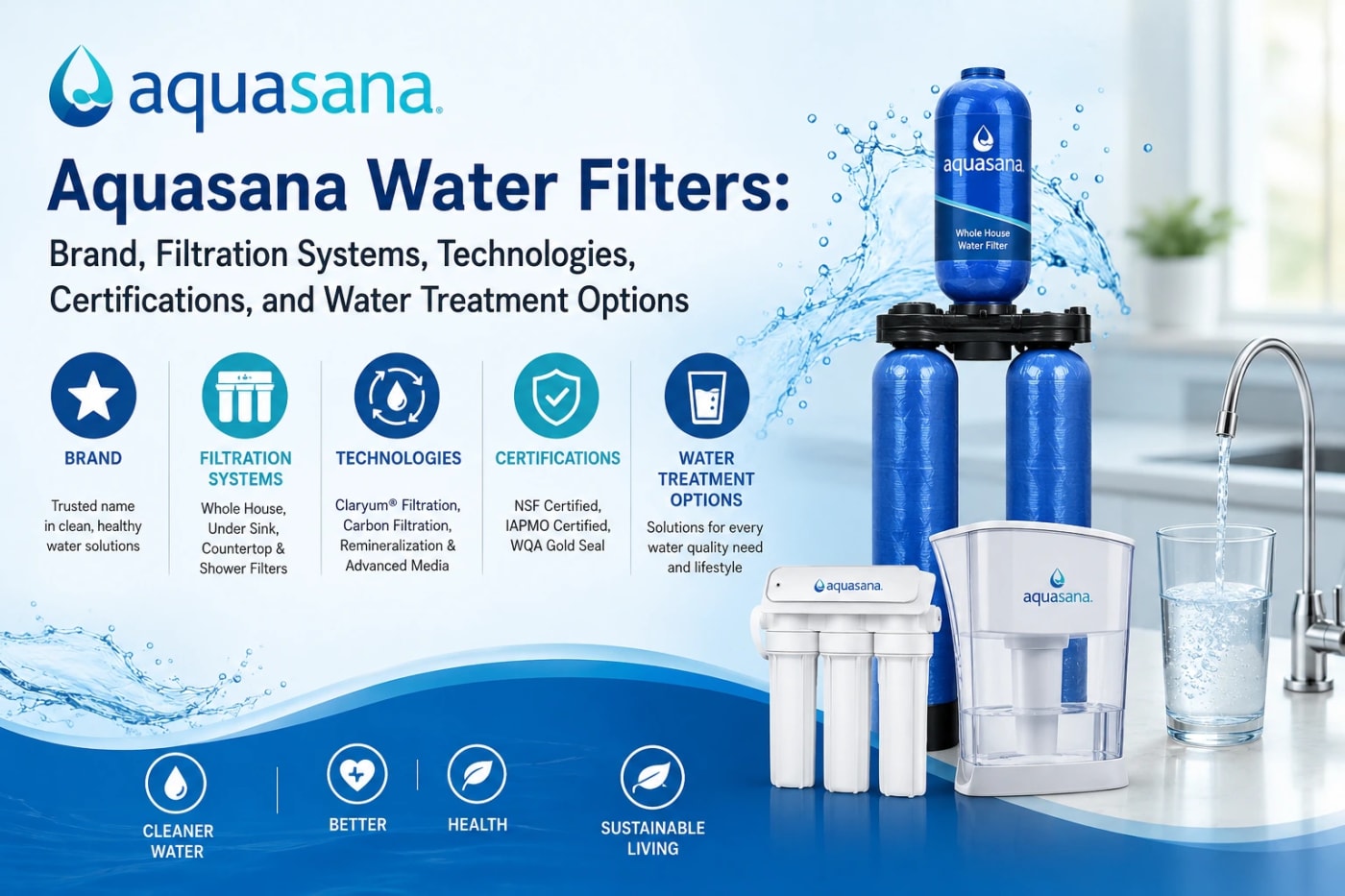
Aquasana Water Filters: Brand, Filtration Systems, Technologies, Certifications, and Water Treatment Options
Share
Our Top Picks
Comparison at a Glance
| Product | Rating | Best For | Price | Link |
|---|---|---|---|---|
| Rhino (Whole House) | 4.7 | Best for Small-Medium Homes | $1,084.99 | — |
| Rhino Max Flow / Rhino Chloramines Max Flow | 1 | Best for Large Families | $1,299.00 | — |
| Rhino Well Water with UV | 4.2 | Best for Well Water | $2,573.00 | — |
| OptimH2O (Premium Whole House) | 3.9 | Best Premium / Lead & PFAS Focus | — | — |
| Claryum 2-Stage / 3-Stage (Under Sink) | 3.9 | Best for Drinking Water | $224.99 | — |
| SmartFlow Reverse Osmosis | 3.6 | Best for Fluoride/Arsenic Removal | — | — |
| Clean Water Machine (Countertop) | 3.9 | Best for Renters | $184.99 | — |
| Aquasana Shower Filter | 5 | Best for Bathing Water | — | — |
What types of water filtration systems does Aquasana offer for different points of use?
Different points of use are organized by Aquasana around where water treatment happens in the home. This structure helps buyers understand the full product range before looking at any single model.
This table shows the main Aquasana product categories and where each one is installed.
Category | Installation Point | Representative Products |
Whole house | Main water line entering the home | Rhino, Rhino Max Flow, Rhino Chloramines, Rhino Well Water with UV, OptimH2O |
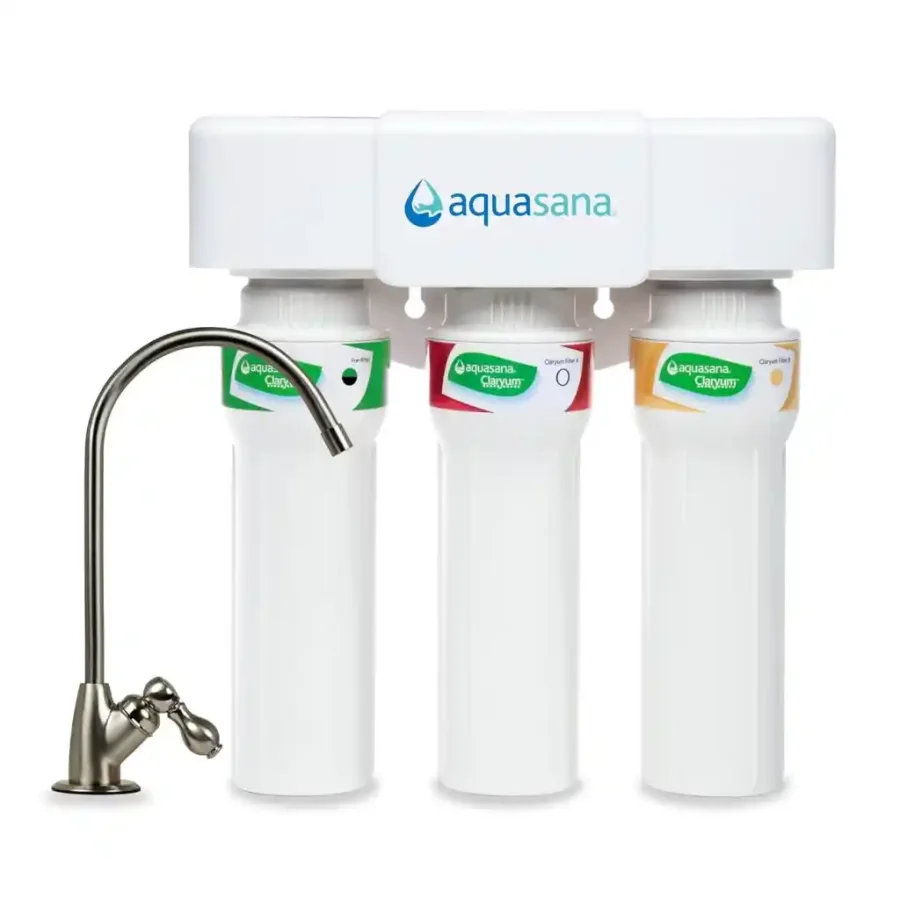
Under sink drinking water | Kitchen cabinet, connected to a dedicated faucet | Claryum 2-Stage, Claryum 3-Stage, Claryum 3-Stage Max Flow, Claryum Direct Connect |
Reverse osmosis | Kitchen cabinet, connected to a dedicated faucet | SmartFlow Reverse Osmosis |
Countertop | Kitchen counter, no permanent installation | Clean Water Machine |
Shower | Shower arm or existing shower head connection | Aquasana Shower Filter |
Each category answers a different need. Whole house systems protect every tap and appliance. Under sink and countertop systems focus only on drinking and cooking water. Shower filters focus only on chlorine exposure during bathing.
How do Aquasana whole house systems treat water throughout a home?
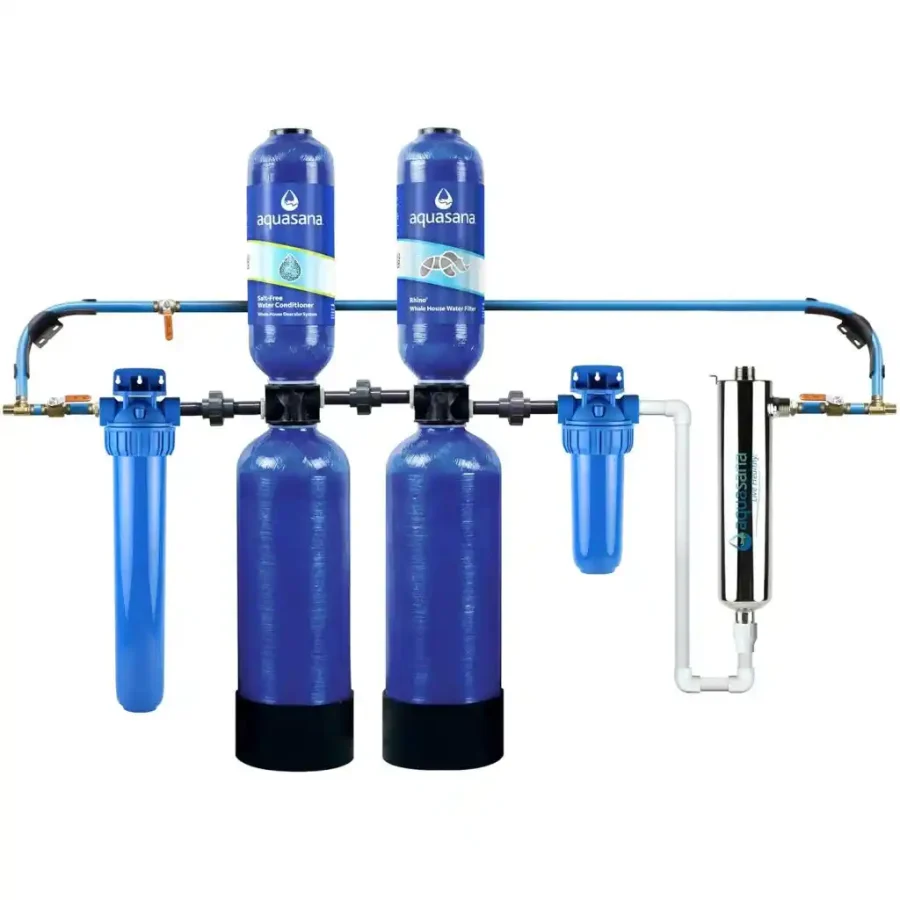
Whole house systems treat water throughout a home by connecting to the main water line where it enters the house. Once installed, treated water reaches every faucet, shower, and appliance connected to that line. Aquasana offers several whole house families for this purpose.The Rhino and Rhino Chloramines systems are built for homes with up to 2.5 bathrooms and 4 or fewer people. The Rhino Max Flow and Rhino Chloramines Max Flow systems are built for larger homes with up to 6 bathrooms and 8 people, and they filter water at a faster flow rate. The Rhino Well Water with UV system is built specifically for private well water and includes an ultraviolet disinfection stage. The OptimH2O system is Aquasana's premium whole house option, built to target lead, PFAS, and cyst reduction in addition to chlorine and chloramines.
Aquasana states that its standard city water Rhino systems are designed to last 1,000,000 gallons or up to 10 years, while the Rhino Well Water with UV system is designed to last 5 years or 500,000 gallons.
How do Aquasana drinking water systems differ by installation location?
Drinking water systems differ by installation location in two main ways, under sink and countertop.Under sink systems install inside the kitchen cabinet and connect directly to the cold water supply line. They use a small dedicated faucet mounted on the counter or sink deck. This location keeps the filter out of sight and out of the way.
Countertop systems, such as the Clean Water Machine, sit on the kitchen counter and connect to the existing faucet without any permanent plumbing changes. This option works well for renters or anyone who wants filtration without modifying under sink plumbing.
This table shows the basic difference between the two installation types.
Factor | Under Sink | Countertop |
Installation | Connects to cold water line under the sink | Attaches to existing kitchen faucet |
Visibility | Hidden inside the cabinet | Visible on the counter |
Plumbing changes | Required | Not required |
Best fit | Homeowners, permanent kitchens | Renters, temporary setups |
What does Aquasana use for shower water filtration?
Shower water filtration treats only the water used for bathing. The filter attaches to the shower arm and works with most standard shower heads. The filter media combines coconut shell carbon with Copper Zinc, known as KDF, to reduce chlorine before it reaches the skin and hair.
Aquasana states that its shower filters are independently tested to NSF/ANSI Standard 177 and reduce over 90 percent of chlorine in shower water. This standard is specific to shower filtration and does not cover drinking water contaminants. A shower filter should not be treated as a substitute for a drinking water system, since it addresses a completely separate part of the home's water use.
How do Aquasana filtration technologies work across its product families?
Filtration technologies work across product families using a small set of core methods. Different products combine these methods in different ways depending on the contaminants they target and the point of use they serve.
This table shows the main technology types Aquasana uses and their general purpose.
Technology | General Purpose | Found In |
Activated and catalytic carbon | Reduces chlorine, chloramines, taste, and odor | Rhino, Claryum, Clean Water Machine, Shower Filter |
Ion exchange | Reduces heavy metals such as lead and mercury | Claryum, SmartFlow, Clean Water Machine |
Submicron filtration | Reduces cysts and asbestos | Claryum, SmartFlow, Clean Water Machine |
Copper Zinc (KDF) media | Reduces chlorine and limits bacteria growth in the filter | Shower Filter |
Reverse osmosis membrane | Reduces dissolved contaminants such as fluoride and arsenic | SmartFlow |
Ultraviolet light | Disinfects bacteria and viruses | Rhino Well Water with UV, optional Rhino UV add on |
How does Claryum filtration combine carbon, ion exchange, and submicron filtration?
Claryum filtration combines carbon, ion exchange, and submicron filtration in one system. It uses four filtration methods together. Activated carbon reduces chlorine, PFAS, microplastics, pharmaceuticals, herbicides, and pesticides. Catalytic carbon specifically targets chlorine and chloramines. Ion exchange targets heavy metals such as lead and mercury, along with asbestos. Submicron filtration targets cysts.
Aquasana states that Claryum filtration is selective, meaning it removes contaminants while retaining naturally occurring minerals such as calcium, magnesium, and potassium. This selective approach is a defining feature of Claryum compared with reverse osmosis, which removes minerals along with contaminants unless a remineralization stage is added back.
How does reverse osmosis change the treatment approach in Aquasana SmartFlow systems?
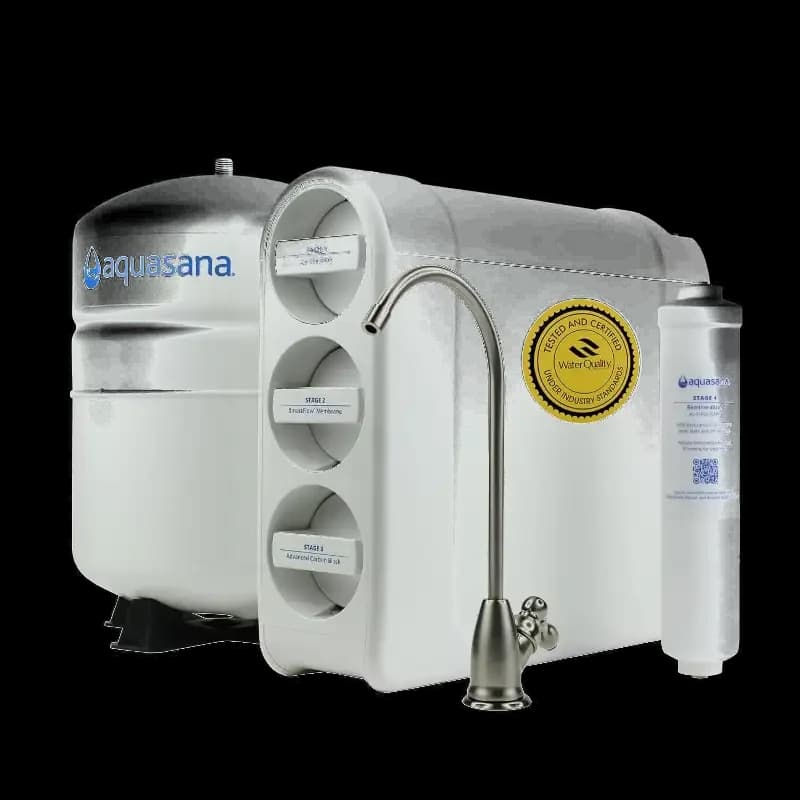
Reverse osmosis changes the treatment approach in SmartFlow systems by adding a membrane stage on top of Claryum filtration. A reverse osmosis membrane pushes water through an extremely fine barrier that blocks dissolved contaminants that carbon filtration alone cannot remove. This includes fluoride, arsenic, nitrates, nitrites, and total dissolved solids, known as TDS.
Because reverse osmosis also removes beneficial minerals along with contaminants, SmartFlow includes a remineralization stage. Aquasana states this stage restores minerals lost during the RO process and improves the pH balance of the finished water.SmartFlow is currently WQA tested and certified to NSF/ANSI Standards 42, 53, 58, and 401, along with CSA B483.1, and is certified to reduce 90 contaminants overall.
How do Aquasana UV systems address microbiological concerns in well water?
UV systems address microbiological concerns in well water through a disinfection stage rather than a filtration stage. UV light does not remove particles from water. Instead, it exposes water to light that disrupts the DNA of bacteria and viruses, preventing them from reproducing.
Aquasana includes a UV filter in its Rhino Well Water with UV configuration because private well water carries a higher risk of microbiological contamination than treated municipal water. Aquasana states that its UV filter sterilizes up to 99.99 percent of bacteria and viruses and up to 99 percent of cysts. This UV stage is specifically necessary for well water systems and is not a standard part of Aquasana's municipal water focused whole house systems.
Which contaminants can Aquasana filters reduce across its certified product families?
Contaminants Aquasana filters can reduce across certified product families vary by group and by the specific certification each product holds. No single Aquasana system removes every contaminant in every category. The table below organizes contaminants by group and shows which product family targets each group, based on official Aquasana performance data.
This table shows contaminant categories and the Aquasana product families that address them.
Contaminant Group | Examples | Addressed By |
Disinfection chemicals | Chlorine, chloramines | Rhino, Rhino Chloramines, Claryum, SmartFlow, Clean Water Machine, Shower Filter |
Heavy metals | Lead, mercury | Claryum, SmartFlow, Clean Water Machine, OptimH2O |
PFAS | PFOA, PFOS | Claryum, SmartFlow, Clean Water Machine, OptimH2O |
Microplastics | General microplastics | Claryum, SmartFlow, Clean Water Machine |
VOCs and pesticides | Herbicides, pesticides, general VOCs | Claryum, SmartFlow, Clean Water Machine |
Pharmaceuticals | General pharmaceutical residues | Claryum, SmartFlow |
Cysts | Chlorine resistant cysts | Claryum, SmartFlow, Clean Water Machine, whole house UV add on |
Dissolved contaminants | Fluoride, arsenic, nitrates, TDS | SmartFlow |
How does Aquasana address chlorine and chloramine in residential water?
Chlorine and chloramine in residential water are disinfection chemicals added by municipal water systems. They affect taste, odor, and can dry out skin and hair during showering. Aquasana uses activated and catalytic carbon to reduce both.
The Rhino Chloramines whole house system is independently tested to NSF/ANSI Standard 42 and reduces up to 83 percent of chloramines and 97 percent of chlorine. The Claryum 2-Stage and 3-Stage systems reduce 97.3 percent of chlorine and 91 percent of chloramines under current certified data. The Shower Filter reduces over 90 percent of chlorine under NSF/ANSI Standard 177.
Which Aquasana systems are designed to reduce lead, PFAS, and related contaminants?
Systems designed to reduce lead, PFAS, and related contaminants are certified only in specific Aquasana product families, not across the entire brand. Claryum 2-Stage and 3-Stage systems are certified to reduce up to 99.6 percent of lead and up to 99.7 percent of PFAS, specifically PFOA and PFOS, tested down to 20 parts per trillion.
SmartFlow Reverse Osmosis is certified to reduce 99 percent of lead and 96 percent of chlorine, chloramines, arsenic, pesticides, and herbicides, as part of its 90 contaminant certification. OptimH2O, Aquasana's premium whole house system, is certified to reduce 99 percent of lead and cysts and 98 percent of PFOA and PFOS. A product without a specific lead or PFAS certification should not be assumed to reduce those contaminants at the same rate.
Which Aquasana systems address dissolved contaminants such as fluoride, arsenic, nitrate, and TDS?
Systems that address dissolved contaminants such as fluoride, arsenic, nitrate, and TDS rely on a reverse osmosis membrane. These contaminants pass through standard carbon filtration because they do not bind to carbon media the same way chlorine or organic compounds do.
SmartFlow is the Aquasana product certified for this contaminant group. It reduces 90 percent of fluoride and 96 percent of arsenic, along with nitrates, nitrites, and TDS, as part of its NSF/ANSI 58 certification, which is the standard specific to reverse osmosis systems. Claryum systems, which do not include an RO membrane, are not certified for fluoride or arsenic reduction.
What do Aquasana NSF, WQA, IAPMO, and performance data claims actually mean?
NSF, WQA, IAPMO, and performance data claims mean that Aquasana products carry certifications from independent testing organizations. Understanding what these certifications cover helps buyers judge a specific claim rather than trusting a general brand statement.
NSF/ANSI standards are technical standards written for water treatment products. Standard 42 covers aesthetic effects such as chlorine, taste, and odor. Standard 53 covers health effects such as lead, cysts, and VOCs. Standard 58 covers reverse osmosis systems specifically. Standard 401 covers emerging contaminants such as pharmaceuticals and certain pesticides. Standard 177 covers shower filtration systems. WQA, the Water Quality Association, is one of the organizations that performs this independent testing and certification against NSF/ANSI standards.
This table shows the standards mentioned above and which Aquasana products carry them.
Standard | General Purpose | Aquasana Product Examples |
NSF/ANSI 42 | Chlorine, taste, and odor reduction | Rhino, Rhino Chloramines, Claryum, SmartFlow, Clean Water Machine |
NSF/ANSI 53 | Health effect contaminants such as lead and cysts | Claryum, SmartFlow, Clean Water Machine |
NSF/ANSI 58 | Reverse osmosis system performance | SmartFlow |
NSF/ANSI 401 | Emerging contaminants such as pharmaceuticals | Claryum, SmartFlow, Clean Water Machine |
NSF/ANSI 177 | Shower filter chlorine reduction | Aquasana Shower Filter |
CSA B483.1 | Canadian drinking water treatment standard | SmartFlow |
How should Aquasana performance data sheets be used to verify a filter's claims?
Performance data sheets should be used to verify a filter's claims before any reduction percentage is trusted. A brand level certification statement is not enough to confirm a specific product removes a specific contaminant. Every Aquasana product has its own performance data sheet, and this document should be checked first.
What to check on a performance data sheet before trusting a claim:
Testing agency: confirm which organization performed the test, such as WQA.
Exact standard: confirm which NSF/ANSI standard applies, since each covers different contaminants.
Specific contaminant: confirm the exact contaminant named, not a general category.
Reduction percentage: confirm the tested percentage, since it varies by contaminant and by product.
Operating conditions: confirm the flow rate, pressure, and capacity the test was based on.
Model number: confirm the data sheet matches the exact model being purchased.
Aquasana itself directs buyers to look for the third party testing seal and the certification context printed on each performance data sheet rather than relying on marketing text alone.
How does Aquasana match filtration systems to municipal water, well water, and specific household needs?
Filtration systems are matched to municipal water, well water, and specific household needs based on which contaminant risk applies. Municipal water and well water carry different contaminant risks, which changes which product family fits best.
Steps to match a system to a household's water:
Identify the water source: confirm whether the home uses municipal water or a private well.
Identify the main concern: chlorine and taste for municipal water, or sediment and microbiological risk for well water.
Decide point of use versus whole home: drinking water only, or every tap in the house.
Check the exact certification: confirm the product is certified for the specific contaminant of concern.
Review installation and maintenance: confirm the household can support the installation type and filter replacement schedule.
How does Aquasana approach well water compared with treated municipal water?
Well water compared with treated municipal water carries a different set of risks. Well water is untreated before it reaches the home, so it often carries sediment, iron, and a higher chance of bacteria or viruses. Municipal water is already treated with chlorine or chloramine before delivery, so the main household concern shifts to taste, odor, and any remaining regulated or emerging contaminants.
Aquasana's well water documentation includes a UV disinfection stage specifically because standard carbon and sediment filtration alone do not address bacteria and viruses. Municipal water configurations, by contrast, focus primarily on chlorine and chloramine reduction since disinfection has already occurred at the treatment plant. Aquasana does not claim its well water systems solve every possible well water problem, and homes with unusual water chemistry, such as high iron or sulfur odor, may need additional pretreatment beyond what a standard whole house filter provides.
What should homeowners consider about Aquasana installation, filter replacement, and ongoing ownership?
Installation, filter replacement, and ongoing ownership follow a repeating cycle for every Aquasana system. Following this cycle keeps the system performing at its certified level.
The Aquasana ownership sequence:
Install: connect the system according to the owner's manual, whether the whole house, under sink, countertop, or shower.
Operate: flush the system as instructed before first use to clear loose carbon particles.
Monitor: watch for changes in flow rate, taste, or odor that signal a filter nearing the end of its life.
Replace: change filters on the schedule stated for that specific product, since schedules differ by model and by household water quality.
Verify: confirm genuine Aquasana replacement filters are used, since only genuine parts maintain the original certification.
Replacement intervals differ by product. Most Aquasana under sink cartridges are changed roughly every six months, while whole house pre filters are often checked every two to three months depending on local water quality and household usage.
How do Aquasana warranties, guarantees, and Water for Life support long term ownership?
Warranties, guarantees, and Water for Life support long term ownership through a 90 day satisfaction guarantee and a discount program. A full refund is available if a system is returned within 90 days of purchase using a Return Authorization Code from customer service. Warranty length is not the same across every product category. Whole house, reverse osmosis, under sink, countertop, and shower systems each carry their own specific warranty terms listed in that product's owner's manual.
Aquasana also offers a program called Water for Life. This program automatically ships replacement filters on a set schedule and includes a discount on replacement filters, free shipping, and an extended limited warranty for members. Enrollment is free and can be canceled at any time.
What should buyers know about Aquasana before choosing a specific system?
Buyers should know that choosing an Aquasana system follows a clear order. First, identify the water source, either municipal or well. Second, identify the specific contaminants of concern, such as chlorine, lead, or fluoride. Third, decide whether treatment is needed at a single point of use or throughout the entire home. Fourth, check the exact NSF/ANSI certification for that specific contaminant on the specific product being considered. Fifth, review installation requirements and the ongoing filter replacement schedule before making a final choice.
This sequence applies to every Aquasana category and leads naturally into the more detailed product specific guides below.
Which Aquasana whole house water filter is right for your water needs?
The whole house water filter that is right for a home's water needs depends on home size and water source. Rhino and Rhino Chloramines fit smaller homes on municipal water. Rhino Max Flow and Rhino Chloramines Max Flow fit larger homes needing a faster flow rate. Rhino Well Water with UV fits private well households. OptimH2O fits households prioritizing lead and PFAS reduction. For a full comparison of these families, see the dedicated guide on Aquasana whole house water filters and Rhino comparison.
Which Aquasana under sink water filter is best for drinking water?
The under sink water filter that is best for drinking water depends on flow rate and pre filtration needs. Claryum 2-Stage offers standard contaminant reduction in a compact system. Claryum 3-Stage adds a dedicated pre filter for sediment and rust. Claryum 3-Stage Max Flow adds a faster flow rate and longer filter life. Claryum Direct Connect skips permanent installation by attaching to an existing faucet. For a detailed comparison of these four options, see the dedicated guide on best Aquasana under sink water filters.
How does Aquasana SmartFlow reverse osmosis compare with Claryum filtration?
SmartFlow reverse osmosis compares with Claryum filtration mainly in whether a membrane is used. SmartFlow uses a reverse osmosis membrane to reduce dissolved contaminants such as fluoride and arsenic, which Claryum does not target. Claryum uses carbon, ion exchange, and submicron filtration without an RO membrane, and it retains more of the water's natural mineral content. For a full side by side comparison, see the dedicated guide on Aquasana SmartFlow versus Claryum.
Which Aquasana filter is suitable for well water?
The filter suitable for well water starts with a water test, not a product name. Well water households should check for sediment, bacteria, and mineral content before choosing a system. Aquasana's well water configuration adds UV disinfection alongside standard filtration. For full guidance on matching a system to well water conditions, see the dedicated guide on Aquasana well water filtration.
How often should Aquasana filters be replaced?
Often is the wrong way to think about Aquasana filter replacement, since the correct schedule varies by product, by household water quality, and by daily usage. There is no single interval that applies across the entire product line. For a complete replacement schedule broken down by product, see the dedicated guide on Aquasana filter replacement schedule.
Does Aquasana remove hard water minerals and scale?
Removing hard water minerals and scale is not what Aquasana's filtration systems are designed to do. Filtration and softening are two separate treatment categories. Households with hardness or scale problems typically need a separate conditioning system in addition to filtration. For more on this distinction, see the dedicated guide on Aquasana water softener versus water filter.
How should Aquasana filters be compared with other water filter brands?
Filters compared with other water filter brands should be judged on certification scope, the specific contaminants each product is tested for, flow rate, filter capacity, installation type, replacement cost, and warranty terms. For a full brand comparison using this framework, see the dedicated guide on Aquasana versus other water filter brands.
In-Depth Reviews
#1Best for Small-Medium Homes
Rhino (Whole House)
$1,084.99
Key Features
Installs at the main water line and delivers treated water to every tap and appliance in the home. Best for smaller to medium homes (up to 2.5 bathrooms, 4 people).
Reasons to Buy
- Covers the entire home
- Lasts 1,000,000 gallons or up to 10 years
- Reduces chlorine by up to 97% (NSF/ANSI 42 certified)
Reasons Not to Buy
- Slower flow rate for larger homes
- Doesn't reduce lead or PFAS
Specs at a Glance
| Capacity | Certification | Best for |
|---|---|---|
| 1,000,000 gallons / 10 years | NSF/ANSI 42 | Municipal water, up to 4 people |
Rhino uses activated and catalytic carbon technology to target chlorine, taste, and odor - independently tested to NSF/ANSI Standard 42. It's specifically designed for municipal (city) water, since city water is already treated and the main remaining concern is disinfection chemicals like chlorine/chloramine. If your home has up to 2.5 bathrooms and 4 people, the standard Rhino is sufficient. The Rhino Chloramines version is built for areas where the municipality uses chloramine instead of chlorine (83% chloramine reduction). Since installation happens at the main line, every tap - kitchen, bathroom, washing machine - benefits once it's installed. Filter life is 1,000,000 gallons or 10 years, whichever comes first.
#2Best for Large Families
Rhino Max Flow / Rhino Chloramines Max Flow
$1,299.00
Key Features
The larger-capacity version of Rhino - built for homes with up to 6 bathrooms and 8 people, with a faster flow rate.
Reasons to Buy
- Handles larger homes Faster flow rate
- Faster flow rate
Reasons Not to Buy
- Likely costs more than standard Rhino (bigger installation too)
Specs at a Glance
| Best for |
|---|
| 6-bathroom / 8-person homes |
This is essentially an engineering upgrade of the Rhino, built to solve the flow-rate problem in larger households. Smaller systems can cause pressure drops when multiple taps run simultaneously - Max Flow addresses exactly that. It supports homes with up to 6 bathrooms and 8 people, making it a great fit for large families or joint households where multiple bathrooms are used at once. The filtration technology is the same carbon-based system as the standard Rhino - only the capacity and flow engineering have been optimized for larger scale.
#3Best for Well Water
Rhino Well Water with UV
$2,573.00
Key Features
Specifically designed for private well water — adds a UV disinfection stage to eliminate bacteria and viruses.
Reasons to Buy
- Sterilizes 99.99% of bacteria/viruses
- Reduces 99% of cysts
- Addresses well water's unique risks (sediment, microbes)
Reasons Not to Buy
- Shorter lifespan - 5 years/500,000 gallons (less than standard Rhino)
- Homes with high iron/sulfur water may need extra pretreatment
Specs at a Glance
| Capacity | Feature |
|---|---|
| 500,000 gallons / 5 years | UV disinfection stage |
The fundamental difference between well water and municipal water is that well water isn't pre-treated - so it carries a higher risk of bacteria, viruses, and sediment. That's why Aquasana adds a dedicated UV disinfection stage alongside carbon filtration in this system. UV light disrupts bacteria and virus DNA so they can't reproduce - this is disinfection, not filtration (particles aren't removed, germs are just deactivated). Aquasana states this system sterilizes 99.99% of bacteria/viruses and 99% of cysts. Important note: if your well water has unusual chemistry like high iron or a sulfur smell, this system alone may not be enough - additional pretreatment could be needed. Its lifespan is also shorter than the standard Rhino - 5 years or 500,000 gallons.
#4Best Premium / Lead & PFAS Focus
OptimH2O (Premium Whole House)
Key Features
Aquasana's top-tier whole-house system - targets lead, PFAS, and cysts, in addition to standard chlorine/chloramine reduction.
Reasons to Buy
- Reduces 99% of lead and cysts
- Reduces 98% of PFOA/PFOS
- Premium overall protection
Reasons Not to Buy
- Likely the most expensive whole-house option
Specs at a Glance
| Certified reductions |
|---|
| Lead 99%, Cysts 99%, PFOA/PFOS 98% |
OptimH2O is the top tier of Aquasana's whole-house lineup, designed for households especially concerned about contaminants like lead and PFAS (PFOA/PFOS) - which can come from old home plumbing or industrial contamination. Standard Rhino focuses only on chlorine/chloramine, but OptimH2O adds reduction of lead (99%), cysts (99%), and PFOA/PFOS (98%). It's the best choice for anyone wanting to maximize the safety of water from every tap in the house, not just improve taste and odor.
#5Best for Drinking Water
Claryum 2-Stage / 3-Stage (Under Sink)
$224.99
Key Features
Installs inside the kitchen cabinet with a dedicated faucet - treats only drinking/cooking water. Combines four filtration methods (carbon + ion exchange + submicron).
Reasons to Buy
- Reduces 99.6% of lead, 99.7% of PFAS
- Retains naturally occurring minerals (unlike RO)
- 3-Stage includes an extra sediment/rust pre-filter
Reasons Not to Buy
- Doesn't reduce fluoride or arsenic (no RO membrane)
- Only covers one tap
Specs at a Glance
| Certification | Lead | PFAS |
|---|---|---|
| NSF/ANSI 42, 53, 401 | 99.6% | 99.7% |
Claryum combines four filtration methods in one system: activated carbon (chlorine, PFAS, microplastics, pharmaceuticals), catalytic carbon (chlorine/chloramine specific), ion exchange (heavy metals like lead/mercury), and submicron filtration (cysts). Its biggest distinguishing feature is "selective filtration" - meaning it removes contaminants while retaining beneficial minerals like calcium, magnesium, and potassium, unlike RO systems. The 3-Stage version includes an extra pre-filter that removes sediment and rust upfront, so if your water tends to come out cloudy or rusty, 3-Stage is a better choice than 2-Stage. Keep in mind: Claryum doesn't reduce fluoride or arsenic since it has no RO membrane - if that's your concern, check out SmartFlow instead.
#6Best for Fluoride/Arsenic Removal
SmartFlow Reverse Osmosis
Key Features
Adds an RO membrane stage on top of Claryum filtration - removes dissolved contaminants (fluoride, arsenic, nitrates, TDS) that carbon filtration alone can't. Includes a remineralization stage.
Reasons to Buy
- Certified to reduce 90 contaminants
- Fluoride 90%, Arsenic 96%
- Remineralization adds minerals back in
Reasons Not to Buy
- The most complex/expensive under-sink system
- RO systems generally produce some wastewater (an industry-wide trade-off, not specified in this document)
Specs at a Glance
| Certification |
|---|
| NSF/ANSI 42, 53, 58, 401 + CSA B483.1 |
SmartFlow essentially adds an RO membrane stage on top of Claryum filtration. This membrane is fine enough to block dissolved contaminants - fluoride, arsenic, nitrates, nitrites, and TDS (total dissolved solids) - that regular carbon filtration can't remove because they don't bind to carbon media. Since the RO process also strips out minerals, Aquasana added a remineralization stage that adds minerals back in and improves the water's pH balance. This system carries the most comprehensive certification of the lineup - NSF/ANSI 42, 53, 58, and 401, plus the Canadian CSA B483.1 standard - and is certified for 90 contaminants total. If your area's water is known for fluoride or arsenic (common in some groundwater regions), this is the strongest option.
#7Best for Renters
Clean Water Machine (Countertop)
$184.99
Key Features
Attaches to an existing faucet with no permanent plumbing changes — ideal for renters or temporary setups.
Reasons to Buy
- No installation/plumbing required
- Portable
Reasons Not to Buy
- Takes up counter space (visible)
- Doesn't match the range of whole-house or well-water systems
Specs at a Glance
| Model | Rated Service Flow | Maximum Filter Capacity |
|---|---|---|
| AQ-CWM2 | 0.5 gpm | 300 gallons |
This system is built for people who don't want to make permanent changes to their kitchen plumbing - whether they're renting or just want a temporary setup. It attaches directly to an existing faucet, with no cabinet drilling or dedicated line needed. In terms of filtration, it uses the same core technologies as Claryum (carbon, ion exchange, submicron filtration), so performance is comparable to the under-sink options - only the installation method differs. The trade-off is that it takes up counter space and stays visible, whereas under-sink systems stay hidden inside the cabinet.
#8Best for Bathing Water
Aquasana Shower Filter
Key Features
Attaches to the shower arm and treats only bathing water. Uses coconut shell carbon plus Copper Zinc (KDF) media.
Reasons to Buy
- Reduces 90%+ of chlorine (NSF/ANSI 177 certified)
- Easy to install, compatible with most shower heads
Reasons Not to Buy
- Only treats shower water - not a drinking water substitute
Specs at a Glance
| Model | Flow Rate | Certification |
|---|---|---|
| AQ-4100NSH | 2.5 gallons per minute (GPM) - optimal | NSF/ANSI Standard 177 (90%+ chlorine reduction); media NSF/ANSI Standard 61 certified |
The Shower Filter's scope is different from every other product in the lineup - it treats only bathing water, not drinking water. Its filter media combines coconut shell carbon with Copper Zinc (KDF), specifically targeting chlorine, which can dry out skin and hair when combined with hot water. It's independently tested to NSF/ANSI Standard 177 - a standard specific to shower filtration and not applicable to drinking water contaminants. That's why it's important buyers don't treat this as a substitute for a drinking water system - it's a complementary product addressing one specific use case (bathing) in the home. Installation is simple - it attaches to the shower arm and is compatible with most standard shower heads.
Our Verdict
If you have to pick just one system, it depends on your household's needs. For municipal water and whole-home coverage, go with Rhino. For drinking water quality, choose Claryum 3-Stage. If fluoride or arsenic is also a concern, SmartFlow RO is the strongest option. Well water households should prioritize Rhino Well Water with UV.
Frequently Asked Questions
No - it has a remineralization stage that adds minerals like calcium and magnesium back in after filtration.
Over 95% of fluoride, along with arsenic and other dissolved contaminants.
Stage 1 (carbon) removes chlorine/odor, Stage 2 (RO membrane) removes fluoride/arsenic, Stage 3 (Claryum + remineralization) removes lead/PFAS and restores minerals.
Every 6–12 months depending on the stage; only genuine Aquasana filters maintain certified performance.
Share