
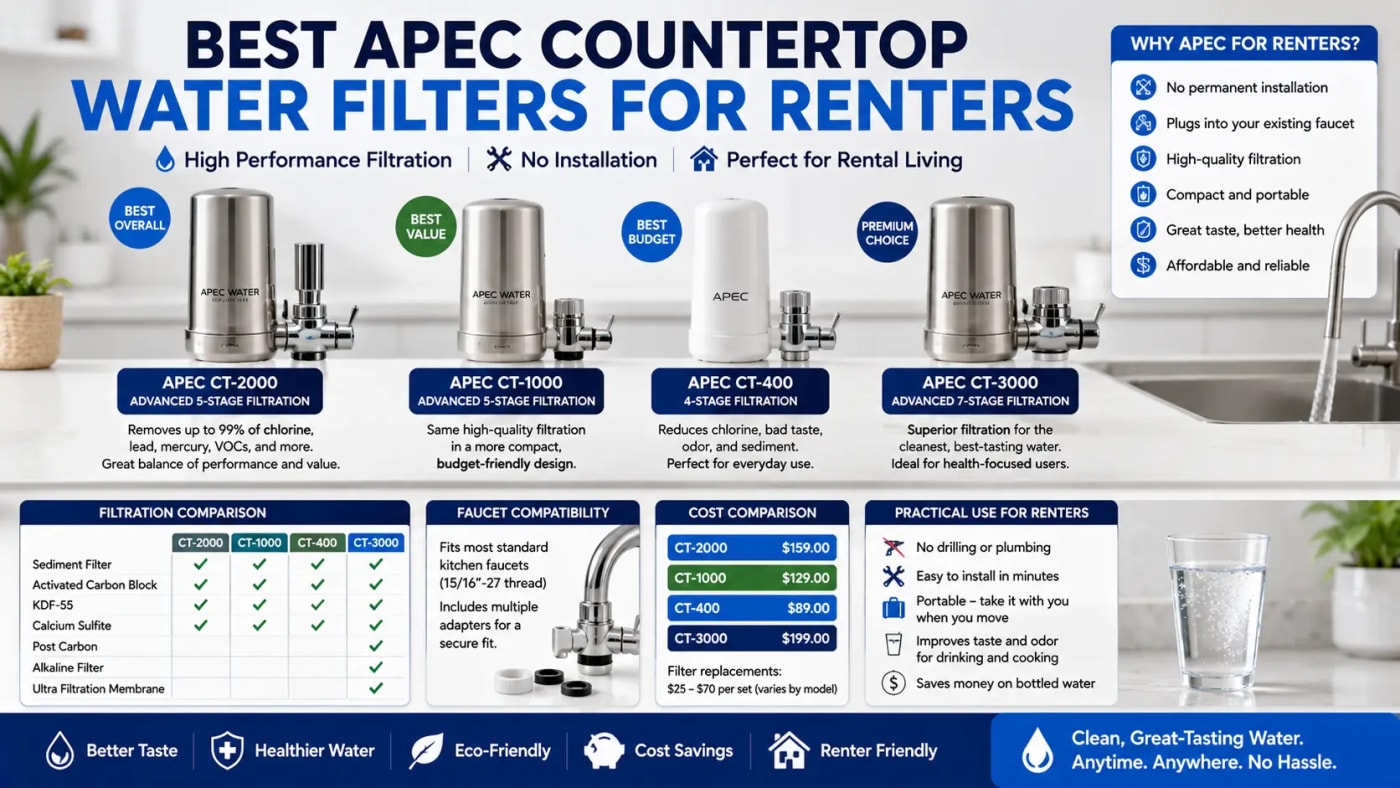
The best APEC countertop water filters for renters are the CT-1000, CT-2000, RO-CTOP-C, RO-CTOP-PH, and the ROCT-PLUS. Each one fits a different need. The CT-1000 is a simple carbon filter. It removes chlorine, bad taste, and bad smell from tap water. It is cheap and easy to use. The CT-2000 does the same job but adds ceramic and silver parts inside the filter. This helps remove bacteria too, not just taste and smell. The RO-CTOP-C is a stronger filter. It uses reverse osmosis, which means it pushes water through a very fine layer. This layer blocks lead, fluoride, and many other small particles that carbon alone cannot stop. The RO-CTOP-PH does the same job as the RO-CTOP-C, but it adds minerals back into the water at the end. This gives the water a fuller taste and a higher pH. The ROCT-PLUS works in a different way. It does not connect to the faucet at all. You fill it by hand and plug it into the wall. This makes it the right choice for a kitchen where the faucet shape blocks other filters. It also gives instant hot water, which the other models do not.
Best APEC Countertop Water Filters for Renters: Models, Filtration, Faucet Compatibility, Costs, and Practical Use
Share
Our Top Picks
In-Depth Reviews
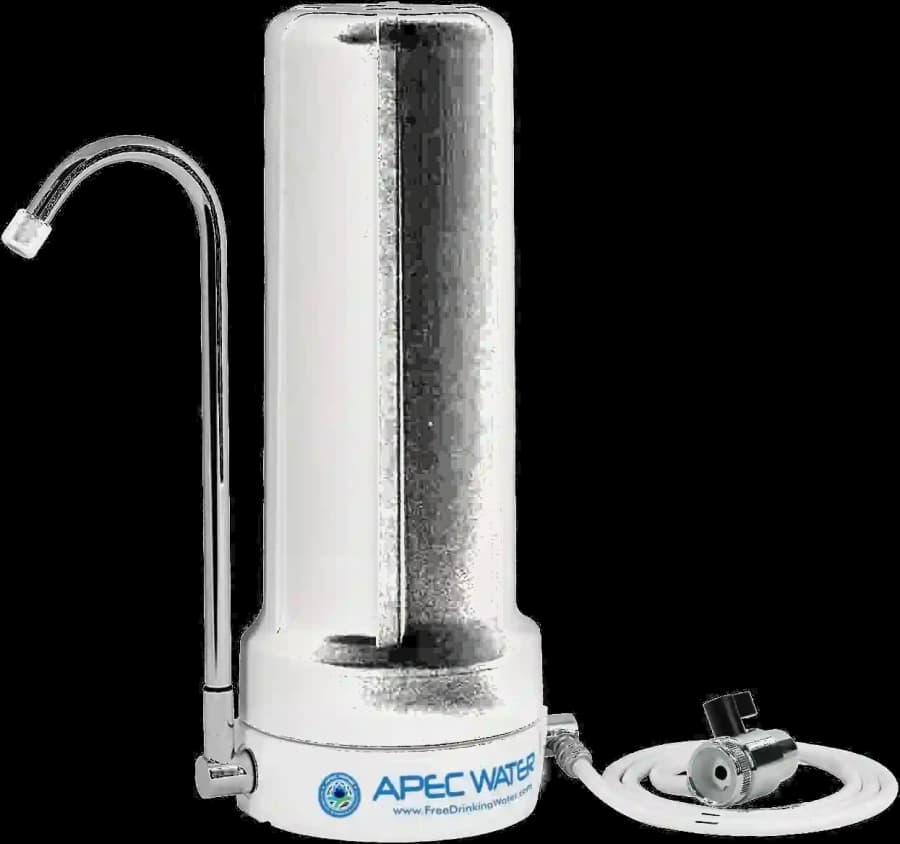
APEC CT-1000
Key Features
A simple, single-stage carbon block filter built for renters who just want cleaner-tasting tap water. It strips out chlorine taste/odor, sediment, and some lead without the cost, waste water, or install of an RO system and at 6,000 gallons of capacity, it outlasts most faucet and pitcher filters by a wide margin.
Reasons to Buy
- Long filter life treats up to 6,000 gallons before replacement
- No installation attaches via faucet diverter in minutes
- Removes chlorine, sediment, and lead effectively
- Lightweight and portable, great for travel or moving
- Budget-friendly, no wastewater produced
Reasons Not to Buy
- No bacteria or cyst reduction (unlike CT-2000)
- No dissolved-solids removal (no RO membrane)
- Smaller review base than other models
- Basic pitcher-style packaging, no carrying case
Specs at a Glance
| Brand | Purification Method | Material | Capacity | Installation Type | Power Source | Item Weight | Package Information |
|---|---|---|---|---|---|---|---|
| APEC WATER | Carbon Block | Carbon | 6,000 gallons | Countertop | Manual Operation | 4 pounds | Pitcher |
APEC CT-2000
Key Features
Steps up from the CT-1000 by adding ceramic and silver ion media to the carbon and ion exchange stack, giving it the ability to reduce bacteria and cysts not just taste and odor. APEC positions this one for both city water and well water, since well sources tend to carry more organisms.
Reasons to Buy
- 4-in-1 filtration: ceramic, silver ion, carbon block, ion exchange
- Removes bacteria and cysts (>99.99% E. coli, Cryptosporidium)
- Suitable for both city and well water
- No installation plug-and-use faucet diverter
- Reduces chlorine, lead, and heavy metals
Reasons Not to Buy
- Lower capacity than CT-1000 (1,000 vs. 6,000 gallons)
- No RO membrane doesn't touch fluoride, arsenic, or dissolved solids
- Ceramic shell needs periodic manual cleaning
Specs at a Glance
| Brand | Purification Method | Material | Capacity | Installation Type | Power Source | Model Name | Package Information |
|---|---|---|---|---|---|---|---|
| APEC WATER | Carbon Block | Ceramic | 1,000 gallons | Countertop | Manual Operation | CT-2000 | Faucet |
APEC RO-CTOP-C
$289.99
Key Features
The full 4-stage RO workhorse of the lineup sediment, carbon, RO membrane, and post-carbon rated to remove up to 99% of dissolved contaminants including lead, fluoride, and arsenic. It ships with its own carrying case, making it the go-to pick for renters who move often and want the widest contaminant coverage without permanent plumbing.
Reasons to Buy
- Full 4-stage RO removes up to 99% of dissolved contaminants
- Includes carrying case built for renters who relocate
- No installation, fits most standard faucets
- Highest review volume of any model with strong average
- Compact and lightweight for easy storage/transport
Reasons Not to Buy
- No storage tank output limited to real-time membrane speed
- Not compatible with pull-out, sprayer, or designer faucets
- Highest upfront price of the standard RO models
- Produces RO wastewater that needs draining
Specs at a Glance
| Brand | Purification Method | Material | Capacity | Product Dimensions | Installation Type | Power Source |
|---|---|---|---|---|---|---|
| APEC WATER | Activated Carbon, Reverse Osmosis | Aluminum | 90 gallons/day | 15.5"L x 6.5"W x 6.5"H | Countertop | Manual/Gravity-fed |
APEC RO-CTOP-PH
$189.99
Key Features
Same 4-stage RO backbone as the RO-CTOP-C, but swaps the final carbon polish for a calcium carbonate remineralization stage raising pH and giving the water a fuller, more mineral-like taste. A solid pick for renters who find plain RO water too flat, without giving up any of the contaminant reduction.
Reasons to Buy
- 4-stage RO plus remineralization for higher pH and fuller taste
- No installation, fits most standard faucets
- Works across a wide pressure range (40–85 psi)
- Strong rating
Reasons Not to Buy
- Not compatible with pull-out, sprayer, or designer faucets
- No storage tank real-time dispensing only
- Remineralization is a taste preference, not a proven health benefit
- Carrying case sold as a separate style/variant
Specs at a Glance
| Brand | Purification Method | Material | Capacity | Product Dimensions | Installation Type | Power Source | Item Weight |
|---|---|---|---|---|---|---|---|
| APEC WATER | Alkaline, Reverse Osmosis | Aluminum, calcium carbonate | 90 gallons/day | 14"L x 6"W x 6.5"H | Countertop | (faucet-fed) | 9.6 pounds |
APEC ROCT-PLUS
$344.99
Key Features
The only model in the lineup that skips the faucet entirely fill the reservoir by hand, plug it into the wall, and it handles the rest with 3-stage RO plus UV disinfection. Its standout feature is instant hot water with digital temperature control, making it the pick for renters with incompatible faucets or anyone who wants tea/coffee-ready water on demand.
Reasons to Buy
- No faucet connection needed fully self-contained
- 3-stage RO plus UV disinfection for added protection
- Instant hot water with adjustable temperature up to 203°F
- Efficient 3:1 pure-to-drain ratio, less wastewater than typical RO
- Digital display with child lock for safety
Reasons Not to Buy
- Most expensive option in the lineup
- Requires manual reservoir refilling no direct faucet feed
- Larger footprint than faucet-connected models (15.59" tall)
- Corded electric needs a nearby outlet to operate
Specs at a Glance
| Brand | Purification Method | Material | Capacity | Product Dimensions | Installation Type | Power Source | Package Information |
|---|---|---|---|---|---|---|---|
| APEC WATER | Activated Carbon, Reverse Osmosis | Polypropylene | 1,056 gallons | 7.87"L x 15.37"W x 15.59"H | Countertop | Corded Electric | Dispenser |
Every model on this list is small, light, and easy to pack. None of them need drilling or plumbing work. This makes them safe choices for a rented home. The right pick depends on three simple things. First, what is wrong with your water. Second, what shape your faucet is. Third, how much you want to spend on new filters each year. This article walks through each of these points in plain steps, so you can pick the right model without any guesswork.
Renting a home comes with a fixed limit. You cannot drill into the counter, you cannot cut into a wall, and you cannot install a permanent water line. This single constraint shapes almost every decision a renter makes about drinking water. APEC builds several countertop water filters that work inside this constraint, and each one solves the problem in a different way. Some connect to the kitchen faucet. Some sit on the counter and use a refillable tank instead. Some remove basic taste and odor problems, while others remove a much wider range of contaminants through reverse osmosis. This article looks at APEC countertop filters through the lens of a renter. It covers the product types, the filtration technology inside each one, faucet compatibility, output speed, maintenance needs, and the real cost of owning one over time. By the end, you will understand every option well enough to match a model to your own kitchen, water source, and budget.
What APEC countertop filter types are available to renters and how do their filtration technologies differ?
APEC countertop filter types available to renters fall into two broad groups, and their filtration technologies differ in how deep they treat the water. The first group uses carbon and ceramic filtration without reverse osmosis. The second group uses reverse osmosis, often shortened to RO. Both groups are built for temporary setups, but they solve different water problems.
The carbon and ceramic group includes the CT-1000 and CT-2000. These models attach to a kitchen faucet through a diverter valve and treat water as it passes through a solid filter cartridge. They are simple, low cost, and require no waste line.
The reverse osmosis group includes the RO-CTOP, RO-CTOP-C, RO-CTOP-PH, and RO-CTOP-PHC, along with the newer ROCT-PLUS. These systems push tap water through a thin membrane that blocks a much smaller range of particles than carbon alone. Standard RO-CTOP models still connect to a faucet, while the ROCT-PLUS works from a manual water reservoir and needs no faucet connection at all.
The table below shows how the main APEC countertop models differ in technology, connection method, and portability.
Model | Filtration Technology | Connection Method | Portability |
CT-1000 | Carbon block | Faucet diverter | Lightweight, plug and use |
CT-2000 | Ceramic, carbon, ion exchange | Faucet diverter | Lightweight, plug and use |
RO-CTOP | 4 stage reverse osmosis | Faucet diverter | Compact, carrying case |
RO-CTOP-C | 4 stage reverse osmosis | Faucet diverter | Compact, carrying case |
RO-CTOP-PH | 4 stage RO with remineralization | Faucet diverter | Compact, carrying case |
RO-CTOP-PHC | 4 stage RO with remineralization | Faucet diverter | Compact, carrying case |
ROCT-PLUS | 3 stage RO with UV light | Manual reservoir, plug in | Self-contained, no faucet needed |
What contaminants do APEC's non-RO countertop filters target through carbon and ceramic filtration?
The contaminants APEC's non-RO countertop filters target through carbon and ceramic filtration are sediment, chlorine, bad taste, bad odor, and in one model, bacteria too. The CT-1000 uses a single extruded carbon block. It targets sediments, chlorine, unpleasant taste, and odor. APEC lists this filter as a fit for chlorinated tap water, and it treats up to about 6,000 gallons before the cartridge needs to be replaced.
The CT-2000 uses a wider filtration approach with ceramic media, silver ion media, an activated carbon block, and ion exchange resin. This adds protection against bacteria and cysts on top of the taste and odor reduction that carbon alone provides. APEC positions the CT-2000 for both city tap water and well water, since well water often carries more particles and organisms than treated city supply.
These are the main things each non-RO filter targets:
Sediment, sand, and rust particles
Chlorine taste and smell
Lead and other heavy metals through ion exchange
Bacteria and cysts, in the CT-2000 only, through ceramic and silver ion media
What filtration stages does the APEC RO-CTOP-C use to treat drinking water?
The filtration stages the APEC RO-CTOP-C uses to treat drinking water are four separate steps, and each one does its own job before water reaches the tap.
Here are the four stages in order:
A sediment filter removes dirt, sand, and rust particles before they reach the membrane.
An activated carbon filter removes chlorine and reduces taste and odor problems.
A thin film composite RO membrane blocks a very fine range of dissolved solids, lead, fluoride, arsenic, bacteria, viruses, and volatile organic compounds. APEC states the system removes up to 99 percent of these contaminants, and this figure comes from the manufacturer rather than an independent lab test on every unit sold.
A post carbon filter gives the water a final taste polish right before it comes out of the tap.
How does the APEC RO-CTOP-PH change the filtered water compared with standard RO-CTOP models?
The APEC RO-CTOP-PH changes the filtered water compared with standard RO-CTOP models by replacing the final treatment step with a calcium carbonate stage instead of a plain post carbon filter. This stage adds calcium minerals back into the water after the RO membrane strips them out. The result is water with a higher pH and a fuller, more mineral like taste. APEC markets this version for people who find plain RO water too flat or slightly acidic.
A short comparison shows the final stage difference:
Model | Final Stage | Effect on Water |
RO-CTOP-C | Post activated carbon | Neutral taste, standard RO output |
RO-CTOP-PH | Calcium carbonate remineralization | Higher pH, mineral tasting water |
What does the APEC ROCT-PLUS add for renters who need a self-contained countertop system?
The APEC ROCT-PLUS adds a self-contained system for renters through a manual reservoir and a plug-in design, with no faucet connection needed at all. Instead of connecting to the tap, it uses a manual reservoir that you fill by hand, and it plugs into a standard wall outlet. This makes it useful in kitchens where the faucet shape blocks every other countertop RO model.
These are the main features of the ROCT-PLUS:
A three stage RO cartridge combined with a UV light for extra disinfection
A three to one pure to drain ratio, meaning four cups of tap water produce three cups of purified water and one cup of wastewater
Instant hot water with four temperature presets, useful for tea, coffee, or baby formula
A digital display that shows filter life, water temperature, and UV status
A child lock for safety around the hot water function
No drilling and no plumbing connection of any kind
Which kitchen faucets are compatible with APEC faucet-connected countertop filters?
Kitchen faucets compatible with APEC faucet-connected countertop filters are standard faucets with a normal, removable aerator at the tip. Faucet-connected models, including the RO-CTOP-C and RO-CTOP-PH, work with these faucets through a small diverter valve. This valve screws onto the faucet spout in place of the existing aerator and redirects part of the water flow into the filter. APEC states clearly that these models do not work with pull-out faucets, pull-down faucets, sprayer faucets, or special size designer faucets, since these faucet types do not have a standard removable aerator for the diverter to attach to.
How can a renter identify an incompatible pull-out, pull-down, sprayer, or designer faucet before buying?
A renter can identify an incompatible pull-out, pull-down, sprayer, or designer faucet before buying by checking a few simple details on the faucet itself.
Check your faucet for these signs of incompatibility:
A hose that pulls out of the faucet head for spraying dishes
A spray head instead of a plain round spout tip
No visible aerator that unscrews from the tip
An unusual or oversized spout shape often found in designer faucet lines
Threading at the tip that looks different from a standard round aerator
If your faucet has a plain, fixed spout with a simple round aerator that unscrews by hand, it is very likely compatible with faucet-connected APEC models.
How much counter space and carrying weight do APEC countertop RO models require?
The counter space and carrying weight APEC countertop RO models require is small, since faucet-connected RO-CTOP models are built to be light enough to move between rentals.
The table below shows the footprint of the main RO-CTOP models.
Model | Dimensions | Weight |
RO-CTOP | Approximately 16 x 6.5 x 6.5 inches | About 7 lb |
RO-CTOP-C | Approximately 16 x 6.5 x 6.5 inches | About 7 lb, with carrying case |
RO-CTOP-PH | Approximately 16 x 6.5 x 6.5 inches | About 7 lb |
Always check the current listing on APEC's own product page before buying, since packaging and case weight can shift slightly between production runs.
How does a faucet-independent APEC countertop system solve apartment faucet restrictions?
A faucet-independent APEC countertop system solves apartment faucet restrictions by removing the faucet connection completely. A faucet-connected system depends on the shape of your faucet. A reservoir-fed system like the ROCT-PLUS removes that dependency entirely. Instead of connecting to the tap, you fill the internal tank with a jug or cup, then the machine filters that water on its own. This means a designer faucet, a pull-out sprayer, or a shared kitchen faucet in a sublet no longer blocks you from using an RO system at all.
How much purified water can an APEC countertop RO system produce under normal renter conditions?
The purified water an APEC countertop RO system can produce under normal renter conditions depends on the model's rated output and your home water pressure. APEC rates the RO-CTOP-C at 90 gallons per day, or GPD, at 60 psi of feed water pressure, and 75 GPD at 50 psi. This GPD number describes the maximum rate the membrane can process under specific lab conditions. It does not describe how fast a full glass fills at your tap, since real output depends on your home water pressure, water temperature, and how long the system has been running.
This is the specification table for output and pressure.
Model | Rated Output | Feed Pressure Range |
RO-CTOP-C | 90 GPD at 60 psi, 75 GPD at 50 psi | 40 to 85 psi |
RO-CTOP-PH | 90 GPD at 60 psi | 40 to 85 psi |
ROCT-PLUS | 3 to 1 pure to drain ratio | Not pressure dependent, reservoir fed |
Why can APEC RO-CTOP models feel slow despite their published GPD rating?
APEC RO-CTOP models can feel slow despite their published GPD rating because that number describes total daily membrane output, not the instant flow rate at the tap. RO-CTOP models have no built-in storage tank, so water comes out only as fast as the membrane can push it through in real time. Renters in online forums often describe this as a slow fill compared with a normal faucet stream. This is a normal trait of tankless countertop RO systems and not a sign of a faulty unit. The practical fix most owners use is filling a separate clean container and letting it build up while doing other kitchen tasks.
How does feed-water pressure affect APEC countertop RO performance?
Feed-water pressure affects APEC countertop RO performance directly, since reverse osmosis depends on pressure to push water through the membrane. APEC lists a feed pressure range of 40 to 85 psi for RO-CTOP-C, with the 90 GPD rating tied to 60 psi specifically. Lower home water pressure lowers the actual output below the rated figure, while pressure below the minimum range can stop the membrane from working well at all. Most city apartments fall inside this range, but very old buildings or units on high floors sometimes run lower pressure than expected.
How should renters handle purified water storage and RO wastewater from faucet-connected APEC systems?
Renters should handle purified water storage and RO wastewater from faucet-connected APEC systems with a separate clean container placed under the filtered water outlet. Faucet-connected RO-CTOP models send filtered water out through a separate spout while sending concentrate, often called RO wastewater, out through a drain line or back into the sink. Since these models carry no internal storage tank, the practical setup is a clean pitcher or bottle placed under the filtered water outlet to catch and store water for later use. The exact ratio of purified water to wastewater depends on the model and your water pressure, so check the specific manual for your unit rather than relying on a single fixed number.
What maintenance does an APEC countertop RO system require during long-term rental use?
The maintenance an APEC countertop RO system requires during long-term rental use is mainly regular filter changes rather than a one-time setup. Renters who move often should treat filter replacement as a normal recurring task, similar to changing batteries in a smoke detector.
The table below shows a general maintenance schedule for RO-CTOP family models.
Component | Typical Replacement Interval | Purpose |
Sediment pre-filter | Every 6 to 8 months | Removes dirt and sand before the membrane |
Carbon pre-filter | Every 6 to 8 months | Removes chlorine, taste, and odor |
RO membrane | Around 2 years, check manual for exact figure | Removes fine dissolved contaminants |
Remineralization filter, PH models only | Every 6 to 12 months | Adds calcium minerals back into filtered water |
How often should APEC RO-CTOP pre-filters and membranes be replaced?
APEC RO-CTOP pre-filters and membranes should be replaced on a regular schedule based on APEC's own filter documentation. This states that the sediment and carbon pre-filters in the RO-CTOP family last about 6 to 12 months under normal use. The membrane itself lasts considerably longer, though APEC recommends checking your specific model's manual for the exact figure rather than assuming one universal number, since actual lifespan depends on water quality, usage volume, and local mineral content.
How much do APEC countertop replacement filters cost over time?
APEC countertop replacement filters cost a modest, ongoing amount over time, and the price depends on which filter set your model needs. APEC sells separate pre-filter sets and full filter sets for the RO-CTOP family, and prices are updated on APEC's own site from time to time, so always check the current listing before budgeting.
This table gives approximate cost ranges based on APEC's published filter sets.
Model Family | Filter Component | Typical Price Range | Replacement Interval |
RO-CTOP and RO-CTOP-C | Pre-filter set, stages 1 and 2 | Around 40 to 50 dollars | 6 to 12 months |
RO-CTOP and RO-CTOP-C | Complete filter set, stages 1 to 4 | Around 120 to 130 dollars | Membrane lasts longer, check manual |
RO-CTOP-PH and RO-CTOP-PHC | Pre-filter set, stages 1, 2, and 4 | Around 75 dollars | 6 to 12 months |
What makes APEC countertop filter ownership easier or harder for a renter after moving?
What makes APEC countertop filter ownership easier for a renter after moving is the carrying case and steady filter supply built into the RO-CTOP family. Countertop RO models built for renters carry an advantage that under-sink systems do not have. The RO-CTOP-C ships with its own carrying case, and APEC maintains a stable line of replacement filters for the entire RO-CTOP family. This means a renter can pack the unit, move to a new apartment, reconnect it to a new standard faucet, and keep using the same replacement filter parts without needing a new setup. The main variable that changes at a new address is faucet compatibility, so it is worth checking the new kitchen faucet before moving day if possible.
Which APEC countertop filter should a renter choose for their specific water, faucet, and budget?
The APEC countertop filter a renter should choose for their specific water, faucet, and budget depends on three simple things covered throughout this article. The right model depends on your water concern, your faucet type, your available counter space, your taste preference, and your budget for ongoing filter costs.
The table below is a decision matrix for choosing between the main APEC countertop options.
Your Situation | Best Fit Model | Why |
Only concerned about chlorine taste and smell | CT-1000 | Simple carbon filtration, low cost, no waste water |
Concerned about bacteria in well or tap water too | CT-2000 | Adds ceramic and silver ion protection |
Want broad contaminant reduction, standard faucet available | RO-CTOP-C | Full 4 stage RO filtration |
Want broad contaminant reduction, prefer mineral taste | RO-CTOP-PH | RO filtration plus remineralization |
Faucet is a pull-out, sprayer, or designer style | ROCT-PLUS | No faucet connection needed |
Want instant hot water for tea or coffee | ROCT-PLUS | Built-in heating with temperature presets |
Which APEC countertop filter fits a renter who mainly wants chlorine, taste, and odor reduction?
The APEC countertop filter that fits a renter who mainly wants chlorine, taste, and odor reduction is the CT-1000. It uses a single carbon block built specifically for chlorinated tap water, and it avoids the extra cost and wastewater of reverse osmosis when the underlying problem is only taste and smell. Renters who just want normal tap water to taste cleaner, without concern for fluoride, arsenic, or dissolved solids, usually do not need to move up to an RO model.
Which APEC countertop RO model fits a renter who wants broader contaminant reduction without permanent plumbing?
The APEC countertop RO model that fits a renter who wants broader contaminant reduction without permanent plumbing is the RO-CTOP-C, as long as the kitchen faucet is a standard style. APEC positions this entire product line specifically for apartments and rental housing, since it needs no permanent plumbing changes and can be removed at the end of a lease with no trace left behind.
When should a renter choose an alkaline APEC countertop RO model instead of standard RO?
A renter should choose an alkaline APEC countertop RO model instead of standard RO when taste and mineral content matter more than getting the flattest, most neutral water possible. The RO-CTOP-PH and RO-CTOP-PHC add calcium carbonate back into the water after RO filtration, which raises pH and gives a fuller taste that some people prefer over standard RO water. This is a taste and mineral preference rather than a guaranteed health benefit, so treat it as a personal choice rather than a medical decision.
When is the APEC ROCT-PLUS more practical than a faucet-connected RO-CTOP model?
The APEC ROCT-PLUS is more practical than a faucet-connected RO-CTOP model when the faucet does not support a diverter connection, or when instant hot water matters to you. This model trades faucet independence for a manual refill step, which some renters find more convenient and others find slightly less convenient, depending on daily habits.
What should renters verify about their water, faucet, counter, and lease before buying an APEC countertop filter?
What renters should verify about their water, faucet, counter, and lease before buying an APEC countertop filter is a short list of practical checks. This turns everything covered above into a practical pre-purchase checklist.
Follow these steps before buying any APEC countertop filter:
Check your local water report or Consumer Confidence Report to identify what is actually in your tap water.
Decide which contaminant matters most to you, whether that is taste, chlorine, lead, or a broader range of dissolved solids.
Inspect your kitchen faucet for a standard removable aerator, and rule out pull-out, sprayer, or designer styles if you are considering a faucet-connected model.
Measure your available counter space next to the faucet.
Check your home water pressure if you are choosing a faucet-connected RO model.
Estimate the yearly replacement filter cost for the model you are considering.
Review your lease for any restriction on countertop appliances or faucet attachments, even though these units require no drilling.
How does a countertop RO system compare with an under-sink RO system for renters?
A countertop RO system compares with an under-sink RO system for renters by trading some tank storage and steady flow for full portability and zero permanent installation. An under-sink system usually offers a larger storage tank and steadier flow, but it needs a permanent connection to the cold water line under the sink, which is often blocked by a lease agreement or a landlord's rules. For a full breakdown of output, storage, and cost differences, see our dedicated guide: Countertop RO vs Under-Sink RO.
How does APEC compare with AquaTru and other countertop RO brands?
APEC compares with AquaTru and other countertop RO brands across certification, exact contaminant claims, output speed, wastewater ratio, and replacement filter cost. This comparison needs its own detailed breakdown rather than a short summary here. See our full comparison: APEC vs AquaTru vs Waterdrop Countertop RO.
Is APEC countertop RO better than a water-filter pitcher for renters?
APEC countertop RO is better than a water-filter pitcher for renters who want a steady, wide-range filtered supply instead of small batch filtering. A pitcher filter is cheaper and needs no setup, but it only filters small batches at a time and generally does not reduce as wide a range of contaminants as reverse osmosis. For a full breakdown, see: Countertop RO vs Water Filter Pitchers.
Does reverse osmosis remove minerals from drinking water?
Reverse osmosis does remove minerals from drinking water, yes, along with other contaminants, since the membrane cannot tell the difference between a harmful particle and a beneficial mineral. Adding minerals back requires a separate remineralization stage, which is exactly what the PH versions of APEC's RO-CTOP line are built to do. For a deeper explanation, see: Does Reverse Osmosis Remove Minerals?
What is the difference between chlorine and chloramine in drinking water?
The difference between chlorine and chloramine in drinking water is how each one behaves inside a carbon filter. Chlorine is generally easier for standard carbon filters to reduce, while chloramine often needs a longer contact time or a specialized carbon media to treat effectively. This distinction matters when choosing between the simpler CT-1000 style filter and a more advanced carbon blend. Read more here: Chlorine vs Chloramine in Drinking Water.
How do you install an APEC RO-CTOP countertop water filter?
You install an APEC RO-CTOP countertop water filter by attaching the diverter valve to your faucet in place of the existing aerator, connecting the supplied tubing, and running an initial flush cycle before first use. For the full step-by-step walkthrough, see our dedicated guide: How to Install APEC RO-CTOP.
How do you replace APEC RO-CTOP filters?
You replace APEC RO-CTOP filters by shutting off the water supply to the unit, disconnecting the old cartridge from its quick-connect fitting, and inserting the new cartridge in the same position. Exact timing depends on which stage you are replacing. For the complete walkthrough, see: APEC RO-CTOP Filter Replacement Guide.
How much wastewater does a countertop reverse osmosis system produce?
The wastewater a countertop reverse osmosis system produces is a normal part of the filtration process, often called concentrate or reject water. The exact ratio of purified water to wastewater varies by model and by feed water pressure, so avoid relying on one fixed number across every APEC system. For a full explanation of recovery ratios, see: Countertop RO Wastewater and Recovery Ratio.
How do you read a US Consumer Confidence Report before choosing a water filter?
You read a US Consumer Confidence Report before choosing a water filter by checking the listed source of your tap water and any contaminants found during testing. The EPA confirms these reports provide information about source water and detected contaminants, which makes them a useful starting point before choosing a filter. For a full walkthrough of how to read one, see: How to Read a Consumer Confidence Report.
Is bottled water cheaper than using an APEC countertop RO system?
Bottled water is cheaper than using an APEC countertop RO system in some cases, and the answer depends on equipment cost, replacement filter cost, daily water use, and current bottled water prices in your area. A full year by year cost comparison needs its own detailed calculation rather than a short answer here. See our complete breakdown: Filtered Water vs Bottled Water Cost.
Share