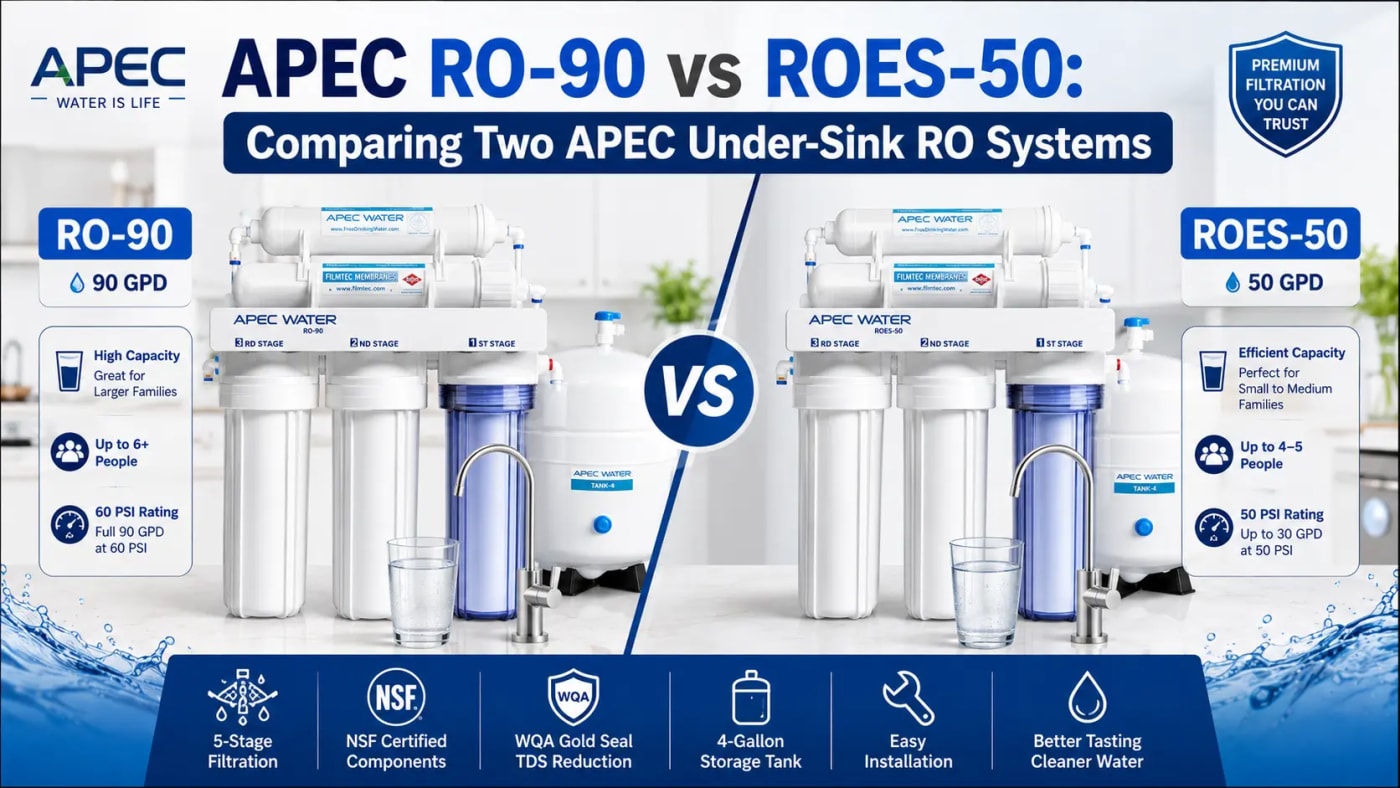
How do the APEC RO-90 and ROES-50 compare on GPD capacity and water production?
GPD stands for gallons per day. It tells a buyer how much filtered water the membrane can produce under standard test conditions, which APEC lists as 60 psi and 77°F for these systems.The APEC RO-90 produces 90 GPD. The APEC ROES-50 produces 50 GPD. The difference between the two ratings is 40 GPD. In percentage terms, the RO-90 has 80 percent higher rated production capacity than the ROES-50.
This number describes membrane output over a full day, not the speed of water coming out of the faucet. A higher GPD rating does not mean water flows 80 percent faster from the tap. It means the membrane can refill the storage tank faster after use and can keep up with higher daily demand.Actual daily production from either system depends on real conditions in the home. Feed water pressure and feed water temperature both affect membrane output. Cooler water and lower pressure reduce actual production below the rated GPD figure for both systems.
Do the RO-90 and ROES-50 use the same five stage filtration configuration?
Yes. Both the RO-90 and the ROES-50 use the same five stage filtration architecture.
The five filtration stages used by both systems:
Stage 1: A polypropylene sediment filter that removes dust, sand, and rust particles before they reach the membrane
Stage 2: A carbon block filter that reduces chlorine, taste, and odor
Stage 3: A second carbon block filter that continues chlorine, taste, and chemical reduction
Stage 4: The reverse osmosis membrane, which is the core filtration component that removes dissolved contaminants
Stage 5: A coconut shell carbon filter that removes any remaining taste from water stored in the tank
Both systems follow this same order of filtration. Having the same number of stages does not automatically mean the two systems perform identically on every contaminant. Stage count describes the filtration path, not the certified performance of the membrane inside that path.
Does the RO-90 remove more contaminants than the ROES-50?
Both APEC product pages state that the systems reduce up to 99 percent of contaminants. This 99 percent figure is a general marketing claim, not a contaminant specific certification number, and it should be read as a general performance statement rather than a lab result for every substance in tap water.The RO-90 product page lists a specific set of contaminants certified under WQA Gold Seal testing. This list includes arsenic plus 3, arsenic plus 5, barium, cadmium, chromium 3, chromium 6, copper, fluoride, lead, radioactivity, selenium, and turbidity.
The ROES-50 product page states that the system is WQA certified and meets NSF/ANSI 58 standards. The ROES-50 page also publishes a long general list of substances the system removes, including arsenic, lead, fluoride, chromium, and radium among many others. This list is presented as a general removal list on the product page rather than as the same itemized WQA Gold Seal certified contaminant set shown on the RO-90 page.A reader who needs certified performance data for a specific contaminant, such as arsenic or fluoride, should check the current WQA certification listing for each exact model before buying, since certification scope can update over time.
How does the 4 gallon storage tank affect the difference between RO-90 and ROES-50?
Both the RO-90 and the ROES-50 include a 4 gallon pressurized storage tank as standard equipment. The tank dimensions listed by APEC are 11 inches by 11 inches by 15 inches for the standard tank used with these systems.A pressurized RO tank does not hold a full 4 gallons of usable water. Part of the tank volume is used by an internal air bladder that pushes water out to the faucet. In practice, a 4 gallon RO tank typically delivers a smaller usable volume, often cited by manufacturers and installers as roughly half of the nominal tank size.
The tank exists to store water produced ahead of time, so a user gets fast flow at the faucet even though the membrane itself produces water slowly, drop by drop. When the tank runs low, the membrane refills it in the background. This is where the GPD difference between the two systems becomes practical. The RO-90 refills its tank faster than the ROES-50 because it produces more water per day.Both systems can accept a larger tank as an upgrade, such as a 14 gallon tank, since APEC sells tanks separately as replacement parts.
Which APEC RO system handles higher household water demand better?
Higher daily water demand favors the RO-90 because of its higher GPD rating.
Households that use RO water only for drinking and basic cooking place a light and steady demand on the system. Households that also use RO water for coffee makers, tea kettles, ice makers, and larger families place a heavier and more frequent demand on the system.
Situations where higher production capacity becomes more relevant:
A larger household with several people drawing water throughout the day
Frequent back to back use of the faucet within the same hour
A connected ice maker, which draws from the tank automatically
Cooking tasks that use several gallons of filtered water at once
For a smaller household with light, spread out drinking water use, the 50 GPD rating of the ROES-50 is often enough because the tank has time to refill between uses. For a larger household or one with an ice maker connection, the 90 GPD rating of the RO-90 keeps the tank filled more consistently during periods of frequent use.
How do operating pressure and water conditions affect RO-90 and ROES-50 performance?
Both systems share the same documented operating range on the official APEC specification sheets.
This table shows the operating conditions required for normal function on both the RO-90 and the ROES-50.
Condition | Required range |
Feed water pressure | 40 to 85 psi |
Feed water temperature | 40 to 100°F |
Maximum total dissolved solids (TDS) | 2000 ppm |
Feed water pH | 2.0 to 11.0 |
The GPD rating printed on each system, 90 GPD or 50 GPD, is measured at 60 psi and 77°F. Real world conditions rarely match this exact test point every day.Lower feed pressure reduces the force pushing water through the membrane, which lowers actual output below the rated GPD for both systems. Colder feed water also reduces membrane efficiency, since reverse osmosis membranes work more effectively in warmer water within their rated range.
A home with feed water pressure below 40 psi will see reduced performance from either system. In that case, a system built with a permeate pump is a better fit than the standard RO-90 or ROES-50, since a permeate pump boosts performance under low pressure conditions.
Does RO-90 or ROES-50 have a better wastewater profile?
Both the RO-90 and the ROES-50 are conventional tank based RO systems, and both send a portion of incoming feed water down the drain as part of the membrane process. This drain water carries away the contaminants that the membrane filters out.APEC does not publish an exact wastewater ratio on the official RO-90 or ROES-50 product pages. Independent reviewers and user discussions commonly report a wastewater ratio of around 3 to 1 for standard APEC tank systems, meaning roughly three gallons go to the drain for every one gallon of filtered water produced. This figure should be treated as a general reference point from independent sources rather than an official APEC specification for either exact model.
Wastewater ratio depends on feed pressure, the flow restrictor installed in the system, and general water conditions in the home. Neither the RO-90 nor the ROES-50 has a documented advantage over the other in this area based on official manufacturer data. A higher GPD rating on the RO-90 does not by itself mean more or less water goes to the drain.
How do filter replacement and membrane maintenance differ between the RO-90 and ROES-50?
Both systems use the same five stage filter layout, so the maintenance routine follows the same basic pattern for each.
General replacement guidance shared by both systems:
Stage 1 through 3 filters (sediment and the two carbon blocks) are typically replaced on a yearly schedule
The reverse osmosis membrane, stage 4, typically lasts two to three years before replacement
Stage 5, the final carbon polishing filter, is usually replaced along with the membrane or on a similar multi year schedule
Actual replacement timing depends on feed water quality and daily usage, and can be checked using a TDS meter on the finished water
APEC sells a dedicated replacement filter set for the RO-90 and a separate dedicated replacement filter set for the ROES-50. The two sets are not interchangeable because the systems use different branded filter cartridges.
APEC markets the RO-90 filters as premium, large capacity components with roughly twice the service life and contaminant holding capacity compared to smaller all in one filters. The ROES-50 also uses industry standard sized solid block filters described by APEC as offering longer filter life compared to smaller cartridge types, though APEC does not apply the same explicit twice the life claim to the ROES-50 line that it applies to the RO-90.
Are the RO-90 and ROES-50 similar in installation and under sink setup?
Yes, the two systems are very similar to install. Both are designed for do it yourself installation under a standard kitchen sink.
Standard components included with both systems:
Quick connect fittings that do not require separate inserts or sleeves
A stainless steel check valve
A flow restrictor
Five feet of food grade tubing
A half inch feed water adapter
A lead free faucet
A four gallon pressurized tank
A wrench, tank ball valve, feed water valve, drain saddle, Teflon tape, and printed manuals
Both systems need similar under sink cabinet space to fit the filter housings, tank, and tubing. An optional ice maker kit is available at checkout for both models.Independent reviewers report that a first time do it yourself installation of an APEC system, following the printed manual and installation video, typically takes about one hour for someone with basic tools and comfort with simple plumbing connections. Installation time can run longer for a first attempt or for a cabinet with tight space.
Is the RO-90 worth paying more for than the ROES-50?
At the time of writing, the APEC RO-90 is priced at $264.99 and the APEC ROES-50 is priced at $230.99 on the official APEC Water website. This is a price difference of $34.00. APEC prices change from time to time, so a reader should check the current listed price before buying.The value question comes down to daily water demand rather than a general idea of which system is better. For $34.00 more, the RO-90 buyer gets 80 percent more rated production capacity, the WQA Gold Seal certification tier, and filters marketed with a longer service life.
A household with light, spread out drinking water use may not use the extra capacity of the RO-90 often enough to justify the price gap. A household with heavier daily demand, several people at home, or an ice maker connection is more likely to draw on the extra 40 GPD on a regular basis, which makes the RO-90 the better value for that specific use pattern.
What should you consider before choosing between the RO-90 and ROES-50?
The comparison above covers every meaningful difference between the two systems. Before making a final choice, a buyer should weigh the following variables together rather than focusing on a single specification.
This table summarizes the key decision variables side by side.
Decision variable | Favors RO-90 | Favors ROES-50 |
Daily water demand | High, frequent use, larger household | Light, steady, smaller household |
Ice maker connection | Yes | Not ideal on its own |
Budget | Willing to pay $34.00 more | Lower upfront cost preferred |
Feed water pressure | Standard range works for both | Standard range works for both |
Cabinet space | Similar space needed for both | Similar space needed for both |
Filter cost over time | Premium filter set, longer claimed life | Standard filter set, still long lasting |
Both systems share the same tank size, the same five stage filtration path, and the same basic operating requirements. The decision mainly comes down to matching rated production capacity to real household demand and comparing that against the price difference.
Which APEC RO system is better for a normal household drinking water setup?
For a household that uses RO water mainly for drinking, basic cooking, and occasional coffee or tea, the 50 GPD rating on the ROES-50 is usually sufficient, since demand stays light and the tank has time to refill between uses. Readers who want the full product breakdown for this system can visit the dedicated APEC ROES-50 page.
What does a reverse osmosis water filter remove from drinking water?
Reverse osmosis uses a semi permeable membrane to block dissolved solids, heavy metals, and many other contaminants from passing through with the filtered water, while a carbon stage handles chlorine, taste, and odor. For a full breakdown of what reverse osmosis removes and how certification works, see the dedicated reverse osmosis contaminant removal guide.
How often should reverse osmosis filters and membranes be replaced?
Replacement interval depends on feed water quality, daily usage, and the manufacturer guidance for the specific filter set installed. For complete replacement schedules and step by step filter change instructions, see the dedicated RO filter replacement guide.
How much water does a reverse osmosis system waste?
A conventional tank based reverse osmosis system sends a portion of incoming feed water down the drain as part of normal membrane operation, and the exact ratio depends on pressure, the flow restrictor, and water conditions. For a full explanation of RO wastewater ratios and ways to reduce drain water, see the dedicated reverse osmosis wastewater guide.
What water pressure does a reverse osmosis system need to work properly?
Feed water pressure directly affects how much water the membrane produces and how quickly the storage tank refills after use. For guidance on low pressure situations and permeate pump solutions, see the dedicated RO water pressure guide.
How do you choose the right reverse osmosis system for your home?
Choosing the right system means matching water quality, daily household demand, available cabinet space, storage tank size, feed water pressure, and budget to a specific model. For a complete buying framework across the full APEC lineup, see the reverse osmosis buying guide.
Our Verdict
The APEC RO-90 and ROES-50 share the same core DNA, identical 5-stage filtration, the same 4-gallon tank, and nearly identical operating requirements, so this comparison really comes down to one question: how much water does your household actually need on a given day?
Choose the APEC ROES-50 if:
Your household uses RO water mainly for drinking, cooking, and occasional coffee or tea
Water use is light and spread throughout the day, giving the tank time to refill
You want the lower upfront cost within APEC's under-sink lineup
You don't have (or don't plan to add) an ice maker connection
Choose the APEC RO-90 if:
Your household is larger or draws water frequently throughout the day
You want to connect an ice maker, which pulls from the tank automatically
You regularly need several gallons at once for cooking or filling containers
You want the WQA Gold Seal certification tier with an itemized contaminant list
Bottom line: For most typical households with steady, moderate drinking-water needs, the ROES-50 does the job well and costs less. But the price gap between the two systems is often just $30–$50, which is a small premium for 80% more rated production capacity. If there's any chance your household will strain the tank more people, an ice maker, frequent back-to-back use the RO-90 is the safer buy so you're not left waiting on refills. Either way, both systems share the same footprint and installation process, so the decision is really about matching capacity to demand rather than picking a "better" system outright.