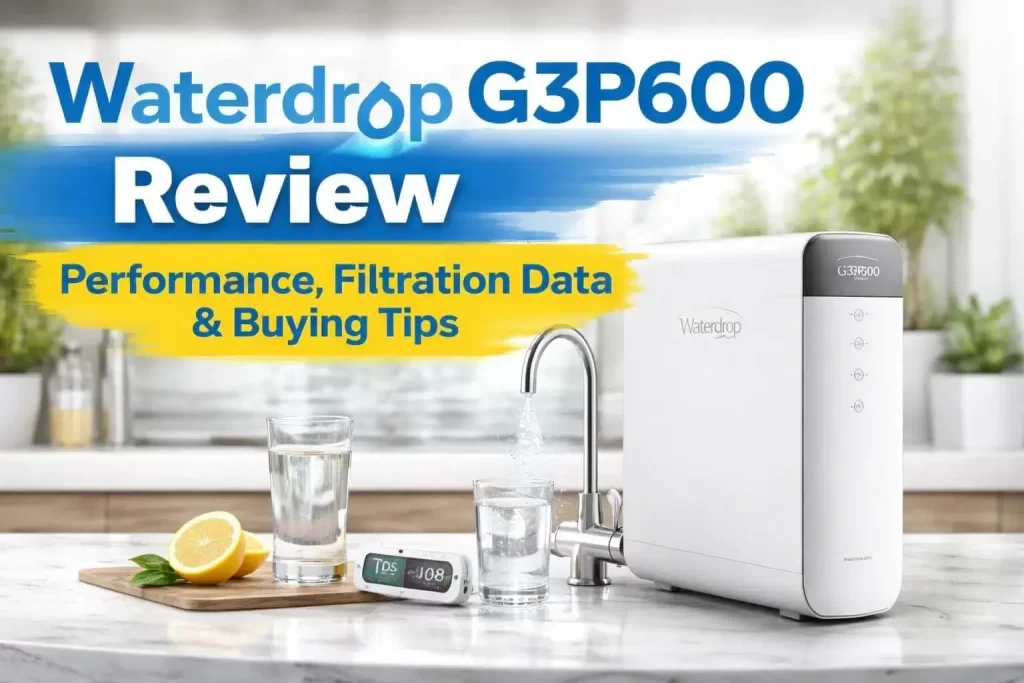
The Waterdrop G3P600 is one of the most efficient tankless reverse osmosis systems on the market, offering a high-speed 600 GPD flow rate that fills a cup in roughly eight seconds without the bulk of a storage tank. Real-world testing shows that this system is best at TDS reduction and user convenience, but has a limited long-term value depending on your local water hardness. And unlike traditional RO units, the G3P600 is designed for small spaces that value plug-and-play installation and a modern, smart-faucet interface.
| Feature | Specification |
| Output Rate | 600 Gallons Per Day (GPD) |
| Filtration Stages | 8-Stage Composite Filtration |
| Drain Ratio | 2:1 (Pure to Waste) |
| Certifications | NSF/ANSI 58 (TDS) & 372 (Lead-Free) |
| Filter Lifespan | 6–12 months (CB) to 2 years (RO) |
| Price Range | $350 – $450 |
What Does the Waterdrop G3P600 Actually Filter Out?
Understanding the filtration capability of the G3P600 requires looking past general marketing and into its official performance data. In water filtration, a certified removal of a contaminant is legally different from having “tested” results. The G3P600 is certified to NSF/ANSI 58, the gold standard for reverse osmosis, for TDS reduction. It is also certified for lead-free materials and for chlorine taste and odor by NSF/ANSI 42.
While NSF certification provides a baseline, independent third-party lab tests (SGS) and Waterdrop internal data sheets document a much wider scope of removal. Because the RO membrane is 0.001 microns in size, most Waterdrop G3P600modern contaminants cannot cross it.
Filtration Breakdown by Stage
| Contaminant | Filtration Stage | Status |
| TDS (Total Dissolved Solids) | RO Membrane (Stage 5) | NSF 58 Certified |
| Lead & Arsenic | RO Membrane (Stage 5) | Verified (SGS) |
| Fluoride | RO Membrane (Stage 5) | Verified (SGS) |
| PFAS (PFOA/PFOS) | Carbon Block & RO Membrane | Verified (SGS/IAPMO) |
| Microplastics | RO Membrane (Stage 5) | Verified (SGS) |
| Chlorine, Taste, & Odor | CF & CB Filters (Stages 2, 7) | NSF 42 Certified |
What it Does NOT Remove
Knowing the system limits is just as important. The G3P600 is not a water softener; while removing the minerals that cause hardness (calcium/magnesium), it is not designed to treat “well water” with high iron or sulfur without a pre-treatment system. Also, the 0.0001-micron membrane physically blocks almost all bacteria and viruses, but the G3P600 was not certified as a microbiological purifier. When adding a UV sterilizer to a biologically unsafe water source, such as a river or lake, it is important to ensure that the water is treated properly.
How Does the G3P600’s 8-Stage Filtration System Work?
This feature makes the Waterdrop G3P600 marketable as an “8-stage” system; the term refers to the composite layers inside the filters and not the eight separate physical cartridges. In reality, the system employs a compact three-cartridge (CF, RO, and CB) design for high-efficiency filtration without the heavy construction of multi-stage units.
The Three-Filter Breakdown
- Stage 1–3: The CF Filter (Composite Filter)
This unit serves as the primary line of defense. It combines PP cotton and a high-grade activated carbon block to catch large particles like rust, sand, and sediment while reducing chlorine to protect the sensitive RO membrane downstream.
- Stage 4–6: The RO Filter (Reverse Osmosis)
The “engine” of the system. It features a DOW® 0.0001-micron semi-permeable membrane. This ultra-fine pore size is what physically blocks microscopic contaminants, including TDS, heavy metals, and PFAS.
- Stage 7–8: The CB Filter (Activated Carbon Block)
The final polishing stage uses natural coconut shell activated carbon. This stage removes any residual tastes or odors that might linger after the RO process, ensuring the water tastes crisp and fresh.
A Note on Remineralization
Standard output from the G3P600 is “pure” water, sometimes slightly flattened, with a lower pH than expected because all the minerals have been stripped away. While the 8-stage process yields exceptional purity, remineralization is not included in the standard box. Alternatively, you can get alkaline water with added minerals like calcium and magnesium by adding an external remineralization filter, such as the WD-ALK35, to the line.
How Fast Does the G3P600 Produce Water, and Is It Enough for a Family?
When shopping for reverse osmosis systems, the “600 GPD” (Gallons per Day) rating can be misleading. It doesn’t mean you’ll be using 600 gallons of water daily; rather, it indicates the speed of the flow. In real-world terms, the Waterdrop G3P600 delivers approximately 0.42 gallons per minute (GPM).
The “Glass of Water” Test
To put that speed into perspective, here is how the G3P600 performs during common kitchen tasks:
- Filling an 8-oz glass: Approximately 8–10 seconds.
- Filling a 1-gallon pasta pot: Approximately 2.5 minutes.
- Filling a reusable water bottle: Approximately 15–20 seconds.
Tankless vs. Tank-Based Speed
Traditional RO systems use a 3-gallon tank. They fill a glass quickly but lose pressure when the tank fills up. It is tankless; the G3P600 filters water on demand. The initial flow is slightly slower than a full pressurized tank, but it never runs out. Five straight gallon jug fillings at the same steady speed fill five at a time, a huge advantage for big families or home cooks.
Is It Enough for Your Household?
A family of three to five people typically hits 600 GPD. Low-rating systems like 400 GPD units are notoriously slow (15+ seconds for a single glass). The G3P600 has enough velocity for simultaneous needs, like filling a reservoir of coffee while someone else drinks without the wait times of entry-level models.
Does the G3P600 Really Waste Less Water Than Traditional RO Systems?
The most common myth surrounding the Waterdrop G3P600 is that it always maintains a 2:1 pure-to-drain ratio. While it is factually true that this system is significantly more efficient than traditional tank-based RO units, which often waste 3 to 4 gallons for every 1 gallon produced, the 2:1 ratio is a “best-case scenario” measured under ideal laboratory conditions.
The Reality of the 2:1 Ratio
In the real world, your efficiency depends on three main variables: water temperature, inlet pressure, and TDS levels.
- The Myth
You will save 300% more water regardless of where you live.
- The Data
If your feed water is colder than 77°F or your household water pressure is at the lower end of the 14.5 PSI limit, the system has to work harder to force water through the membrane. This naturally increases the amount of wastewater sent to the drain.
Why Tankless Wins Anyway
No matter what your real-world ratio is, even if it slips to 1.5: cold winter pipes 1, the G3P600 still outperforms traditional systems for a reason: it lacks a storage tank. The traditional system uses the water to continually top off a tank against rising backpressure. The internal pump and tankless construction of the G3P600 ensure a direct and pressurized filtration process.
For the average family, a switch from an old-school RO to a G3P600 saves thousands of gallons annually. But you should also expect that 2:1 efficiency may vary seasonally.
How Difficult Is the G3P600 to Install and Maintain?
The Waterdrop G3P600 is touted as “your 30-minute DIY project,” but for most homeowners, the reality is a little more nuanced. Although the system is far simpler to handle than typical tank-based RO units, there is a big difference between “simple” and “effortless” during initial setup.
Installation
- The Myth
You can unbox the unit and have pure water running in under 20 minutes with no tools.
- The Reality
Leaks are less likely with the integrated waterways, but the unit is a permanent plumbing fixture. DIYers typically complete installation in 60 to 90 minutes. Clear your under-sink area, hook up your cold water line, and most importantly, make sure you have 1 inch of room under your sink for your smart faucet and an outlet for an electrical unit underneath the sink. If you’re not a natural driller into granite or stainless steel, you may need to pay a pro for that one step.
Maintenance: Where the G3P600 Wins
The genuine “win” for this system is the ongoing maintenance. Unlike older systems that require shutting off the water and using heavy wrenches to unscrew canisters, the G3P600 uses a twist-and-pull design.
- Filter Swaps: You can replace a filter in about 3 seconds without turning off your water supply.
- Tracking: The smart faucet and the front panel of the unit feature LED indicators that turn from blue to red when a filter is spent. You don’t have to guess or track dates on a calendar.
If you can handle a simple wrench and have a power outlet, the G3P600 is a manageable DIY project. After completing the “muscle work” of installation, the system requires virtually no maintenance, with only a 3-second filter swap once or twice a year.
What Does the G3P600 Cost to Own Over 3–5 Years?
The Waterdrop G3P600 has a higher upfront “sticker price” than budget tank-based systems, but its efficiency and consistent performance provide long-term value. To understand the true cost, you have to look beyond the initial $430–$540 purchase price and account for the proprietary filter replacements required to keep the 600 GPD flow rate and TDS reduction at peak levels.
The 5-Year Cost Breakdown
- Initial Investment: ~$450 (System, smart faucet, and first set of filters).
- Annual Maintenance: The CF (Sediment/Carbon) and CB (Post-Carbon) filters typically cost $30 each and need replacement every 6–12 months. The RO membrane costs roughly $110 but lasts up to 24 months.
- Estimated 5-Year Total: Approximately $1,100–$1,250 (including the system and four years of replacement cycles).
G3P600 vs. the Alternatives
Compared to bottled water, the savings are massive. A family of four spending $15 a week on plastic bottles will spend nearly $3,900 over five years. The G3P600 is a steal at less than 12 months. The proprietary filters make the G3P600 around $200-$300 pricier over five years compared to budget tank-based RO systems. Standard systems use $5-$10 “universal” 10-inch filters, while Waterdrop, with its snap-on locks, locks you in on their pricing.
The greater long-term cost of G3P600 is simply a convenience trade-off. You’re paying a premium for that 3-second filter swap and that tiny tankless design. If cost per gallon is your primary concern, a traditional system wins. The G3P600 is a better functional investment if you don’t mind a system that requires a plumber or wrench every six months.
Which Is Better for Your Home: G3P600, G3P800, or the Waterdrop X12?
Choosing between Waterdrop’s top-tier models involves balancing speed, efficiency, and your household’s daily water volume. While the core filtration technology, a 0.0001-micron RO membrane, remains consistent across all three, the mechanical output and waste ratios vary significantly.
Key Specs Comparison
| Feature | G3P600 | G3P800 | Waterdrop X12 |
| Daily Capacity | 600 GPD | 800 GPD | 1200 GPD |
| Fill Speed (8oz) | ~8 Seconds | ~6 Seconds | ~3 Seconds |
| Drain Ratio | 2:1 | 3:1 | 3:1 |
| UV Sterilization | No | Yes | Yes |
| Special Features | Compact Design | LED Smart Faucet | Alkaline Remineralization |
The Decision: Which One Should You Buy?
- Buy the G3P600 if:
Small household (1-3 people) looking for the best value. It’s high-end filtration without the premium price tag on the faster models. Unless you mind waiting three seconds longer for your glass to fill up, this model is the cheapest choice.
- Buy the G3P800
If you have a family of four or more, or if you use your RO system for heavy cooking, please let us know. The 3:1 drain ratio makes it the most eco-friendly option in the lineup, and the addition of UV sterilization provides an extra layer of safety against potential bacterial growth in the tankless lines.
- Buy the Waterdrop X12 if
You want the ultimate “luxury” experience or have a massive household. With a 1200 GPD flow rate, it is one of the few RO systems that feels as fast as a standard kitchen tap. It also includes integrated alkaline remineralization, making it the best choice for those who dislike the “flat” taste of pure RO water.
Is the Waterdrop G3P600 Suitable for Well Water or Only Municipal Supply?
Waterdrop does not recommend the G3P600 for well water unless specific pre-treatment conditions are met. Officially, the system is designed for municipal tap water that has already been treated and disinfected.
The Three Main Barriers for Well Users
Sediment and Turbidity: Well water often contains high levels of silt, sand, and large particles. Because the G3P600 is a compact, tankless system, these particles can clog the internal composite filters and the RO membrane far faster than intended, leading to a sudden drop in flow rate and expensive filter replacements.
Iron and Manganese: These common well minerals are “membrane killers.” If your iron levels exceed 0.3 ppm, the iron can oxidize and physically coat the RO membrane, permanently damaging its ability to filter water.
Biological Safety: Despite the 0.0001-micron membrane physically blocking many bacteria, G3P600 isn’t certified as a microbiological purifier. Unless your well has been shock-chlorinated and tested for coliform bacteria, the system cannot guarantee 100% safety.
Can You Make It Work?
Yes, but only with pre-filtration. If using the G3P600 on a well, you must install a dedicated sediment pre-filter (5 microns or less) and, if necessary, an iron filter or water softener before the RO unit. Check TDS, iron, and hardness with a professional water test before buying. If your raw well water is complex, a traditional heavy-duty RO system with larger, universal filters may be the more economical option.
Who Should Buy the Waterdrop G3P600 – and Who Should Look Elsewhere?
Choosing the right RO system depends more on your lifestyle and plumbing than just the filtration specs. Here’s a direct recommendation for those who should buy the G3P600 and those who should consider other options.
- Profile 1 — Space-Limited City Homeowner
(2–4 people, municipal water, small cabinet) BUY the G3P600. This is the target audience. Its tankless design saves roughly 70% of under-sink space compared to traditional units, and the smart faucet provides real-time data that city dwellers value.
- Profile 2 — Budget-First Buyer
($200 range) SKIP the G3P600. If your primary goal is the lowest cost per gallon, consider the iSpring RCC7AK. You sacrifice the sleek design and smart monitoring, but the essential quality of the reverse osmosis filtration is comparable for nearly half the upfront price.
- Profile 3 — Large Families or Pre-Treated Well Water
(5+ people) UPGRADE to the G3P800. For high-occupancy homes, the faster flow is noticeable. More importantly, the G3P800’s integrated UV sterilization adds a critical layer of pathogen protection that the G3P600 lacks.
- Profile 4 — Renters Who Cannot Drill: WRONG category
If you cannot modify your countertop or sink for the dedicated faucet, don’t buy an under-sink unit. Look at a “plug-and-play” countertop RO system instead.
Does RO Water Taste Flat and Should You Remineralize?
Reverse osmosis removes most minerals along with contaminants that may leave a “flat” or slightly acidic taste compared to spring water. Remineralization is the optional final step, adding back small amounts of calcium and magnesium to flavor and pH. Many owners of the G3P600 add an external alkaline filter to restore a natural, crisp taste to their water.
What Is TDS and Does a Lower Reading Always Mean Cleaner Water?
TDS stands for Total Dissolved Solids and measures the concentration of dissolved minerals, salts, and metals in your water. While the G3P600’s lower TDS reading confirms the RO membrane is successfully stripping away particles, a low score is a performance indicator rather than a total safety guarantee. TDS meters cannot detect non-conductive threats like bacteria, viruses, or certain organic chemicals, so low TDS should not be confused with complete sterilization.
How Does the G3P600 Compare to the iSpring RCC7AK for Budget Buyers?
The Waterdrop G3P600 offers a modern, tankless design and smart monitoring, while the iSpring RCC7AK relies on a traditional storage tank and basic universal filters. The iSpring is significantly cheaper upfront and includes remineralization, but it takes up much more cabinet space and is more difficult to maintain. Choosing between them depends on whether you prioritize the low long-term costs of the iSpring or the space-saving convenience and speed of the Waterdrop.
Does the Waterdrop G3P600 Work with a Refrigerator or Ice Maker?
The G3P600 is compatible with a refrigerator or ice maker but not a plug-and-play setup and requires a separate bypass kit. Because it is a tankless unit, the water pressure at your fridge might be slightly lower than for a tank-based fridge, so you may get smaller ice cubes or a slow dispenser. You’ll need 1/4″ or 3/8″ tubing and possibly a specialized pressure protection valve to prevent a leaky connection.
What Are the Most Common G3P600 Problems and How Are They Fixed?
Usual issues are internal vibration noise during high-flow demand and frequent auto-flush cycles that can sound like a leak. Minor leaks are caused by incorrectly seated quick-connect tubing and can be repaired by cutting again and pressing the lines into place. Waterdrop’s standard warranty covers the majority of mechanical faults, such as persistent flushing that indicates high TDS or low inlet water pressure.

